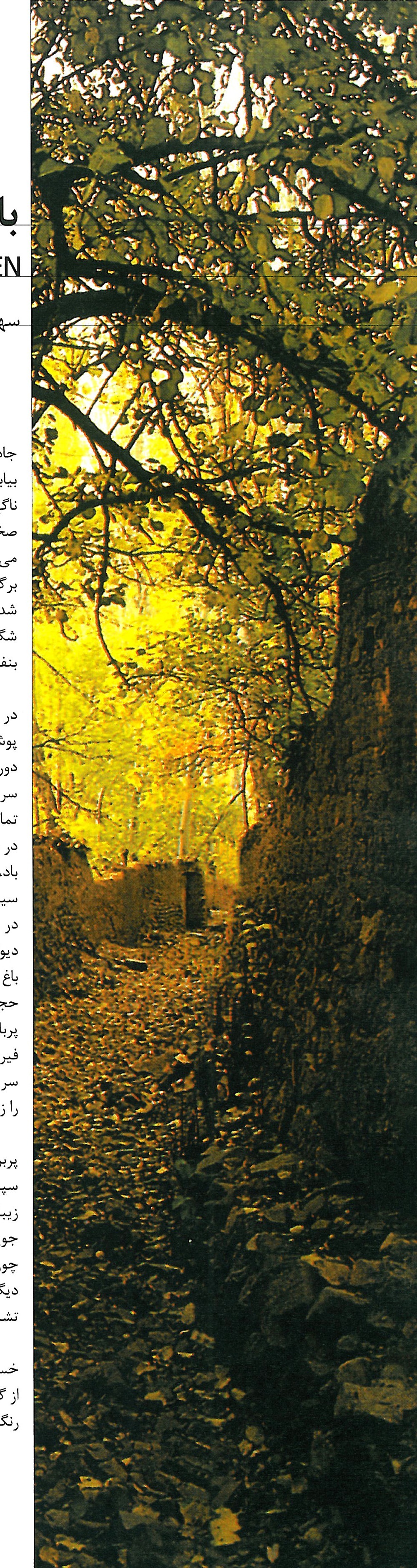
A garden, secluded, alone, at the world's end — in a desert the colour of straw, among purple mountains... and suddenly, beyond a mountainside pass, in the shelter of a rock, beside a water that seems to spring from the ground by enchantment, an oasis the size of a palm. The thick leaves of its broad-spreading trees, taken by a damp wind, tremble. This is no green mirage; an astonishing green patch that has, as if in dream, settled as a brief summary on a yellow-brown and purple ground.
These green patches taking shelter in the folds of the earth, across our country, in the prospect of deserts covered with the silver shrubs of camel-thorn, ringed by distant mountains carrying snow on their peaks; among the deep-red hills on which a single palm of green has a magic glow; or in the depths of unending silent valleys; in any place where a shelter can be found or built — from the wind, from the sun — they merge with the white and red of the apple and the peach blossom behind the poplars. And in the dusty old cities, still — beyond the walls of the cool garden-alleys, in the shade of the broad-spreading garden trees, or in the depths of the houses and in the sunken courtyards of the cells of old bazaars — they are hidden; and the image of a heavy branch of cracked-red pomegranate on a green bough, framed in the turquoise-blue of an open shop-door in a cool covered bazaar that smells of earth, brings back the scent of the garden and the memory of the garden.
The garden — with its tall poplars, its plane-trees and its heavy-leaved elms beside the high walls, which, like a latticed canopy, would turn the burning whiteness of the light into a gentle shade, into the beautiful play of light and shadow upon the streamlet at the foot of the trees. A clamorous streamlet caught up in the sharp scent of basil, that, like a small waterfall, would pour from one little pool into another; and the very hearing of its sound was enough to put the thirst of the burning sun outside out of mind.
The garden, the field of pleasing colours for eyes wearied by the colour of earth and the purple of the mountains; in the small flowerbeds full of glorious wild flowers — with stems clothed in thick down, and sharp wild colours, not the gentle colours of cultivated flowers — the sharp colour of village women's clothes, with no scent. No: cock's-comb, four-o'-clocks, hollyhocks, larkspur, dahlias, violets and the fragrant tendrils of yellow jasmine, purple jasmine, white jasmine... and the lush bushes of the dog-rose, the Damask rose, the forgotten Iranian rose, the Sourian rose.
The garden of fruit trees in beds on either side of the streams, around stone-piles set against the shoulder and trunk of the trees — apple trees, peach trees, sweet cherries and tart greengages, and a little farther the broad-spreading walnut trees with the sharp scent of their leaves and the inexpressible flavour of fresh, crisp walnut.
The garden of small kitchen plots in the less-shaded part of the garden, with the unripe small watermelons and small melons, the slender cucumbers and the tiny red tomatoes; the garden full of nightingales, of hoopoes, and the long childhood hours of waiting beside baskets propped on a piece of wood and a thin invisible thread, for the catching of birds.
The garden, the field of the contrast of light and shadow, of colourlessness and colour, of heat and coolness, of the safety of the high wall and the dread of the unending nature outside the garden — that endless chain of high mountains and the horizonless plains and deserts faded in the burning sun: gardens that inspire the images of the garden-paradises full of sweet fruit, the streams of honey and milk, and the Persian miniatures, in which it was not only the spirit but bodies, too, that bloomed and were renewed; and the coolness of its shade, the colour of its flowers, the scent of its kitchen-cucumber, the sweetness of its white mulberry, the fragrance of its rose — these could be found nowhere else.
And what truth is truer than all these manifestations — this reality of the Iranian garden, with its geometric order and its symmetry exposed to philosophical readings, the deliberate beddings, the encompassing composition of flower and tree and fruit-saplings, for the full taking-up of every drop of water, every particle of moisture, every grain of soil in a land that contends with drought and water-scarcity and burning sun — and the effort to keep and to guard this fresh, blooming green, in the shelter of the high wall and the heavy-leaved spreading tree.



