Introduction
A great deal has been studied about the classical architecture of Rome and Greece, and it has been shown that the temples, palaces and other buildings of that period were designed according to complex and highly complete rules which brought both the overall form and even the smallest building details into order. About Takht-e Jamshid and the other buildings of the Achaemenid period — which have long attracted the attention of researchers and archaeologists — very little has been written from this point of view. The most important studies, which are fundamentally from the standpoint of metrology (the science of measures), have been presented by Michael Roaf.1,2 He established the existence of more or less exact units of measurement at Takht-e Jamshid, and of marks incised on the stones to fix the axes of the columns and the centre lines of the walls (which were apparently used for setting out the plan with cords).
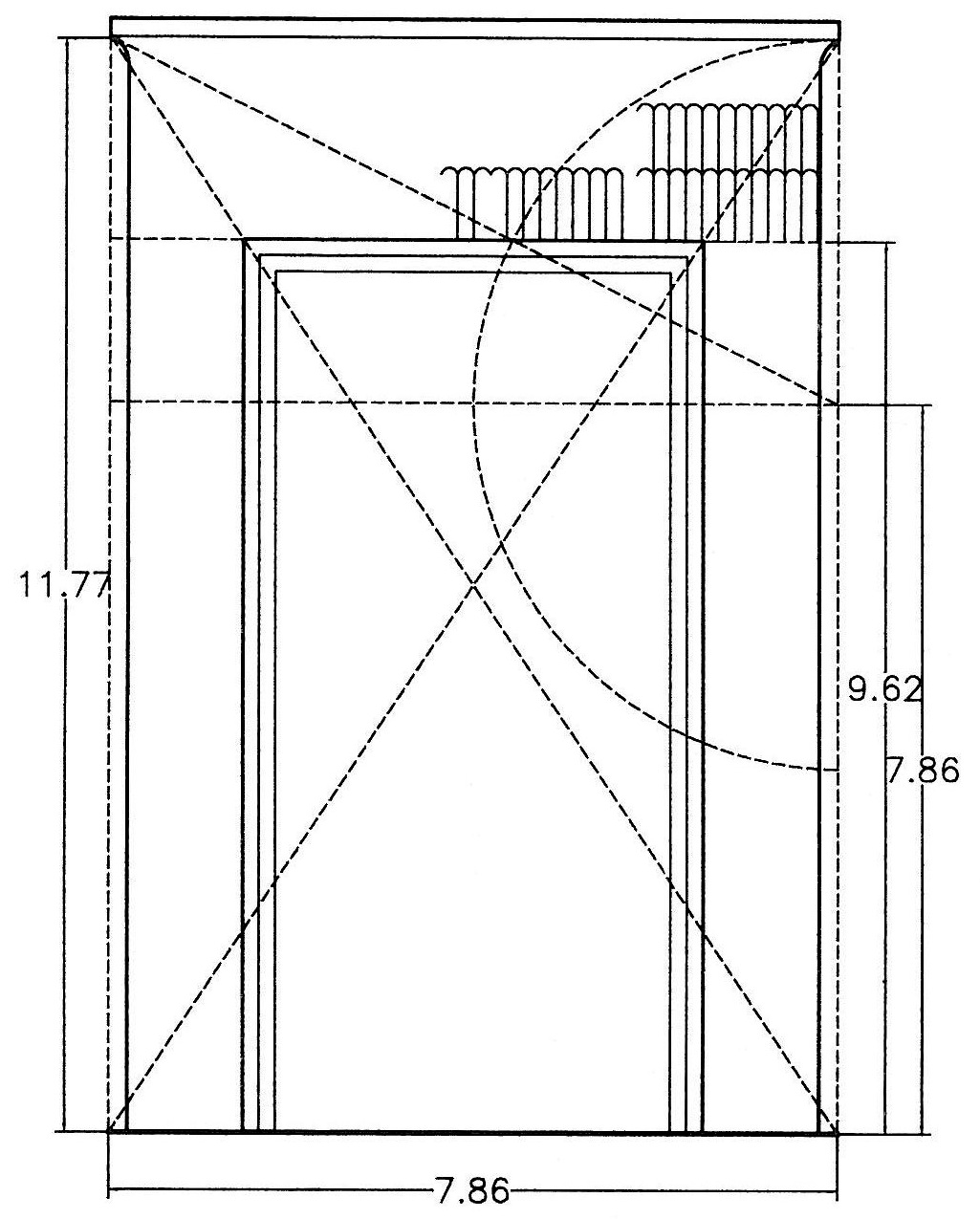
Long ago, while I was researching the origin of the apadanas from a typological standpoint, and because of my earlier study of proportion and geometry in Islamic architecture and their relation to religious and mythological concepts, out of curiosity I also devoted some time to examining the proportions of Takht-e Jamshid. The work carried out in that first stage, although entirely empirical, greatly aroused my curiosity. Seeking to discover the relation between the parts of the building and its overall scheme, I compared the proportions of the doorways of each building — which are the characteristic elements of Achaemenid architecture — with the building as a whole, and in this connection I discovered an interesting point. When I enlarged the drawing of one of the doorways of the Palace of Darius until its length coincided with the length of the palace plan, I observed with astonishment that all the other lines of the doorway likewise coincided, in a remarkable way, with the lines of the plan. I also discovered other interesting points about numerical and geometrical relations which, because they were scattered, I did not present at that time.
In those years, besides the question of typology, I had also become interested in the iconography and interpretation of the reliefs of Takht-e Jamshid and their relation to the myths and religious concepts of pre-historic Iran. At the same time as discovering certain specific numerical relations and coefficients in the various dimensions of the building, I was searching for possible relations between the numerical coefficients employed and the old sacred concepts.
In the relief of one of the well-known doorways of the Hall of a Hundred Columns, to which this article will refer again, I observed five rows of ten soldiers each, with the king’s throne placed above them. It seemed to me that the repetition of the number 10 in the relief was connected with the number of columns in this hall, which is one hundred. If multiples of ten were used both in the number of the columns and in the number of the decorative reliefs, there must certainly have been an intention behind it, and it is possible that this number was also employed elsewhere — for example in the dimensioning of the building. Later studies proved this theory and other, more important points, some of which are explained in this article. These studies did not continue, because I was living abroad and had no opportunity for further investigation.
Some time ago one of my students, Hossein Hassanzadeh, volunteered to determine on site the correctness or otherwise of some of the hypotheses concerning the Hall of a Hundred Columns, by comparing the various documents and the existing surveys. The result of this research, which confirmed all my theories, was so extraordinary as to be scarcely believable. To check the information and the dimensions I obtained help from various people, especially from Mr Hamidreza Mehr-Ali, a student at the Islamic Azad University of Isfahan, and I realised that some of the points were — as was natural, and as I had suspected — wrong. About six months ago I asked Ms Pamela Karimi, a doctoral student in architecture, to help me in this matter. The main difficulty was the great discrepancy between the available sources over the information and the dimensions. Ms Karimi undertook a very careful comparison of the available sources and information. Although some of the principal dimensions have been checked on site, a complete new survey of the Hall of a Hundred Columns was beyond us. In any case all the drawings and the information of the various researchers, from Pascal Coste to Erich Schmidt3 and Giuseppe Zander4 and Michael Roaf, were carefully compared. In the course of this work some of the initial theories were rejected and some new theories were added to them. What is presented in this article is not a definitive and complete verdict on the system of proportions and dimensions in the Hall of a Hundred Columns. Such an achievement appears for the present impossible, given the absence of first-hand written historical documents. In any case, what has been discovered — although very slight and small beside the engineering knowledge of the Iranians of the Achaemenid age — is nevertheless worth attention. These few instances out of many show that the Achaemenid architects were familiar with engineering techniques and had complete rules in hand for designing and setting out a scheme.
Given the existence of metrological (dimensional) relations in the plan, confirmed by the discovery of the marks incised on the stone, it can be stated with confidence that the Achaemenid schemes were not rudimentary, and that beyond the axes of the columns and walls — which are used in any kind of elementary design — the thickness of the walls and the column bases were also determined in advance. A comparison of the vertical and horizontal dimensions indicates the existence of definite relations between the height of the columns and the doorways, and even of their parts, and the dimensions present in the plan. Besides using specific units of measurement, the Achaemenids took the height of the column base and of the walls in the plan as a fixed module forming the basis of the design. The number of times a module is repeated in the plan, or in a column or doorway, bears a definite relation to the old sacred concepts and to the reliefs carved in the building. Beyond numerical proportions and metrological relations, even geometrical relations were employed in the design of the parts of the building.
The history of the Hall of a Hundred Columns and the reasons for its construction
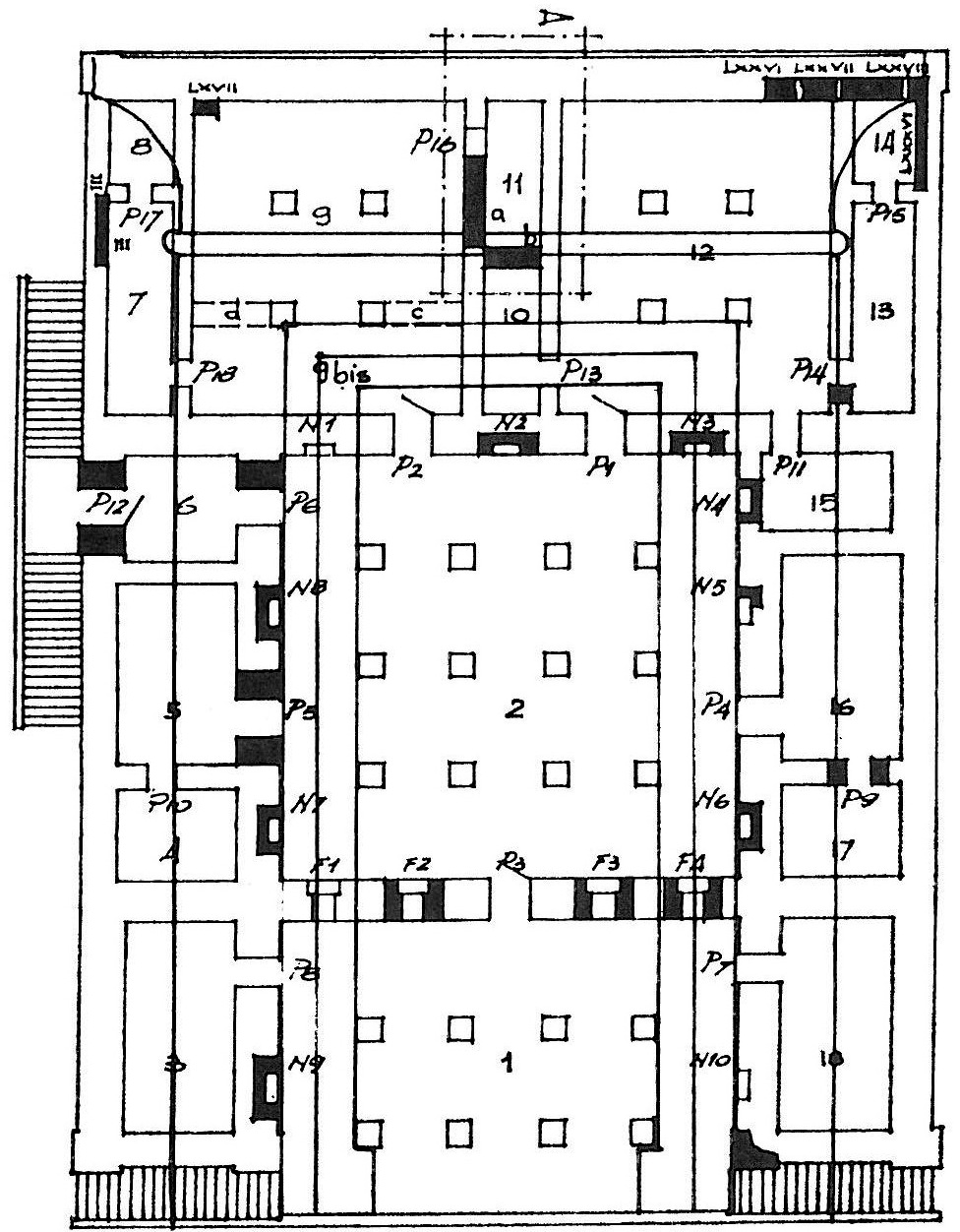
The Hall of a Hundred Columns, or Throne Hall, stands at the far end of the eastern side of the terrace of Takht-e Jamshid. It is so named because of the 100 columns within it. The date of its construction has been estimated at about 450 BC to 470 BC. In the 1930s Herzfeld found a stone tablet among the earth in the south-eastern corner of the Hall of a Hundred Columns, bearing an inscription in the Babylonian language. According to this document the construction of the building was begun by King Xerxes and afterwards brought to completion by his successor, Artaxerxes. According to the theories of Erich Schmidt this building, whose main hall covers 4,700 square metres, was built for the display of the royal treasures. Archaeological studies show that repairs were carried out on the treasury building in the Achaemenid period which assigned the courtyard and every other available space to the storage of goods. The evidence obtained also proves that precious objects were stacked to the ceilings of the storerooms, and that even the administrative offices of the treasury had been turned into storage. Given the typology of the building — the central hall being surrounded by a corridor and having no window to the outside — it is surmised that this hall was the place where the most valuable and remarkable objects of the royal treasury were kept and displayed, thereby also relieving the congestion of the storerooms. The abundant ash found on the floor of the hall shows that the room was full of combustible objects. Given the likelihood that the central part, or main hall, was higher than the surrounding corridors, and that there were clerestories in the space between the tops of the walls and the roof of the hall, and that no trace of a hinge or pivot has been found there, the building was certainly without doors. This theory seems somewhat doubtful. In the writer’s view, since the portico lies on the axis of the gateway and on the route of ceremonial procession, it is possible that the hall — besides holding some valuable objects and furnishings — was the setting for great ceremonial banquets.
Dimensions and measures
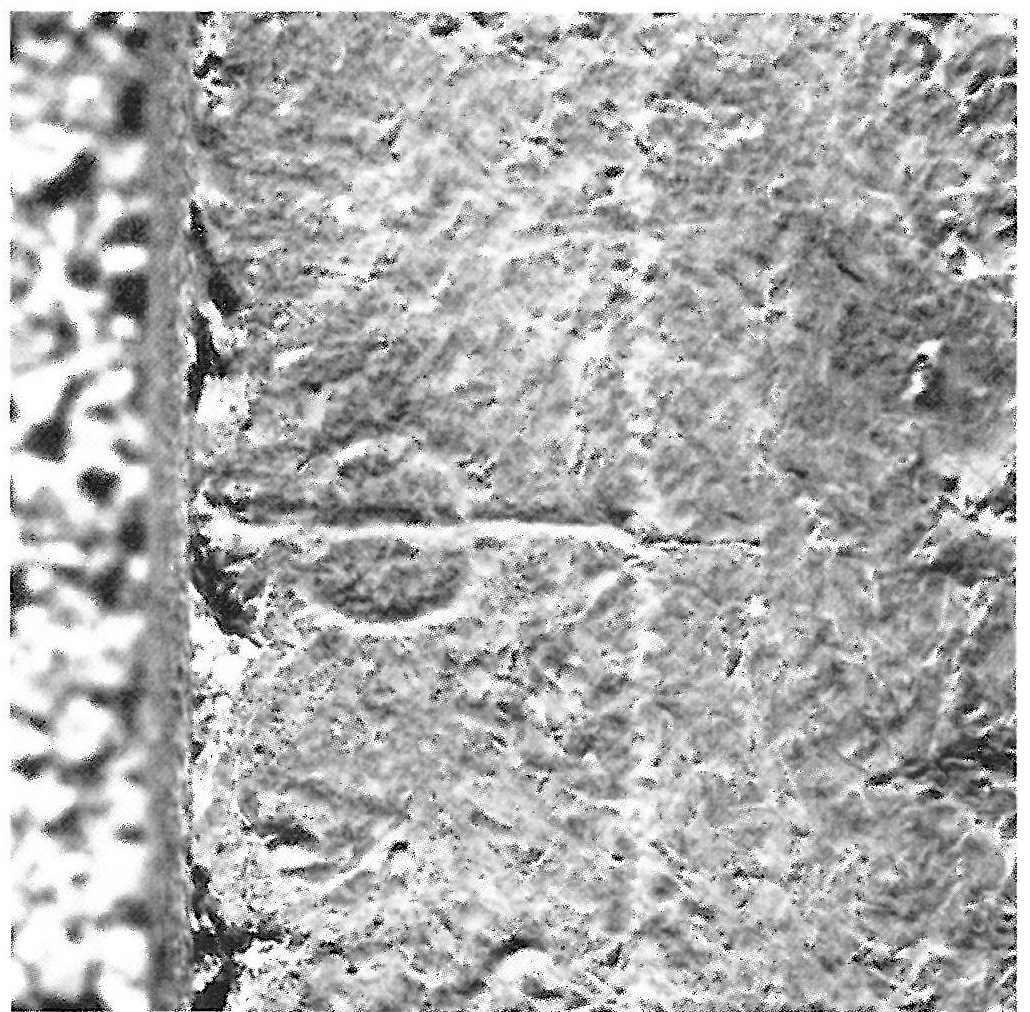
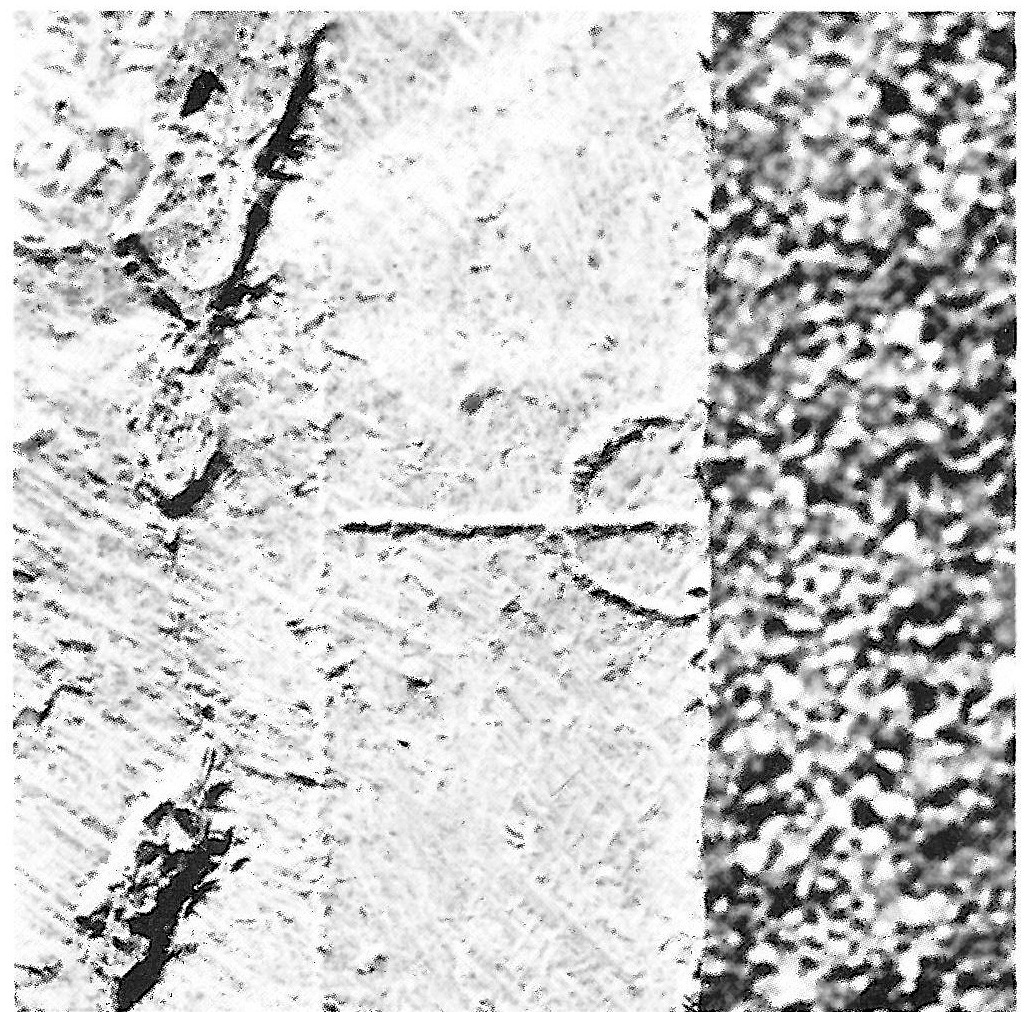
In an article entitled “Persepolitan Metrology”,1 Michael Roaf makes important observations about the setting-out marks in the palaces of Darius and Xerxes. These studies draw on the archaeological report of Cesare Carbone, who first referred to the existence of these marks and their relation to the principal lines of the plan in the book Travaux de Restauration de Monuments Historiques en Iran.5
The rectangular marks lie along the edges of the walls, the T-shaped marks on the axes of the walls, and the circles along the centres of the palace columns. On the basis of the distances between the marks, Roaf proposes a system of setting out as follows: the cubit, 52.1 to 52.2 centimetres; the foot, 34.7 to 34.8 centimetres; the palm, 8.7 centimetres; and the finger, 2.2 centimetres.
Although no such marks have been discovered in the Hall of a Hundred Columns, the existence of definite numerical coefficients in the distances between the edges and the axes of the walls, and likewise at the centres of the columns, makes the existence of definite rules of setting out appear certain.
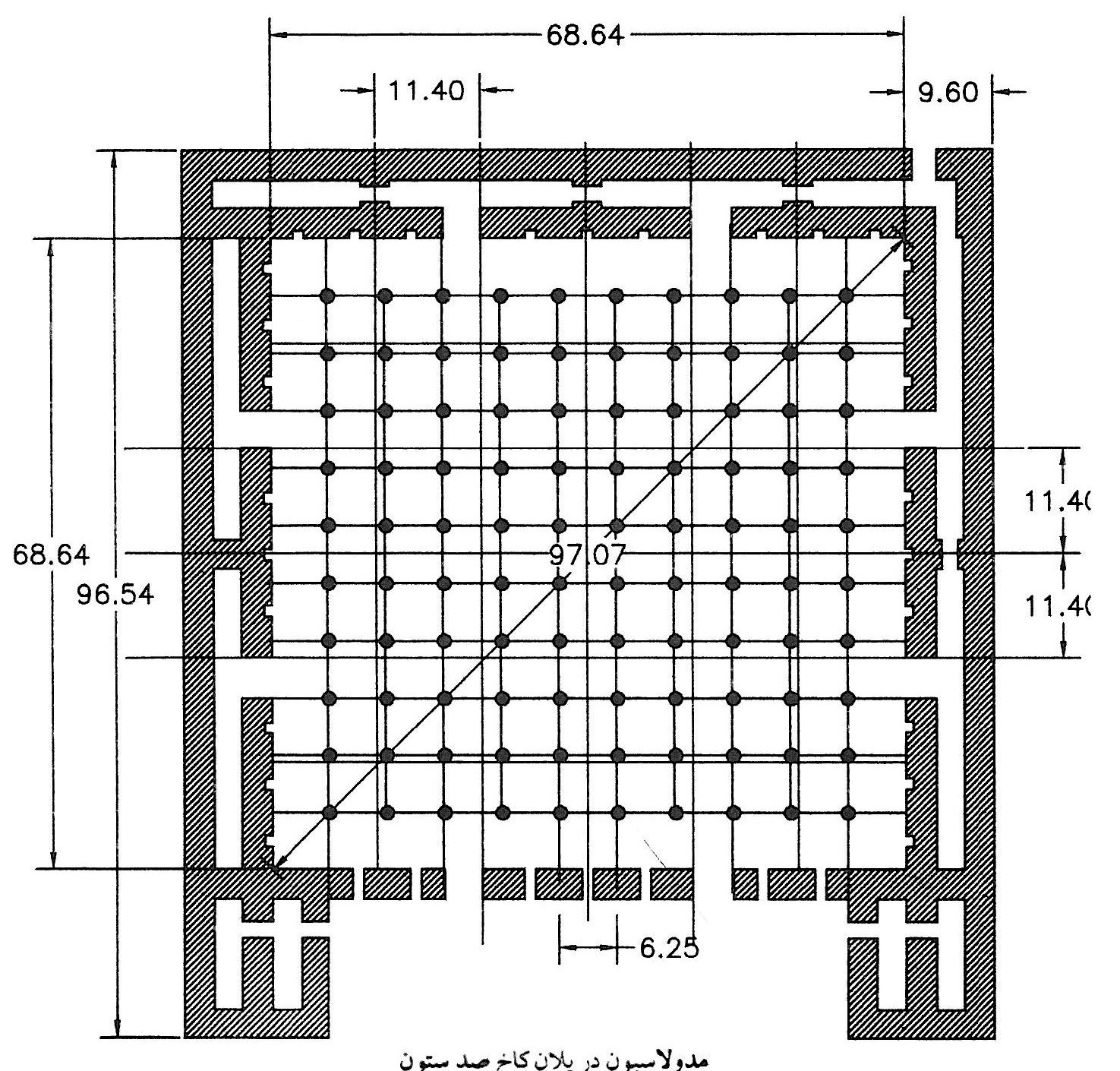
The spacing between the columns — generally an important dimension in the design of a columned building — is 625 centimetres in the Hall of a Hundred Columns. On the basis of Roaf’s proposed units this amounts to 18 feet. We know, moreover, that 18 was an important number; and the column bases of this hall have 36 (2×18) flutes.
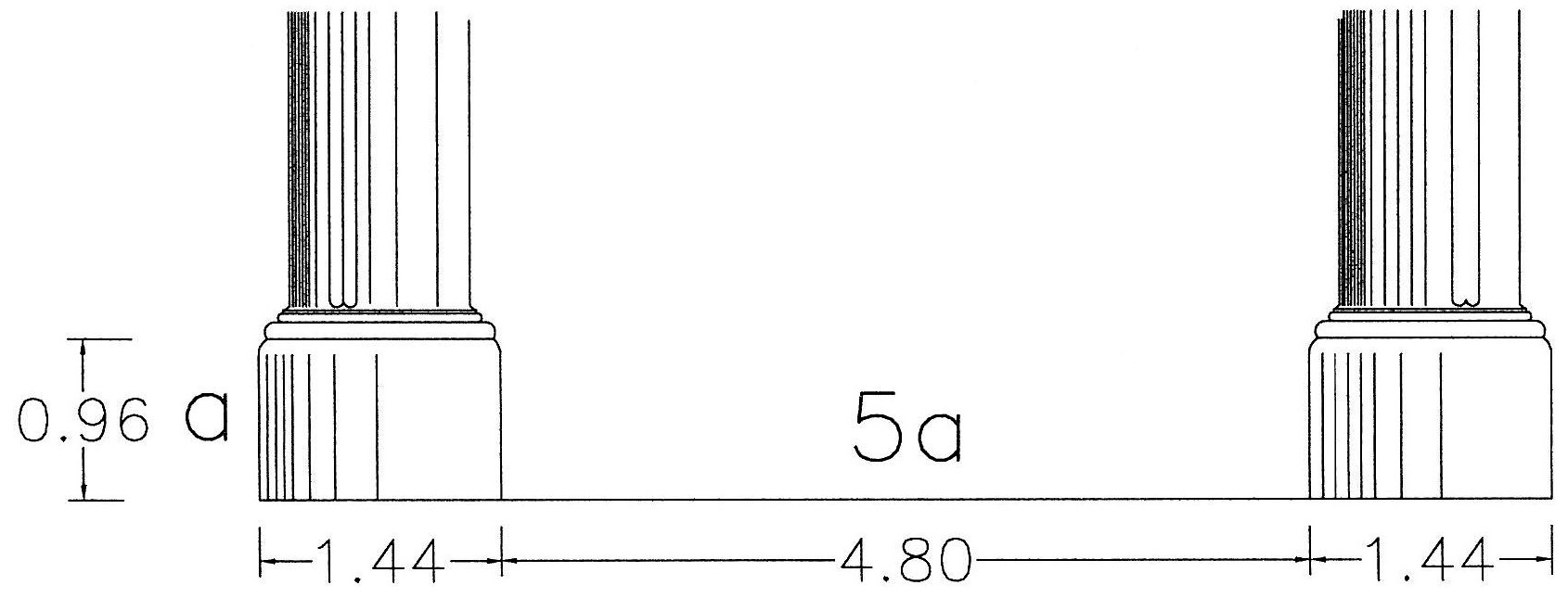
The height of the column bases and of the plinths of the walls and doorways is 96 centimetres. According to Krefter, one of the larger Achaemenid units of measurement, called the royal ell, was equal to 96 centimetres. Our studies show that this value was one of the modules by which the building was set out. In this respect there is a fundamental difference from classical architecture, in which the diameter of the column at its base was the basis of the design. In any case the length of the building is 96 metres, or exactly one hundred units. The use of a factor of 100 cannot be accidental. In one of the entrance doorways on the north side, overlooking the portico, we see the king seated on the throne with five of his attendants before and behind him. Beneath the king’s feet five rows of ten Median and Persian soldiers are shown. The thickness of the wall on the eastern, western and northern fronts is equal to ten units (royal ells). The distance between the edges of two bases is 9.61 metres, which equals five units (the diameter of the column base being 1.5 times the unit). The numbers 5, 10 and 100 held a special importance in the ancient religions: the tenth day of the month of Bahman is the feast of fire, one of the important rites; Bahram, according to tradition, has 10 incarnations or forms, and Zahhak sacrificed 100 horses to Anahita; and in the battle between Tishtar and Apaosha, Ahura Mazda sacrifices himself for Tishtar so that the strength of ten horses, ten camels, ten bulls, ten mountains and ten rivers (fifty in all) may be breathed into Tishtar.
The orthogonal grid (modularity) in the plan
In view of Roaf’s studies, and having realised that the axes of the walls, the axes of the columns and the corners of the walls coincided with certain lines, the idea took shape in our minds that the plan of the building might have arisen from the superimposition of more than one grid. Later studies proved this hypothesis. The orthogonal grid passing through the centres of the columns fixes the exact position of the niches and of the eastern and western gateways, which fall precisely on the central axis of the column bay.
Another grid, each unit of which equals the height of one complete column (11.40 metres), fixes the edges of the intermediate walls and the position of the southern and northern gateways. It should be explained that if the height of one column is taken as the unit, the dimensions of the hall become 6×6 units.
Geometrical proportions
The only evidence for the use of geometrical construction in the design of the parts of the building consists of marks which were probably left on the stones by the use of instruments such as the compass and the plumb-line. In any case, in the design of the gateways there was in all likelihood a definite geometrical system for designing and setting out the drawing in the workshop. It should be recalled that, in the absence of advanced engineering equipment in the past, the use of simple geometrical constructions that could be executed with a cord and a plumb-line made the setting out of a drawing easier; and for this reason, in ancient architecture, architectural elements and schemes most often arose from a series of definite and repeatable geometrical constructions. In the illustration below, the geometrical constructions can be seen which in our view were the basis for determining the dimensions of the doorway.
As was said in the introduction, the geometrical and numerical relations observed in the Hall of a Hundred Columns and in the other buildings of Takht-e Jamshid are abundant; but their complete codification requires much wider study.
In closing we consider it our duty to thank the Cultural Heritage Organisation of Tehran Province and the library of the National Museum for their sincere cooperation in making available the visual sources and the books held in the organisation’s library and archives.
Notes and sources
1. Roaf, Michael, Persepolitan Metrology, in: Iran, V. 16. 1978, page: 67-78
2. Roaf, Michael, Sculptures and sculptors at persepolis, Iran, Volume XXI The Britsh Institute of Persian Studies, London, 1983
3. Schmidt, E, F; Persepolis, University of Chicago, Oriental Institute publications, 1957.
4. Zander, Giuseppe, Travaux de Restavration de Monuments Historiques en Iran, IsMEO, Rome, 1968
5. Ibid
6. Razmjou, Shahrokh, The origin of the constellations of the zodiac, Nojum, Esfand 1374 and Farvardin 1375, no.
7. Bahar, Mehrdad, A study in the myths of Iran, Agah Publications, first edition, spring 1375
8. Hinnells, John, Persian Mythology, translated by Zhaleh Amouzgar and Ahmad Tafazzoli, Sarcheshmeh, fourth edition, 1375
9. Asefi, Asefeh, Foundations of philosophy: an introduction to world philosophy from ancient times to the present, Agah Publications, fourth edition, 1370



