Roberto Pezzetta belongs to that class of industrial designers whose creative output does not blaze on billboards but all the same carries a distinctive signature — and can be found in millions of kitchens.
Pezzetta has bound his career to one large manufacturer after another. His job title is "product designer," and in that field he is among the most experienced. He began at the Zoppas works; then spent a brief period at Nordica, then joined Zanussi, and today works at Electrolux. Pezzetta's name is not stamped in bold on any single eye-catching product; he is hidden behind a broad swathe of industrial output. His work, in other words, does not announce itself — but is decisive and shaping.
Design inside a major technical-industrial factory is a very complex kind of work. Often, even those of us who work in the same field do not properly grasp what Pezzetta calls "the hidden part of the iceberg" — the activity that lies behind the production of every object. His work produces a limitless kind of satisfaction: it is work in which "creativity" has to be fused with the non-negotiable principles of industrial production — keeping prices low, answering millions of customers, and so on. An example: it was Pezzetta who, in 1986, designed the dishwasher for the first time in such a way that it could be "camouflaged" among the other kitchen appliances. Today this idea is so obvious that it draws no attention, but that is not the whole story: his idea of invisible controls on the machine's door is now used by every manufacturer.
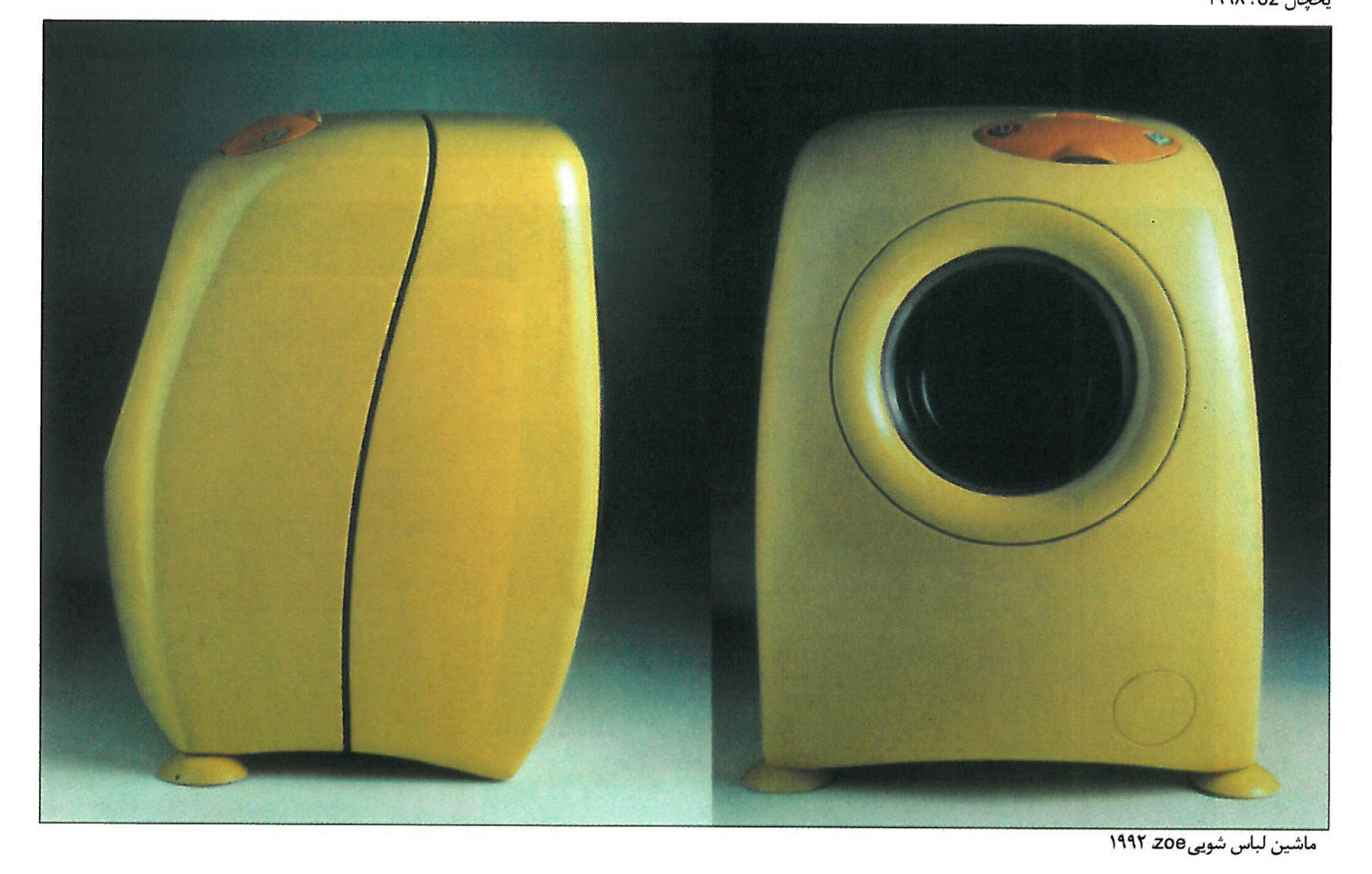
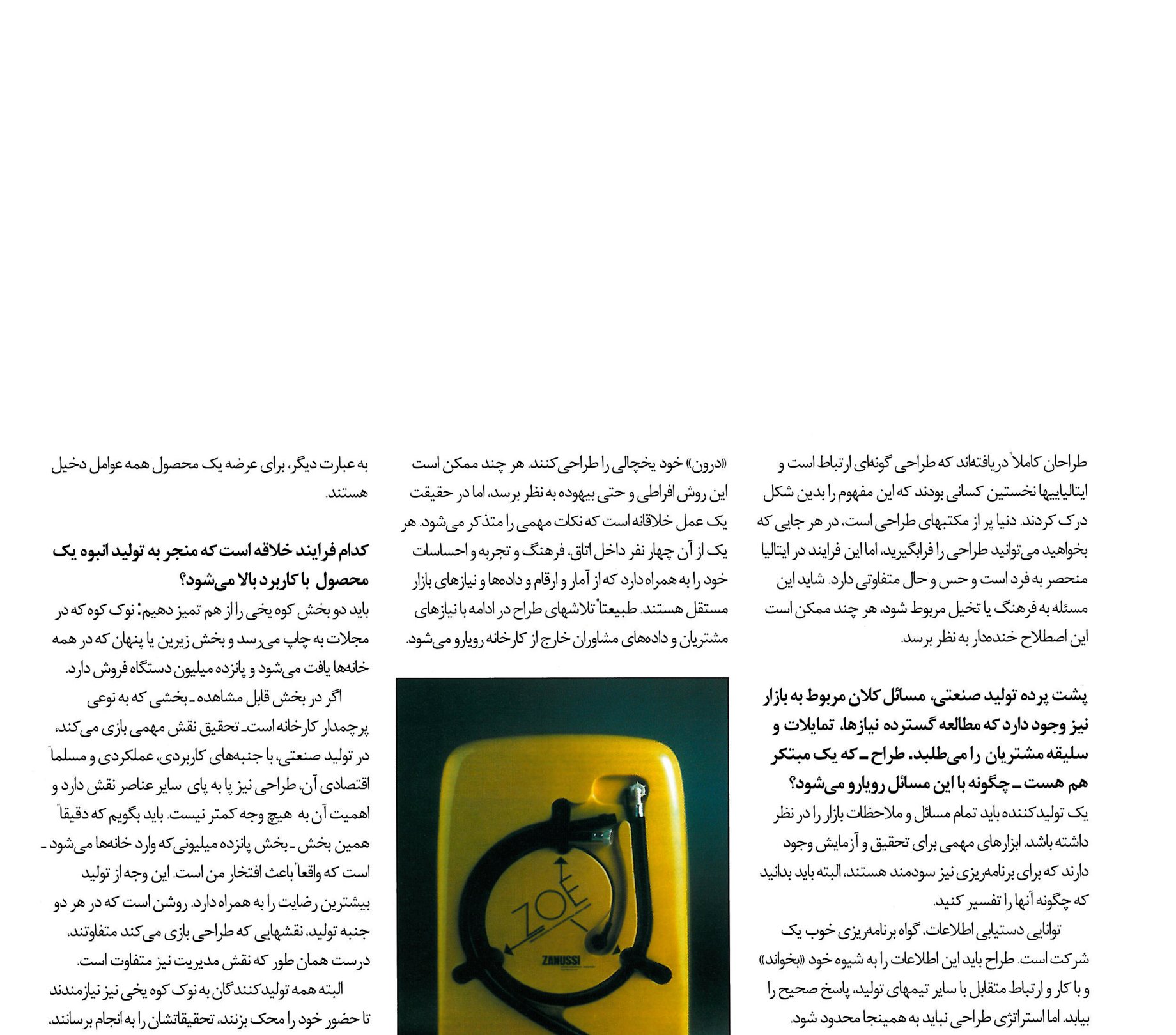
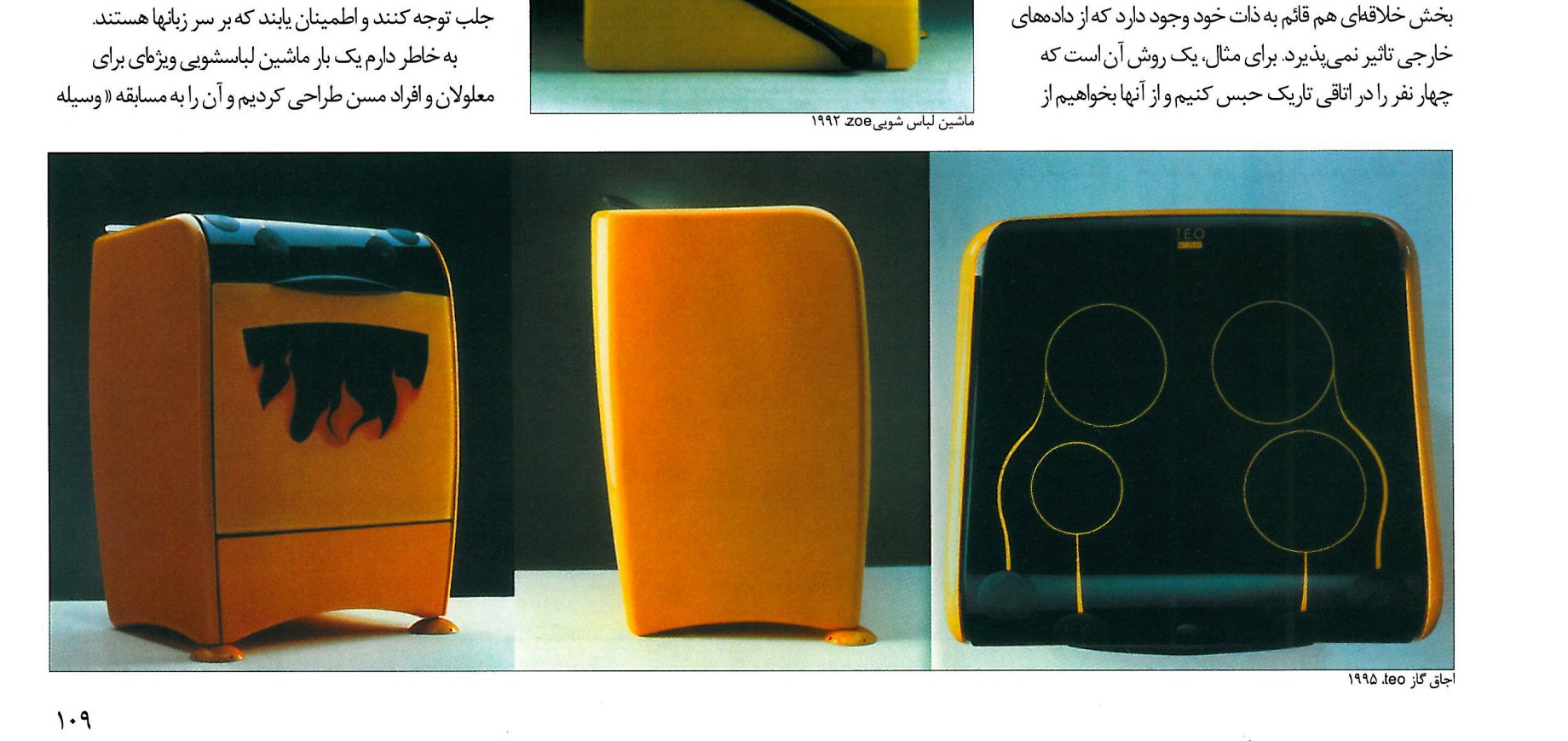
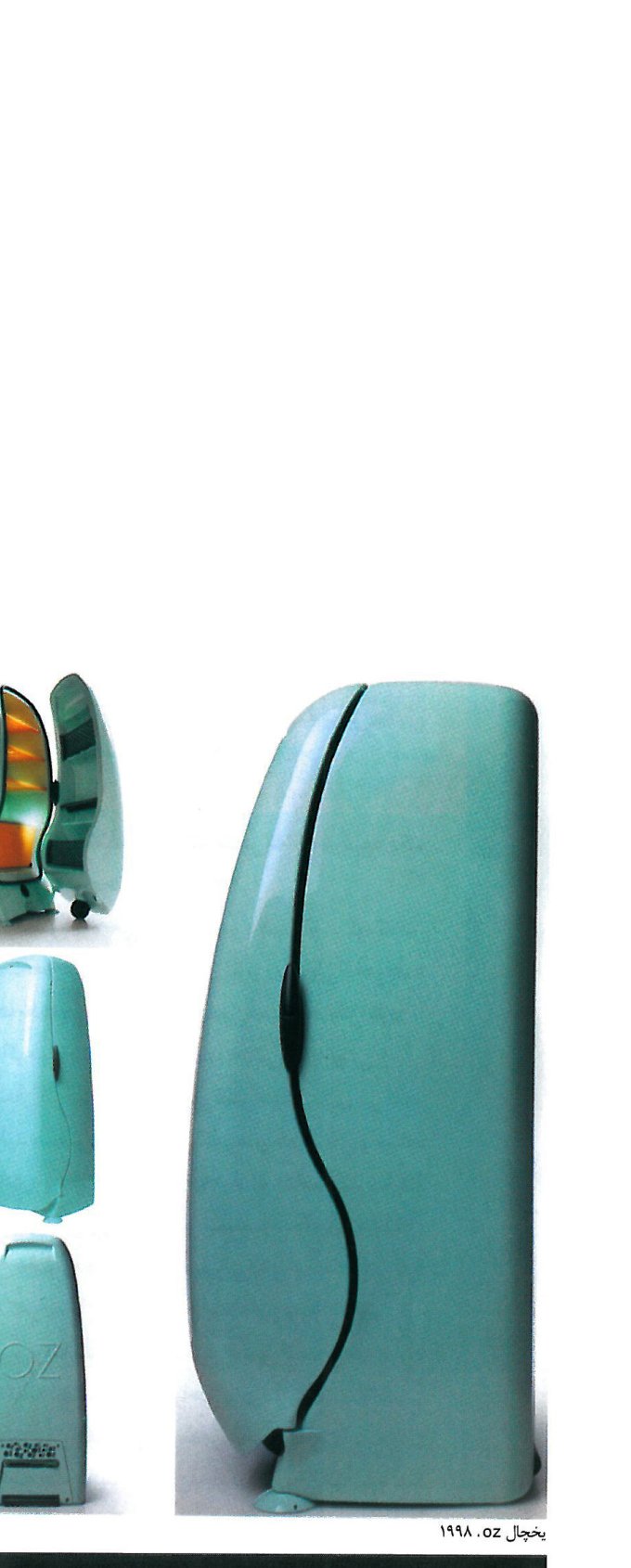
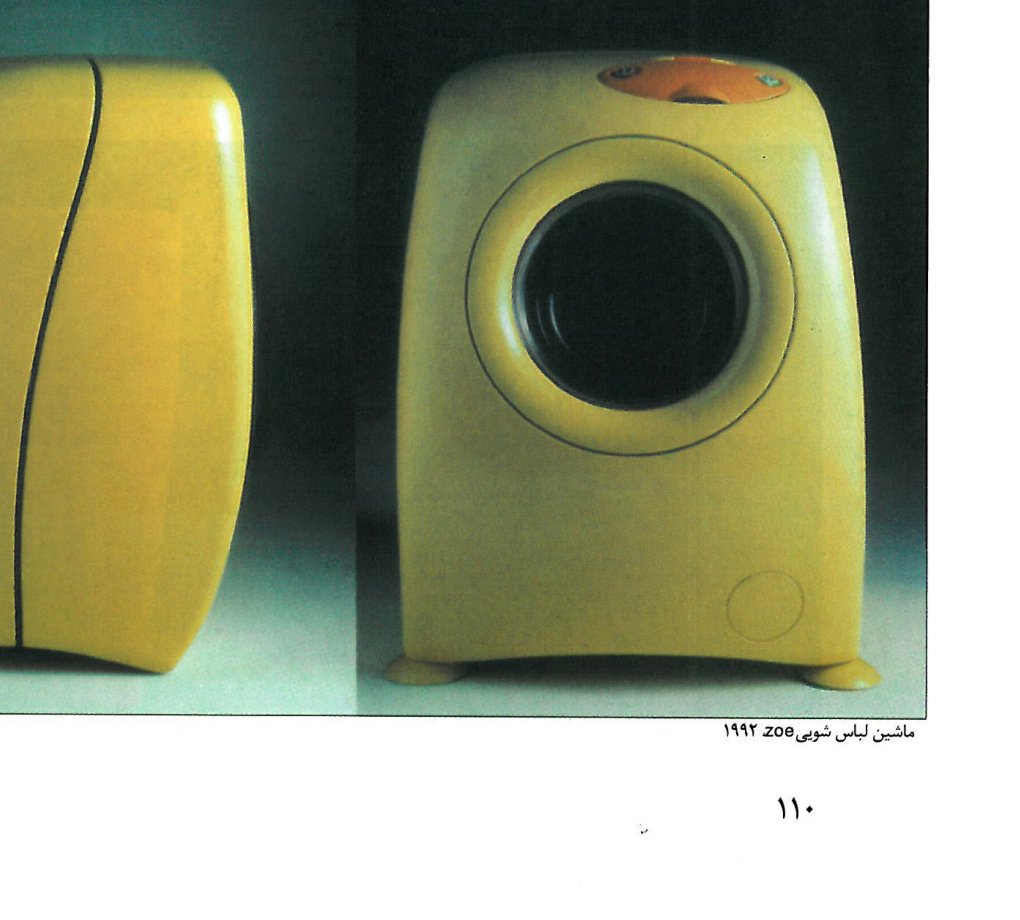
Pezzetta says that part of the vast iceberg also shows above the surface, and it is this part that has drawn the most thinking and studying to itself. Pezzetta — who comes from the Veneto region of north-eastern Italy — believes that it is at this "tip" that all the drive and research for "keeping the industry alive" is done, and it is in this spirit that he has designed the Oz refrigerator, the Zoe washing machine, and the TEO gas hob. These objects are designed to be seen, to step away from the inherited image of the kitchen in our minds.
Take Oz as a closer example. It is an object that looks "friendlier" than it does technological; its name raises a sense of magic and ties back to the imagery of childhood fantasy. At the same time, its rounded, unusual form is a break with the cornered tradition of household objects. For this reason Pezzetta's design sits at the tip of the iceberg: its motives differ, and it opens new avenues.
Pezzetta's work has won many prizes. In 1981 he took the "Golden Compass" for a Zanussi piece. Others of his works were shortlisted at the same competitions in 1987, 1989 and 1991. He received the gold medal at the twelfth BIO competition in Ljubljana. In 1990 he took the Paris Home-Arts design prize, and won further awards in the Netherlands, the Czech Republic and Cuba. Another of his pieces was shortlisted for the 1998 Golden Compass. On the day this interview took place, Pezzetta received the news that he had won Chicago's "Good Design Award" for the second time (the first being in 1999). Pezzetta presently works out of Pordenone in northern Italy, as head of design for Zanussi, and collaborates across the whole Electrolux group.
From the many awards you have collected at the Golden Compass, it is clear that you have had a long and distinguished career. How did it begin?I picked the wrong field! I should have been an engineer. But life always has its surprises for a person, and in 1976 I found myself at Zoppas designing refrigerators. I remember my start coincided with one of the fiercest strikes I have ever witnessed; I wanted to drop the job and go home. In 1979 I worked with Rodolfo Bonetto, who had decided to open his own industrial-design office. But then Zanussi took over Zoppas and we all joined it at once. The working environment was genuinely motivating and full of energy; each of us was our own director. In 1982 I was appointed head of the industrial-design office, and in 1984 the Swedish Electrolux group bought Zanussi and set up its industrial-design centre in Pordenone.
More than anything, that was a recognition of a long-standing and consolidated design tradition stretching back to 1954, when Zanussi first called in Gino Valle as a consultant for the design of its export products and, beyond the design of its offices, entrusted him with the preliminary in-house design unit. Electrolux could also point to its own long tradition, which already went back to the first decade of the century. Electrolux's policy has always been to separate its production units, and the design that follows, on a regional basis. Zanussi is strong in Pordenone, and Electrolux does most of its design work here in Pordenone. Some of the production, too — the oven of a gas cooker, for instance — was handled regionally. In Italy people cook on the flame; in Germany on teflon; in England in the oven. Every country meets you with different cooking! We design projects for all groups, because Electrolux supports the breadth and diversity of its product range and lets each group keep its own particular character.
The difference is methodological. The designer has to act one-by-one with the rest of the company. The designer no longer — as in the past — stands as a client over others; on the contrary, they stand alongside the whole company. That lack of a sense of superiority over others is one of our first qualities: at the same time we are engineers, sociologists and planners. Further, designers have fully understood that design is a kind of communication, and Italians were the first to grasp that concept in this way. The world is full of design schools; wherever you like you can learn design, but the process in Italy is unique and has a different sense. Perhaps it comes down to culture or imagination — though the term may sound amusing.
A manufacturer must hold all the market's issues and considerations in mind. Important tools exist for research and testing, and they are useful for planning — provided you know how to read them. The ability to reach information is itself proof of a company's good planning. The designer has to "read" that information in their own way and, through dialogue with the other production teams, find the right answer. But design strategy should not end there. There is also a creative part that stands on its own, not shaped by external data. For example: one method is to lock four people in a dark room and ask them to design a refrigerator "from inside." As extreme and useless as that might sound, it is in fact a creative act that flags up important points. Each of those four people brings into the room their own culture, experience and feelings — which are independent of statistics, figures, data and market needs. Naturally, the designer's efforts are then met with the customers' needs and with data from external consultants. In other words, bringing out a product involves every factor.
We have to separate the two parts of the iceberg: the tip, which is printed in magazines, and the lower or hidden part, which is found in every home and sells fifteen million units. If research plays an important role in the visible part — the part that in some sense is the factory's flagship — in industrial production itself, with its practical, functional and of course economic facets, design plays a role shoulder to shoulder with every other element, and its importance is in no way smaller. I have to say that this second part — the fifteen-million-unit part that walks into people's homes — is what really makes me proud. This aspect of production brings the greatest satisfaction. It is clear that in both sides of production the roles design plays are different, just as the roles of management are different.
Of course all manufacturers also need the tip of the iceberg, to measure their own presence, to carry out their research, to draw attention, and to be sure that they are being talked about. I remember once we designed a special washing machine for the disabled and the elderly and sent it to the Golden Compass competition, and it went unnoticed. But we received our real prize when an elderly English lady sent us a video showing that, thanks to that machine, she had been able — for the first time in thirty years — to wash her own clothes. There you see it: different grades of satisfaction and different kinds of research!
There is no doubt that a factory's dynamism depends on magazines too — but it is also a fact that they rarely print anything about, say, a washing machine for the disabled. We have to give the magazines too a motive. A few years ago we built a black gas cooker and photographed it in a setting different from what is usual in home-appliance advertising — the familiar image of a happy family in a shared scene.
As I said before, this is not a question of form and function; it is a question of "distinguishing character." During the day we use thousands of objects in the house — objects that are a part of us and of our activity. We are alongside these objects for all twenty-four hours, but perhaps we actually use only two of them. Why shouldn't these objects be beautiful? Why shouldn't we make objects with which we can strike up a relationship? Why shouldn't we make objects that are instantly recognisable? Domestic appliances are boxes that do the work they were made for; but if those appliances had not been designed, what would our homes have come to?
Who is your best application?An Italian who has been sent abroad for work, or who lives in Africa and misses home food for the natural taste of raw ingredients; or an Italian family spending five days in a row at its summer villa. Don't be surprised. Our office is full of enquiries and suggestions for improving the products — because using a washing machine for a two- or three-hour stretch is a different thing from cleaning the floor of a room or cooking a meal. The information you need for designing a washing machine has to do with personal items of the house, with usage hours, with how dirty the clothes are, and so on. That information is gathered and ordered at our design institute.
Does Electrolux pay any attention to families with children and young families?Yes, because different generations' tastes have to be respected. It varies enormously between countries and between generations. Our age is very rich and complex, and inside the family, communication has sped up. What is fascinating is that we witness very small changes in objects; they gradually shift through time. A twenty-year-old's cultural class today is different from the twenty-year-old of their father's generation — it is a different "application." But we have to produce a broad range of products, so as to answer different needs. That is why new products are produced year after year. When we talk about users' needs we have to think of several things: how they will be used, the beauty of the design, and ease of use. These are the three chief roles of design, and they have to improve continuously.
What balance do you see — or seek — between the design of today and the design of thirty years from now?My art lies in designing for today's needs while, at the same time, shaping things that will change in the future.



