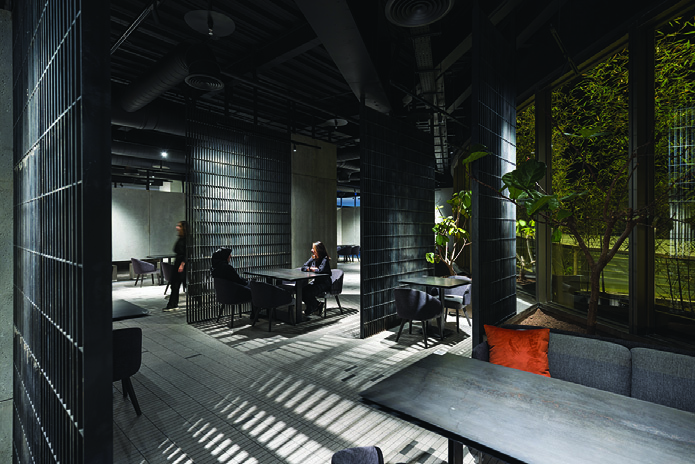
Every architecture student acknowledges the importance of the question of space in architecture. It is one of the most common topics in the discipline, and every student encounters it from the moment they enter the school. Most of the reference books used in university teaching give the idea particular attention. Giedion's Space, Time and Architecture — available in Persian translation for many years as the most authoritative book on the history of contemporary architecture — is still widely used. Francis Ching's Form, Space and Order has also played a significant role in recent years. The very titles of these two books, and their authors' references to the notion of space, testify to how central the category is. It seems self-evident that space should be emphasised in architectural teaching; and yet it is remarkable how rarely, in student projects, the design actually addresses space. It is of course true that volume necessarily produces some kind of space, but that is not the same as consciously designing space.
The students' disregard for the category is also visible in their answers to the question “Who is your favourite architect, and why?” published in Memar 02. Strikingly, none of the answers referred to architects whose work the students had actually seen. Even the two Iranian architects named among the selection — Bahram Shirdel and Hadi Mirmiran — were known only through their published work in magazines and books on architecture.
Why? Why, despite all the attention given to space in architectural courses, is the category in practice forgotten? It seems to me that part of the problem lies with the books and magazines of architecture themselves. Given that worthwhile examples of contemporary architecture in our country are limited, students rely above all on architecture books as their sole means of encountering architecture. But the difficulty is that no photograph can really convey architecture. Many of the values of architecture are lost in images. One can never recover, from a photograph, the feeling of touching materials in a place, or of moving through architectural space.
A photograph above all shows form and volume, whereas the space felt in architecture is, in truth, more important and more affecting. The memory each of us carries of the first house we knew bears this out: our sense of the spaces of our childhood homes is by far deeper than our sense of their volumes. For this reason, reliance on magazines as the only means of experiencing architecture can easily cause space to be overlooked in design. One might even say that magazine photographs shape entirely inaccurate judgements. Analysing a building through such photographs is almost always a very different exercise from analysing it through physical presence.
Photographs fundamentally lie to us. No one can slither across the ground like a chameleon and look at a building through the view a wide-angle lens — like that chameleon — provides; nor does anyone rarely get to look down at a building from the sky. Yet these are precisely the viewpoints found in magazine pictures, and so we all discover a building in ways in which, in reality, we will never see it.
At the same time, ignorance of worthwhile examples of contemporary architecture and unfamiliarity with actual examples of architectural space confine students to historical buildings. But even here the analysis goes astray, and in many cases historical values replace architectural ones. The sensory experience of seeing an inscription carved on the wall of a mountain is roughly the same as the sensory experience of seeing an Achaemenid palace — in both cases the question of being historical is the most compelling element. Unfortunately, architecture is then valued according to its historical rather than its architectural qualities. As a result, even though it is impossible to create a historical space in a contemporary building, many student projects are still directed primarily at producing a sense of the historical.
There is another factor at play in students' neglect of space. Regrettably, university teachers also rarely address the issue. What tend to be assessed in student projects — in plans or horizontal sections — is the resolution of functional relationships, while much less emphasis is placed on tracking and analysing ideas about space, or even the choice of the building's form.
Perhaps if more attention were paid to the question of space in student projects, and if architectural teaching gave greater weight to the critique, analysis and study of real existing examples of architecture, students would — in answering Memar's question — refer to buildings they had truly understood and lived in.