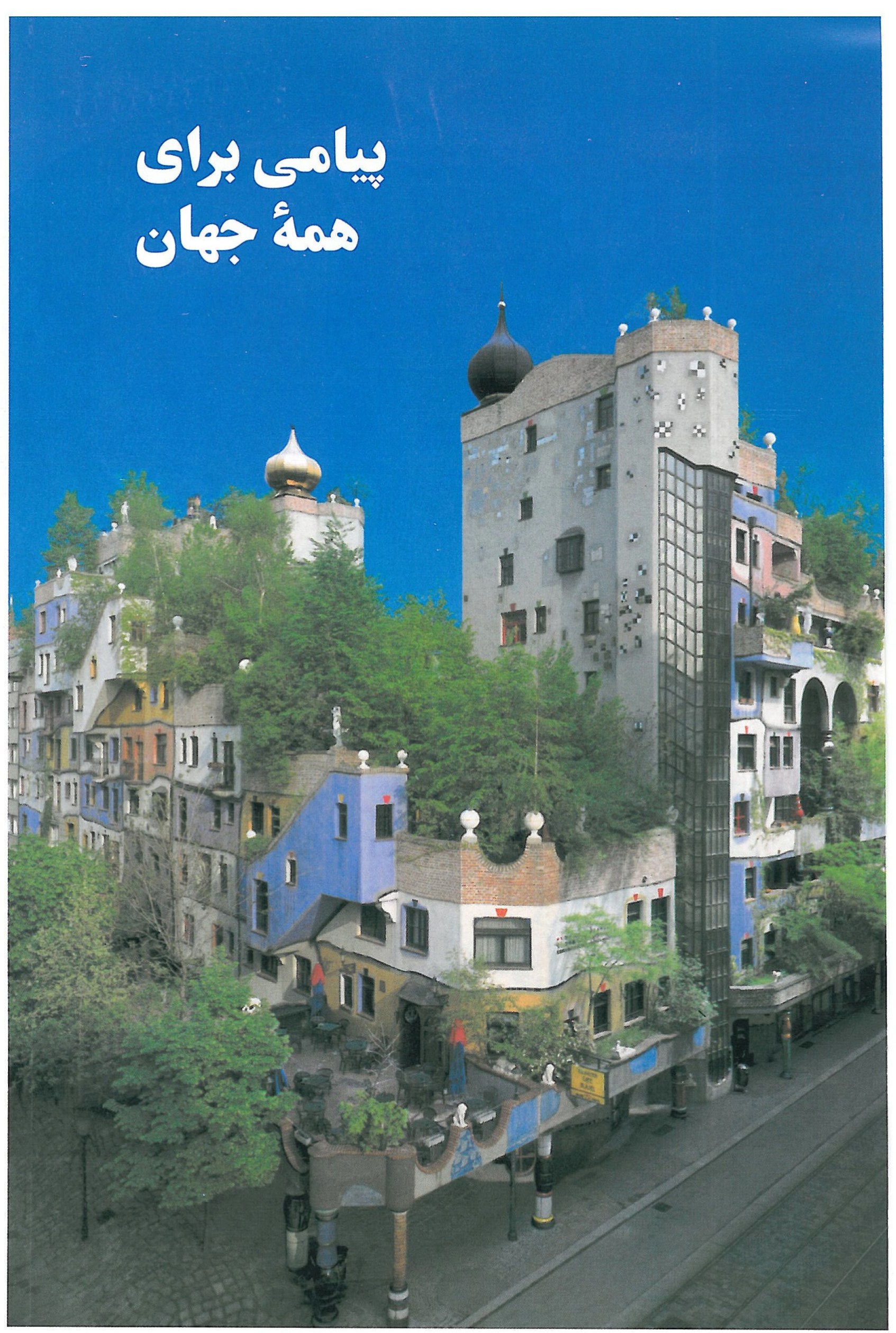
The Hundertwasserhaus, Vienna, Austria — Friedensreich Hundertwasser's most celebrated building, completed in 1985
Friedensreich Hundertwasser (1928--2000), the Austrian-born artist and architect, devoted his life to a singular vision: architecture that breathes, grows, and belongs to the people who inhabit it. His buildings reject the tyranny of the straight line. Facades undulate, floors rise and fall like gentle terrain, trees sprout from rooftops and balconies, and no two windows are alike. For Hundertwasser, the standardized box of modern architecture was a crime against the human spirit -- a prison dressed up as progress.
The Hundertwasserhaus in Vienna, completed in 1985, remains the most vivid embodiment of his philosophy. A municipal housing block transformed into a living organism, it features onion-shaped domes, irregular brickwork, hand-painted ceramic columns, and an explosion of color across every surface. The building is home to over fifty apartments, each unique, with more than two hundred and fifty trees growing from its terraces and roof -- what Hundertwasser called "tree tenants" who pay their rent in oxygen and beauty.
Friedensreich Hundertwasser at one of his buildings, framed by his signature organic brickwork
Central to Hundertwasser's thought was the concept of the "five skins" that envelop every human being: the epidermis, clothing, the house, the social environment, and the global ecosystem. Architecture, as the third skin, must be as personal and alive as the first two. He passionately advocated for what he called "window right" -- the principle that every inhabitant should be free to paint and reshape the facade around their window as far as their arm can reach. The result, as seen in his buildings, is a joyful patchwork of individual expression.
An entrance to the Hundertwasserhaus: hand-painted surround, organic brickwork, and ornamental details
Each window of the Hundertwasserhaus is unique -- a visual catalog of Hundertwasser's "window right" philosophy
Hundertwasser's message was indeed for the whole world: that the built environment need not be a monotonous grid of identical cells, that nature and architecture can coexist in mutual enrichment, and that beauty is not a luxury but a fundamental human need. His buildings -- in Vienna, Germany, Japan, and New Zealand -- stand as colorful protests against the gray uniformity of the modern city, and as invitations to imagine a more humane way of dwelling on this earth.