Perspective
In the previous article titled “Creativity,” we discussed the two complementary and distinct aspects of invention and imagination in creating a creative work. We also noted that imagination, which constitutes the sensory dimension of creativity, comprises two stages: imitative and creative. The article concluded with an introduction to several primary areas of creative activity: adaptation, text modification, and rewriting. In this issue, we had intended to address techniques for developing creative ideas. Naturally, creativity cannot take place without relying on the powers of imagination, and imagination constitutes the most artistic aspect of creativity. Here, given the breadth of the discussion, we will focus solely on imagination and the practical methods for cultivating it. The discussion of practical techniques for creative design, which naturally follows this material, as well as the chapter on invention — the complement of creativity — will be presented in future issues. Before addressing the techniques of imagination, I would like to explain more precisely the question of “invention and imagination,” which I had indirectly raised in the introduction to the previous article.
1 — Invention and Creativity
Invention means bringing into existence something that did not previously exist. Therefore, it does not concern itself with the aesthetic dimension of the work. The important commonality between creativity and invention is the back-and-forth process from concreteness toward abstraction and vice versa. Let us give an example: from the very beginning, humans have always observed sharp and cutting objects in nature. A thorn is a common example. The first stage of any invention is observation (and information gathering): a thorn wounds the hand. After reflection on this phenomenon — the second stage of invention — one arrives at the third stage, or the discovery of a principle (the stage of abstraction): any pointed object causes injury. The fourth stage is a return to concreteness, or creating an object for practical use: the invention of a sharp-pointed weapon such as a spear for inflicting wounds.
In architectural design, we constantly deal with interpretation, and interpretation in architecture is nothing other than observing what has attracted our attention, thinking about it, discovering the principle or essential characteristic of the subject of attention at a completely abstract level, and finally reconstructing the discovered principle according to new rules. In the La Tourette monastery (1956–1960) (Figure 2), Le Corbusier draws inspiration from the old French monasteries. However, rather than imitating architectural elements such as arches, vaults and tiled roofs, or decorations such as capitals and facade reliefs, he establishes a deeper relationship with history. In the plan sketches (Figure 1), we see that Le Corbusier takes the most important compositional principles and common features of the old monasteries — namely the rectangular plan with a central arcaded courtyard, which are the principal elements of spatial organisation — as his guiding principle, and then transforms these principles according to his own aesthetic sensibilities into a modern form.
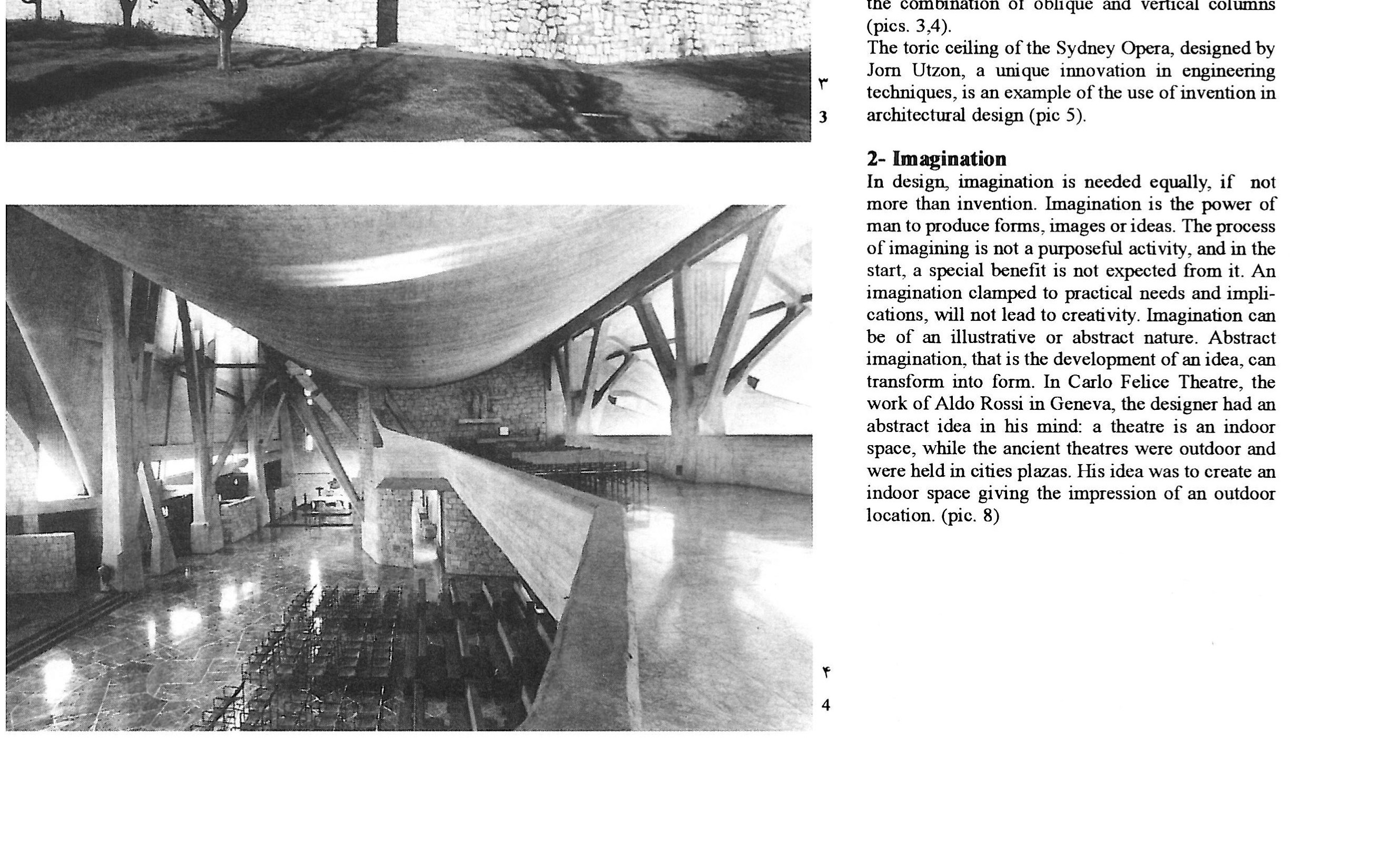
Giovanni Michelucci (1891–1990), in his famous church known as the Highway of the Sun Church (1961), chose the form of the tent as a symbol of Christians — a people who, like nomads, are always moving toward truth. The tent form has been reconstructed in his project in an entirely new way. The connection to the original concept is maintained solely through the concave surfaces of the building's concrete shell and the composition of oblique and vertical columns (Figures 3 and 4).
As we stated at the beginning, creativity is a combination of invention and imagination. Invention occurs when the designer devises a new path for solving a functional, structural or aesthetic problem. Naturally, such an innovation — like the case of invention — has value when it is considered novel in relation to the global culture of architecture. The invention of the parabolic shell roofs of the Sydney Opera House by Jørn Utzon (1918–2008), which were entirely innovative from an engineering standpoint, is an example of the use of invention in architectural design (Figure 5).
Most of the time, as in the previous example, the need for inventing a new method or technique is not requested by the client, and the project could be designed using established and proven methods. It is the designer's responsibility to transform ordinary conditions into exceptional opportunities for creating an original work. There is considerable risk involved in this endeavour.
2 — Imagination
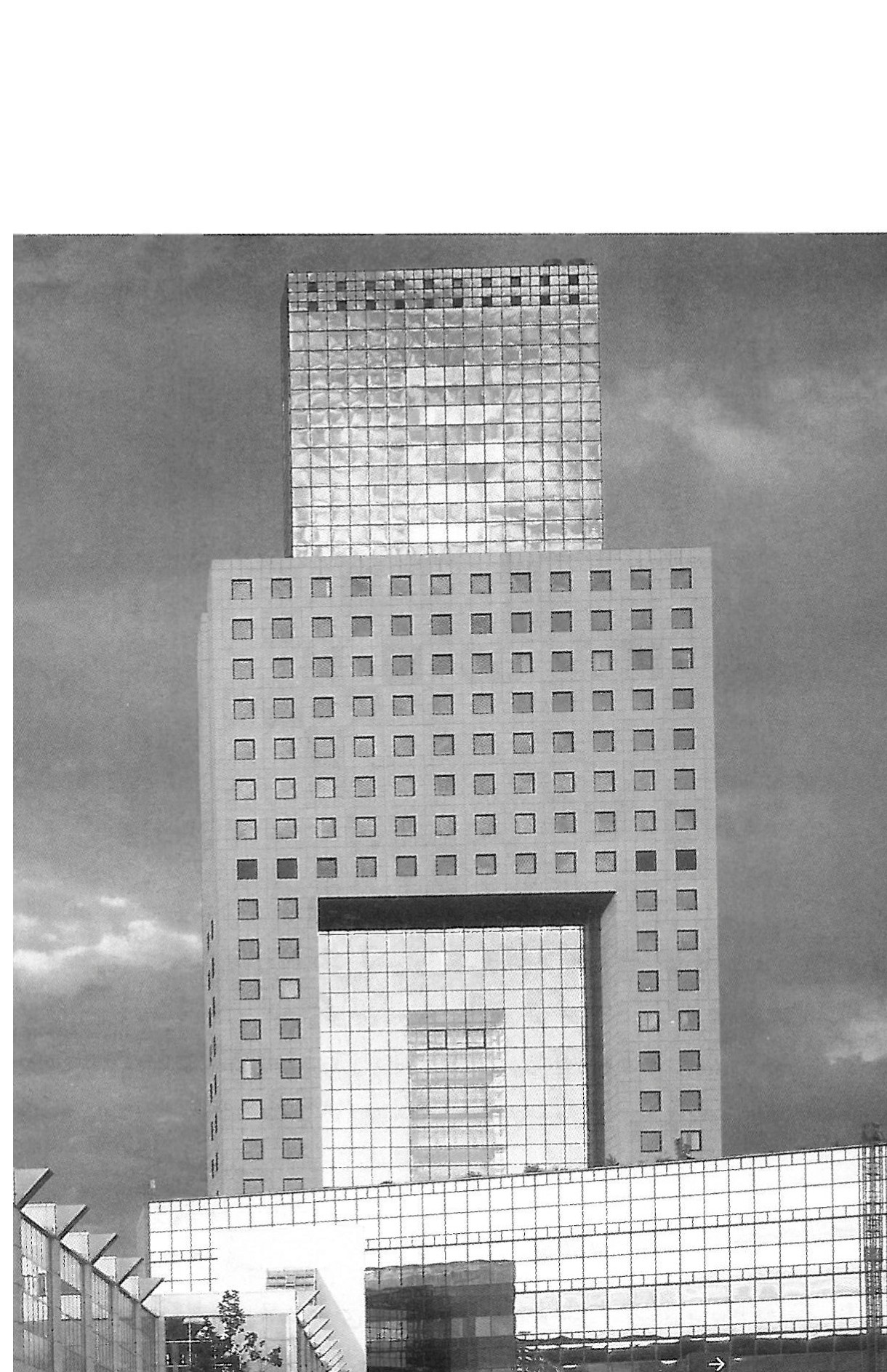
In design, imagination is as important as invention, and perhaps more so. Imagination is the human capacity for producing form, image or idea. The process of imagination is not goal-oriented, and no practical benefit is expected from imagination from the outset. Imagination that is constantly bound by practical needs and constraints does not lead to creativity. Imagination can be visual or abstract. Abstract imagination, which means the development of an idea, can be transformed into form. In the Carlo Felice Theater (1983–1990) by Aldo Rossi in Genoa, the designer had an abstract idea in mind: a theatre is an interior space, yet ancient theatres were held in outdoor spaces, generally in city squares. His idea was to create an interior space that would evoke an outdoor space. In the design phase, he designed the stage and main hall in a way that evokes a city square. In the main hall, windows and balconies were designed that recall the windows and balconies of old houses (Figure 8).
When imagination leads to the creation of an image, there are generally two stages: imitative imagination and creative imagination. In the first stage, the designer visualises something that has resulted from the juxtaposition of visual memories in a new way, and is therefore dependent on concreteness and what already exists. In the second stage, the images from stage one are reinterpreted and transformed into elements that have meaning only within the project in question and do not belong to any other building or external object.
Imagination can, without the need to pass through the idea stage, directly lead to the creation of a new form, and in this endeavour the power of visualisation is employed. Today, with the use of advanced computer programs, the dimensions of human visualisation have expanded, and designers can create forms whose visualisation without a computer would be extremely difficult and even impossible. Visualisation is the ability to conceive of a form that has no external existence.
3 — Techniques of Imagination
Imagination is the product of processing knowledge and visual memories and placing them in new relationships. In its final stage, imagination becomes creative imagination. Creative imagination means distancing oneself from mental stores and creating a new world of forms and meanings that crystallise only in a unique work of art. Artistic imagination is a complex undertaking that does not fit into rules and clichés. What is presented here is a scientific and logical study of a phenomenon that is inherently supra-scientific and not accessible through reasoning and method alone. In simple terms, our analysis has been developed based on artistic imagination in certain works of art, and not the other way around. Imagination has a vast and expanding domain, and its function is to break existing moulds. The cases explained below are examples of known techniques of imagination.