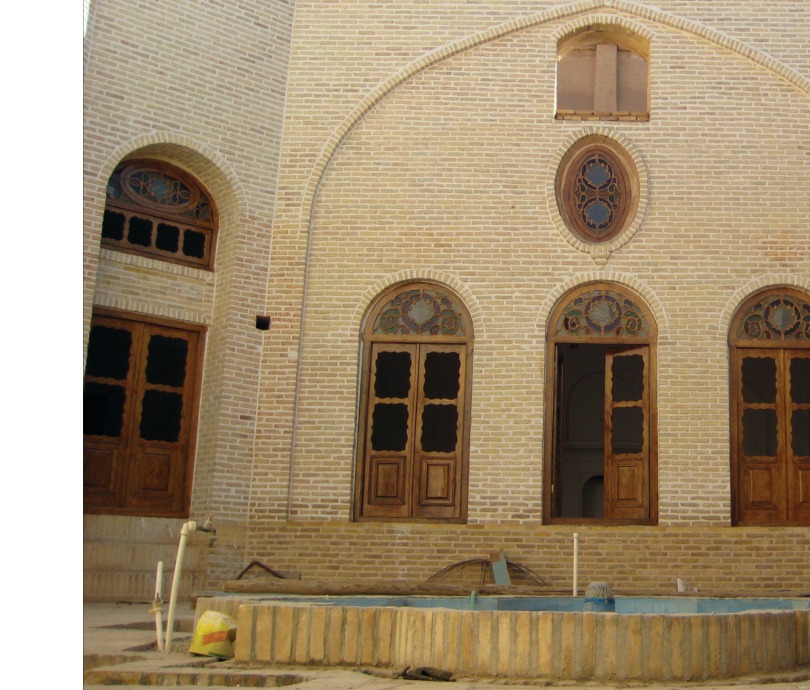
The Imperial (Shahi) Bank, Yazd
Prior to the official opening of the first bank in Iran, a number of large and reputable commercial institutions had begun work as financial institutions in the country's major cities. In Yazd, the most notable among these were the trading houses of Jamshidian and Jahanian, belonging to prominent Zoroastrian merchants. These trading houses had earned the utmost trust of the people through their integrity and trustworthiness.
Following these commercial houses, the first bank to begin operations in Iran was the "New Eastern Bank," headquartered in London with its main branch in India. In 1267 SH (1888), additional branches were established in Tehran and six other cities without any special concession. After a year or two, the government purchased all the bank's establishments and transferred its Tehran premises to the Imperial Bank of Persia. The Imperial Bank of Persia was formally established in 1268 SH / 1889, with the full support of Drummond Wolff, the British envoy, based on an agreement between Amin ol-Sultan, the prime minister under Nassir al-Din Shah, and Baron Julius de Reuter.
One of the branches of the Imperial Bank, established approximately 150 years ago during the Qajar period, was built in the city of Yazd. For a time, this branch was managed by an Englishman named John Frederick Toole. Following the closure of the bank, ownership passed to the police station of Yazd's District 2, after which Mr. Khedmatgozar, one of Yazd's well-known merchants, purchased it and converted it into a storehouse for household goods. Eventually, the building came under the ownership of the Yazd Housing and Urban Development Organization.
The Imperial Bank is located within the highly valued Maidan-e Khan complex, on the southern end of the western colonnade abutting the square. Continuing along the ceilings of the western arcade of Khan Square, a circular uncovered opening creates a pause at the bank's entrance. The beautiful ornamental portal of the bank, constructed of brick, plaster, and stone, can be seen as an emphasis on the entrance along the otherwise unadorned arcade.
The building consists of a basement, ground floor, and first floor. Passing through the main entrance, one encounters two rooms situated on the north and south sides of the entrance corridor. The northern room served as a security post, while the southern room leads to the interior areas. The entrance opens westward into an octagonal and semi-octagonal internal courtyard, facing a room with a five-part division featuring beautiful timber doors and multi-colored windows, which appears to have been the bank manager's room and is larger than the other sections.
On the northern and southern sides, rooms with three-part divisions and wooden doors and windows were used for customer services and as an archive for bank documents. In the basement on the northern side of the courtyard, the vault is accessed by seven steps through an iron door with very secure locks. The rooms on the southern side served as the bank's guesthouse. No ornamental traces are visible inside the rooms, though they may have disappeared over time. Most rooms have pointed vaulted ceilings while some feature groined vaults. The building materials are brick with gypsum and clay mortar, and the roof is clad in adobe.
This building was restored between 1375 and 1376 (1996-1997) by the Yazd Housing and Urban Development Organization, and is intended for use as the Yazd Museum of Cultural Works and Dignitaries.



