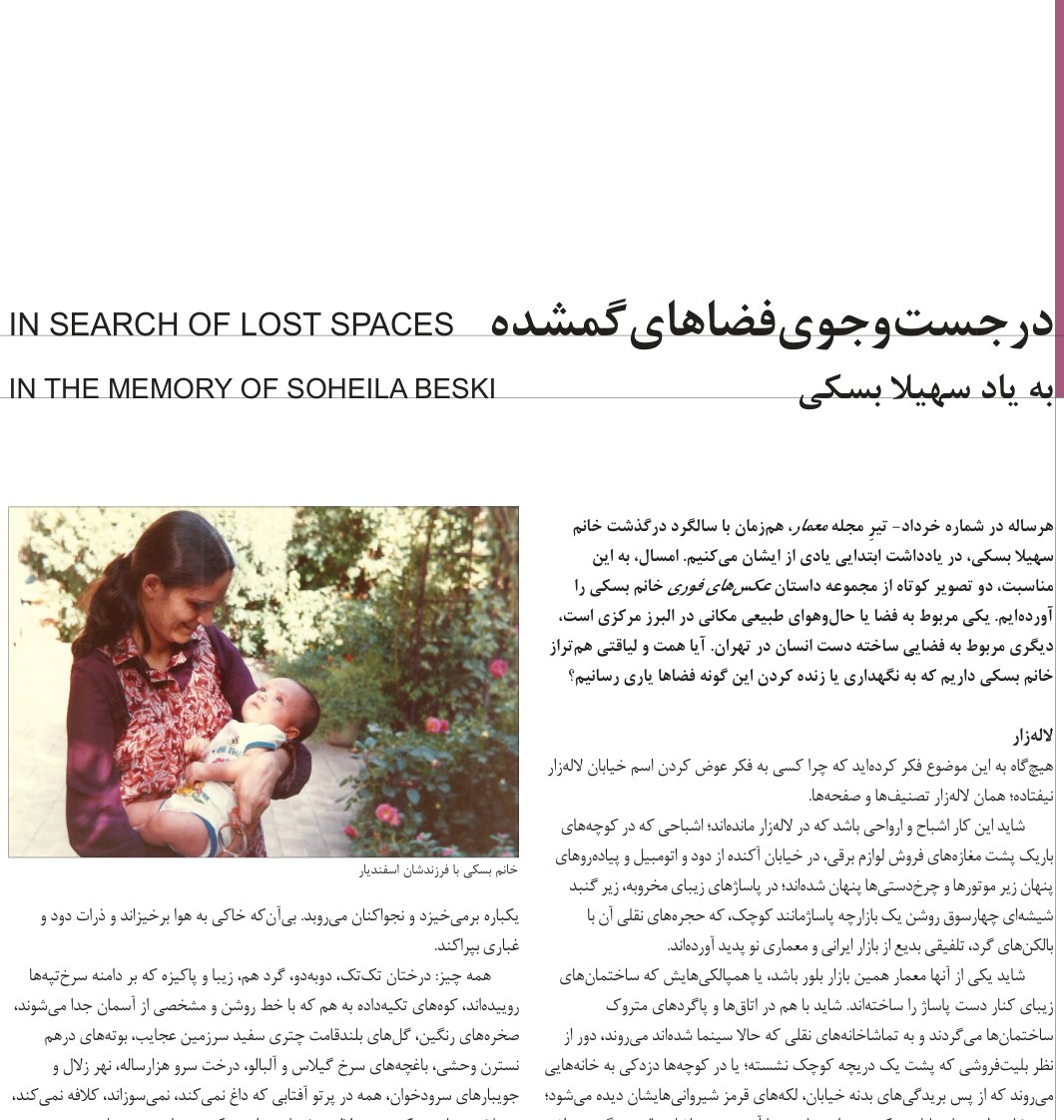
Every year in the Khordad-Tir (May-June) issue of Memar Magazine, coinciding with the anniversary of the passing of Ms.
Soheila Beski, we remember her in the opening editorial. This year, on this occasion,
we have included two short vignettes from Ms. Beski collection of stories, Instant Photographs.
One pertains to the natural atmosphere of a place in the central Alborz,
the other to a man-made space in Tehran. Do we possess the resolve and worthiness equal to
Ms. Beski to help preserve or revive such spaces?
Lalehzar. Have you ever considered why no one has thought of changing the name of Lalehzar Street -- the very Lalehzar of ballads and gramophone records? Perhaps it is the work of the ghosts and spirits that remain in Lalehzar; specters hiding in the narrow alleys behind electrical supply shops, on streets choked with smoke and automobiles and sidewalks buried under motorcycles and pushcarts; in the beautiful ruined arcades, beneath the glass dome of the luminous four-way intersection of a small passage-like bazaar, whose miniature shops with their rounded balconies have created a novel fusion of the Iranian bazaar and modern architecture. Perhaps one of them is the architect of this very Crystal Bazaar, or his companions who built the handsome buildings beside the arcade. Perhaps together they wander through the abandoned rooms and landings of buildings and visit the intimate little theaters now turned into cinemas, unseen by the ticket seller sitting behind a small window; or in the alleys they steal into houses whose red rooftop patches can be glimpsed through the gaps in the street facade; and to the house of My Uncle Napoleon, which is still here, with its faded red ornamental entrance. The wild rose bush is gone and no gravel remains on the ground of the courtyard, but those whose lives are as old as the house still dwell within it. The old man wears a jacket that has shrunk like him and a red handkerchief tied beneath his checkered shirt. His hair is white, and his Douglas-style mustache is salt-and-pepper. Keys jingle in his trembling hands. He does not fear the ghosts; he whispers to them, says goodbye, and locks the doors. The living do not come at night to these alleys, where behind the crumbling staircases of ruined buildings the spirits of musicians from Lalehzar cafes lie curled up, breathing in the air. Nor do they linger in the silent streets, emptied of sound and color and scent and garden-alley songs. Perhaps they fear the night-wandering spirits. The guardian spirits of Lalehzar, the ballad of the ladies of Lalehzar, who still stubbornly roam the intimate little theaters with their colorful posters for the film Above the Battle, at the entrance of the beautiful Crystal Cinema, in the delicate lobby of Hotel Central, in the tiny under-staircase shops of the arcades, in the cafes turned into fast-food joints, and behind the beautiful doorways at the corners of alleys... It cannot be otherwise. The spirits of Lalehzar have not allowed anyone to think of changing its name.
Shemshak: The Old Summer Retreat of Tehran. The silence of the valley is light, flowing, and soothing. Sound resonates within it with a pure and bright echo. The sounds of birds, the conversations of people on opposite sides of the valley, the laughter of children rise right beside your ear and are not disturbing. The silence of the valley expands; the compressed, excitable particles gently and softly move apart, separate, grow light, and a gentle breeze
suddenly rises and sweeps through with a whisper, without raising any dust or scattering particles of smoke and haze. Everything: the trees standing alone, in pairs, gathered together, beautiful and pristine, growing on the red slopes of the hills; the mountains leaning against one another, separated from the sky by a bright, distinct line; the colorful rocks, the tall white umbrella-shaped flowers of a wonderland, the tangled bushes of wild dog-rose, the small gardens of red cherries and sour cherries, the thousand-year-old cypress tree, the limpid stream and the singing brooks -- all in the light of a sun that does not scorch, does not burn, does not stifle, with the gentleness of wind and silence, in the brilliant clarity of the air, appear near and proportionate, connected to one another, not disordered or fragmented, different yet alike. If you stretch out your hand you can touch the mountain, massive and multidimensional. You stand as tall as the mountain and can place your hand upon its summit; everything is close and of equal weight, and you are the size of a plump cherry hanging from a red cluster of cherries; a part of the continuous flow of a soothing unity. The valley with all its elements, gentle, patient, with its millennia-long life, is untroubled. And the sunset of the valley, quiet and tiptoed, without your noticing or knowing, spreads its mantle. The sky, grain by grain and imperceptibly, takes on color. The coolness of dusk upon the wind settles on the skin. The silence deepens and grows heavier. Colors become uniform and the distinct outlines of shapes, trees, mountains, and earth blend into one another. Sounds arrive from farther away, and that invisible murmur of the day flowing life in the stones, mountains, trees, and cherries subsides. Even the river quiets and its voice reaches drowsily from a greater distance. And suddenly in the encroaching darkness, the full bright moon, in the middle of the sky, shines upon the expanse sunk in shadow, and the distant lights of the hamlet kindle. On the upper road, far from the houses in the valley below hidden behind their newly lit lamps, a storm of dust rises. The black phantoms of sheep silently, soundlessly, pour down from the sky. The headlight of a car illuminates the apparition of the shepherd and the sheep pressed together, undulating, shrouded in dust and haze as they move, and when it goes dark, suddenly everything plunges into blackness. The silence and the mountain night become, for one moment, absolute.
Ms. Beski with her son Esfandiar



