On the Threshold of Seventy Years of Living with Architecture
Being in close proximity to several generations of elder architects active in Iran—many of whom, regrettably, are no longer with us, while most of the rest are spending their retirement years—has afforded me the opportunity to become acquainted with their personalities, habits, and manners, and through these, with their designs and their perspectives on architecture. Several generations who entered the profession of architecture in the 1940s and 1950s (1320s and 1330s solar) and whose peak years of professional vigor have long since passed. Among these generations, diverse phenomena can be observed, each possessing exemplary distinguishing qualities in its own right. One of the surviving members of that generation who continues to engage steadily in serious architectural practice is Engineer Faramarz Sharifi. Sharifi is a recognized name in Iran's architecture today—renowned for his residential designs and the great number of his built projects. My close acquaintance with him dates from a decade ago, and for some time now I have been engaged in compiling and documenting his life and architectural projects. Faramarz Sharifi was born in Tehran into a small family. Until his adolescent years, owing to his father's occupation as governor of various cities across Iran, he experienced living and studying in different parts of the country. His two distinctive passions—automobiles and painting—emerged in childhood and remain with him to this day. His painting began with renderings of automobiles and portraits of individuals during his adolescent years in watercolor or oil. During his high school years he took up caricature, and from his university days to the present, sketching landscapes and buildings has accompanied him as one of his principal artistic abilities. Despite his slight build, from his early youth he would sit behind the steering wheel of his father's car and, with great effort, get it moving. From the time he received his driver's license until today, he has purchased more than thirty different automobiles, and he vividly remembers the sensation of driving most of them. He received his high school diploma in mathematics from Alborz High School and in the 1955 entrance examination for the architecture program, he secured second place after his high school classmate Manoushan Azam Zangana. Owing to Manoushan's withdrawal that year, he entered
the Faculty of Fine Arts and Seyhoun's atelier as the top student of his cohort. The Faculty of Fine Arts at the University of Tehran in the 1950s (1330s solar) had a markedly different character from its inaugural decade of the 1940s. The arrival and dominance of the modern architectural movement in the faculty, the diversity of students' architectural projects, and the new generation of recently arrived professors—such as Houshang Seyhoun, Abdolaziz Farmanfarmaian, and Heydargholi Ghiaei—had shaped a new experience for the students of those years. In the Beaux-Arts system of the Faculty of Fine Arts, architectural education proceeded through work in the atelier, and the transfer of knowledge flowed from upperclassmen to underclassmen. What set any student apart in this system was innovation in design and the ability to convey ideas on the drawing board through sketches and the power of one's hand. This factor made the names of certain students more prominent among that generation. Faramarz Sharifi belongs to the group of distinguished students who, in the parlance of their contemporaries, were among the "strong hands" of the atelier—and it is by virtue of his skill in rendering mental ideas on paper that he has remained in the memory of most of them. According to several
Faramarz Sharifi in childhood, first year of primary school, in the city of Qom, 1943. Faramarz Sharifi in his youth.
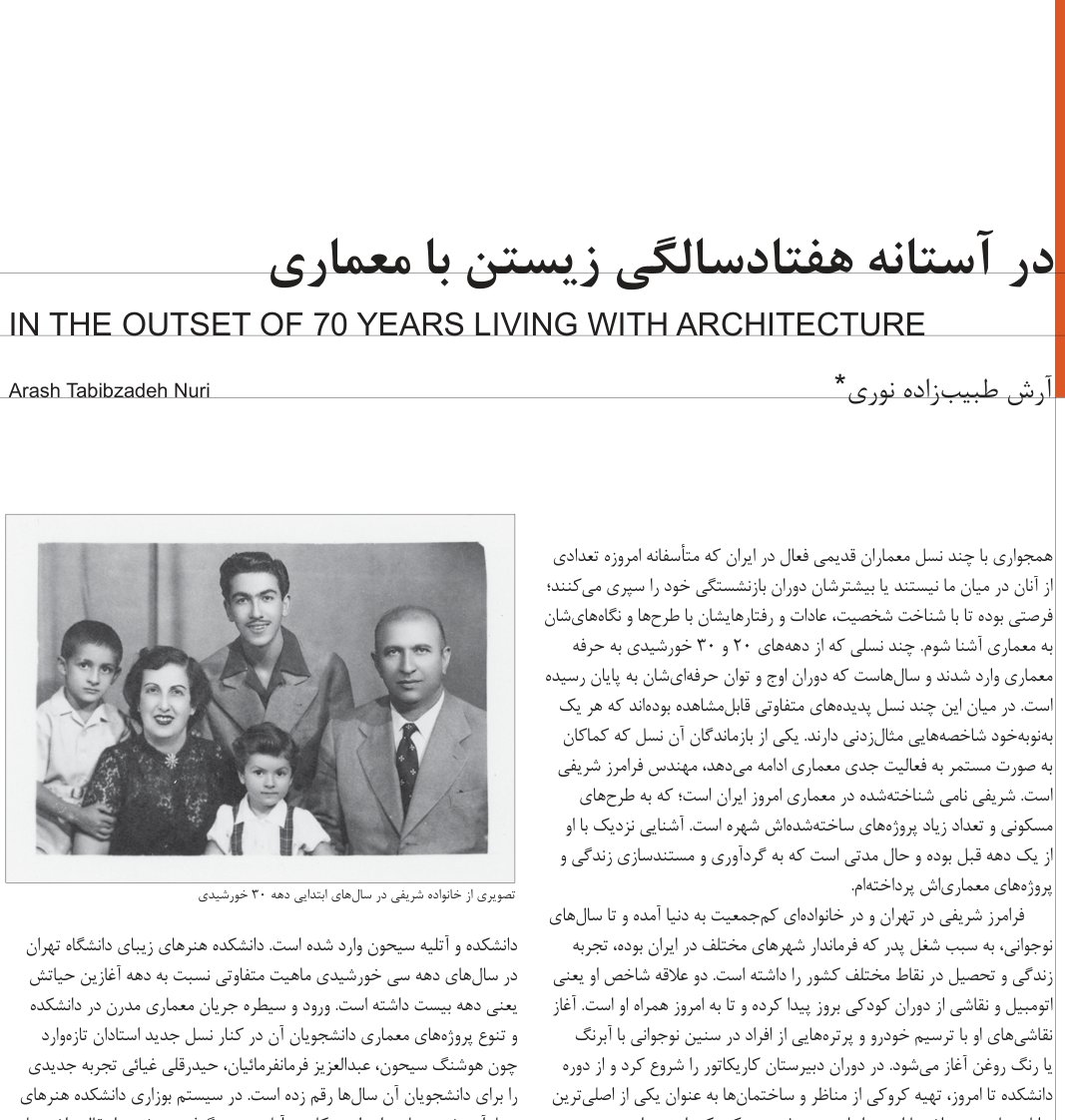
A photograph of the Sharifi family in the early 1950s (early 1330s solar).
A student field trip with classmates from the Faculty of Fine Arts, circa 1958. A trip to Europe and visit to the Brussels International Exposition in 1958.
Faramarz Sharifi during the visit of the world-renowned architect Richard Neutra to Tehran. During his tenure at the Litchfield company, circa 1962.
Plan of the first villa designed and built for his old friend, Engineer Espand Siahpoush, in 1959.
students of those years: Faramarz Sharifi drew automobiles superbly, and this skill led to traces of his automobile drawings appearing in other students' atelier projects. Although Faramarz Sharifi received his master's degree with distinction on December 8, 1962 for a project entitled "National Library," thereby officially attaining the title of Architect, his presence in the architectural profession dates to the middle years of his studies—specifically 1958, when he worked at the joint office of Manouchehr Mohammadi and Houshang Seyhoun, and subsequently at the Tajan contracting company as head of the design department. In 1961, he began working at the Tehran branch of the Litchfield Whiting company, where, by his own account, one of the most influential periods of his architectural education took shape working alongside the accomplished architect, Engineer Leon Babayan. Following his marriage in 1963, he joined the building department of the Iran Telephone Company, and for three years, as a designer, he designed several telephone company buildings in provincial capitals. Concurrent with his work in the engineering offices and agencies of that era, his personal projects commenced in 1959, encompassing innumerable built residential and commercial designs totaling more than three hundred. His first design was a villa in the Zafaraniyeh neighborhood for Engineer Espand Siahpoush, a high school friend and graduate of the road and construction program at the Faculty of Engineering, who calculated the building's steel structure and with whom he built it together. Following the experience of this first work, other residential commissions were entrusted to the architect, and over time his designs were built in collaboration with the craftsmen of that era. In the 1960s and the first half of the 1970s
Khorshid Sheibani Villa. An example of one of the houses built in the 1970s.
Pirouz Afshar villa house. Mansour Jahanbani villa house.
Engineer Faramarz Sharifi and his partner Engineer Hashem Zia-Ebrahimi in the 1970s. Navy Headquarters, 1974.
(the 1340s and early 1350s solar), he designed and built more than eighty houses and villas. Among them, the projects for the Mansour Jahanbani Villa and his partner Houshang Etezadi's villa (1961) in Heravi, the Kikavusi Building (1962) in Ehteshamiyeh, the Keighobadi Building (1965) in Amaniyeh, the Ansari Villa (1967) in Pasdaran, and the villas of Khorshid and Nafiseh Sheibani (1968) in Saltanatabad, along with several other projects, are examples that follow the dominant current of modern architecture in 1960s Iran, employing continuous surfaces of stone and glass. These projects, built mostly in the first decade of his career, represent an effort to gain experience and arrive at a personal architectural language. Alongside these, in a number of his houses and villa designs during the 1970s (1350s solar), an attempt was made to harmonize modern architecture with the quality and context of the building site. Among these projects, one may note the Dr. Samiei residence (1973) in Hamadan, the Zirakzadeh office building (1975) on Karimkhan Street, the Pirouz Afshar house
(1975) on Jordan Street, the Mehdi Mazhari house (1976) in Kamraniyeh, the Houshang Okhovat house (1978) in Ajoudaniyeh, and several other projects—most of which were built with brick and exposed concrete on the facade and feature pure volumes with a modern architectural character. With the flourishing activity of architectural consulting firms in the 1960s and the receipt of rankings and consulting credentials from the Plan and Budget Organization, Engineer Faramarz Sharifi, together with his senior classmate Engineer Hashem Zia-Ebrahimi, registered the Artiman consulting firm in 1967. His activity and partnership in Artiman Consulting Engineers continued until 1995, encompassing numerous public projects including several factory buildings in various Iranian cities, the Asia Insurance Company headquarters (1969) on Fisherabad Street, the Navy headquarters (1974) in Tehran, and the Jam Township housing project (1979)—which included the design and construction of a number of public buildings and 1,200 residential units in the town of Kangan. Faramarz Sharifi's architecture is rule-governed and geometry-driven. Like many of his contemporaries, he begins his design from the plan and, through a simultaneous back-and-forth process, shapes the building as a whole. He pays redoubled attention to details and materials, and following his longstanding habit, after construction commences he continues to attend to the formation of interior spaces and the exterior details of the volume—and if dissatisfied with portions of the initial design, he demolishes what has been built and rebuilds it with new modifications. Two-thirds of this architect's professional career has fallen in the post-Revolution years, during which he has been able to keep pace with the fluctuations and changes of society and new clients, and to continue on his path. At the end of the 1970s (late 1350s solar), he designed and built several residential complexes, including the Gerami Residential Complex (1979) in Zafaraniyeh, the Lashkari Residential Complex (1980) in Kamraniyeh, and the Kazemini Residential Complex (1980) in Elahiyeh, Tehran—each of which merits study as an enduring example of post-Revolution residential architecture. In the mid-1990s, he voluntarily withdrew from the realm of large-scale government projects at consulting firms, and over the past three decades his architectural office's close presence and collaboration with the Deno company has yielded optimal results, enabling him, with the assistance of his colleagues, to continue shining as a masterful designer in Iran's architecture today. Throughout this period, residential projects of varying scale, aimed at enhancing the quality of life for Tehrani citizens in small-scale apartment settings, have been among the design objectives within a system that Engineer Sharifi has pursued. Notable successful examples include the 22-unit Zafar Residential Complex (2000), the 65-unit Gheytariyeh Residential Complex (2011), and the 56-unit Artesh Residential Complex (2021), which is currently under construction. After seventy years of living with architecture, Sharifi's works bear their own distinct character and are recognizable in most instances. His architecture has evolved over the years, moving with materials, construction technology, and the prevailing currents of the world. Sharifi possesses an exceptionally powerful visual memory, and this is one of the most important distinguishing features that set him apart from other designers. He studies many of the world's prominent projects, retains their salient points in his mind, and by examining the works of other architects, strives to elevate his own designs. In the early period of his professional career, he was greatly influenced by Richard Neutra and Alvar Aalto. During another phase, attention to the architecture of Louis Kahn was an influential factor in his designs. In more recent times, he has drawn inspiration from Michael Graves, Mario Botta, and even the architecture of Renzo Piano and Tadao Ando. His strength becomes evident in how he absorbs influences from diverse projects yet ultimately, through his own characteristic geometry and idiom, his Iranian sensibility, and his modern outlook, he creates distinguished works. Engineer Sharifi has a distinctive personality. He takes pleasure in life's moments and has sustained many friendships and relationships from his past to this day, while also conversing easily with the younger generation. He delights in driving his personal car and in long drives to northern Iran. His attention to the smallest details of his attire and appearance, and above all, the daily labor of designing and creating architectural space at his old desk with his vintage templates and set squares, imparts a sense of vitality to his young colleagues.
* Architect-researcher (Oral History of Contemporary Iranian Architecture Project)
Gerami Residential Complex, 1979.
Tim Spinning Mills building, Mashhad, 1975. Zafar Residential Complex, 2000.
Deno 8 residential building, 2017. Deno 6 residential complex, 2011.



