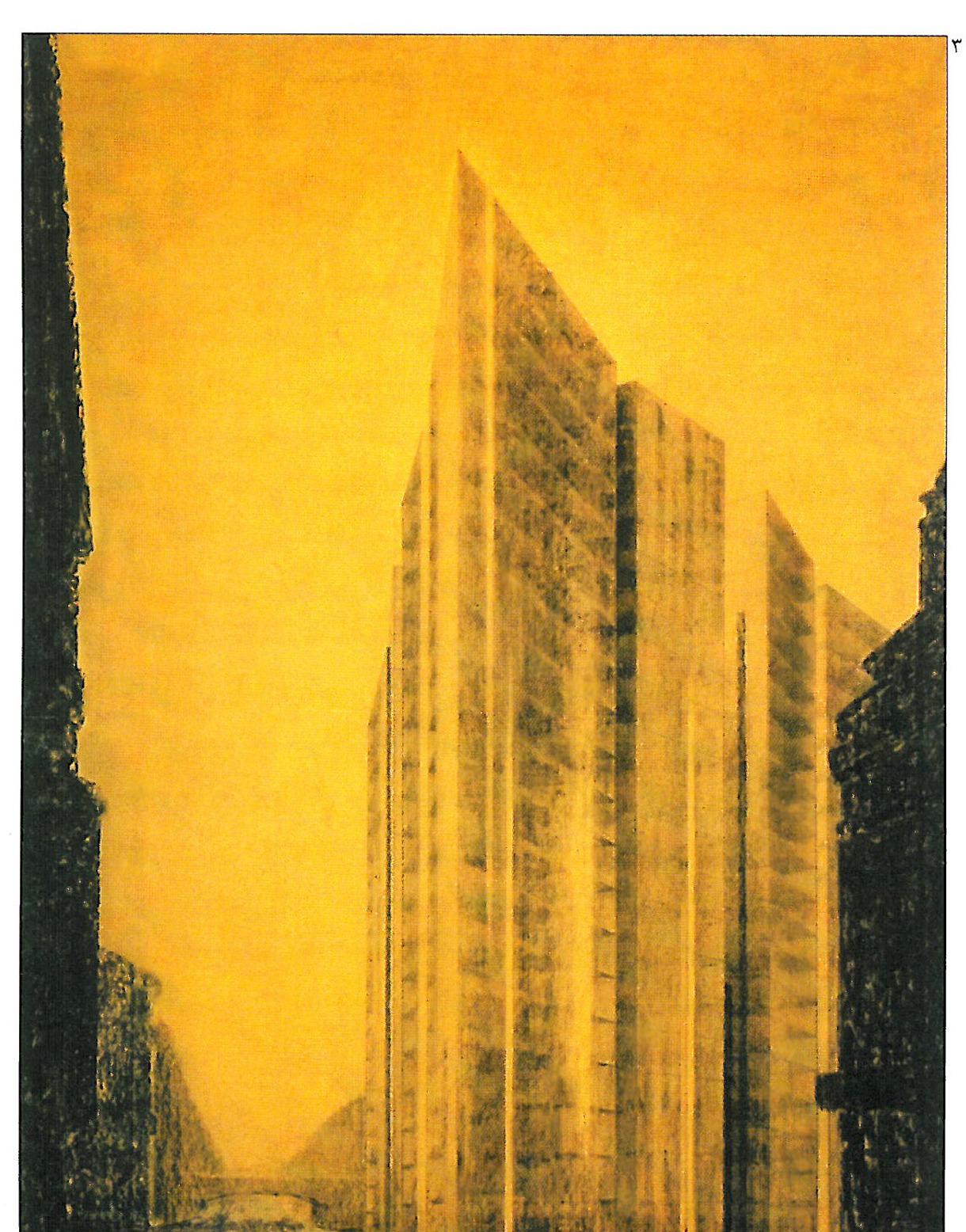
According to Musil, that event is at any moment on the point of happening. But in the course of events, and along the evolution of a field of creative activity, there are periods in which no perceptible movement or motion is to be seen, and in which people fall into the temptation of valuing the past far more than the present — reckoning other ages as more important than their own, and regretting things that long ago departed. In these sometimes widespread and enduring periods, devoid of creative strength, no belief in the power of the individual, or in his or her capacities and possibilities, remains.
In these periods, everyone is caught up in a state in which the future is regarded as something undecided, or with indifference. The latent capacity for creativity dissolves within one. A hope germinates that something "great" and "new" will prove itself, and that afterwards an era will begin in which we too may wish to play an active part. But how is one to recognise "the great" and "the new"?
It must be stressed that both the cause and the effect of such conditions is what, in the term coined by George Steiner in his essay "In Bluebeard's Castle," may be called "lethargy" (ملالت) — a state of general cultural lassitude and disenchantment. What I have in mind is a comprehensive process of helplessness and mounting uselessness.
"The more the entropy grows, the more the energies break down. Repetitive motions or interruptions in activity, becoming-protracted, the seeping of poison into the body, a tormenting inertia, a fevered torpor, the drowsy nausea of a man who cannot see the steps in a dark stairwell, and a host of similar conditions and images." — George Steiner, "In Bluebeard's Castle."Lethargy, for example, is apparent in conditions in which every creative expression, the moment it steps into the arena of existence, is unconsciously — even by its own maker — looked at with contempt; is not counted as real; is treated as a passing thing, something to be amended and to issue in the next thing. In this interval we seldom recognise anything meaningful or new. Another face of lethargy is that the cultural authorities themselves provide an environment ideal for those who do not wish to change (or do not have the capacity to change) and who are for the prolongation of the present condition of fatigue.
Sticking to the accepted rules looks meaningful; looking back is read as a sign of humility and cultural understanding; and the use of familiar devices is read as a sign of special sensitivity. In other words: the commonplace celebrates its own triumphs.
When lethargy has been stirred into being, every flash of creativity is pale and faint. Events come wrapped in a thick shell of verbiage. A generalised ill-speaking, or the disguised dress of "critical regard," appears. In the period of lethargy, the copy is worth more than the original. Light-headedness under the mask of simplicity is promptly attributed to deep intellectuality. Every independent creativity is looked at with doubt and is treated as the exhibitionism of a driven professional, or as an attempt to belittle the values that have been reached up to today. To understand the present, far too much weight is given to the past, and historical processes are put on display. In short, everyone waits for something that waiting itself has already blocked the road to.
Lethargy and architectureLethargy has struck wide territories of creative activity in architecture. Its emergence means the building of works whose examples can be seen everywhere, and of reproductive structures that cast a sterilising shadow on architecture. Architecture has taken a very heavy blow from lethargy. Another sign of the illness — and one with severe consequences — is architecture's inability to turn its creative potential into productive use.
For several decades, architects could not free themselves from the action of the heroes of Modernism. Their surface glare had so dazzled architects that they could no longer distinguish the essential, the foundational structures. The spread of similar citations was not followed by a new and comprehensive definition of the craft of architecture. It is no wonder, then, that architects could not move at the pace of their time: the moment architecture had adapted itself to the consequences and possibilities of industrial production and rebuilt its first principles on that ground, those principles had already fallen out of use and taken their place among the reserves of history. The moment architecture tried to digest the production conditions of the post-industrial age, the craft of architecture — under the influence of the electronic world — came apart, and real space began to take shape on the basis of those artificial worlds. The permanent battle for conditions which, by the time one reaches them, are already obsolete, is the clearest symptom of the illness of the architectural stream in the recent decades.
Why Zaha Hadid?We began this short essay on Zaha Hadid's architecture with this "calamity" in order to frame the "conditions of production" that meet and surround her work. We believe that these conditions matter for an understanding of her work. The general torpor in architecture mentioned earlier shows that today productive communication between architects is seldom to be seen, and the pre-conditions for the achievements of exceptional individuals are not to be found in them. Those preconditions rather appear in the thirst and reasonable desire for intelligent dialogue. For this reason, those who do not wish to sink into the torpor of the prevailing non-committal stream of intellectualism must, for debate and invention, create for themselves their own private, inward conditions. The architect's workshop sometimes becomes an independent counter-world.
Zaha Hadid's workshop has, with a careful professional eye, turned into an architectural arsenal that has gone far beyond the last decades (or could have gone further) and may be much more influential than the formalist surface of her work suggests. Zaha Hadid and her colleagues have had at their disposal innovative, relatively radical solutions in almost every domain of architecture. The novelty, the display of the idiom of construction, and the strange choice of "word and syntax" easily led to a reading of her architecture as though its main aim were the outward exceptionalism of the work — with less attention paid to the essential structures. As a result, the first impression cannot be mistaken for the substance of the work. We must remember Lyotard's remark that architecture is the art that can least be judged by what appears immediately to the eye.
Not only Modernism, but the whole history of architecture, is used as a reference. Habermas's "project of modernity" is carried forward and, at the same time, some of its essential requirements are transformed directly. One example of this is the role of structural systems in architecture — the relationship between structural systems and spatial requirements.
Zaha Hadid's work, and the work of her office, can also be seen as an essential chapter in post-Modernist architecture: an architecture that has entirely freed itself from the entanglements of theoretical shortcomings. An architecture that, by virtue of its simplicity and of the absence of professional and specialist dialogues, for a time raised its head where the craft of architecture shows itself best: in the reality of the site of construction.
The Wolfsburg Science CentreWe wish to pursue general arguments by concentrating on one project, and are aware of the risk hidden in that. Every project is of course unique, and carries new and unexpected elements. But themes can also be found that repeat themselves in different settings and run through two decades of architectural work.
We shall examine these themes in the "Wolfsburg Science Centre" project in the north of Germany. Wolfsburg, the production centre for the Volkswagen car — a car whose purchase, for the thousand Marks of the time, lay within the reach of the German middle-class family — had its town centre later completed with the buildings of Alvar Aalto and Hans Scharoun. The Science Centre is a project that won its design competition.



