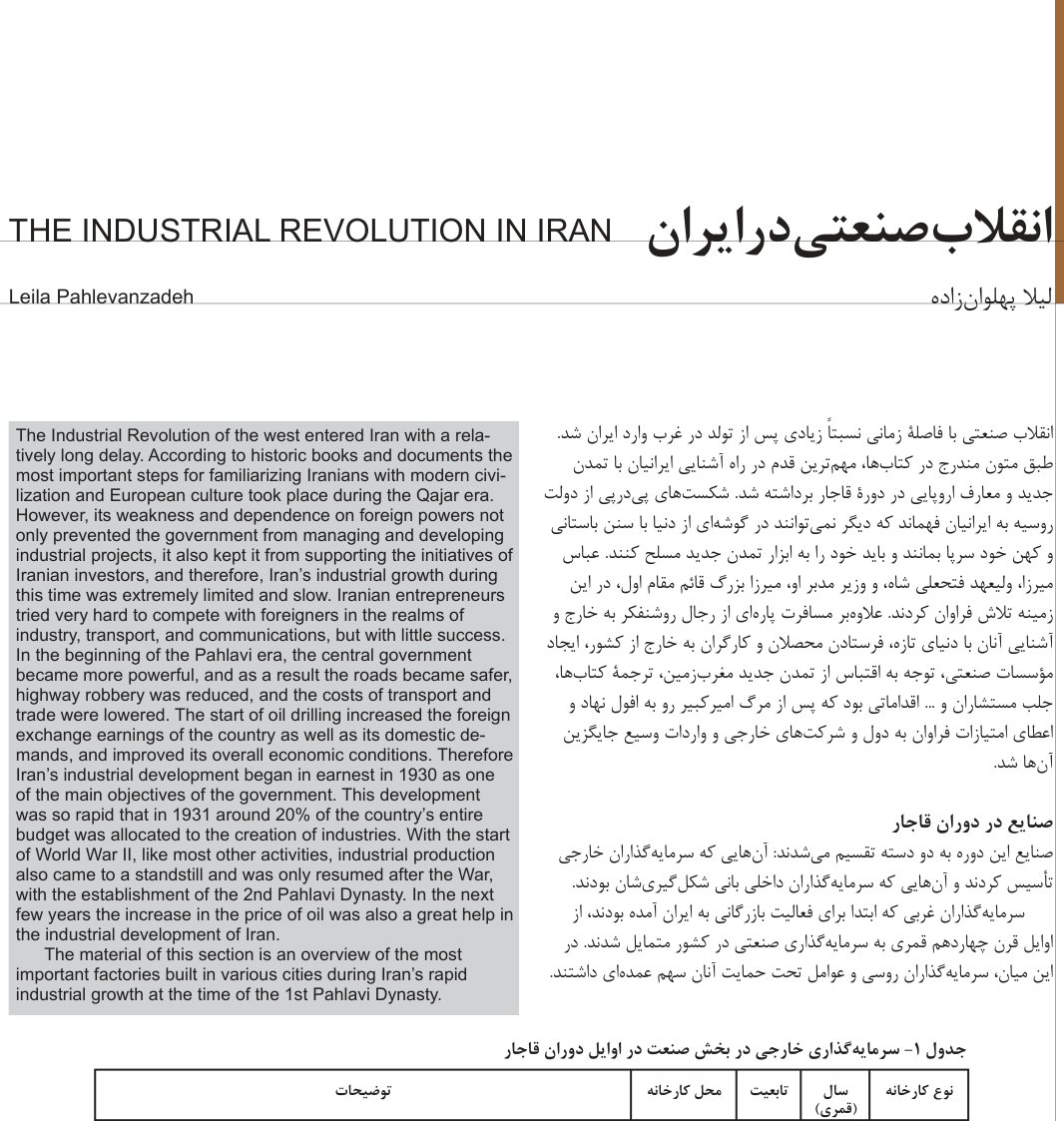
The Industrial Revolution arrived in Iran with a considerable time lag after its birth in the West. According to texts found in historical records, the most significant step toward familiarizing Iranians with modern civilization and European learning was taken during the Qajar era. Successive defeats at the hands of the Russian state made Iranians realize they could no longer sustain themselves in a corner of the world relying solely on their ancient traditions, and that they needed to arm themselves with the instruments of modern civilization. Abbas Mirza, the crown prince of Fath-Ali Shah, and his astute minister, Mirza Bozorg Qa'im-Maqam the First, made tremendous efforts in this regard. In addition to the travels of certain enlightened statesmen abroad and their acquaintance with the new world, dispatching students and workers overseas, establishing industrial institutions, adopting Western civilization, translating books, and recruiting foreign advisors were among the initiatives that declined after Amir Kabir's death, replaced by the granting of numerous concessions to foreign states and companies and extensive imports.
Industry in the Qajar Era Industries of this period were divided into two categories: those established by foreign investors and those founded by domestic investors. Western investors, who had initially come to Iran for commercial activities, became inclined toward industrial investment in the country from the early fourteenth century AH. Among them, Russian investors and their protégés held a major share.
Olive Oil 1313 AH Russian Rudbar Two Greek merchants who were Russian subjects obtained the concession, and machinery was purchased from England. Products were exported to Russia. With the increase in Russian customs duties, the factory ceased operations and was shut down.
Match Manufacturing 1308 AH Russian Khalazir Established at the encouragement of Amin al-Dowleh near his estate. It was shut down due to a shortage of wood and inability to compete with Austrian and Swedish matches.
Sugar Refining 1313 AH Belgian Tehran At the encouragement of Amin al-Dowleh, sugar beet cultivation began on his estates in Kahrizak, and the factory was established there. Since the factory was fledgling, it could not compete with Russian sugar. The Russians, who were the main exporters of sugar to the northern provinces, temporarily lowered sugar prices. A shortage of sugar beets was another reason for the factory's closure.
Cotton Ginning 1320 AH Russian Barforush, Sari, Behshahr, Bandar-e Gaz, Amol
This type of factory was generally in the hands of non-Iranian capitalists, who, in addition to profiting from cheap cotton and labor, also made sums by cheating on weights. In the years 1323-24 AH / 1905-06, more cotton ginning factories were established.
Lumbering 1307 AH Russian Gilan, Mazandaran The Russians obtained an exclusive concession to fell and export one hundred thousand boxwood and cypress trees annually from the northern forests, and in the year 1330 AH, the Iran-Russia Wood Industries Company was formed. The Rasht electricity plant and the Rasht-Pireh Bazar railway were among its ancillary establishments.
Silk Spinning 1330 AH Russian Rasht Established by Agha Mohammad Rashti with Russian capital, it was shut down after some time due to political considerations and mismanagement.
Industrial Workshops 1316 AH Russian Khorasan Russian subjects established several industrial institutions in various cities of Khorasan, including Neyshabur.
Table 1 - Foreign Investment in the Industrial Sector in the Early Qajar Period
In general, the economic activities of Iran's northern and southern neighbors, under the semi-colonial conditions of the time, were primarily politically motivated and served as instruments for consolidating and stabilizing their political positions. Meanwhile, the scope of efforts by German, Belgian, and French investors was very limited and unsuccessful. The activities of British investors were confined to commercial and banking affairs, and only toward the end of this period did they enter industrial activities through investment in the oil industry — and even then, only in one specific sector. Russian investors, however, had a relatively active participation in industrial ventures as well. Due to the active involvement of Iranian merchants, Western investors never fully dominated foreign trade. The industrial activities of foreign investors, except for the oil and fisheries industries, were of a nature that allowed Iranian investors to compete. The rivalry between Russia and Britain impeded the growth and development of necessary communication networks in the country, and only a few roads were built in the spheres of influence of these two colonial powers. The lack of communication network development was a fundamental obstacle to the country's economic growth. The establishment and expansion of the Imperial Bank of Iran and the Russian Loan Bank
— which had complete control over the country's money market — not only consolidated the colonial influence of the northern and southern neighbors but also became a fundamental obstacle to the birth of modern banking from within the traditional banking system and its development and progress.
Domestic Investment in Industry During This Period The weakness of the government, the incompetence of the Qajar kings, and their severe dependence on colonial powers had stripped the government of the ability to establish new institutions such as industrial factories, railway stations, shipping, and the like. The government not only lacked the power to execute and manage such projects but was also incapable of supporting what domestic investors had founded, which is why these institutions were destroyed in competition with foreign rivals. The idea of establishing factory-based industries in Iran was first raised by Abbas Mirza, the Crown Prince, during the Russo-Persian Wars. According to information recorded in the book "History of New Civilizational Institutions in Iran" by Hossein Mahboubi Ardakani, the establishment of a broadcloth weaving workshop in Khoy was one of his earliest initiatives for promoting modern civilization and meeting military needs in Iran.
Factory Type Factory Location Number Nationality Number of Workers Percentage of Workers Relative to Total Employed Workers in the Country
Table 2 - Foreign Investment in the Industrial Sector in the Late Qajar Period
Factory Type Investor Year (AH) Factory Location Notes
Yarn Spinning Naser al-Molk 1275 AH Tehran Purchased from Moscow and after some activity, it stalled and was sold.
Glassmaking - 1285 AH Tehran With Belgian collaboration, it had fine production, but was shut down due to a shortage of raw materials.
Glassmaking Haj Mohammad Hasan Amin al-Zarb 1305 AH Tehran Shut down after a period.
Porcelain Making Haj Mohammad Hasan Amin al-Zarb - Tehran Shut down through Russian machinations.
Porcelain Making Haj Abbas Ali and Haji Reza - Tabriz Shut down through Russian machinations.
Textile Weaving, Linen Fabrics - - Isfahan The military forces of Zel al-Soltan used fabrics woven at this factory.
Silk Spinning Haj Mohammad Hasan Amin al-Zarb - Gilan One of the largest factories of its time, with equipment purchased from France.
Silk Spinning Agha Mohammad Mohsen Rashti with Russian financial backing - Rasht Shut down shortly after commencing operations due to political considerations and mismanagement.
Gas Lamp Mirza Hossein Khan Qazvini (Sepahsalar) 1297 AH Tehran Shut down due to a coal shortage. After some time, an Iranian purchased it and sold it to a Belgian company, but the Belgians also failed and the factory was shut down.
Electric Lighting Haj Hossein Agha Amin al-Zarb 1323 AH Tehran Purchased from Germany and commenced operations in 1325 AH.
Electric Lighting Haj Mohammad Baqer Milani (Rezayof) 1320 AH Mashhad Purchased from Russia to provide illumination for the shrine of Imam Reza and the adjacent street.
Brickmaking Hossein Agha Amin al-Zarb - Tehran Shut down after a period of operation.
Soap Making Rabi'-zadeh and Partners 1328 AH Tehran Produced fine-quality soap.
Spinning Morteza Qoli Khan Sani' al-Dowleh 1312 AH - Its product was of very high quality, but it could not endure competition from foreign manufacturers who temporarily lowered their prices, and it was shut down.
In sum, it can be said that Iranian capitalists and merchants in the late Qajar period embraced new methods of commercial activity, such as establishing joint-stock trading companies, and founded several reputable firms in the European style. They also made some efforts in industrial investment, though these were very limited and unsuccessful. They demonstrated their capability for expanding commercial activities and taking advantage of favorable opportunities, competing with Western merchants and preventing their monopolistic domination of foreign trade markets. They also took steps to establish Iranian banks to compete with Russian and British banks and to end foreign control over the country's monetary market, though they did not achieve significant results. Furthermore, they invested in transportation and communications, but in this field too, due to internal and external obstacles, they did not attain much success. Consequently, major merchants channeled the bulk of their capital and energy into landownership, diverging from the main path of commercial activities.
Industry in Iran During the Pahlavi Era The Iranian economy at the beginning of this period was entirely primitive and based on agriculture. Approximately one-fifth of the population lived in small towns, one-quarter were nomadic tribes, and the rest lived in impoverished villages. The primary occupation was agriculture, and each locality was virtually self-sufficient due to the lack of road infrastructure. The lifespan of new banking institutions was very short, and roughly fifty percent of government revenues — derived mainly from incomplete tax collection — were spent on useless military forces. With the outbreak of World War I and its impact on Iran, conditions worsened, and even the relative security and trade that had existed disappeared.
After some time, following the consolidation and expansion of the central government, roads became safer, banditry decreased, and the cost and risk of trade diminished. The beginning of oil extraction boosted the country's foreign currency revenues, increased domestic demand, and improved economic conditions. The most important infrastructural initiative of the government during this period was the construction of the railway, proposed to the Majlis in 1305 SH (1926) by Hedayat. Industrial development also commenced in earnest as one of the government's foremost programs in 1309 SH (1930). The government's industrial development program, given the country's social and economic conditions, was implemented in two phases: first, capital accumulation and preparation of technical and specialized personnel; second, construction of industries. In the first phase, which lasted until 1310 SH (1931), capital accumulation for industrial construction proceeded slowly, mainly due to the poverty of domestic resources (including state monopolies on tobacco, opium, sugar, tea, and cotton, taxes, and customs duties and tariffs). It should be noted that due to Britain's control over the country's oil resources, government revenue from oil extraction and export was negligible and, given the political structure of the country and Reza Shah's military proclivities, played no serious role in capital accumulation for industrial development. Since the bulk of capital was accumulated through monopolistic control over main revenue sources, the government was the primary investor — to the extent that in the 1310s SH (1930s), approximately twenty percent of the entire national budget was spent on establishing industries. Although industrial construction accelerated thanks to these expenditures, due to bureaucratic dominance, unfamiliarity with modern technology, high raw material prices, numerous errors in factory siting and operational methods, and high freight rates, state-owned industries incurred enormous losses. In the early years of industrialization, Iranian capitalists were not very active in establishing modern industries due to their weak financial base
During this same period, other factories were also established and put into operation, including arms manufacturing, papermaking, sugar refining, calico weaving, candle making, gunpowder milling and detonator manufacturing, and cotton processing, though little information about them and their fates is available.
and fear of property confiscation. However, following government activities and their growing confidence in the country's industrial policies, the private sector showed inclination toward investing in modern industries and became active. Industrial development in Iran accelerated further in the 1310s SH (1930s). The government encouraged industrial investment by raising tariffs, creating state monopolies, financially supporting new factories through the Ministry of Industries, and providing abundant low-interest loans from Bank Melli to factory owners. The impact of these activities was such that between 1311 and 1317 SH (1932-1938), sixty-three new factories in Tehran and other cities were established, employing approximately thirty thousand workers. From 1311 SH (1932) onward, in addition to financial facilities, the government passed laws through the National Consultative Assembly, including permits to import machinery without customs licenses, other customs facilities, and a law exempting newly established workshops and factories from taxation for five years. The passage of these laws fostered the growth and expansion of industrial activities in the country, so that by 1320 SH (1941), the number of modern factories reached 346. The bulk of Iran's industrial factories (except for agriculture-related industries such as tea, rice, and cotton ginning factories established near farmlands) were concentrated in the capital after various regions of the country were connected to Tehran via asphalt roads, transforming the city into the center of Iranian industry. In other words, the policy of centralizing economic affairs aligned with the policy of centralizing political affairs in the 1310s SH (1930s). This centralization also occurred for certain industries such as textiles in other cities. Although new textile factories and workshops were established in the cities of Shahi, Behshahr, Chalus, Tehran, Mashhad, Shiraz, and Yazd, Isfahan became the country's largest
textile center. In this city, nine large textile factories were built, employing eleven thousand workers. During the 1310s SH (1930s), alongside new factories and workshops, existing small workshops — particularly shoemaking, carpet weaving, and tailoring workshops — expanded under the influence of the country's modernization program, to the point that each employed more than thirty workers. One of the problems hindering the development and expansion of new industries in Iran during this period was the lack of skilled labor. Due to the backwardness of Iranian society and its engagement in agriculture until that time, the first generation of Iranian industrial workers came from rural areas to cities, and thus the overwhelming majority were unskilled simple laborers. This deficiency prompted the educational system to establish specialized training centers, technical schools, and vocational institutes according to needs and priorities. Concurrent with the creation of urban industries in the 1310s SH (1930s), agricultural industries were also established in rural areas through the creation of dozens of food processing factories. The most important of these factories, whose establishment transformed the tranquil rural environment, were engaged in sugar production. With the event of the 3rd of Shahrivar (the 1941 Anglo-Soviet invasion), industrial activities, like all other activities, came to a halt and remained so for some time, resuming after the establishment of the Plan Organization and the Ministry of Industries and Mines during the second Pahlavi era. The increase in oil prices in subsequent decades accelerated this development.
* The sources for this section are very extensive and numerous, and due to space limitations, they are available to interested readers on the Memar magazine website and at the magazine's office.
Khosravi Leather Factory, Tabriz Golestan Tea Processing Factory, Lahijan
Workers, managers, foreign experts, and shareholders of the Rasht Flatouri Factory
This article is part of a project for the recognition of the contemporary industrial architectural heritage of Isfahan Province,
carried out in collaboration with the Provincial General Directorate of Cultural Heritage, Handicrafts, and Tourism.
Isfahan, which had always been one of Iran's important centers of industrial production and trade in handcrafted goods produced by hundreds of workers in small, traditional workshops, was gradually transformed during the first Pahlavi era into one of the major centers of the textile industry. During this period, the private sector, with government support, established twenty-nine textile factories in the country's major cities, the greatest number of which were built in Isfahan, earning the city the title of "the Manchester of Iran." The idea of establishing the Vatan Factory, with the initiative and capital of Ata al-Molk Dehesh and Haj Mohammad Hossein Kazerouni, began in 1300 SH (1921) and was inaugurated in 1304 SH (1925) on land adjacent to the Choubi Bridge — at the site of the Haft Dast palace and Mirror Hall that Zel al-Soltan had destroyed — marking the origin of machine-based industries in Isfahan. Indeed, following the establishment of Iran's first factory — the yarn spinning and calico weaving factory in Tehran by Morteza Qoli Khan Sani' al-Dowleh — and subsequently the yarn spinning factory in Tabriz by Haj Rahim Qazvini in 1289 SH (1910) with the partnership of Haj Mohammad Taqi Shahroudi in 1273 SH (1894), the launching of the Vatan Factory was considered a significant step in advancing the nation's industry. The construction of ten new factories — Pashm-baf, Nakhtab (the current Tobacco facility), Rahimzadeh, Noor, Vatan, Zayandehrud, Risbaf, Shahrezaye Jadid, Sanaye Pashm, and Bafnaz — most of which were designed by European, particularly German, architects — gave Isfahan a new face and rapidly transformed it into an industrial city. (All the factories featured in this section were built under the supervision of Schönemann, a German engineer.) Of course, Isfahan's industrial institutions at that time were not limited to these; apart from small industrial centers and workshops, approximately forty other important industrial factories were active in the city.
The Mo'tamedi Risbaf Factory, Schönemann The Risbaf Factory, located southeast of Si-o-seh Pol (the Bridge of 33 Arches) and on the grounds of the E'temad al-Dowleh and
Hatam Beig gardens, is one of the most important and beautiful examples of industrial architecture in Isfahan. Established in 1311 SH (1932) on a plot of sixty-nine thousand square meters with an initial capital of 314 thousand tomans, the factory still stands with little deterioration visible. This building was constructed by the skilled architect Mo'tamedi under the supervision of Schönemann,
1-Entrance 2-Guardhouse 3-Service Areas 4-Administrative Spaces 5-Production Hall 6-Electrical Engine Room 7-Finishing Hall 8-Warehouse and Other Structures 9-Dyeing Hall 10-Thread Storage
the German engineer, under the direct influence of Peter Behrens's works. In one of the surviving documents from this joint-stock company, Haj Seyyed Javad Kasaei, Heydar Ali Emami, Hasan Soltani, E'zaz Nikpey, Haj Abdol-Ali Feyz, and Haj Seyyed Ebrahim Kasaeian are mentioned as the factory's founders. In other sources, the names of Haj Mohammad Kazem Mesgali, Ali Almasi, Mahmoud Qoreishi, Haj Mohammad Hasan Shokrani, Abdol-Baqi Daei Javad, and Reza Kasaei are also found. In 1334 SH (1955), after two decades of operation, the factory fell into crisis; the same year, management was transferred to Haj Mirza Abdollah Moqaddam, and damaged machine parts were rebuilt, reinstalled, and put back into operation. Nevertheless, the factory was not saved from bankruptcy, and the Isfahan Bankruptcy Liquidation Office shut it down and put it up for auction. Between then and 1344 SH (1965), the Risbaf Factory was shut down and restarted several times. Finally, in Aban (November) 1344 SH, after a prolonged closure, the factory was reopened by the Industrial Support Board and, due to debts to Bank Melli Iran, came under the bank's ownership — until in the 1380s SH (2000s), after many ups and downs, it was permanently shut down. The factory is bounded on the west by the main Chaharbagh Bala axis, on the north by the secondary Yahya Khan axis, on the south by the secondary Haft Dast axis, and on the east by a residential neighborhood. The major portion of the western side is allocated to the entrance and administrative spaces, while the other sides are entirely devoted to warehouses, in such a way as to separate the workshop spaces from their surrounding environment. On its northern and southern sides, the factory presents a simple, tall facade, occasionally adorned with several unadorned windows. Within this complex, the production halls are situated on the western side, the finishing halls on the northwestern side, and the dyeing hall on the southeastern side. The workshop buildings, to create a uniform and
cohesive space — like their contemporaneous industrial counterparts — are elongated rectangles that, by virtue of their modular and expandable design, allow for any modification in spatial structure to accommodate needs and the arrangement of equipment and machinery. However, in some of them, sections have been attached to or removed from the main volume. Thus, a kind of three-tiered structure has formed, making these single-story spaces appear as two stories. The longitudinal facade, both at the lower level and the upper level — that is, the protruding central skylight wall — features a modular form with a rhythm of identical square or rectangular windows, divided by pilasters projecting from the facade surface and a gap in the middle section. Occasionally, sections attached to these sides as the complex's entrance or another space disrupt the continuity of this rhythm. The transverse facades of the buildings are similarly symmetrical, with either a three-tiered or five-tiered structure: in the former case, they generally have two doors at the middle level, and in the latter, a single entrance door in the central section. The purification tower on the northern side and the factory chimney on the eastern side are other structures constituting this industrial complex, which, with their height, serve both a symbolic role and an urban structural function — in other words, they have become a new metaphor for ancient minarets.
Decorative Elements of the Building This complex is among the most beautiful factories in Isfahan, and its decorations vary in each section according to function and structure. For example, in the warehouses, with their vaulted construction, the facade is mud-plastered, featuring very delicate brick pilasters and parapets with arched windows in the upper portion. In the administrative section, where the design of the structure and
spatial arrangement is traditional, windows adorned with wooden motifs and colored glass have been employed. In the other spaces — namely the workshop spaces, purification plant, chimney, and so forth — all decorations are of brick, attesting to the architect's skill in adorning spaces built with new materials using traditional materials. Two-tiered brick pilasters with a central gap, cylindrical brick pilasters at intersecting edges, recessed square brick surfaces, raised oval and circular motifs, delicate brick surfaces and bands between windows, stepped breaks at the edges of certain facades, brick arches above windows, and polygonal motifs at the upper edge of the purification tower are among this building's decorative elements. To these must be added the use of windows with delicate wooden tracery in various square or elongated rectangular forms, lapis lazuli tilework above the entrances to workshop spaces, stone wainscoting — featuring diverse arabesque and geometric motifs — and the very beautiful ironwork at the entrance. In this factory, even the free terminal edges of the gutters installed within the two-tiered brick pilasters have not been left unadorned, being embellished with curvilinear motifs. It is worth noting that the western side, adjacent to the Chaharbagh Bala axis, has a main entrance with a wooden structure and two lofty brick pilasters flanking it, along with a secondary entrance with a very fine iron door.
Structural Characteristics of the Building In this complex, as in other factories of this era, modern materials such as steel, I-beams, and cement have been used with a cladding of traditional materials such as brick. However, for the construction of warehouses on the complex's perimeter, as their plans show, numerous columns and vaulted construction have been employed. But in the workshops, which required vast spaces, new materials such as I-beams were utilized. The interior workshop spaces and the exterior facade walls demonstrate that the structural system and the peripheral facade are interdependent — that is, the two-tiered pilasters with a central gap on the longitudinal facades, which project beyond the facade surface and segment the workshop facades at regular intervals, are in fact the columns embedded in the walls, whose modular order creates the harmonious rhythm of the facade. The number of these columns has increased or decreased in accordance with the span dimensions and has risen in the central section. Skylights installed between the columns have enabled adequate natural lighting and ventilation. The transverse I-beams set within the square formed by every four columns, which have been shaped as jack arches in a concave form, lend an undulating quality to the workshop ceilings.
The Zayandehrud Factory, Peter Behrens This factory, alongside the Vatan Factory and south of today's Ferdowsi Bridge, was registered in 1314 SH (1935) under the name of the Zayandehrud Spinning and Weaving Joint-Stock Company of Isfahan. Mohammad Kazerouni, Mohammad Ja'far Kazerouni, Haji Zeyn al-Abedin Amin, Seyyed Abdol-Rahim Mahmoudiyeh, and Haj Mohammad Karim Samsar were the members of its first board of directors. The Zayandehrud Factory was designed by Behrens, the German architect. This exquisite building was completely demolished in 1375 SH (1996) to make way for a residential-commercial complex.
This factory, located north of the Zayandehrud River and the historic Joui Bridge on Kamal Esma'il Street, was registered in 1314 SH (1935) as the Nakhtab Joint-Stock Company of Isfahan. In Willem Floor's book, the owners of this building (mostly Jewish) are identified as Eshaq Samson, Eliyahu Derlian, Qasem Rasti, Azizollah Maghen, and Azizollah Shakib. Fortunately, this factory building has been preserved from destruction and is currently engaged in tobacco production.
The complex plan has been drawn based on the factory's previous condition (before demolition); therefore, new spaces are not shown.
1-Entrance 2-Administrative Spaces 3-Workshop Spaces 4-Engine Room 5-Zurkhaneh (Traditional Gymnasium) 6-Warehouse
This factory was established in 1314 SH (1935) on a plot of approximately forty-eight thousand square meters at the site of the Upper Zereshk Garden, south of Si-o-seh Pol. The beautiful factory building was demolished in the late 1370s SH (late 1990s) despite all efforts by those concerned with preserving Isfahan's historic buildings. Currently, only the central pavilion and portions of the entrance portal remain, having been saved from demolition after restoration and the establishment of the City Council Secretariat within them.
This factory, north of the Zayandehrud River and the historic Khaju Bridge, was established in 1314 SH (1935) as a joint-stock company. According to Jaberi Ansari's writings, the gentlemen of the Roughani merchants were among the founders of this factory. This building, which after restoration was placed at the disposal of the Islamic Republic of Iran Broadcasting organization, possesses a magnificent and consummate appearance by virtue of its surrounding open spaces and semi-transparent enclosing walls.
1-Entrance 2-Guardhouse 3-Administrative Spaces 4-Warehouse 5-Spinning Hall 6-Electrical Engine Room and Purification Tower (1) 7-Weaving Hall (2) 8-Weaving Hall (3) 9-Weaving Hall 10-Water Tanks
This factory, located in the town of Shahreza in Isfahan Province, was built on a plot of forty-eight thousand square meters in 1315 SH (1936). According to documents in the National Archives Center, Haj Mohammad Hasan Behbahani, Haj Agha Mosalla'i, Mirza Agha Mirbod, Alireza Kian, Mohammad Esma'il Meshki, and Haj Mohammad Hossein Hariri were the principal founders of this factory. Despite the damage sustained during and after its operational period, the building still stands and is currently owned by the municipality, having been converted into a greenhouse and sales bazaar.
1-Entrance 2-Guardhouse 3-Shop 4-Warehouse 5-Workshop Hall 6-Electrical Engine Room and Ventilation Tower 7-Administrative Spaces
This factory — the last industrial building on the Chaharbagh Bala axis — was established in approximately 1329 SH (1950) on a plot of roughly seventy thousand square meters. It is currently owned by the Hamedanian Charitable Foundation, and in the near future, after demolition, residential, commercial, and office units are planned to be built on its land.
This building, Iran's third factory and Isfahan's first, was established in 1302 SH (1923) by Ata al-Molk Dehesh (as a joint-stock company) and began operations in 1304 SH (1925). This factory was perhaps the first building in which the use of new materials, such as I-beams, was tested. The exact date of its demolition is unknown, but its presence in aerial photographs from 1335 and 1348 SH (1956 and 1969) and its absence in the 1360 SH (1981) aerial photograph suggest its demolition in the 1350s SH (1970s). After the demolition of the Vatan Factory, its grounds were divided in an orderly manner and allocated to residential spaces.
1-Entrance 2-Administrative Spaces 3-Finishing Hall 4-Dyeing Hall 5-Warehouse 6-Boiler Room and Utilities 7-Wool Spinning Hall 8-Cotton Spinning Hall
This factory, located on Shahpur Street in Isfahan in a garden known as Bagh-e Darb-e Sang, was registered in 1312 SH (1933) under the name Haji Abdol-Rasoul Roughani Partnership. After its activities were transferred outside the city limits, the factory building was abandoned and completely demolished. Only one of the purification plant towers and a portion of its administrative spaces survived demolition, ultimately in early 1385 SH (2006).
This factory was registered in 1314 SH (1935). Haj Seyyed Mostafa Bonakdar, Haj Mohammad Hossein Nilforoushan, Haj Hasan Ali Hamedani, Haj Mohammad Ali Saheban, and Mohammad Javad Nilforoushan were among its founders. Despite all the measures and efforts undertaken to prevent the demolition of the old and valuable buildings of this factory, and also contrary to the relevant legal commitments and resolutions in Isfahan, demolition operations on the remaining structures resumed on the 27th of Aban 1380 SH (November 18, 2001). After its complete demolition, the Shahrezaye Jadid Factory gave way to high-rise residential blocks.
The first modern textile factory in Kashan was founded in 1313 SH (1934) near the city center, on a plot of more than eighty thousand square meters with a built-up area of 57,175 square meters. Hasan Tafazzoli was one of its principal founders. Following the transfer of industrial activities from the old facility to factories on the city's outskirts, the complex of old buildings was demolished for the value of the land.



