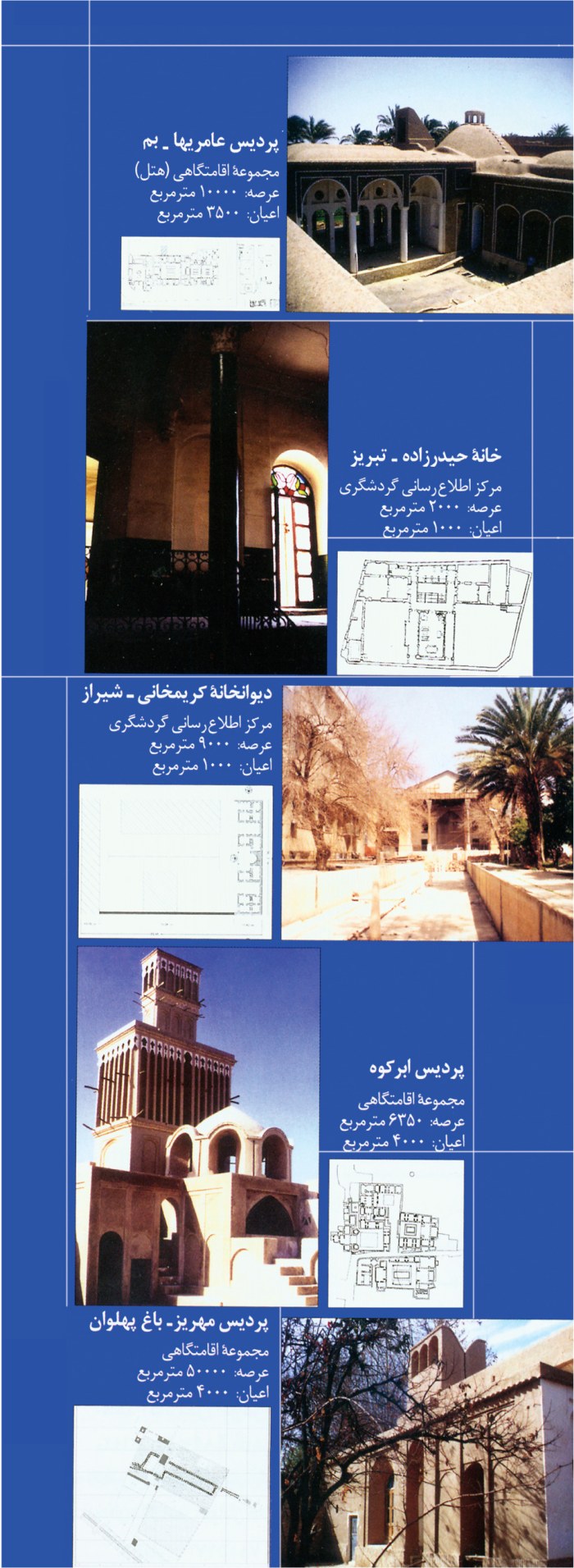
The award ceremony for the winners of the Interior Design Competition for Restored and Rehabilitated Historical Buildings was held on Tuesday, 11 Azar 1382 (December 2003), in the amphitheatre hall of the Cultural Heritage Organization. The ceremony, opened by a speech from Eng. Beheshti, head of the Cultural Heritage Organization, included a film showing five buildings under restoration that were selected for the competition, and the seven designs that advanced to the second round of the competition were also displayed.
Speech by Eng. Beheshti
Conservation of historical works is one of the matters we deal with in Cultural Heritage. When historical works are spoken of, attention — especially that of architects — turns chiefly to immovable works, and in particular to historical buildings. According to the Cultural Heritage Organization's estimate, there are more than one million historical buildings in the country — which is, of course, not a strange figure. These very works are not even identified, documented, or recorded. By "historical works" I do not mean historical sites, of which there are about 10,000; rather, I have in mind, more, the historical buildings. A small number of these works — at most a thousand — like certain mosques registered on the national and world heritage lists, are well known.
Nine thousand other buildings must be preserved, and their conservation is possible only through rehabilitation. By rehabilitation I mean that a current of new life appears in them and that they become suitable for new living and for answering the needs of life, in such a way that the values of these historical works are preserved within them. International experience has also proven this. Over the long years that we have worked on the restoration of historical buildings, owing to the hierarchy involved in restoration-related activities, we have not been able to go beyond one level.
The first stage in the restoration of historical buildings is urgent and necessary measures, or what is technically called emergency restoration or the removal of risk. For example, if the arch of a work is breaking, we place a wooden brace under it or put a buttress behind its wall. These are of course for a short time, and after that the condition of the work must be seriously attended to. The second stage is consolidation of the building — strengthening it in its present condition and halting its process of destruction. The next stage is that, with the studies conducted, the building is given a form drawn from its history, such that, while approximating its original state, it is clear that reconstruction work has been carried out on it. The next stage is rehabilitation: at this stage, conditions must be created such that the current of new life is realised, its needs are answered, and at the same time the values of that historical work are also reached.
But in the stage of rehabilitation we have not entered much. For this reason we may say that our country is poor in knowledge, experience and expertise concerning rehabilitation. Historical buildings — and today's uses — have great variety. Finding the appropriate use for the building, and the quality with which one can establish this appropriateness, is very complex work — even more complex than designing a new building, because one must solve a puzzle whose different dimensions present pre-existing constraints that tightly bind one's hands and feet. At the same time, the subject of rehabilitation is not like the construction of a new building, which is subject to specific charters and regulations giving you wide freedom of action within a framework of a few standard codes. This stage has very stringent charters — designed and arranged not for vexation or playfulness, but on the basis of long international experience.
If you make a mistake in constructing a new building, you ultimately cause financial loss to the employer. But if a mistake is made in a historical work, the loss is not merely financial — for one loses an authentic document, and all future generations will suffer the loss. For these reasons the rules of this matter are very strict.
In a country where 999,000 historical buildings await rehabilitation, there are naturally also problems on the way. One of these is knowledge, experience and expertise in rehabilitation. We also face this obstacle: when a decision is made to restore, we do not have the masters and persons capable of restoring these works. In many cases there is also the conception that restoring these works is uneconomical and very costly — while the economic value is not high. In many instances there is also the conception that the Cultural Heritage Organization is a very, very orthodox organisation and does not accept many creativities and innovations. Sometimes it is also thought that there is no practical possibility for use and new life to flow in all of these buildings. But international experience shows the opposite of these conceptions. The English easily live in 200-year-old houses. When you visit cities that possess historical fabric, you see that the current of new life — through urban restoration and the rehabilitation of historical buildings — answers today's needs in the best quality.
One of the most economic activities is investment in the rehabilitation of historical buildings. With these mental obstacles ahead of us, and with the limited resources placed at the disposal of the Cultural Heritage Organization, we have tried to remove these obstacles from the path. When the Cultural Heritage Organization had the opportunity to seriously approach tourism management in the country, it was ready to invest in this field; we too, in this situation, used a programme entitled "Plan for the Restoration and Rehabilitation of Historical Buildings."
For details of how the winners were selected by the jury, see Memar 22.



