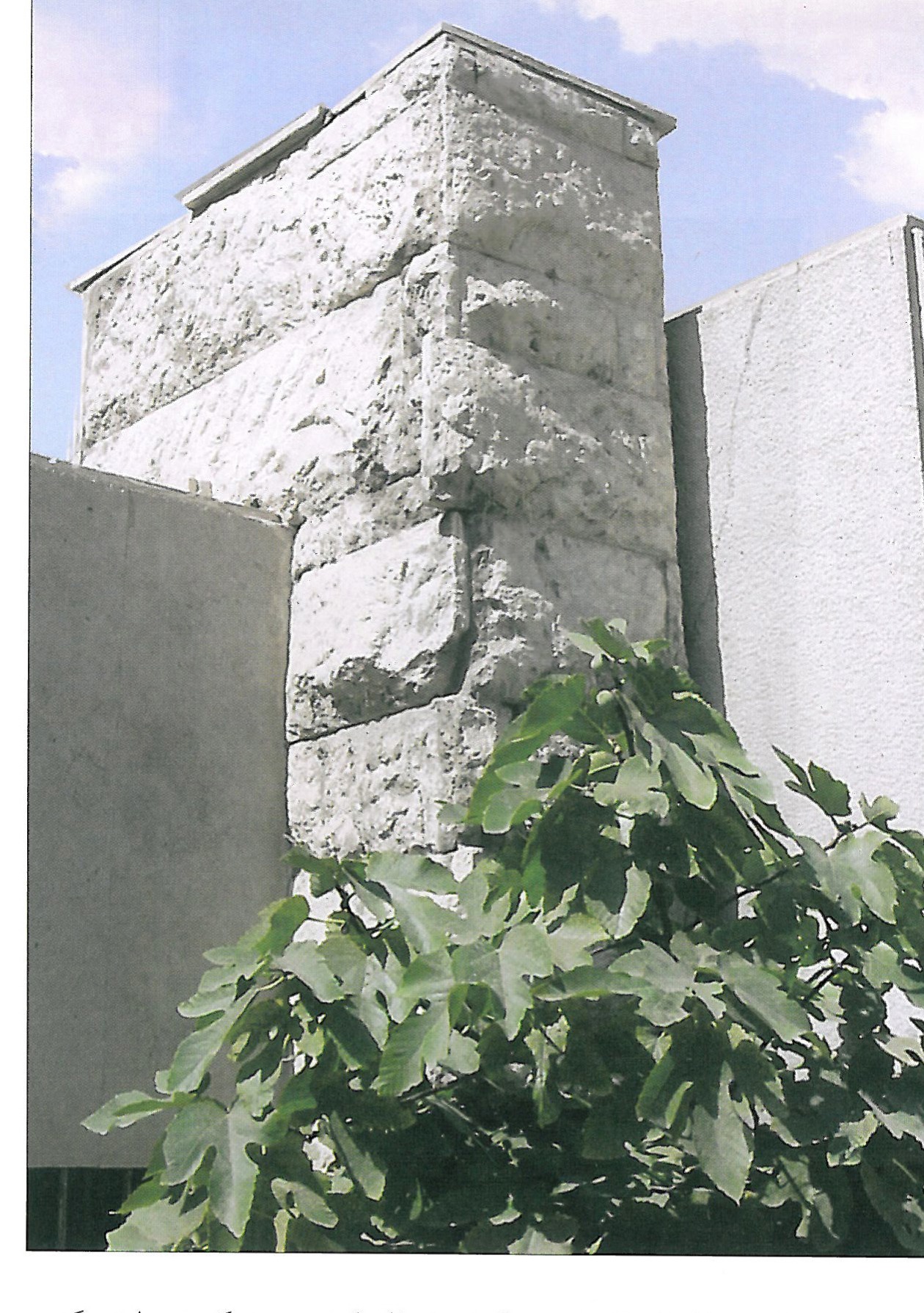
Photographs by Habibeh Majdabadi.
Foreword
Stone is a natural sign of rigidity, firmness, and impenetrability, and that's what makes it so beautiful. For creating a masterpiece out of stone, it's enough to let it expose its natural beauties. Stone doesn't have a very vivid or important presence in Iran's ancient architecture, though, today, due to the great number of various stone mines in Iran, the application of traditional materials in great buildings doesn't seem so rational anymore. Unfortunately, the ever-increasing use of this beautiful material, and the improper methods of manufacturing — from the time of extraction, to the moment of installation in buildings — have brought the use of stone in Iran to a critical point. Regarding this matter, Me'mar has held an interview with three experts of stone-building construction and design.
Stone, naturally, is a sign of hardness, impenetrability and firmness, and these qualities are what make it beautiful. In the design and building of stone works, it is enough only to keep and bring forward the natural beauty of the stone in order to produce a masterpiece. The use of stone in past Iranian architecture is faint and pale; for this reason our references and patterns in using this material are very few. Given the abundance of stones in Iran's quarries, and the need to face the large façades of today's buildings, the use of traditional materials for big buildings no longer seems rational, and the use of materials with larger surfaces is required.
Unfortunately, in our architecture today, the unrestrained and unprofessional use of this beautiful element — and the lack of principle in the production and use methods, from the moment of extraction in the quarry to the moment of installation in the building — has brought a crisis in the use of stone in Iran. Our small experience in this field; the absence of written-down methods of production and execution; the lack of necessary standards; and the disappearance of the older master craftsmen, have all fed our ignorance.
Traditional, non-industrial methods no longer answer today's needs, and the result has been the production of baasaaz-o-beforush (developer-built) stone façades. In today's Tehran, the value of stone has fallen to that of a display material to draw the customer, while its principal qualities — strength, beauty, durability — are called into question. After the announcement of the results of the Italian competition for the best works built in stone, and Kamran Afshar Naderi's trip to take part in the prize-giving and to visit the stone factories, Memar magazine has held a conversation with Engineer Sharifi, Engineer Tajeddin, and Mr Ghaffar Davarpanah — who have all had successful experience in the design and execution of stone buildings — which follows.
Conversation with Engineer Sharifi
Q: Engineer Sharifi, you have used stone in most of your work; what was the reason for this choice?
A: Our motivation for starting stone work and undertaking it in Tehran was Engineer Sayhoun. After the building of the Khayyam and Avicenna mausoleums and the other works our great master Sayhoun did, all of us, his pupils, believed that stone is the principal material of architecture. He had taught us that, if you build in brick, build wholly in brick; if it is concrete, let it be wholly concrete; these composite façades that they paste up and lay sheets on and so on were against his belief.
We were of the school of Sayhoun and started stone work because of Sayhoun. He made us interested. The starting point was the establishment of the Fapka stone factory in this country. A craftsman by the name of Ghaffar Davarpanah was working there, and he became a stone specialist at Fapka. Fapka itself was the country's first stone factory, and taught us the family of stone. We came to know Ghaffar Davarpanah through Engineer Sayhoun. Davarpanah's father had been an excellent stonemason in Tehran, a specialist in laying migouni stone (the black stone laid irregularly and used on building façades and fireplaces). At that time Ghaffar Davarpanah had set up the Khara stone factory and we used to take our stones from him. After that, he set up the granite stone factory; he was the first man in Iran to cut granite, and had a milling machine specifically for it.
An example is my old office on Kakh Street. In Sayhoun's and Davarpanah's memory, we worked the floor and entrance in granite and built the rest with pre-cast panels. In recent works too, Davarpanah is still kind to us — it is he who gives us clean, well-set stone; whenever we go to a stoneworker and meet a problem, Davarpanah comes to our help again. The stone work of the Amiri building in Niavaran was also done by Davarpanah; I went to the site twice a week, but he was there every day, looking at the stones and loving them. The good stone work we have done has been with him. I owe him a debt, and he has put us all — me and all the architects — in his obligation. The Iran Trade Centre, designed by Engineer Marjan, was also built by Fapka. Engineer Manouchehr Marjan has very fine stone works and has worked extensively on construction details. We jointly designed a house with him, which was built by Davarpanah; this house was wholly of stone, with massive travertine pieces of about 20 × 60 × 45 cm laid in the alley wall.
The place of stone in Iran today
Q: Tell us, in principle, what place stone has had in Iran, and what its situation is today?
A: From my point of view, having done stone work, if stone is used rightly and in the right place, it is a very fine material. But in Iran's present situation — where stone is cheap and we have every kind — the way it is used today is truly a waste, and I personally am wholly against it. Today, in no part of the world is stone used in this way. In Italy, on account of plentiful capital, a great granite piece 20 cm thick and 4 m long may be set at the entrance of a bank, while in Italy that same stone would be used in a memorial.
I personally am not fond of the stone work being done in Iran today, especially for residential architecture. In residential work our traditional materials have their own place, and stone cannot replace them. In summer, when you pass a brick house, its wall has no heat; but stone is hot. Today I have seen building façades made of iron, from which steam rises in the 40-degree heat of summer. By and large, brick is a more beautiful and more reasonable material for a residential building. Of course, if someone has the means and uses stone inside the building and in the floors, that is fine.
In Italy, even though stone is plentiful, it has kept its value and is used only in particular buildings, with floors finished in granite. But in Iran the developer-builders, at the very start, do the alley wall in granite! In my view, by doing so they bring down the value of stone in Iran.
Stone in Aleppo and elsewhere
Yet in many countries — for instance in Syria — stone is almost the principal material. The five-million-strong city of Aleppo is a beautiful historic city built wholly of stone; whether in old works of architecture or in today's, stone there is a material that is used very easily and is in everyone's reach. Their architecture, by and large, is a stone architecture. But in Iran there is no stone architecture; certain government buildings and certain particular structures have been built in stone. At the present time, when, as you say, stone is much used inside and on façades, its place is still not very clear, and how it should be used is not settled.
The trouble here is the question of price. The developer compares the price of ceramic and travertine, and concludes that the buyer prefers stone, and so builds in travertine. So stone is only an expensive material for displaying the building, and it seems that the skill of stonework, too, is no longer here in Iran.
The decline of skilled craftsmen
A: Unfortunately so; this is our trouble at present. The number of good masters and skilled stoneworkers grows fewer every day. We are forced to turn to mediocre stoneworkers, who too do bad work. One of the best fitters I knew was Mr Abbas Shaqaqi; he gave up the work because the margin was small. His work was unique, but at present he no longer works, and there is no one who can do it as he did. At present the developer-builders do stone work and it sells anyway; even granite with a wave on its surface is bought; the old care and the small attentions are gone. Although the number of stone works grows, their quality falls. In my view the story of stone is fading.
Pre-cast panels for high-rise buildings
Q: Now that high-rise buildings with large façade surfaces are coming into vogue, stone seems a fitting material for the façade. What is your view?
A: The customary execution of stone on tall buildings is not feasible, and is not advisable; certain measures must be taken. In Singapore there is a factory that imports granite panels from Italy — or any other stone you, as architect, choose; for example the red travertine of Azarshahr — and sets the stones into pre-cast panels, which are then installed on tall buildings. The façades of most stone-clad tall buildings in Singapore are produced this way, and are clad from top to bottom with crack-free stone. Using these panels, the troubles of installing stone by the customary method are removed. This method is highly applicable for high-rise buildings, and we are testing it in Tehran at the moment.
Pahlavi-era stone work
The stone works of the first Pahlavi era are good buildings with good stones. Davarpanah holds that the best stone of Iran is travertine, and a good example of work in travertine is the Iran National Bank (Bank-e Melli), which is still considered one of the cleanest white-stone buildings of Tehran. The Ministry of Justice, built by the Germans, also has fine stones; or the Ministry of Foreign Affairs, a brick building, which has much stone work in its interior and grounds.
On the Avicenna Mausoleum (Hamadan) — Sayhoun's work — when we asked, they said that the head of the stone work there had been a Czech master craftsman. The Iranians had been mostly stone-cutters; that is, we did not have masters who could do stone work at that level. Even the stones of Nader Shah's tomb are not as beautiful as those of the Avicenna Mausoleum. By and large, the Avicenna project is finer than the Nader project; Engineer Sayhoun himself counts this work among his best.
Conversation with Engineer Tajeddin
Q: Engineer Tajeddin, you have used stone in the design of the central building of the Office of the Presidency and other big projects. What role does stone play in your designs?
A: In the design of governmental buildings and national monuments, stone is a material that conveys, at the same time, historical continuity, strength, and dignity. But the use of stone calls for a careful study of its behaviour against climate, earthquake conditions, and the process of execution. Unfortunately, in many of the present projects, the choice of stone is made without regard to these factors, and the result is façades which, years later, suffer damage or whose natural face is spoilt.
Conversation with Ghaffar Davarpanah — master stone-worker
A: In my view the best stone of Iran is travertine; a stone that responds well in interior space as well as on façades, and whose colour and texture grow better over the years. Our workshop in Tehran — out of which Fapka, and then the Khara and granite factories, grew — was the first place where granite-cutting took root in Iran. In those years, working with Engineer Sayhoun and the architects of his school — Engineer Sharifi, Engineer Marjan, Engineer Tajeddin — we attained a generation of stone works whose accuracy of execution and surface finish stand comparison with the central building of the Office of the Presidency, the Iran Trade Centre, the Amiri building in Niavaran, and the Avicenna Mausoleum. Unfortunately, today's young stone-workers do not have the chance of specialised training, and this skill is being lost.
Closing questions
Q: What course of action do you recommend, at present, for restoring the true place of stone in Iranian architecture?
A: First, the standardisation of the methods of extraction, cutting, transport, and installation of stone, and the codification of these methods in technical instructions. Second, the revival of the professional training of fitters and stone-cutters through technical schools and free courses. Third, encouraging architects to design for building in stone, not to paste stone on a building designed for another material. Fourth, the establishment of specialised centres that present engineering services together with materials to architects' offices — as the Campolonghi company does in Italy. Only in this way can the stone of Iran, which in quality is among the world's best, be restored to its fitting place in today's architecture.
Memar magazine is grateful to the three experts for taking part in this conversation.



