An introduction to the design
South Africa is a country with particular conditions and a history all of struggle and epic. It is a country of varied peoples, races, colours, and religions — a country in which there have always been boundaries not only between whites and blacks, between mixed-race and Asian populations, but between the various tribes of the black population themselves. This very fact has, over the past century, given rise to a complex situation and to many political, economic, and cultural difficulties. Since the middle of the past decade, with the abolition of racial discrimination and the freeing of South Africa from the rule that was based upon it, much effort has been spent on establishing social justice and equality there.
Yet in spite of the contradictions and the variety of cultures, the achievements of contemporary Western architecture and construction are clearly to be seen in this country, and building technology has reached a notable level of advance. The marked tendency that one sees in this field — opposite to what we see in Iran — is a particular attention to climatic conditions; in this regard, very large and successful efforts have been made for the closest possible adaptation of architecture to climate, for the introduction of fresh ideas in this connection, and for the use of various materials and elements both inside and on the outside of the building, in order to achieve the best environmental conditions.
The starting point in the design of the Iranian representation building in South Africa was likewise this same tendency (the building's adaptability to climatic and environmental conditions) — which can be regarded as the common ground of contemporary architectural tendencies, irrespective of geographical and cultural boundaries. The aim was that, in the course of design, by drawing on this tendency, fresh spaces bearing the conceptual values of historic Iranian architecture should be created — for one of the basic and salient features of that tradition has always been adaptation to climatic and environmental conditions. In this process, the advances of South African building industry were also fully taken into account.
1. Site and the early options
The embassy site has approximate dimensions of 48 × 68 metres. Pretoria's urban code requires a setback around it. If we suppose that all the spaces required by the embassy are placed within a single building, three options A-1 to A-3 may be presented.
In option A-1, a major part of the site is given over to the parking of cars; the landscaped area is greatly reduced, and the view of the building from the entrance and within the site is blocked by the cars. Visitors to the consular section have to cross the whole site to reach the building — undesirable from a security point of view.
In option A-2, the parking is moved to the basement. The view to the building from the entrance is opened, and a wider area becomes available for landscaping; but the practical possibility of green-spacing this part of the site is very limited.
In option A-3, the building's view is not blocked by the parking, and consular visitors' access to the building is closer; yet the site enjoys only a limited subdivision. In options B-1 to B-5, in order to observe security considerations and to facilitate visitors' access, the consular section is placed in the north and the other sections of the embassy in the south.
2. The chosen option B-4: the central courtyard
In options B-4 and B-5, the consular building is placed in the north of the site, providing fitting access for visitors, and the parking is moved to the west. In option B-4 the parking is moved to the basement, releasing fitting open space across the whole site. In this state, more spatial release is achieved across the site, and the route of the cars is wholly separated from the principal green area of the building.
This pattern approaches the Iranian central-courtyard pattern. The central courtyard is one of the principal features of Iranian architecture. In many examples of Iranian architecture, the central courtyard has been transformed into two adjacent courtyards — or into two courtyards in continuation of one another, separated by a covered colonnade. In this pattern, while each of the courtyards retains its own quality, they are in direct relation with one another, and a greater spatial expanse is opened.
3. The effect of climate on the building's form
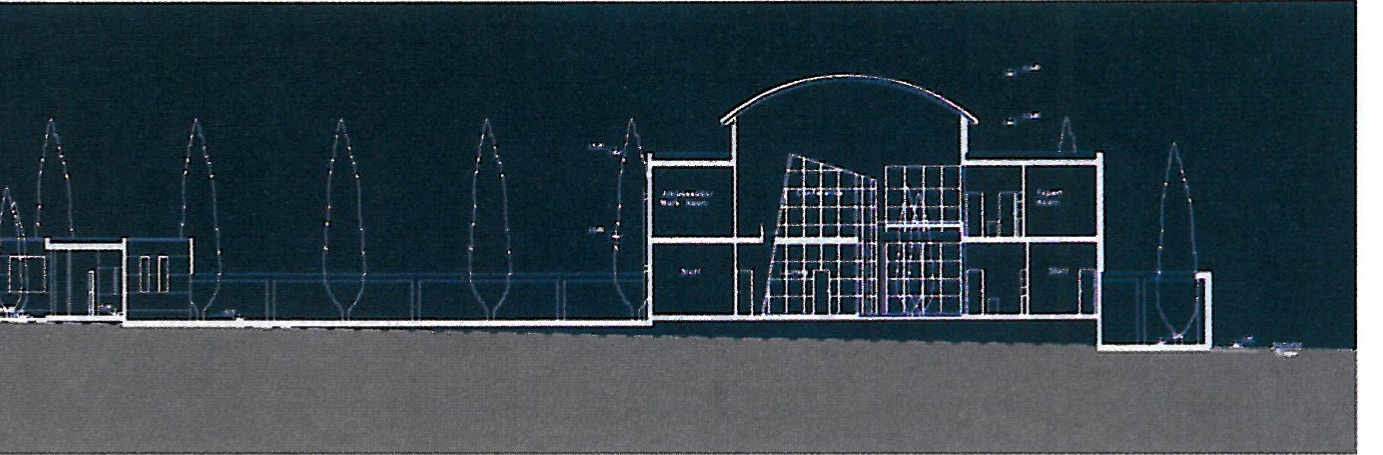
Bearing in mind three principal aims — the possibility of natural ventilation in the interior; the control of solar gain in warm seasons and the admission of sun in cool seasons; and the use of light building materials — and given the favourability of the north and south fronts for daylighting and the unsuitability of the east and west, if the building were taken as an east-west elongated rectangular volume, it would enjoy better lighting conditions.
The building's elongation also draws the favourable wind more deeply into the interior. Functionally, the elongation makes for better divisions of the interior space. If we suppose this elongated rectangle has a central corridor and two strips of work-spaces, then the use of an empty space — which can be a covered central courtyard — gives effective help in achieving better conditions of ventilation, light, spatial release, and a sense of privacy among the various working departments.
On the other side, the pattern of the covered central courtyard is the marker of those Iranian spaces in which the building is given a transparent central core, and the calm and pleasant interior of that core is a manifestation of the building's spirit.
4. Spatial organisation
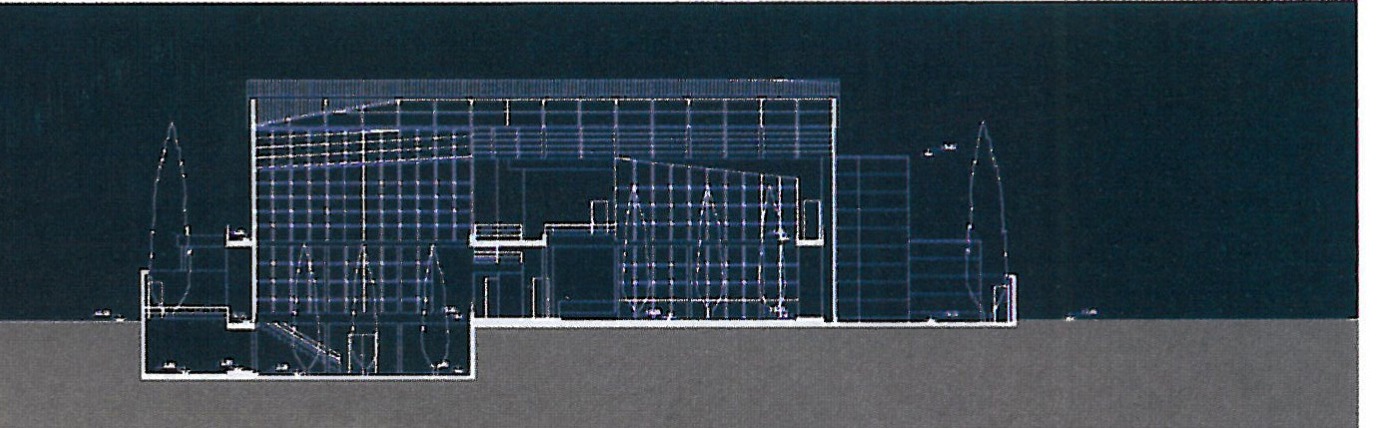
The pedestrian entrance into the main building, where the principal entrance hall opens between two parts of the covered courtyard, divides the building into two unequal portions. In the eastern part, where the major part of the main building stands and where it is in contact with the open ground of the site, the office and interior spaces are placed. In the western part — the shorter portion, set against the vehicular access — the embassy's service spaces are placed. The meeting of vehicular and pedestrian routes beside the principal entrance hall provides for a separate access for ceremonies and for VIP visits.
On the ground floor, in the eastern portion of the building, are placed those parts of the embassy that have a greater outward connection, set within two semi-controlled areas (level 2). These two are the cultural and the administrative wings; through a corridor adjacent to a central courtyard — which mirrors a shadow of the early elongated rectangle — they form their secondary connections. The library, a more public element and a particular space, is placed beside the covered central courtyard; while moderating the direct sight-lines of the secondary corridors, it is, in physical terms, affected by the transparency of the building's central core, and itself becomes a part of the transparent middle space.
5. The character of the principal pedestrian axis
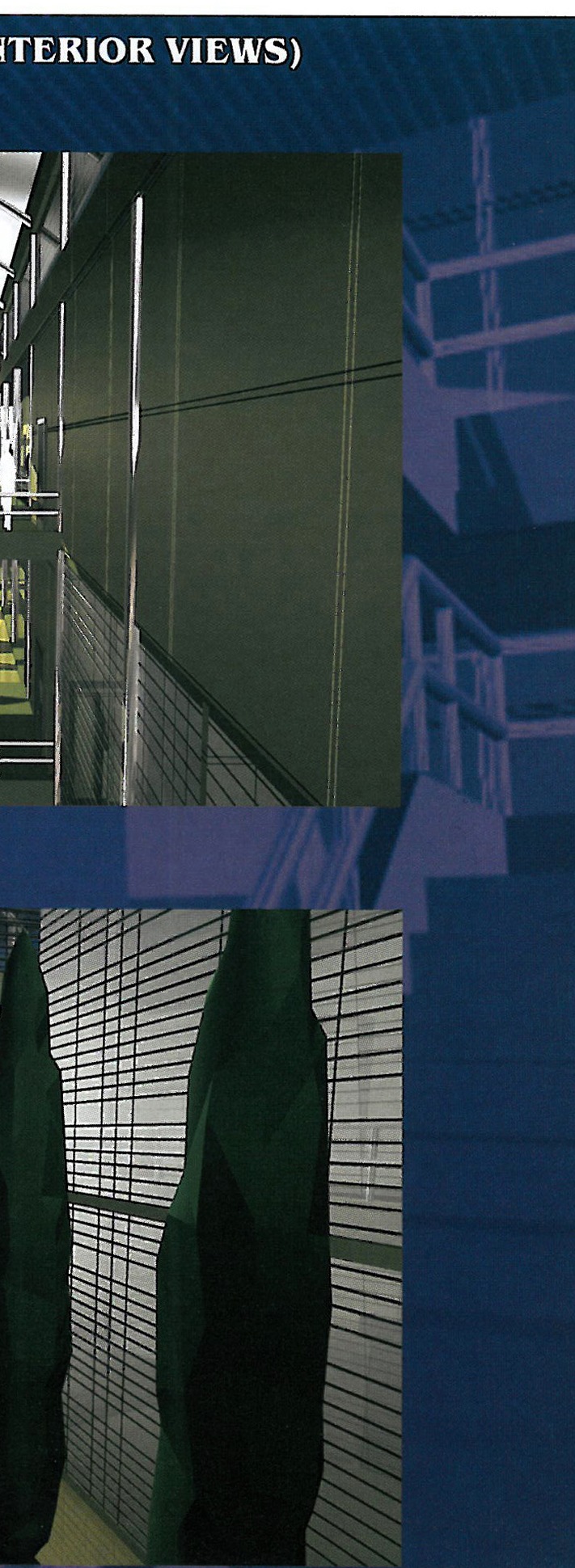
The principal pedestrian axis, which forms a direct, guided, controllable route from the gate of the site to the main building, is continued within the building and gives rise to the main entrance hall. All vertical circulation is placed beside this axis, easing the guidance of visitors and increasing the means of control.
The principal pedestrian axis, which forms the spine of the embassy building, is set immediately beside the central courtyard and the covered middle courtyard, lending it many qualities and varieties for visitors and for staff. Along this axis, panels offer the possibility of presenting images representative of Iranian culture. This main artery — which on one side, by linking the central courtyards and the transparent core of the embassy, is in some sense a marker of Iranian architecture's qualities — itself becomes, on the other side, a means of presenting Iranian culture as a covered exhibition.
Project credits
Client: Ministry of Foreign Affairs, Department of Construction and Logistics. Managing director: Eng. Nikkar-Esfahani. His Excellency, the ambassador of the Islamic Republic of Iran in South Africa: Javid Ghorban-oghli. Consultant: Mehrazan Consulting Architects & Planners. Design: Behrouz Pakdaman. Senior architect: Nima Mouhebati. Design team: Rashin Nafissi; Farhad Farimanpoor. 3D images: Arash Afshar Ahmadi. Model: Ali Azadi. Space-programming: Mitra Zandi. Structure: Rassoul Mirghaderi. Mechanical & electrical: Mohammad Kheiri. Reports: Roxana Sarkari.



