From its very first issue Memar has aimed — as a complement to its discussion of architecture — to cover urban design, industrial design, interior design and furniture as well. Quite apart from the fact that many of the great contemporary architects — Behrens, Rietveld, Le Corbusier, Aalto, Portoghesi, Aldo Rossi, Gehry, Piano, Foster, Starck, Sottsass… — have worked in painting, sculpture, industrial design and stage design alongside architecture, anyone who studies the history of architecture from the second half of the nineteenth century onwards sees at once that the trajectory of architecture cannot be understood without attending to the parallel history of the other arts. As Alvar Aalto said: “It is deeply meaningful that all the arts today — architecture included — have a single root.” One of the first modern historians of architecture to grasp this was Sigfried Giedion; his Space, Time and Architecture discusses the influence of the other arts on modern architecture. We shall therefore try, from this issue on, to set aside a portion of the magazine's pages for the other arts wherever we can.
The subject of this issue is a preliminary reflection on the link between architecture and stage design, and an account of the stage design for the production of Federico García Lorca's Blood Wedding, directed by Ali Rafii.
In a conversation with the director, he set out his ideas, his aims, the technical questions and the ways in which he arrived at the stage design discussed here, and also made a number of remarks about the evolution of acting and of stage design; these are woven into the piece that follows.
Architecture and the Stage
Architecture, in its usual sense, is the making of a space for human life and activity; it would seem to have little to do with the temporary constructions of the ephemeral arts (theatre, cinema, etc.). In the theatre not only is ordinary, everyday life — the chief material of architecture — absent; the best kind of theatre deliberately tries to keep the spectator, at every moment, from believing that the scene on stage is real. That is a modern achievement that, in Rafii's view, comes out of Eastern theatre, medieval performance and the Commedia dell'arte of the sixteenth century. At any rate, there are at least three important connections between stage design and architecture that matter to us: 1. Acting is bound up with life and its rituals, and so with architecture — the space of life. Everyone has in some way experienced playing a role. The theorists of theatre locate the first experience of acting in children's play, in which each child takes on a defined and partly pre‑set role. Rituals are another kind of acting, in which people are at once players and spectators. Architecture has always paid attention to the ritual aspect of social life and to life in public space; for that reason many critics and historians have described the Baroque piazzas and Isfahan's Naqsh‑e Jahan Square as “scenographic.” A contemporary, tangible example of attention to social functions as rituals, through elements brought together by actions such as entering, moving and gathering, is Hadi Mirmiran's project for the Iranian Academies — which, sadly, was not built, despite winning first prize in the relevant competition. 2. Modern theatre is closely related in its development to the other arts, architecture included. The leap by which architectural design moved away from eclecticism — architecture as the assembly of pre‑existing elements and rules — towards a free style whose main aim was the expressive possibilities of the abstract elements of space, surface and volume, corresponds to theatre's shift from an imitation of reality and a descriptive acting towards an expressive acting. Stage design, too, was once a reconstruction of actual landscapes and spaces, as close to reality as possible. Adolphe Appia, the Swiss scenographer, at the beginning of the last century formulated a notion of stage design very close to Le Corbusier's “free plan” and poetic space. Like Le Corbusier he rejected the reproduction of reality and the use of pre‑existing spatial conventions in stage design; like Le Corbusier he held that architecture could not go on using classical, pre‑determined elements. Appia opposed painted backdrops that depicted real spaces through perspective; he said that these surfaces, unlike real space, do not respond to light (because they are two‑dimensional). A decade later Le Corbusier, in place of the traditional two‑dimensional façade, set out the notion of a four‑dimensional (space‑time) design using the properties of light. As Sottsass put it, “the difference between the different disciplines is only in the technology.” 3. In many cases stage designers have been architects, and famous architects have also designed for the theatre. One example I recall is the Moby Dick directed by and starring Vittorio Gassman, with stage design by Renzo Piano, in which the spectators were placed in a space inspired by the old ships, and the play was performed within the same environment. Leaving broader points aside, the concerns of stage design are very close to those of architecture. The move from stage design as “decor” to stage design as “space” has given the art a common root with architecture: the making of space. The concept of space — always difficult to grasp in architecture, and often confused with volume — can, I believe, be visualised more effectively in stage design. The difficulty in architecture is that design moves from the abstract towards the real, so that in the built work — the objective space — it is hard to distinguish volume from space. In stage design, whose final product is a kind of abstraction or stylisation of reality, space is directly visible. Dario Fo, the Nobel‑laureate Italian playwright and actor, insists in his teaching on acting that performance should not be descriptive but expressive. He says that in order to play a lion one cannot walk on all fours: the good actor is the one who, with the minimum of gesture and a reading of a few of the lion's key attitudes, evokes the state required. Stage design has followed the same expressive direction. Ali Rafii quotes Appia: “In the naturalistic scenery, the stage designer reproduced the landscape of the forest as faithfully as possible and then placed people inside it. Today we place the actors on stage in a way that evokes the space of a forest without any actual forest being present. In the new stage design the space of the stage is born from the mechanism of movement and the mode of acting on stage.” If we return to the notion of space in architecture, we see that space — unlike volume — is not an absolute, and is directly shaped by the factors of visual perception. Antonin Artaud said: “Yesterday the theatre was for listening; today the theatre is an art of the eye, and from now on it must engage every sense.” In modern theatre, just as lighting, sound and acting are decisive in producing space — and in many cases the masses and forms do not change, the scene being transformed only by light and performance — so in architecture the actors are the people themselves; the mechanism of movement through the building, the discovery of space, the way it is lit and other non‑volumetric factors play a vital part in producing space. Stage design today, as it clearly appears in Ali Rafii's work, is, in a particular and pure sense, design for the making of space, and in this respect today's architecture stands very close to stage design.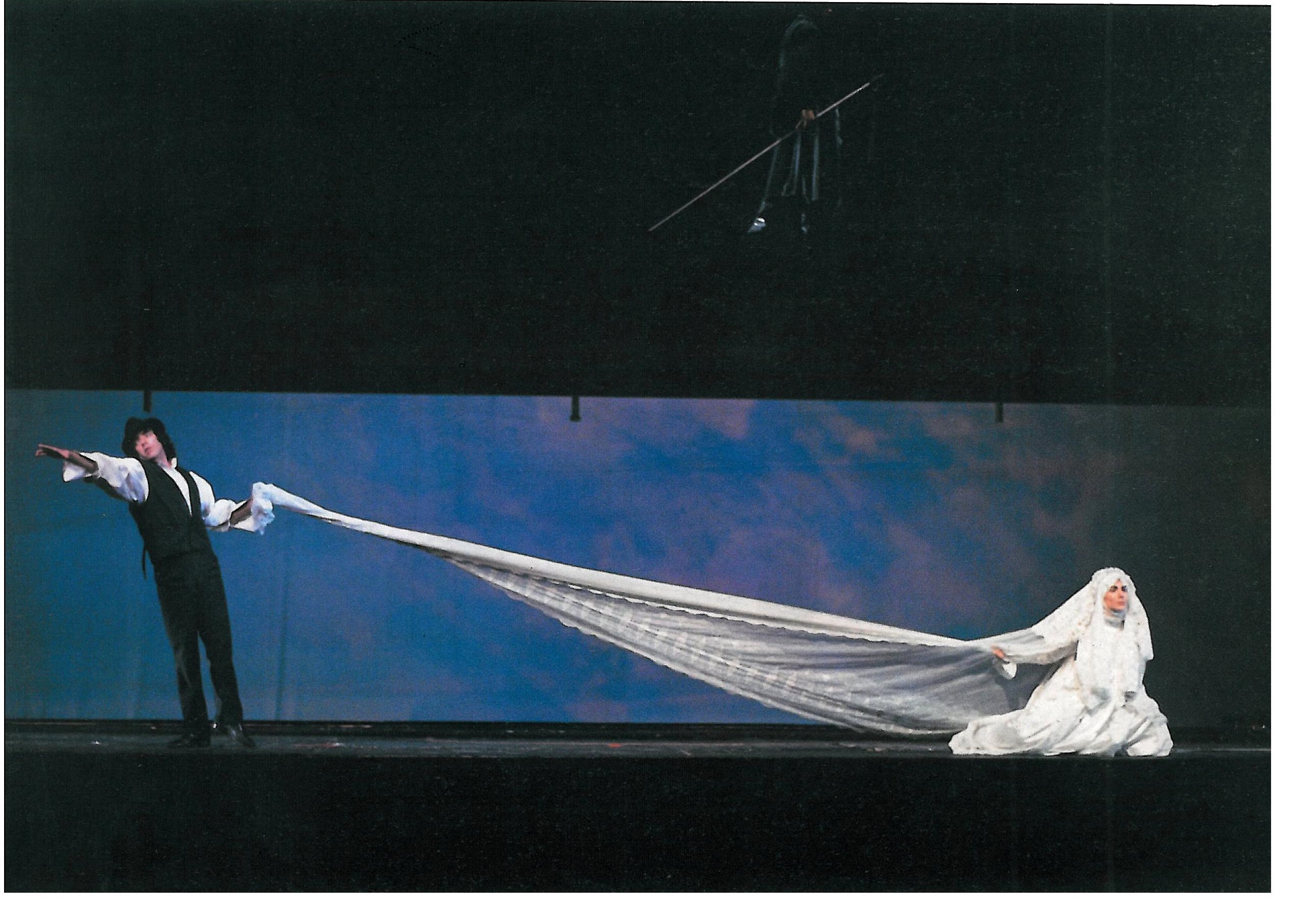
'Blood Wedding', directed by Ali Rafiei
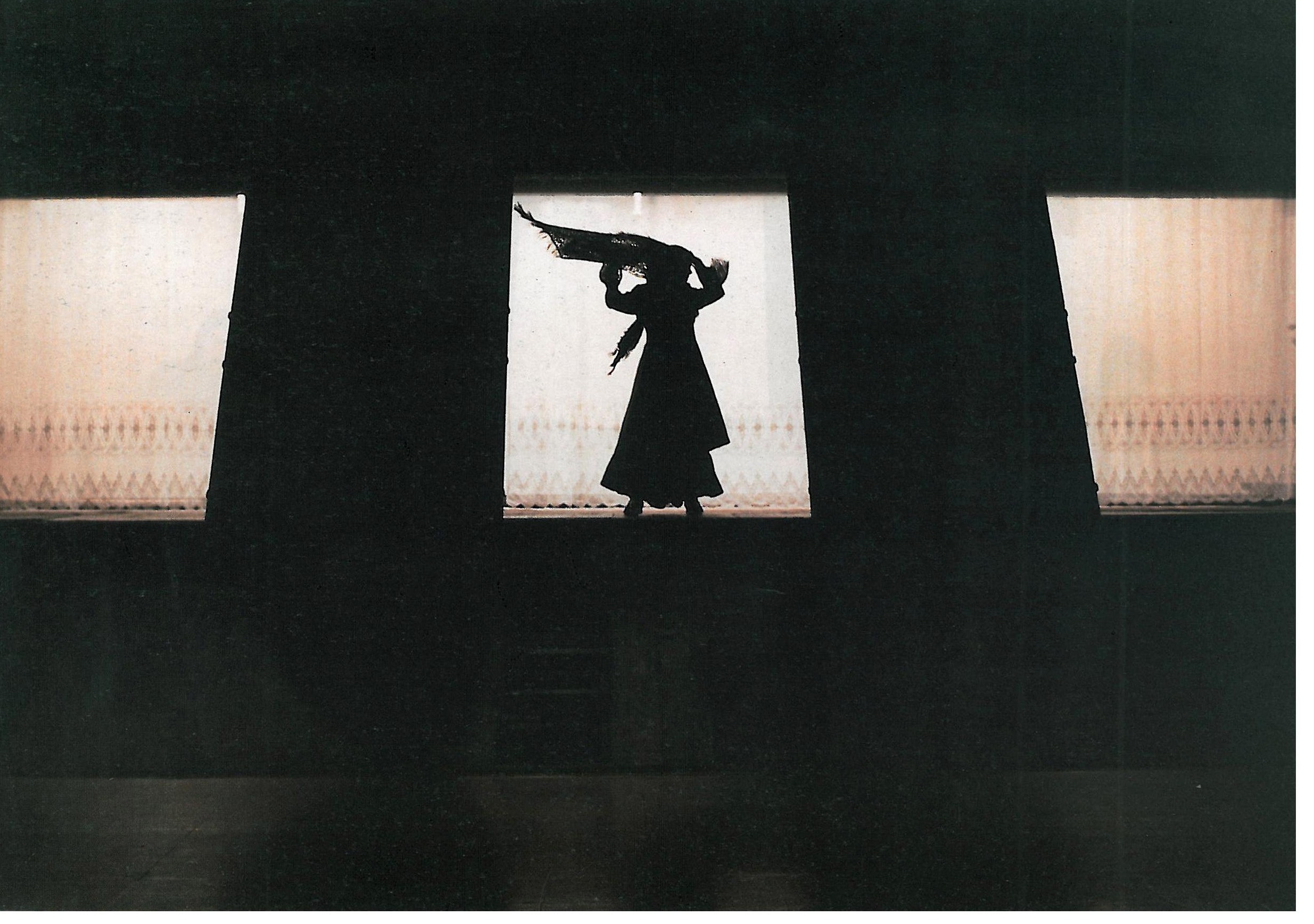
'Blood Wedding', directed by Ali Rafiei
Blood Wedding
To grasp the quality of the stage design for Blood Wedding, no special knowledge of the designer's working method is needed; it is enough to note that this set was made for about 400,000 tomans — less than the cost of a professional architectural model. Art can flourish even under economic constraint, if the creative force is there. The stage — rich and expressive as it is — is in fact no more than a single inclined surface with three window‑shaped openings in it. Behind this inclined surface, which becomes by turns the face of a building, a mountain, or the outside world, there is a platform: whatever stands beyond or behind this curved, sloping surface is thereby turned into a kind of Iranian shahneshin or a house whose windows open outwards. The platform is in fact a movable piece of stage equipment that was already there, and the designer has used it in the scenography. An inclined surface and a few chairs, with the help of the actors' play, produce several different spaces out of this minimal scenography. For Ali Rafii direction and stage design are inseparable: “From the very first moments of work I am thinking about the stage. It is impossible for me to imagine the acting without having already seen the space of the stage in my mind. The stage design is therefore in a direct relation with the performance and with the means the actors will need. Just as the stage's space is flexible and can evoke different spaces, the acting too enjoys a relative freedom.” He adds: “My aim is to raise acting from an instrumental level to a creative level; the ultimate aim is the education of the actor.” In Ali Rafii's theatre the actors are not chess pieces performing set moves; through hard, exhausting work with the director, they acquire a sense of the space that is bound up with the play — a sense that allows them to recognise their position at any moment of the performance, without jarring between one mise‑en‑scène and the next, and if the moment requires, to shift their place on stage together. Every performance therefore has the freshness and the appeal of the first. The physical movement of the actors has a real effect on the stage design. In Blood Wedding every part of the stage is designed for a specific movement; the inclined surface that forms the main elevation is there so that the actors can climb it and run down from it with great speed. Rafii says the model for the design was taken from skate‑slopes. He attributes the need for speed and sudden movement to the “erotic, bloody atmosphere” that pervades Lorca's work, saying that only rapid, tense, sudden movement can evoke it. Another question is the need for vertical composition in the stage, to build a more effective relationship with the audience. Rafii's stage has three levels — the floor of the stage, an inner space or platform about one metre high, and the roof of the stage. At different moments of the play each of these three levels becomes a different space and a specific place: the bride's house, the groom's house, the house of her former fiancé, the wedding feast, the public square, outside the town, the forest. Although the levels are always distinct, the skill of the actors ties them together, and the spectator does not experience them as separate, sealed-off compartments. 1. The author has published a critique of the Academies project that unfortunately appeared in incomplete and heavily corrupted form: “A critique of the theoretical foundations of the Iranian Academies project,” Memari va Shahrsazi, vol. 5, nos. 28-29, 1995. 2. Adolphe Appia. 3. Ettore Sottsass. 4. Dario Fo. 5. Antonin Artaud.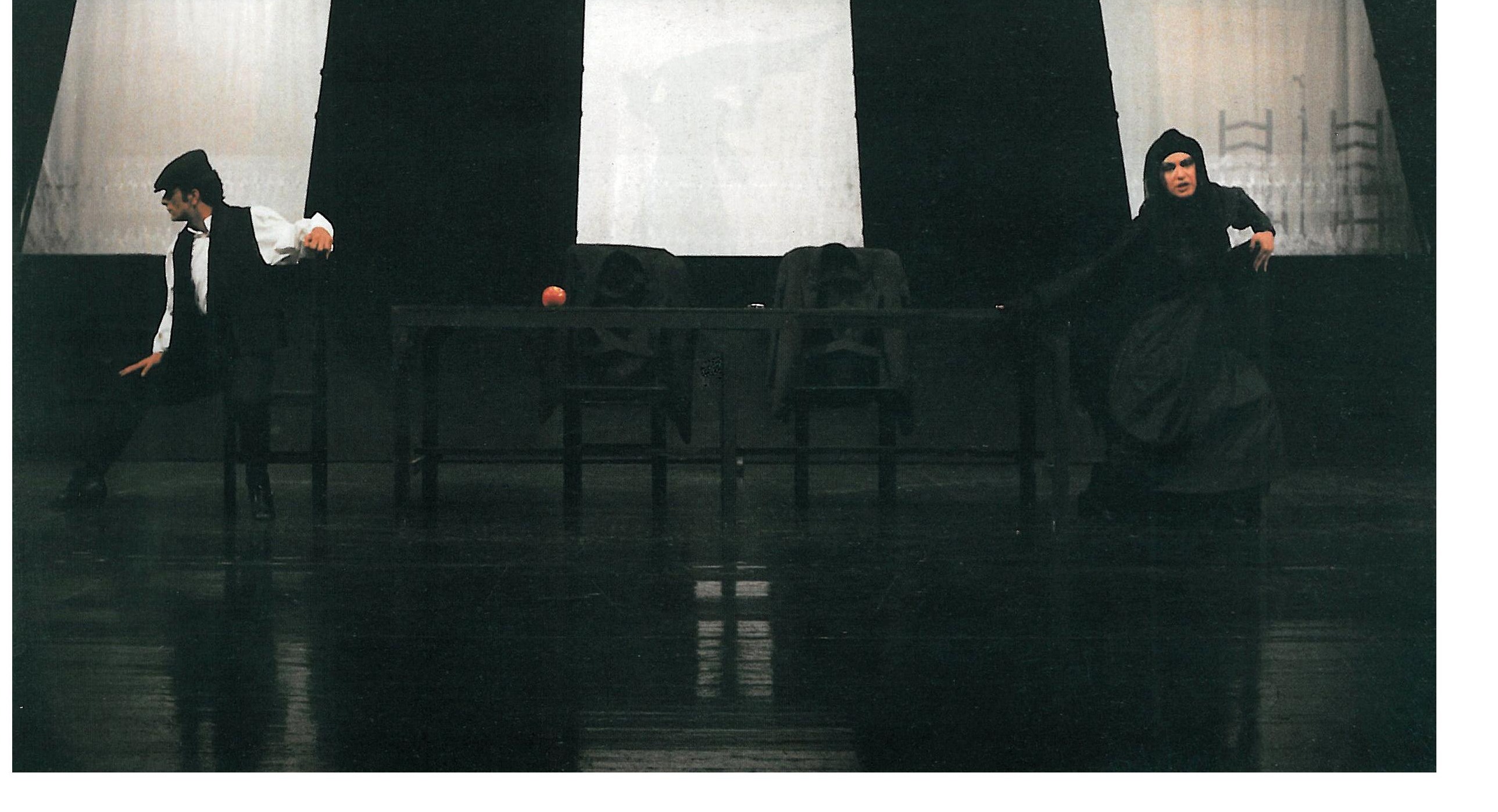
'Blood Wedding', directed by Ali Rafiei
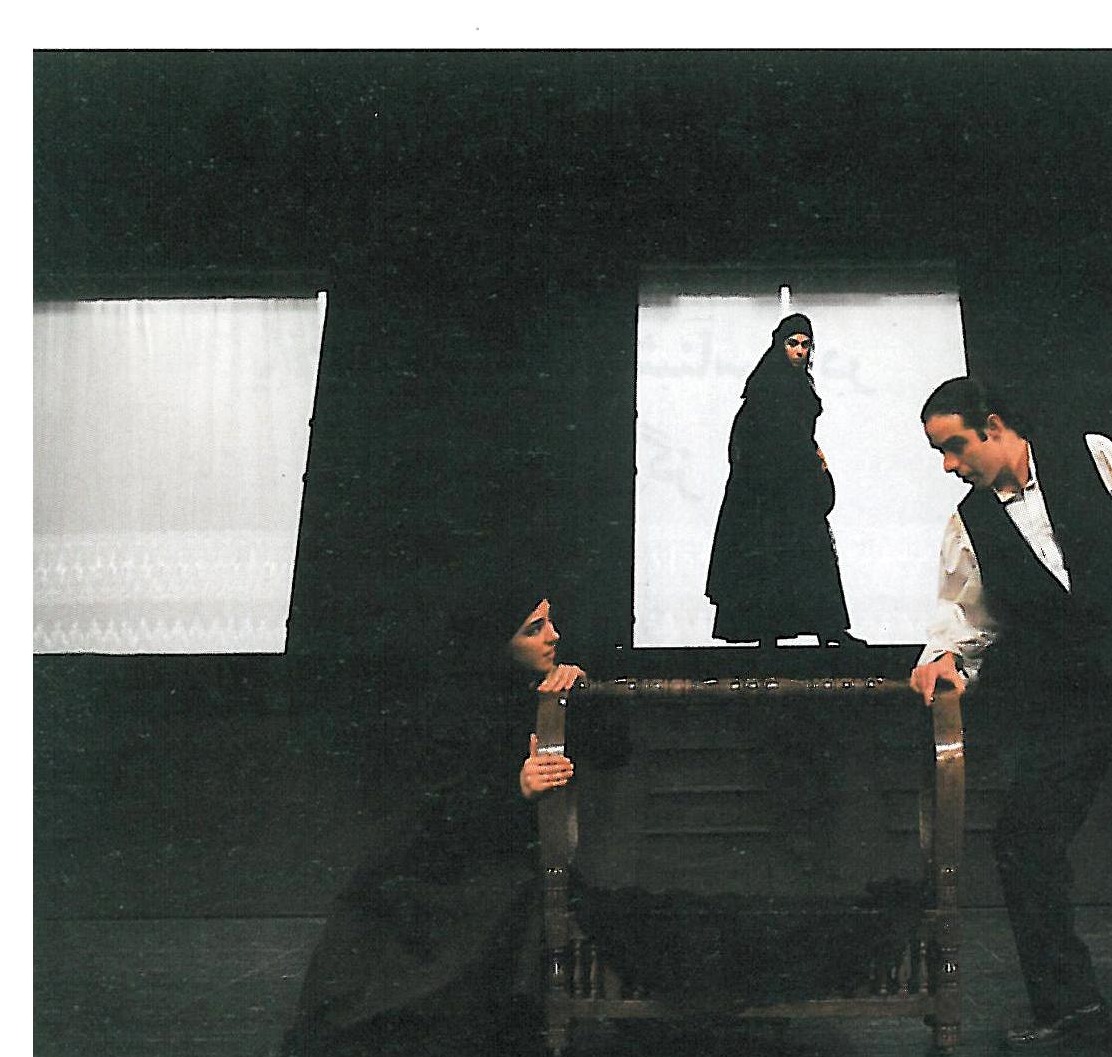
'Blood Wedding', directed by Ali Rafiei
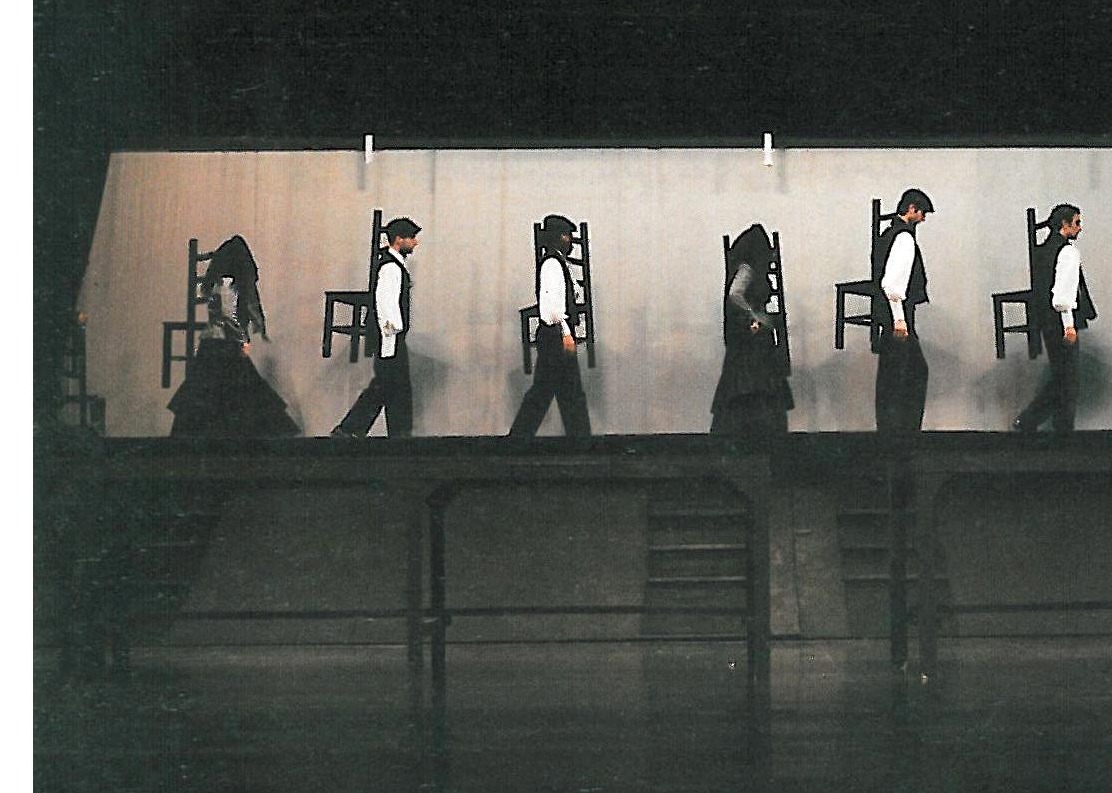
'Blood Wedding', directed by Ali Rafiei
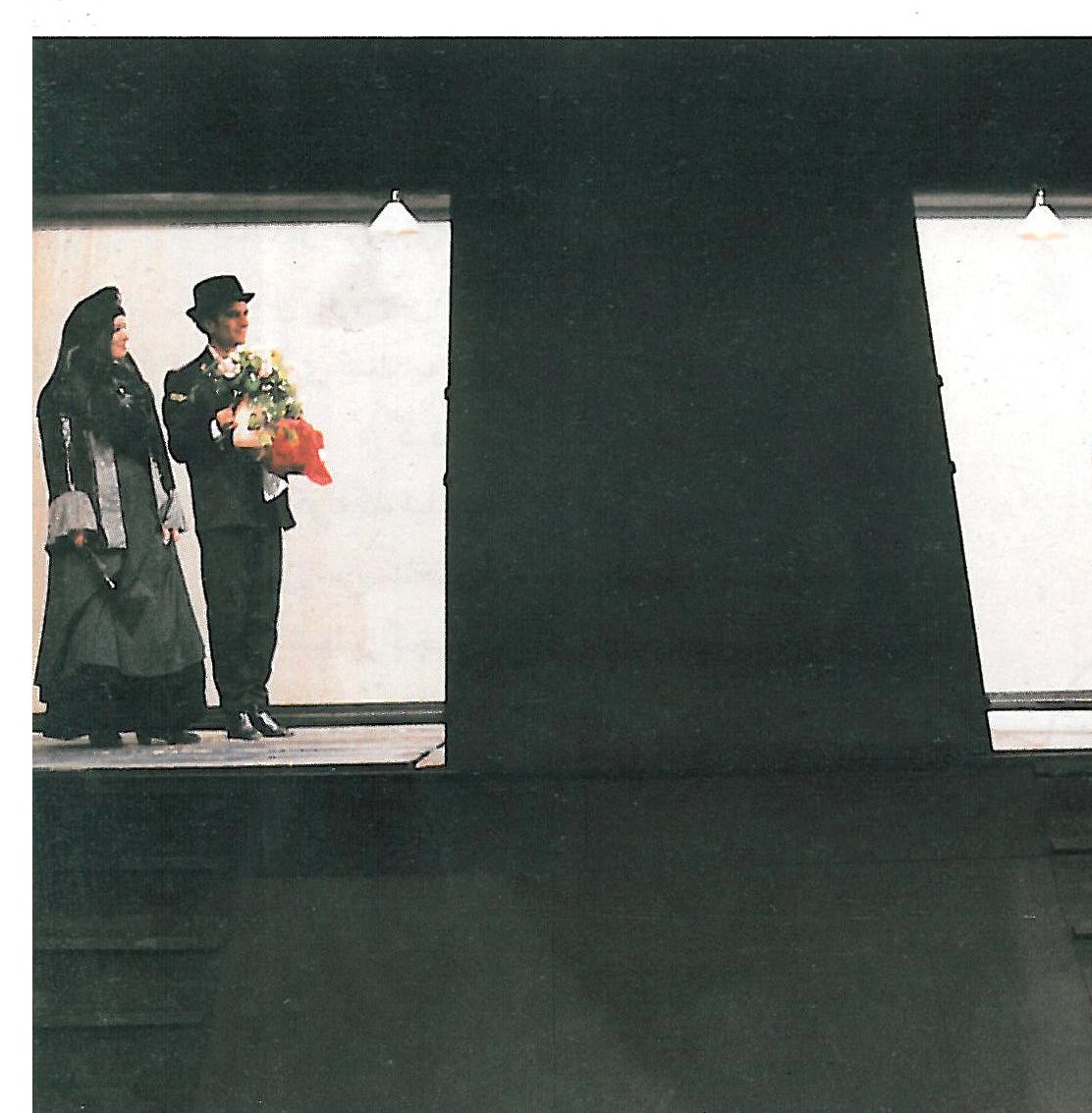
'Blood Wedding', directed by Ali Rafiei