Paris is one of the world's legendary cities — not only for its technical architecture and magnificent urbanism, but also for the way its society works, or, as one might say, for its Parisian culture, which has of course shaped the habits and manners of its citizens. Short distances and the efficiency of public transport invite contact between neighbourhoods and make coming-and-going and urban cohesion easy. Although Paris has undergone gradual change in the last fifty years, the singular feature of Paris remains the abundance of cafés, restaurants and the café life. Meeting in a café is part of the daily programme of Parisians. In the past — on account of poverty, cramped apartment conditions, lack of occupation or of a pleasant setting in apartments (especially before TV became widespread) — people were obliged to spend their leisure hours in the café and on the street. As a result Paris cafés were equipped with public phones, public toilets and even games (chess and dominoes once, then pinball after the Second World War). These cafés have been, and still are, the gathering-places or haunts for the leisure hours of the neighbourhood's residents. One such café, Select, is the Paris meeting place of Iranian architect friends, and one of its regulars is Mohammad-Reza Moqtader. I knew Moqtader at a distance in Tehran — one of the senior partners of MADAM consulting engineers, whose "M" was for him. A good talker, a storyteller, he is one of the most respected and senior architects in Iran. For this reason it seemed to me a brief set of his memories would be interesting and pleasant for architect friends. I invited him to lunch at one of the cafés and to talk about the various periods of his professional life.
Diba: What year did you go abroad to study? And could you briefly describe the Tehran of those days and then your first impressions of Paris — how, stepping off a flight as a high-school student into an unfamiliar world, did it appear to you?
Moqtader: In 1329 (1950), with a secondary-school diploma from Alborz School, I left Tehran — a small, simple, relatively quiet city — for Paris, then a great, bustling city. For years before, through writing, film, music, painting and the stories our elders scattered among us, a vague picture of Western culture had been forming in the minds of most of our high-school generation, and we were curious about foreign life. We would repeat to each other whatever we heard and drew our conclusions! Going to a few well-known cafés of Tehran — which were the haunt of most writers and intellectuals of the time — added to those imaginings. Certain cultural figures of the day, their followers and journalists gathered at Café Ferdowsi or Café Naderi and other cafés and talked, in the social style, often with humour. We fresh young ones tried to take up a seat on the fringes of that circle, in the hope of catching an aphorism here or there to add to our store.
In the summers they gathered in the garden of a café built in the European style among the first Reza Shah-era buildings north of the lower Darband square, or in the garden of the Continental Café on Istanbul Street, or at Café Nayeb where today the City Theatre stands, or in one or two of the old Tehran hotels; sometimes they would take me along. Their talk usually circled around Iran's history and the distant glories of the past, and they discussed Iran's future and the solutions that came to mind; now and then one of them would read out satirical verses he had made about the day's politics, which were applauded, and these verses would later pass from hand to hand.
The architecture of Tehran in the 1940s was still a mix of late-Qajar and Reza Shah-era buildings that had arisen from the city's rapid growth, and their difference in spirit was plain to see. The architecture of the important state buildings differed widely and was each marked by the culture of the architects who had designed it. Buildings that had a reading of Achaemenid architecture — like the Melli Bank and the Police Administration — were, for me, the leftover works of the decorations and triumphal arches that had been put up in Tehran by order of Reza Shah for the wedding of the Iranian crown prince with the Egyptian princess. Another group included the Ministry of Justice, the railway station, and the hotels at Darband and the north — all of them, for us schoolboys, the token of Western culture, and we knew they had been built by foreign companies. A third group were the buildings the foreigners built but which did not stray too far from our own culture — like the Post Office, the Ancient Iran Museum, and the National Library. We took more to their architecture and thought of them as ours.
Following the view of most thinkers of that time, who saw Iran's progress along the path the West had taken, the translation of books, novels, articles and serialised fiction grew daily, and the public welcomed new ideas. Even in the mid-1940s a gracious and respected lady, Mrs. Fakhroldowleh (Amini), founded the C.T. taxi company, and at the first dairy plant (named "Micky") pasteurised yoghurt and milk were brought to market in packaging with a picture of Walt Disney's Mickey! Little by little foreign words appeared, beyond the cinemas and hotels, on shops and stores, and had even found their way into Tehran's bazaar.
Diba: This revival of old memories is very interesting. I see similarities between the time you describe and today, although the scale and method have changed. Iran's return from a twenty-year seclusion has, just as in the past, produced the same intellectual curiosity about the West. To be sure, in that time knowledge of the West was confined to a select class; my guess is that today in Iran this awareness is more widespread. Well, now, tell me a bit about the Paris of that time.
Moqtader: In Paris, after consulting acquaintances, I settled at last on architecture, and I spent my preparatory year at the Gromort-Arretche atelier of the École des Beaux-Arts as a new entrant (nouveau). To ready ourselves for the school's entrance exam we had to take classes — besides drawing and the classical elements of architecture — in drawing, painting and sculpture. After the first year I changed school and continued my studies at the École Spéciale d'Architecture in Paris, at the Perret-Chevalier atelier. Auguste Perret, in the last years of his life, rarely came to the atelier; and whenever this honour fell to the students, absolute silence prevailed in his presence, and only his quiet voice could be heard. Perret was held in extraordinary esteem in Paris society, and a group of French intellectuals and artists was always gathered around him. At that time the building method of the naked body — which Perret and his brothers Gustave and Claude had made current in France from the beginning of the twentieth century — was gradually becoming the century's classical school.
Besides the teachers in the architectural schools — all of them active and well-known French architects — the works of other major world architects outside the school's teaching plan (Le Corbusier, Frank Lloyd Wright, Walter Gropius, Mies van der Rohe, and the rest) had a great influence on the education at the architecture school. The theories of the early-century architecture, the Bauhaus group, the charters of the Congrès International d'Architecture Moderne (CIAM), and newer schools were discussed among the older pupils to whom we looked. The taste and fashion of the mid-twentieth century differed from what is today regarded in the history of architecture; the works of Art Nouveau architects like Hector Guimard — or even Robert Mallet-Stevens and others — had little place in those years' curricula.
During my time at the architecture school I had no other Iranian contemporary; only the engineer Bijan Saffari, who came in a year after me. The first Iranian architect graduate from this school was Vartan Hovanessian, who completed his architectural studies in 1922 / 1301. After him, the engineers Khorsand, Nasser Badi' and Ajdari had passed through this school's architecture course.
At the end of my studies, and before taking my diploma, I made a trip to Iran and went to Isfahan for the first time. I need not explain how deeply seeing a city like Isfahan can affect an architecture student. On the road to Isfahan, seeing the mud-brick architecture of the village of Moocheh-Khort was also an important prelude. During my studies I had been to Italy a few times and had always thought Florence the best city in the world. Now, seeing Isfahan, I saw a close relation between these two cities. Even today, if I had to give a precise account, it would not be easy.
Diba: I agree with you about these two cities. Is it not wonderful that at two points on earth, vast distances and two strange cultures apart, in roughly the same era, two beautiful cities — attuned to today's urbanistic criteria — were designed and built as such treasuries of two civilisations, and with no connection between them? If we are to take a lesson from history, it is surely this: that governments are capable, under conditions of cultural vitality, with planning and purpose, of leaving valuable works of art, architecture and urbanism behind them. They are even capable of being themselves the fostering and creating climate of cultural fertility. And they are likewise capable of ignoring golden opportunities and contenting themselves with motorway-building, flower-bed-laying and raising grotesque towers! If we tally how many building materials and how much labour we have spent in our country in the last fifty years, and what has come of it — and compare it with the materials, resources and sheer scale of the old fabric of Isfahan, both quantitatively and qualitatively... In recounting that affliction, the thread of the talk slipped from our hands. Back to Paris …
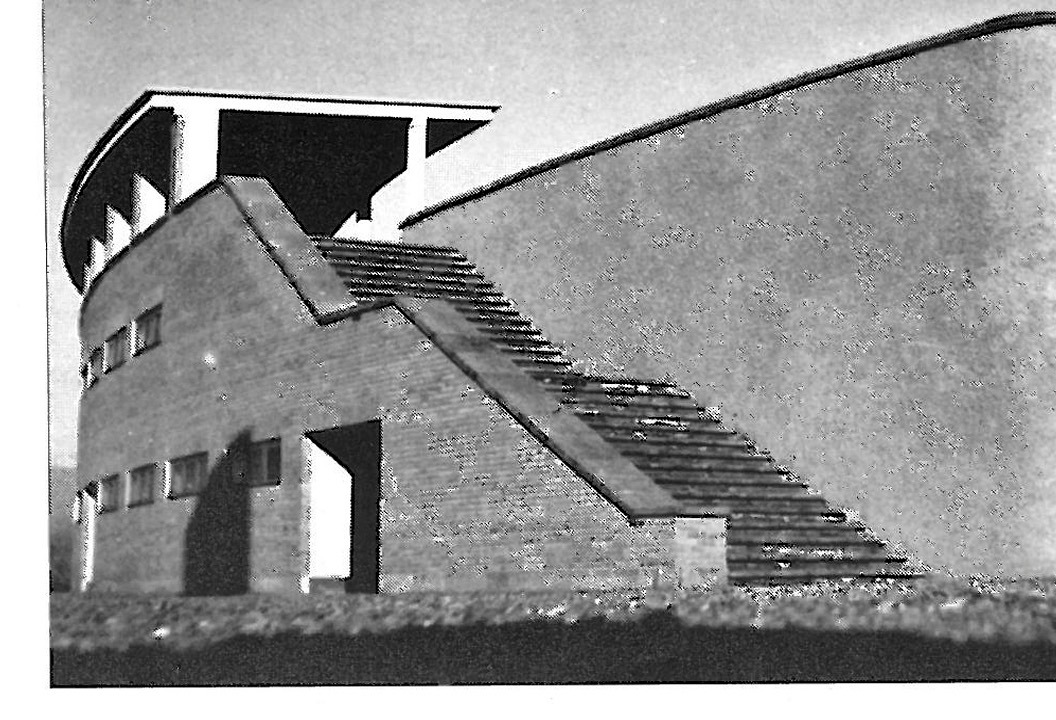
Moqtader: Back in Paris, for the architectural diploma I chose the project of the blind school of Isfahan; its brief was prepared with the help of one of the Paris blind schools. The first drawings — comprising simple brick buildings — I showed to our atelier's master, M. Chevalier. The simplicity and primitive character of the project so angered him that I had to avoid consulting him during the work, so that the teacher-student relationship would not, at least until the day the results were announced, slide into something regrettable.
The appointed time came: November 1956. Diplomas were hung on the wall of the school's great hall, and I felt the difference between my project and the others more keenly than ever. The diplomas included vast, striking programmes with buildings of concrete, steel and glass; the blind school, by contrast, consisted of low brick buildings with arched and domed roofs around internal courtyards. The jury-masters made their rounds of the diplomas; we anxious young ones watched from a distance, their cryptic talk and our fates. After several hours of deliberation, with a gesture of the hand, my teacher called me over from a distance. With a reproachful, vexed air — that I had hidden the project from him — he said: "It has been judged the best diploma. Go and thank God!" Even among the Parisians the trip to Moocheh-Khort had done its work!
Diba: How did things look on your return home?
Moqtader: At the end of 1325 I returned to Iran. By that time most graduated architects were employed by the building departments of the Ministry of Finance, the Melli Bank, the University of Tehran, the army and other institutions; only a few architects had offices and worked in private practice, and buildings were rarely handed over to them by institutions. State development projects, most of which were concentrated in Plan Organisation, had been divided into three regions, each handed to a group of foreign consulting engineers. The architectural projects comprised hospitals, clinics, schools and a number of other state buildings scattered across the country. One of these groups, the French consulting firm P.L.C.O., hired me as a design architect.
The then-head of Plan Organisation, Abolhassan Ebtehaj, used to visit the office from time to time to follow up on projects; the consulting engineers took him very seriously and were always anxious about the outcome of his visits.
After three years of work in that group and familiarity with Iran's construction methods and materials, I took on private projects that were gradually entrusted to me by acquaintances. In 1338 the Iranian government decided to dispense with foreign consulting engineers — who proved very expensive — and to recognise a number of existing Iran-based offices as Iranian consulting engineers, and to entrust the continuation of the work to them. At that time, together with old friends — Mrs. Nectar Papazian and Mr. Constantine Andreev — we had formed a group. Among the first Plan Organisation projects entrusted to us were several half-finished foreign-consulting projects. The Shahre Rey Hospital and the Mollasani Agricultural College in Ahvaz were among the most important.
Diba: I did not want to cut you off. Is it not strange that for purely financial reasons they would halt work with foreign consultants? Was not Plan Organisation's ultimate aim self-sufficiency in technical matters?
Moqtader: Yes, that was the aim at the outset. Besides, Plan Organisation itself had not yet had experience with a consulting engineer, and on the other hand working with foreign consulting engineers — counting the various incidental expenses, supplements and personnel travel — proved more expensive than a contract with Iranian consulting engineers. So, after a few years of experience and once the Iranian groups were ready, continuing those contracts was not without its problems for Plan Organisation.
Diba: At that time, alongside your professional work, did you have opportunity for artistic pursuits? I had heard you put together an interesting collection of photographs of Iranian architecture?
Moqtader: On the side, my love of travel and of getting to know Iranian architecture — especially the mud-brick architecture, and photographing it — made a very rich period of my life. The article "Straw-and-Mud and the Face of the Iranian City" in the journal Honar-o Mardom, and the article "Abarqu: A City on the Edge of the Desert" in the journal Sokhan, were among the first fruits of these visits. Besides the great desert cities — Kashan, Na'in, Yazd and Kerman — visits to smaller, less-touched towns like Zavareh, Ardestan, Abarqu, Ardakan, Bafq and Fahraj, and conversations with their residents, made up the greater part of the best memories of my life. Showing pictures of the architecture of the Iranian cities to interested listeners is still one of the finest pleasures of my life.
At a time when I was still looking for a building project more important than home-building, one evening I read in the newspaper that a society had decided to build a school for the blind. The honorary head of this group was Hossein Ala, then Minister of Court. I rang his office and asked for an appointment. A few days later his secretary set an appointment by telephone. At the appointed hour I went, anxious, to his workplace. I had prepared myself to give the necessary explanations about the blind school; without pause I sketched the project I had earlier prepared for the school diploma and announced my readiness to prepare the design for this complex. Listening carefully to what I said, he responded with his extraordinary calm: "If I am not mistaken, you are saying that you will prepare the design of the school with care and compassion, and will supervise its execution to the very end." After a moment's pause he added: "And of course you will accept this on an honorary basis!" Naturally this sentence produced a few moments of silence and uncertainty in me, and then I had to answer: "Of course!" In this way I had, for several years, the good fortune of Mr. Ala's guidance and of the respected board of the school, who, with the utmost compassion, brought this centre into being.
In the late 1340s, besides the older architectural offices — those of engineer Vartan, engineer Paul Abkar and others — more equipped and modern offices were gradually emerging in Iran. At that time engineer Mohsen Foroughi, the most senior, was consultant to most government bodies; the Darabi building and the Melli Bank at the Bazaar were nearing completion under his supervision. On the other hand engineers Houshang Seyhoun, Abdolaziz Farmanfarmaian and Heydar Ghiai — the Beaux-Arts-diploma musketeers and standard-bearers of Iranian modern architecture — each, besides having an atelier at the Faculty of Architecture at Tehran University, ran their own private offices, each with a different spirit. Closer friends like engineers Parviz Moayyed-Ahd and Bahman Paknia and others gradually joined the beaux-arts circle. Moayyed-Ahd had set up an architectural office on Bozorgmehr Street and, with great kindness, gave me a desk in his office for several months until I found a place of my own.
Though I was not on the staff of the Faculty of Architecture at Tehran University, Houshang Seyhoun kindly invited me several times to the faculty's field trips, and we grew closer; and outside the faculty group, too, I went on trips to the desert cities with other friends — including Farrokh Ghaffari and Jalal Al-e Ahmad. These trips and getting to know our motherland's desert lands made for a valuable stock that I still carry with joy in my memory.
With Michel Ecochard — who was, for me, something of a master and mentor — or with engineer Antoine Debre, my colleague, I also visited the cities of Iran many times. My friendship with Michel Ecochard goes back to the 1340s and, with the Tabriz Master Plan and close collaboration, my affection deepened. Working beside this renowned urbanist and architect was not only professionally very valuable for our office; his human and moral side also made its mark on all of us. The last lesson in humanity that Ecochard gave me was shortly after the Islamic Revolution, when, tired of the representative of the prosecutor at Plan Organisation, I had to abandon my office and go to France. A few days after my arrival in Paris, I went to see Ecochard at his office at 55 Boulevard Montparnasse, and I was astonished at how concerned he had been about me. At that very meeting he gave me a spare key to his office and asked me to consider it my own; from the next day he made me his collaborator on the Kuwait Museum extension project, and in this way, until his death in May 1985, I had the benefit of this exceptional man, and enjoyed his and his family's affection.
Diba: If we wanted to name two important historical points in the life of the architectural profession in Iran, one would be Plan Organisation's dispensing with foreign consulting engineers. That was the first serious step in the real work of Iranian architects, who at that time were very few. The next step is of course the mergers of engineering offices. Plan Organisation, through one of its able deputies and managers, engineer Mehdi Samii Rad-Pey, set about strengthening the private offices. Through the introduction of the "rating" system, private offices were obliged to come together and merge, gradually transforming themselves from small ateliers into consulting firms meeting the standards of advanced countries. Now let us come back to your group's situation.
Moqtader: That is right. Plan Organisation, which had most of the country's development projects in hand, began to contemplate the merger of engineering offices in order to execute large projects. At that time Moqtader-Andreev was in charge of the preliminary design for the students' quarters of Shiraz University, and also for the Faculty of Agriculture at Tabriz University. On the other hand MANDA — a firm that had begun work in 1337, under the management of engineers Avarang Dana and Manoochehr Mohamedi — was in charge of other projects at these same universities. For this reason, and by order of Plan Organisation, these two groups were merged in 1346 under the name "MADAM," which was a combination of the first letters of the managers' names.
After a while, with the growth of the country's development programmes, engineer Bijan Fouladi (architect and urbanist), engineer Bahman Ehsan (structural engineer), and engineer Fariborz Farhangi (civil engineer) joined the managers' group. The firm's other colleagues — architects, urbanists, structural and civil engineers, mechanical and electrical engineers, supervisors and administrative staff — made, before the Islamic Revolution, a great family.
At the time of the Revolution a number of the projects assigned to MADAM were halted, and the rest continued slowly. MADAM was obliged to lose a great many of its colleagues gradually; and, after some struggle with the revolutionary prosecutor's representative in Plan Organisation, MADAM was purged and dissolved. A number of its former colleagues, under the name "Tadbir-Banā," took over the continuation of the earlier projects — and, thank God, this group is still at work to this day.
Diba: Of the projects you had in your working period in Iran, which would you count a significant professional experience?
Moqtader: One should say that every scheme and the execution of every project, small or large, is a significant experience. But if we go back and limit ourselves to the period of work in Iran, from among the projects assigned to Moqtader-Andreev or MADAM, we come to the Tabriz Master Plan and the Shiraz University Master Plan. The first was the experience of knowing a city — with all its social, cultural, economic and traffic questions — and of finding rational, sensible solutions for bettering the condition of the city and its future development, while respecting the old, historical fabric and steering clear of disturbing and altering the city's personality and spirit. The second was the experience of study and planning with Iranian and foreign expert teams and with the Shiraz University faculty, with buildings in a restricted space on a hill the university had been given.
Diba: In the first buildings at Shiraz University I saw that artists' works were used to adorn the buildings. How was the payment for these services handled? Was such a possibility available for other state buildings too?
Moqtader: From the beginning of my work in Iran, I insisted on using artists' works simultaneously with the construction operations. In private buildings this presented no difficulty, but in government-affiliated institutions buying these works was a fundamental problem. Not a single figure for this was provided for in any state pricing schedule. After much effort and many visits, we concluded to enter a per-square-metre price in the schedule for the items relating to mural painting and decorative tile-cladding. The second difficulty was persuading the artists of this condition. At last we came to agreement, and in this way at Shiraz University works by Saidi, Zenderoudi and Mohassess, and a sculpture by Ghazizadeh, were incorporated with the architecture. In other government buildings we reached agreement on the same basis; for instance, Oshayiza-Arabshahi did the walls of the Red Lion and Sun lecture hall ...
Diba: Well, now, the exile years? How did the first years and the years after pass — how much work was there?
Moqtader: As I said earlier, at first I spent a few years in Michel Ecochard's office. I worked with him for a time, and occasional small works were entrusted to me by acquaintances. After I lost my master, with the help of a few colleagues we kept the architecture atelier at 55 Boulevard Montparnasse. Together and separately we pursued various projects. I had close collaboration with the Atelier des Architectes Associés on several of their projects. This collaboration lasted many years, during which the Master Plan of the city of Honfleur and several of its central buildings were carried out; the restoration of the lost gardens of the Château de Blois with the close collaboration of the landscape engineer Clement; the tourism centre of Izmir in Turkey; and several other projects. From the 1990s onward, with greater familiarity with the environment, independent works were gradually entrusted to me: the rehabilitation of a large complex of office and commercial buildings in Arcueil; the conversion of a factory building whose façade is on the Paris historical register into offices in the Bastille quarter of Paris (1992); the headquarters of an advertising firm in Boulogne-Billancourt (1995); and finally the residential apartment in Levallois which was completed this year.
In this time, my interest in Iranian studies led me to prepare articles on the art and architecture of Iran for UNESCO publications, for Encyclopaedia Iranica, or for specialised journals in France and America, and talks for me were arranged at various professional forums and at the Paris School of Architecture. In 1998, in collaboration with Mehdi Khansari (photographer) and Mrs. Minouch Yavari (architect), we published a book titled The Persian Garden through MAGE in Washington in English. Happily, the gap left by architectural photography — which in Iran had become the complement of my architectural practice — was in France filled by study in Iranian studies.
Diba: I wanted to thank you, at the close, for giving your time for this conversation, and that we have been able to record short portions of your professional memories.
January 2001