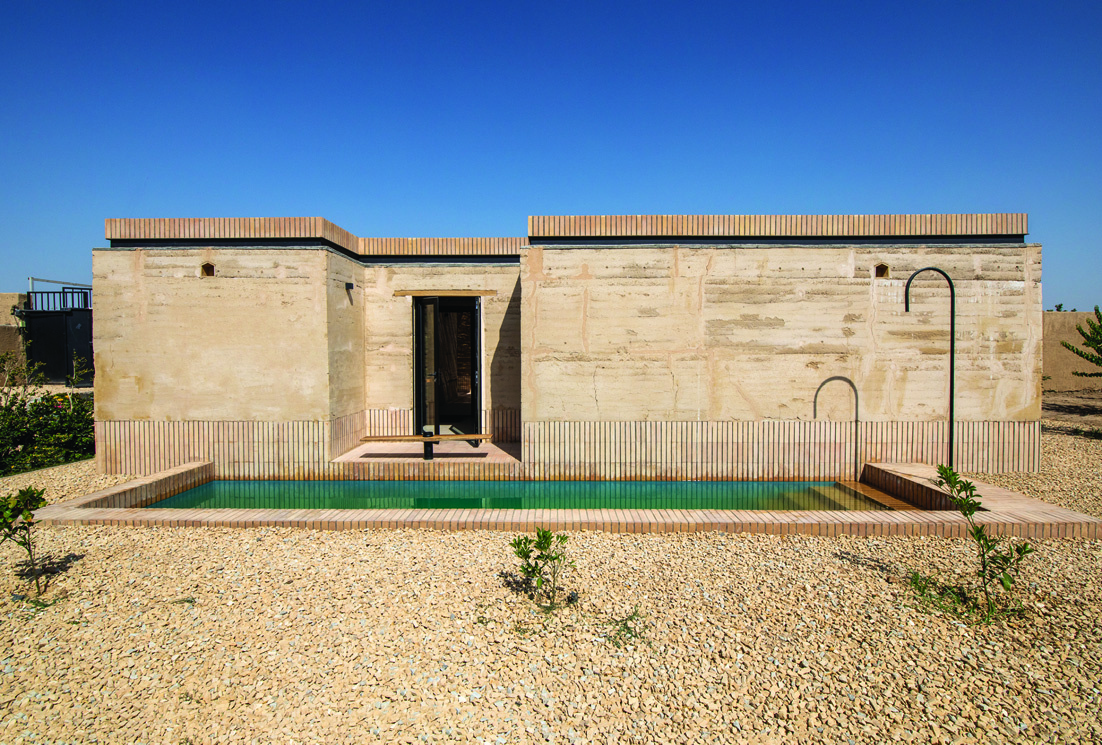
Contemporary Architecture

Khaki House, Isfahan

Pedram Izadi Boroujeni·Photos: Ali Gorjian·Memar 142 — 23rd Memar Award
Khaki House, Isfahan
Location: Qahderijan, historic village of Fahran, Isfahan · Client: Private · Design team: Paria Izadi, Razieh Shams, Alireza Saanei, Forough Hadad · Supervision & Construction: Pedram Izadi Boroujeni · Structure: Izadi Architecture Studio · Mechanical: Milad Ahmadi · Electrical: Amir Abdsharif · Graphic: ADD Studios · Photo: Ali Gorjian · Built area: 60 m² · Site area: 600 m²

Sometimes doing nothing brings about things that the greatest undertakings cannot achieve. Sometimes not-building can give rise to a space whose feeling and atmosphere no construction could ever produce. To subtract from what exists becomes to add to what does not. Something barely visible, merely the relation between spaces that find meaning along its course. A passage that sets the mind in motion so that one may discover life within it. A completing emptiness that holds within itself interior and exterior, movement and stillness, and whose presence grants an awareness of the surrounding world.
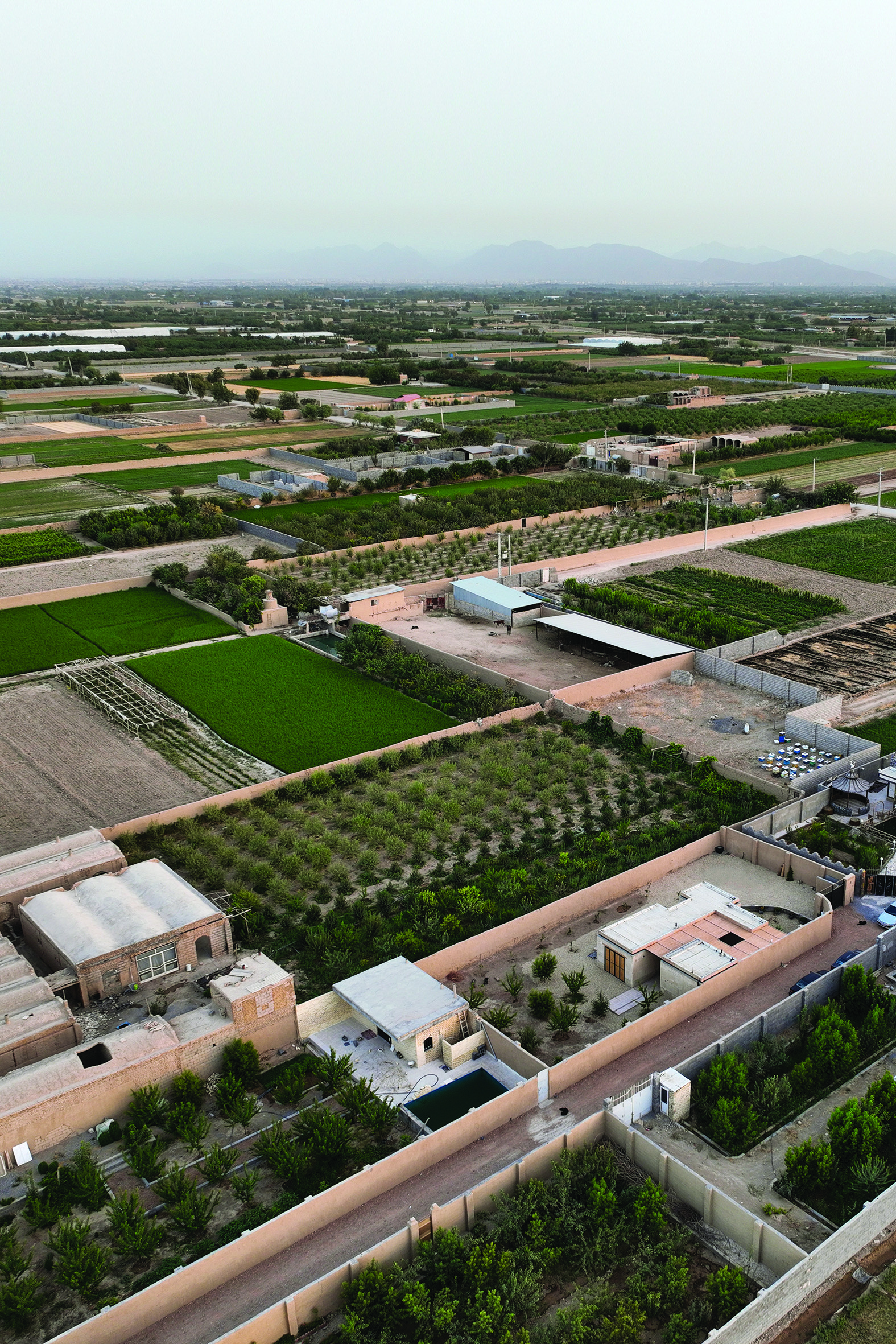
Aerial view of Fahran village showing agricultural fields, orchards, and the house nestled among traditional mud-brick structures with mountains in the distance
The project is situated in the rural fabric of Fahran, alongside farms and orchards on the outskirts of Qahderijan, Isfahan — a village with a history nearly four hundred years old

Cozy corners and compositions of light and shadow bring into being intoxicating micro-worlds in unity with the whole of the building — the product of not-building. A space in which being present means oscillating between inside and outside.

Yet a house is a vessel that must come into being so that its contents may attain the desirable comfort that is the product of cohabitation with climate and culture, and in its coexistence with others of its kind give rise to the concept of neighborhood. The alley is the concept that renders meaningful the interaction among these coexistences. A house, if it is truly a house, can establish a point of connection between the urban lifestyle within and the charm of the village without.
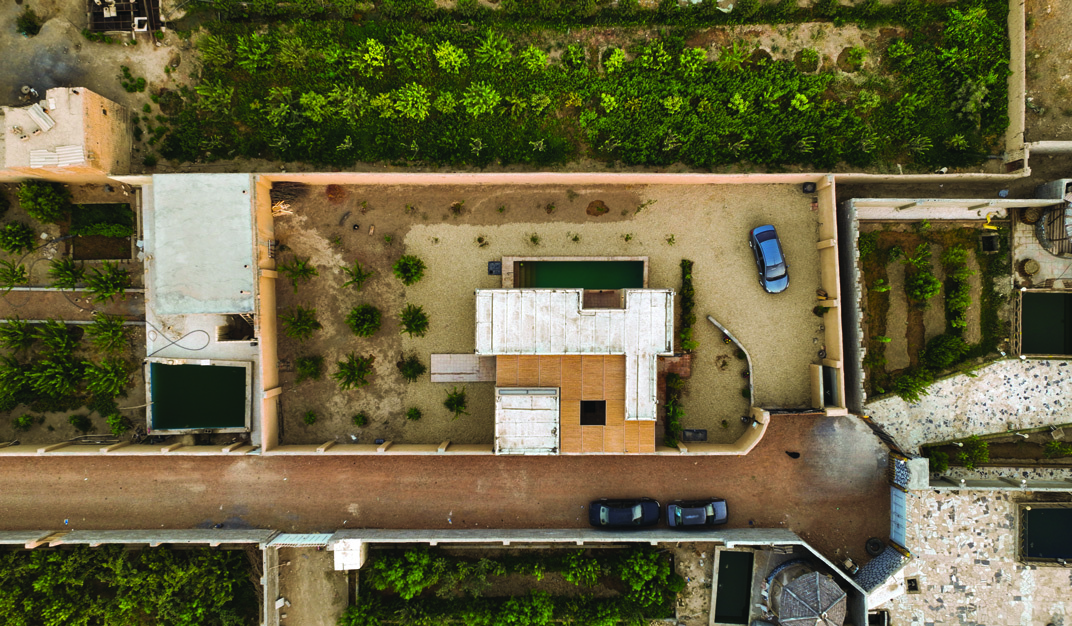
Top-down aerial view of Khaki House showing the compact built footprint within a large walled garden plot, with orchards and a road visible
Aerial view — the compact 60-square-meter house sits within a 600-square-meter garden plot
◆ ◆ ◆
The Reverse Migration

With the passage of time and humanity's ever-growing drive toward progress and modernity, a flood of migration was set in motion. Migration from houses that had been shaped to suit the human condition, toward cities full of stacked and ostentatious cubes. But in this world nothing can contend with human nature except death. Human nature craves the stillness and tranquility that urban life has unjustly stolen. So people chose the reverse path of migration, to drag their unfulfilled urban dreams to the village — oblivious that they were carrying the clamor entrenched in their being into the heart of the village's straw and clay, and by heaping piles of stone, disrupting the symphony of earth.
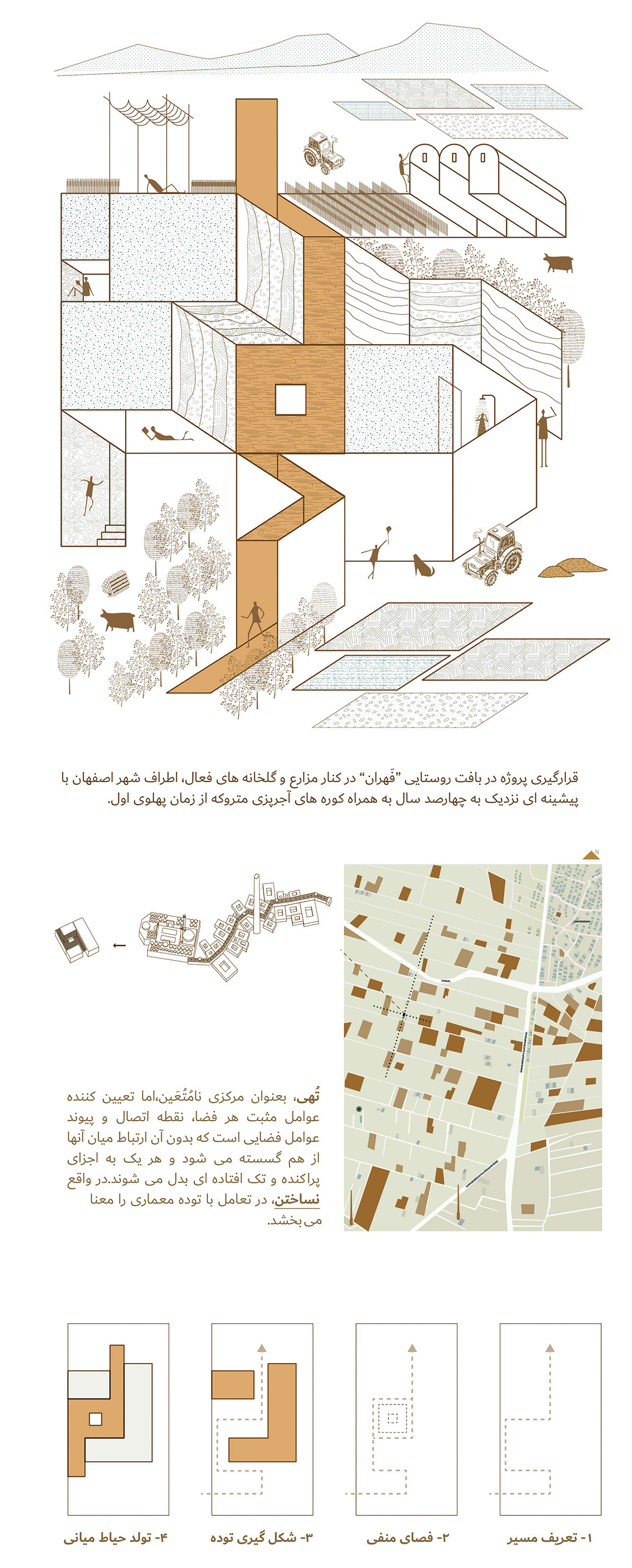
Concept diagram showing an exploded isometric of the house, contextual analysis with village maps, and four design steps: defining the path, negative space, generating volume, and creating the central courtyard
Design concept — from defining the path to generating volume and the central courtyard

Khaki House took shape in this way. It was never meant to be a villa. Its mission was to become a house that simultaneously possessed the comfort of urban living and the simplicity of a rural countenance. A newcomer that quickly finds its place in the heart of the village and, in pursuit of a different way of living, at every step invites its inhabitants into a fresh world.
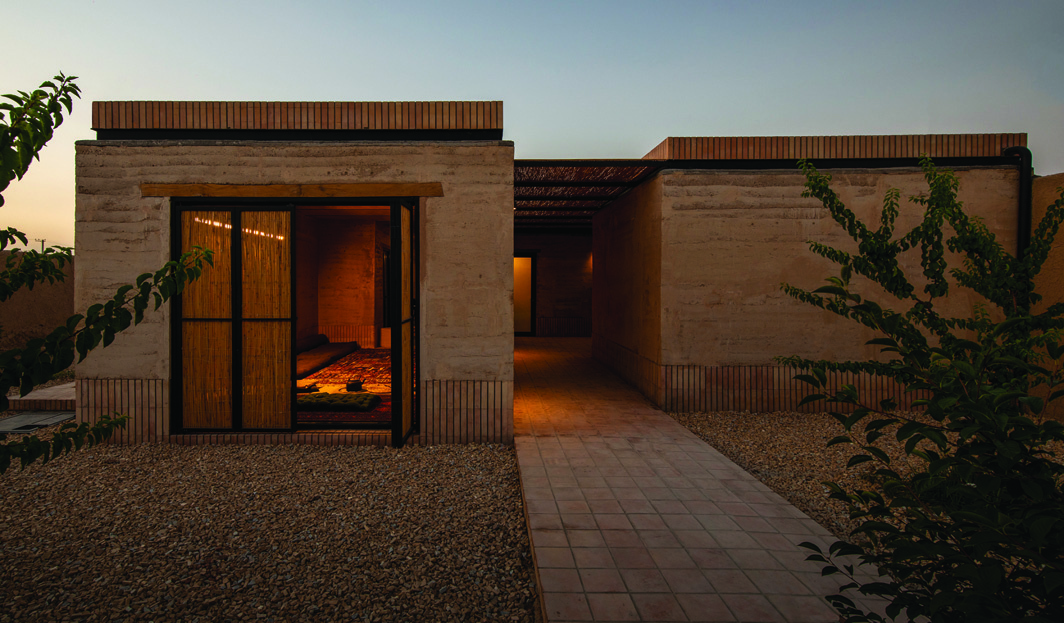
Dusk view of the house entrance with rammed earth walls, lit interior visible through large glass doors, and a covered passageway between volumes
Entrance at dusk — the passageway between volumes
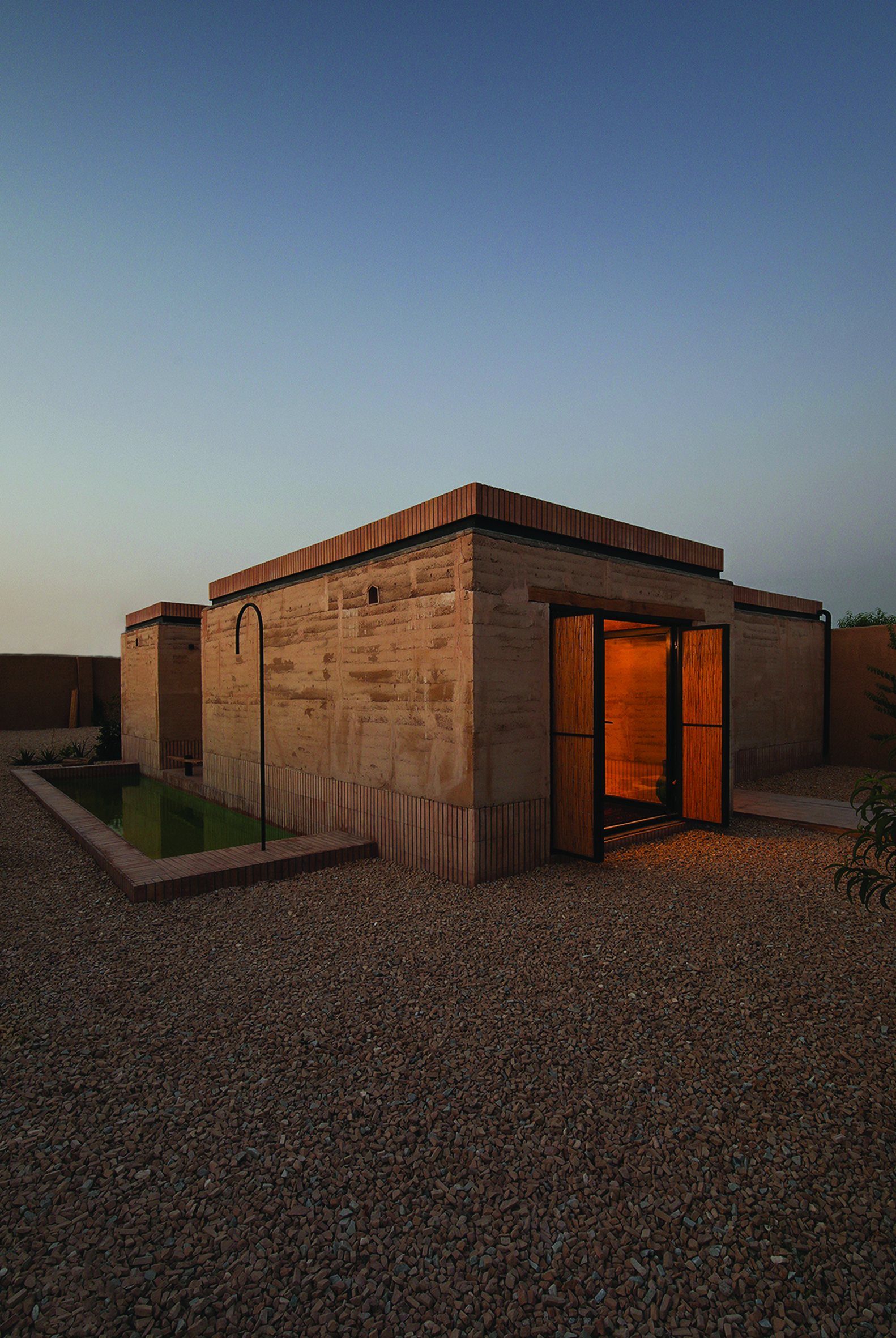
Evening view of rammed earth facade with a green-lit water pool reflecting the building, and warm light emanating from the interior
The pool glows at dusk against rammed earth walls
◆ ◆ ◆
The Alley Became the House

The alley became the house. A serpent gliding languidly through the bamboo reeds — sometimes stretching its neck, then falling asleep again — fashioning a world of dancing light and reed stalks so that between every sliver of light a new world might arise. In one place the play of light and shadow, of dark and bright, builds the space and enters into conversation with the sun; and in another it finds an aperture through which to draw water inside and frame the sunset.
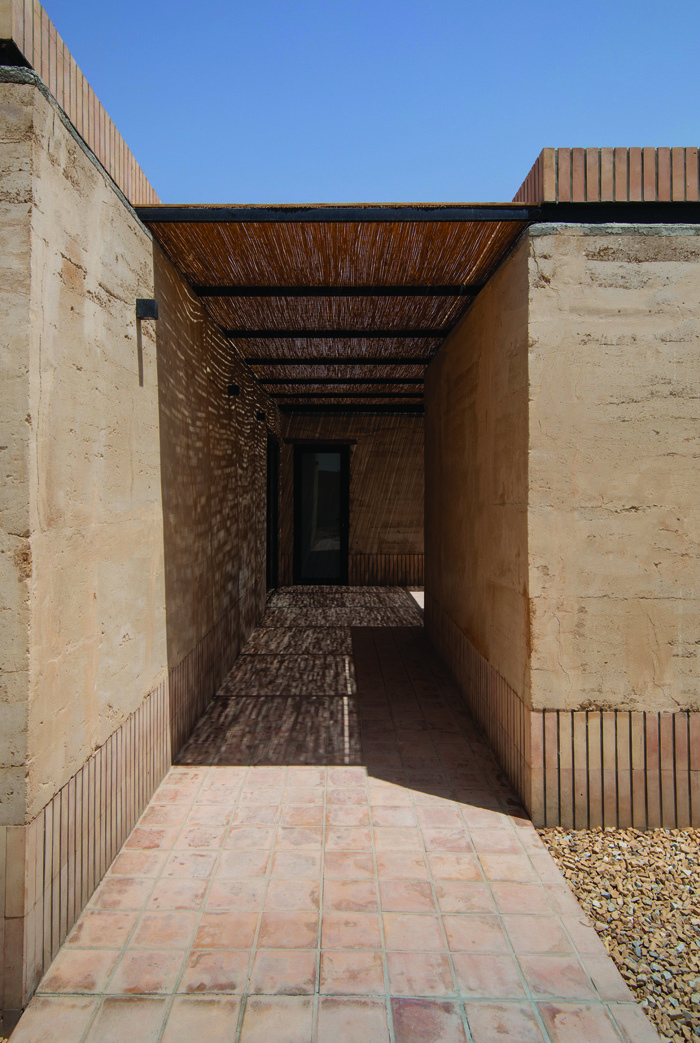
View through a narrow covered passageway with rammed earth walls on both sides and a reed canopy overhead, with dappled light on brick flooring
The passage — a serpentine alley through the house, with reed canopy filtering the light
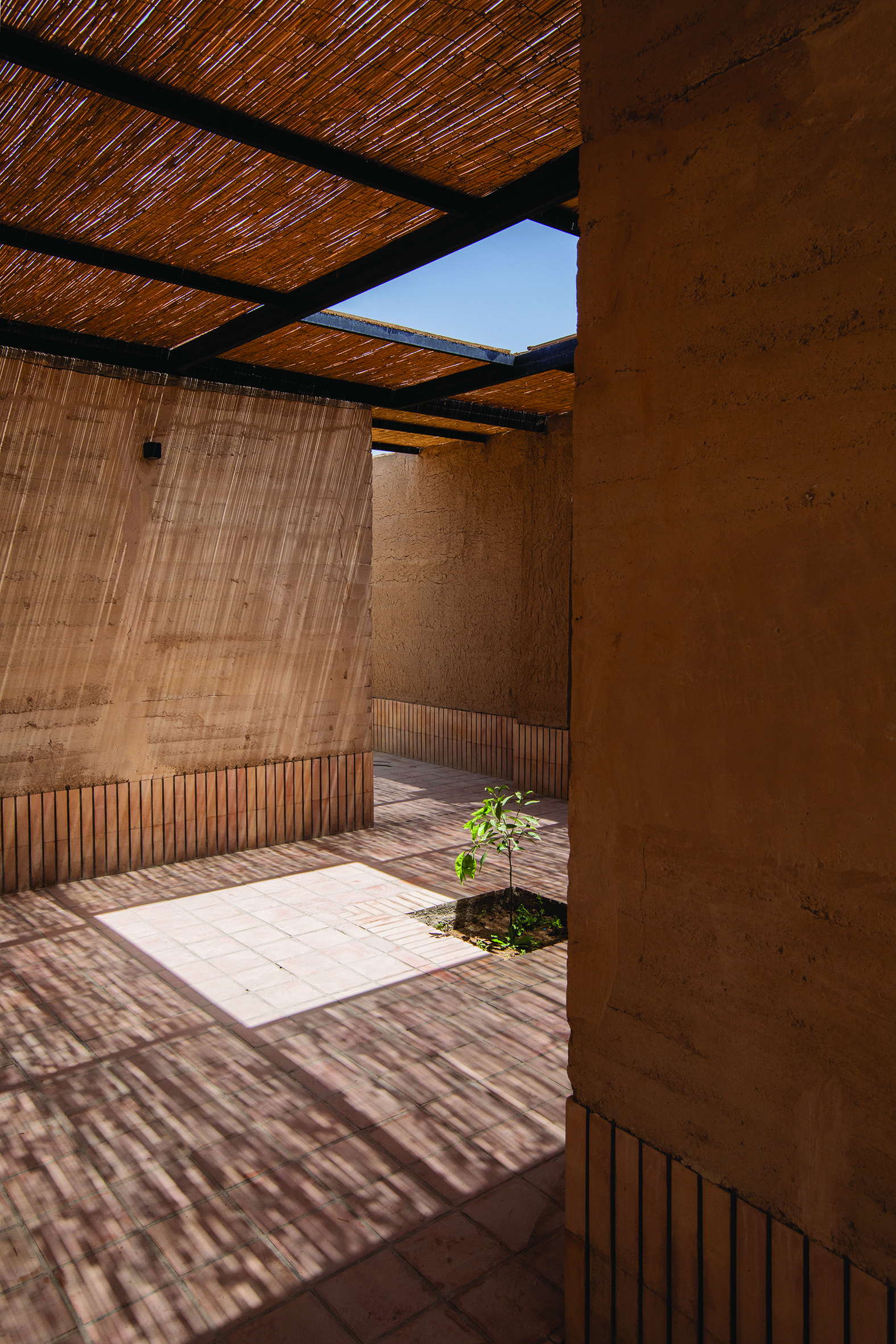
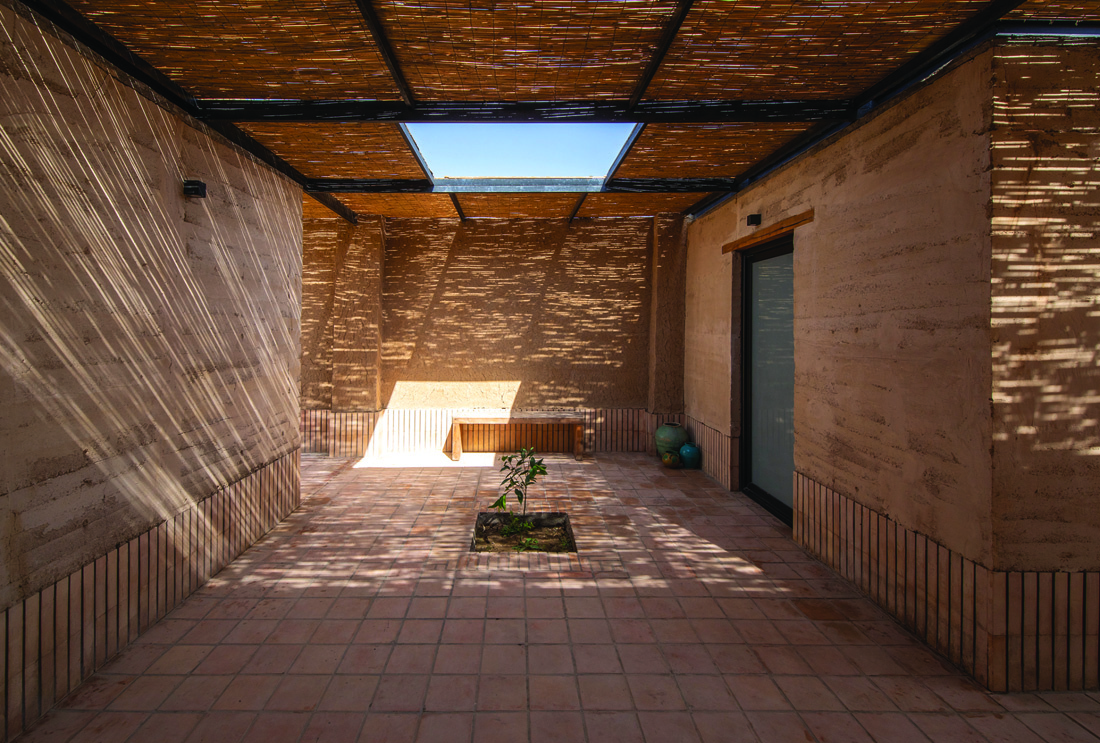
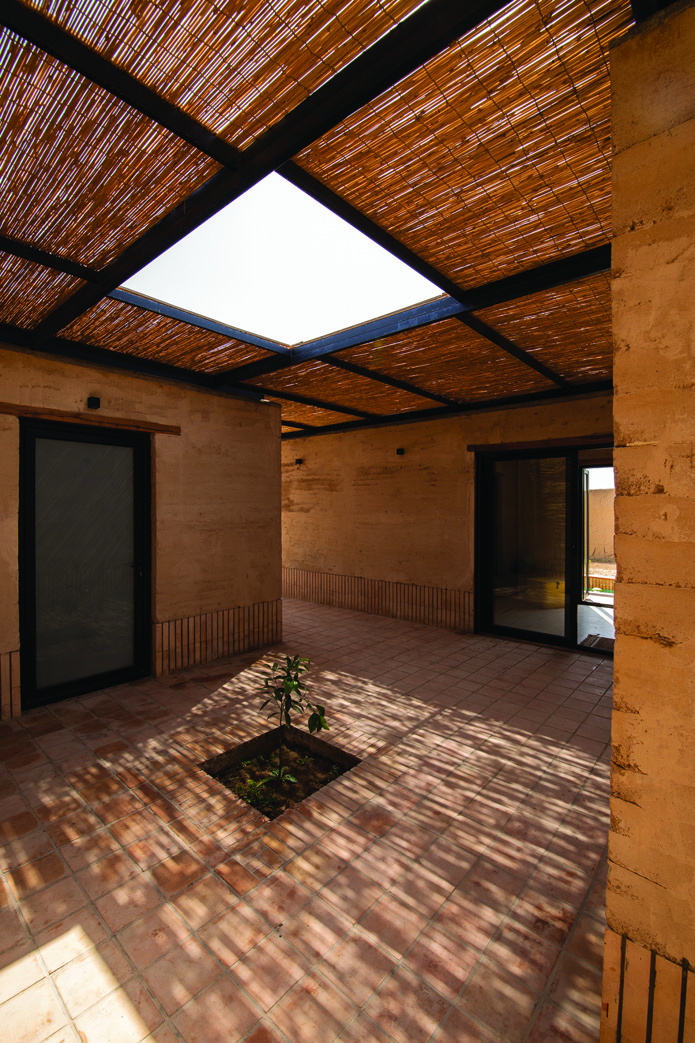
Central courtyard with a skylight opening in the reed canopy, rammed earth walls, and a small tree in a planting bed at the center
The courtyard beneath the skylight opening
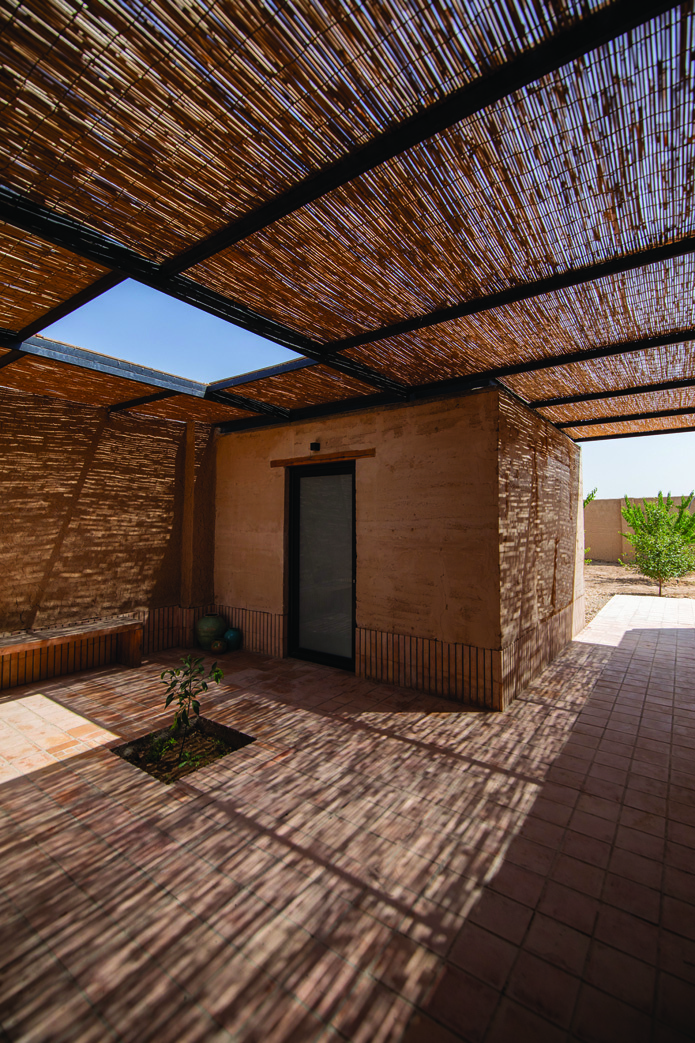
Semi-outdoor courtyard space with reed canopy ceiling, rammed earth walls, and a young tree growing from a planting bed in the tiled floor
Reed canopy and a young tree in the courtyard
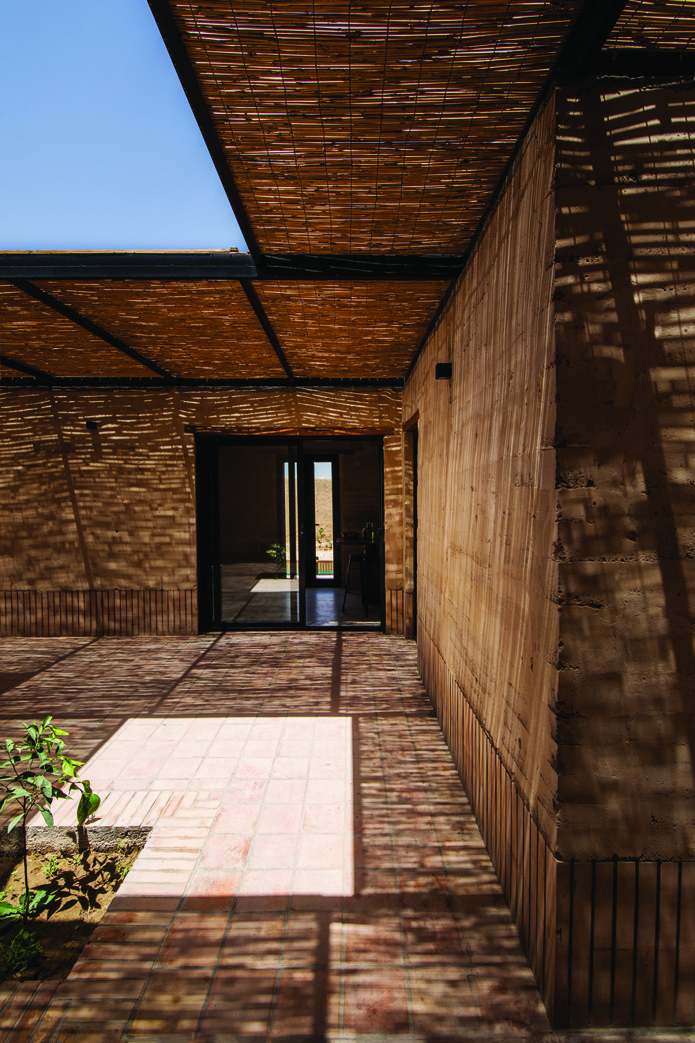
Covered courtyard with intricate reed canopy casting striped shadows on the brick walls and tile floor, with a glass door visible at the end
Dappled light through the reed canopy
Courtyard view with reed canopy, rammed earth walls, a small tree, and a doorway leading into the interior spaces
Courtyard looking toward the interior
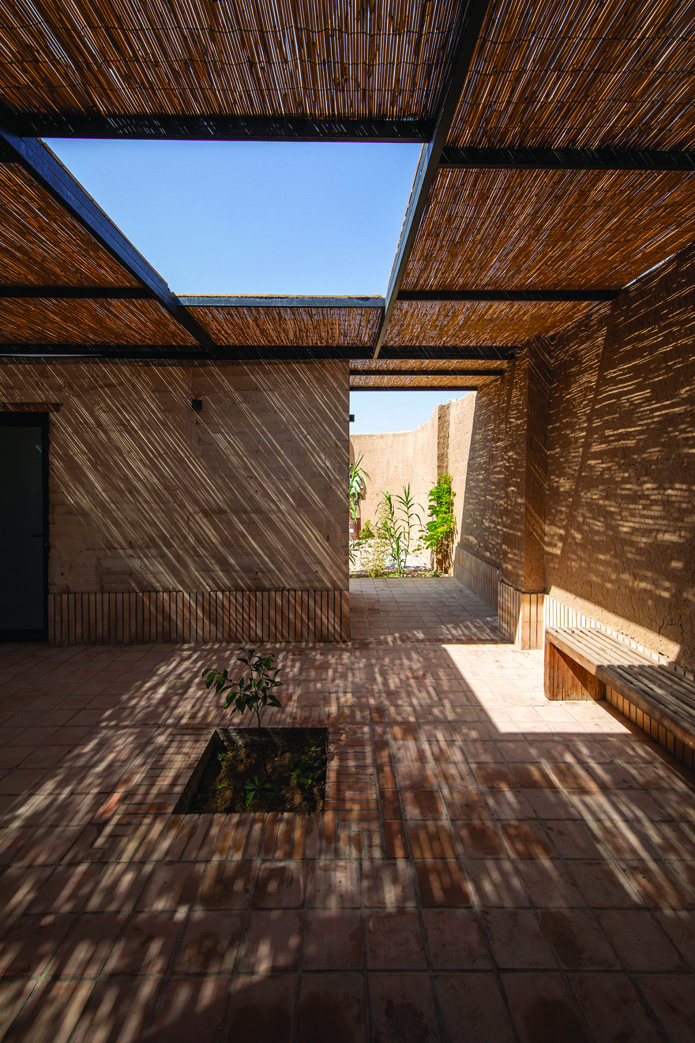
View along the courtyard with a reed canopy overhead, skylight opening, wooden bench, and small trees in planting beds
The courtyard as a living room open to the sky — with bench, planting beds, and filtered light
Wide view of the central courtyard showing rammed earth walls, reed canopy with skylight, wooden bench, and a young tree
Central courtyard — the alley that became a house
◆ ◆ ◆
Earth

Earth is in harmony with nature; it is everywhere; it interacts with cold and heat — thus the finest choice for cladding a desert-edge building. At night it stores the moisture needed to produce the coolness of day. It is durable, fire-resistant, secure, and intimate — holding sound within itself.
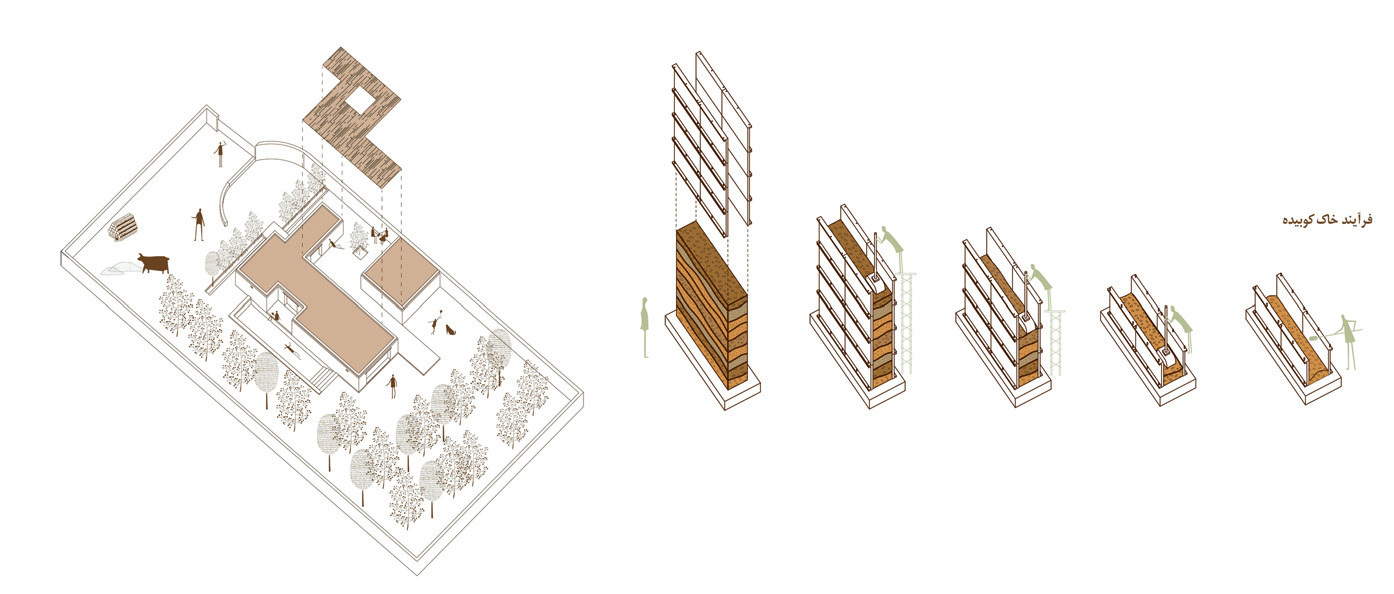
Isometric diagram of the house showing the building volumes within the garden, alongside a step-by-step illustration of the rammed earth construction process with wooden formwork
Isometric view and the rammed earth (khak-e koobideh) construction process — layer by layer in wooden formwork

In building the house, first a place for water was established, and the house emerged from the tamping of earth excavated from the ground. The accumulated soil was graded, processed, poured layer by layer into large wooden formwork, and pounded and compressed by hand and mallet. Each day a section of wall was built, then the formwork was removed to let the wall breathe and the mortar dry. This construction was a rare experience, realized under the shadow of knowledge gained from locals who had spent years in the company of earth and were familiar with its temperament and defiance.
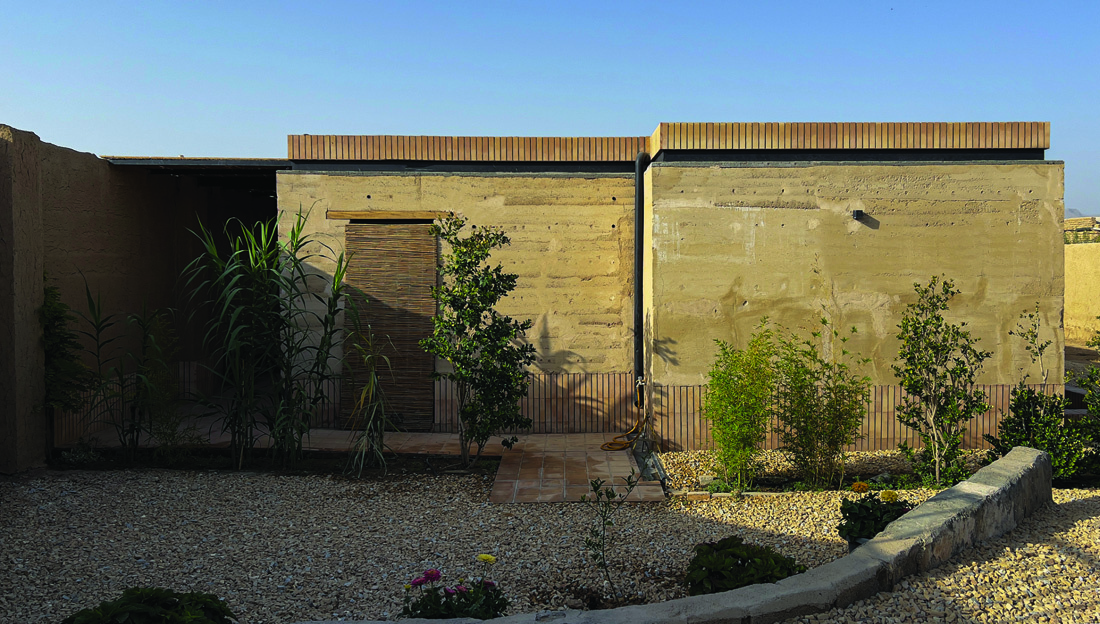
Daytime view of the house from the garden showing rammed earth walls with horizontal layers visible, reed door screen, and young plantings in the gravel yard
The rammed earth walls with their visible horizontal layers — a testament to the traditional construction process
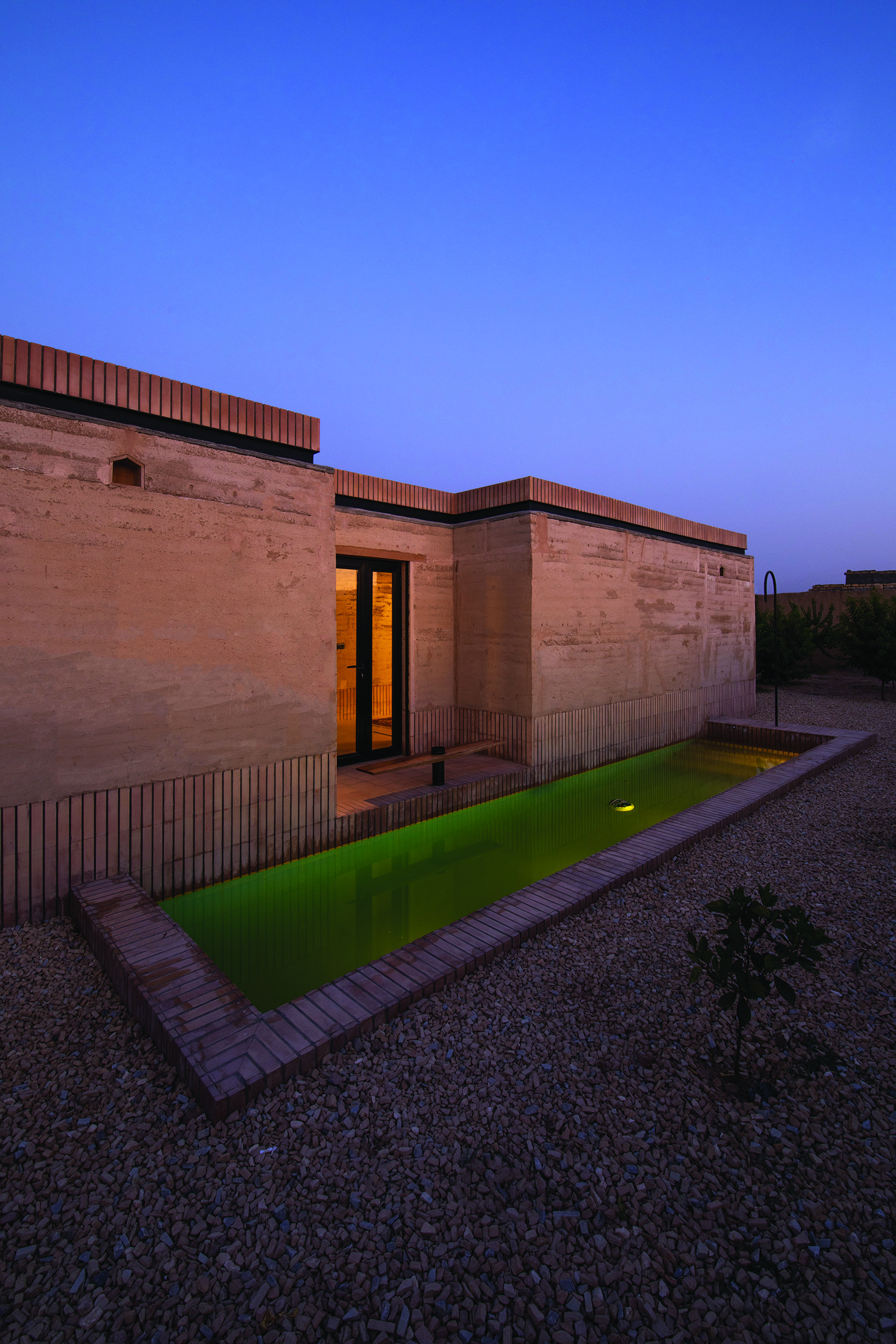
Twilight view of the south facade showing the rammed earth house with a green-lit pool, warm interior light, and clear sky
South facade at twilight — the pool draws water into the composition while the house glows from within
◆ ◆ ◆
Interior Spaces
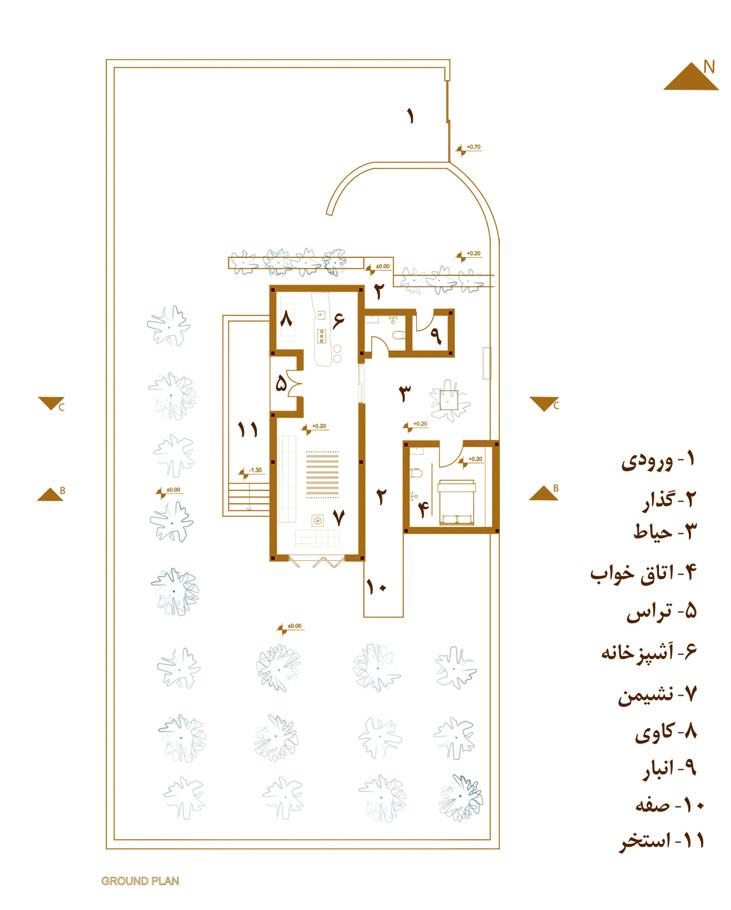
Ground floor plan showing the L-shaped layout with entrance, passages, courtyard, two bedrooms, terrace, kitchen, living room, kavi space, storage, sofa area, and pool
Ground floor plan — 1. Entrance, 2. Passage, 3. Courtyard, 4. Bedroom, 5. Terrace, 6. Kitchen, 7. Living room, 8. Kavi, 9. Storage, 10. Sofa, 11. Pool
Architectural sections B-B and C-C showing the relationship between interior rooms, the courtyard, the sunken pool, and the reed canopy overhead
Sections B-B and C-C — showing the spatial sequence from garden through house to courtyard, with the sunken pool below
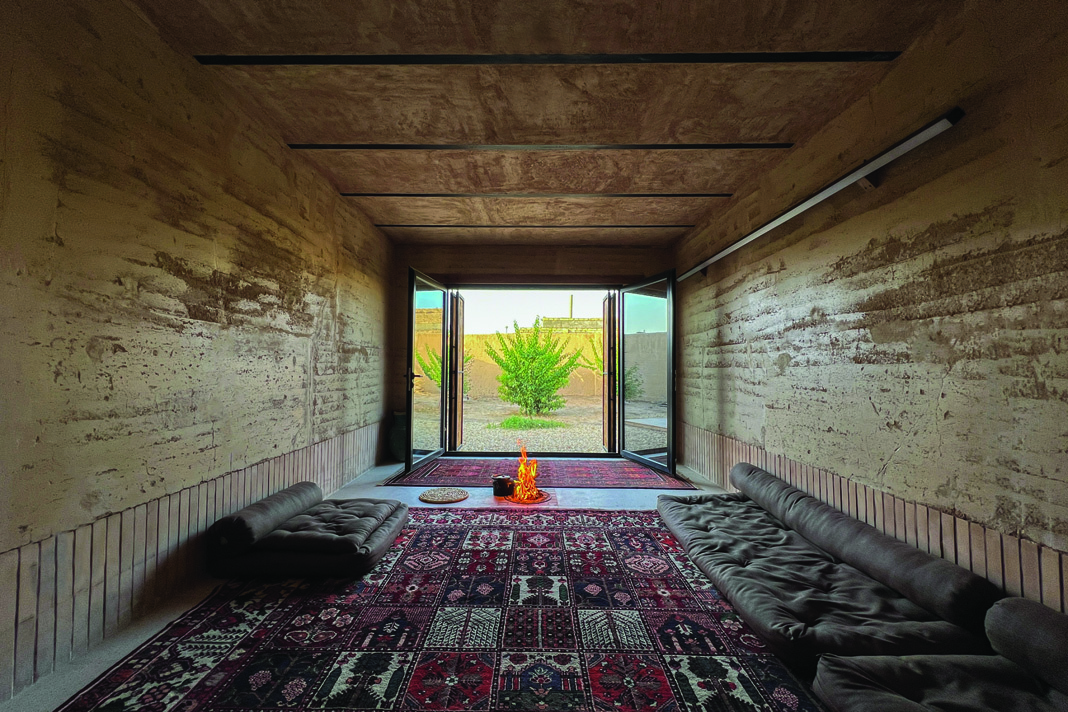
Living room interior with rammed earth walls, floor cushions and traditional rugs, a fire pit in the center, and full-height glass doors opening to the garden
The living room — floor cushions, traditional rugs, a central fire pit, and glass doors opening to the garden
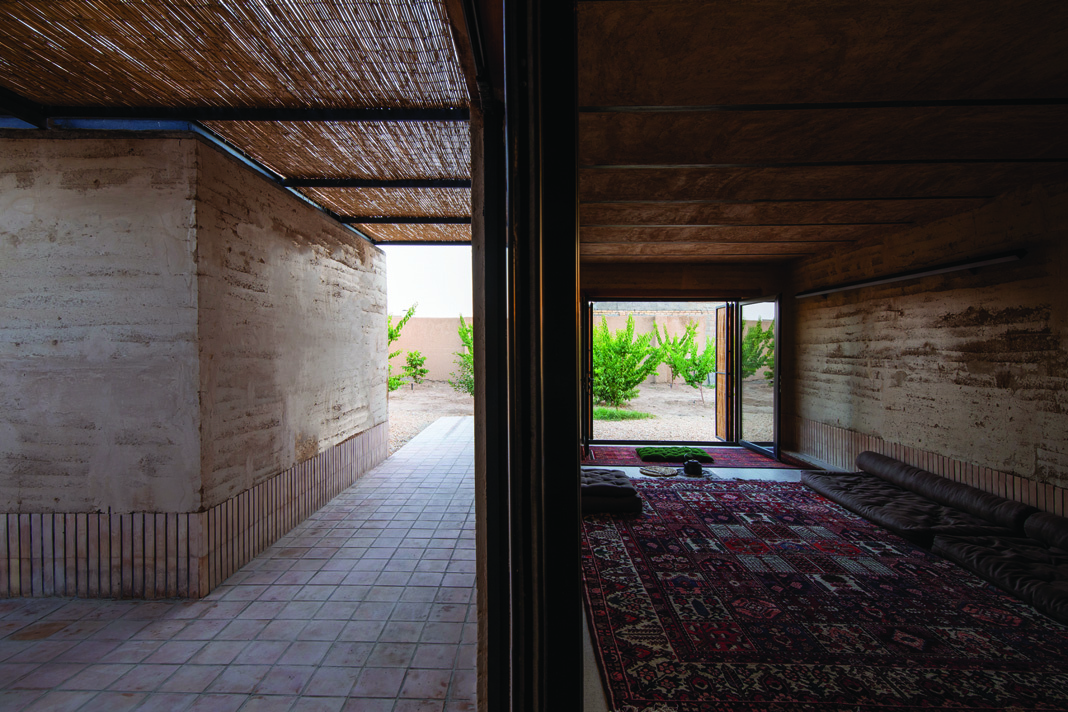
View from the covered passage showing the living room on the right with cushions and the courtyard ahead, with reed canopy overhead
The passage mediates between the living room and the courtyard — oscillating between inside and outside
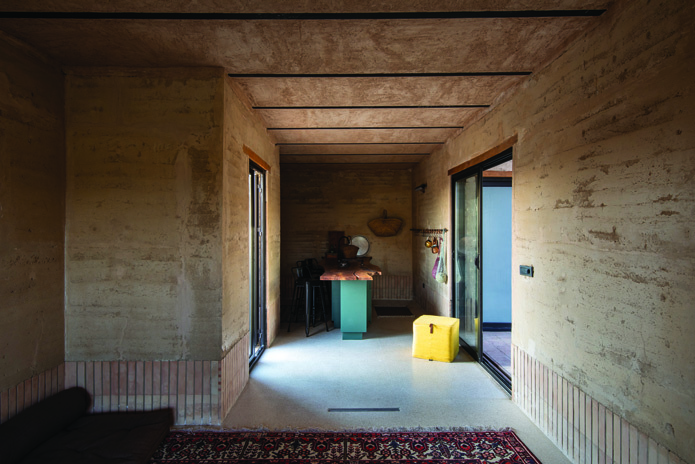
Interior hallway connecting to the kitchen area with rammed earth walls, colorful furniture, and natural light from glass doors on both sides
Hallway and kitchen with rammed earth walls
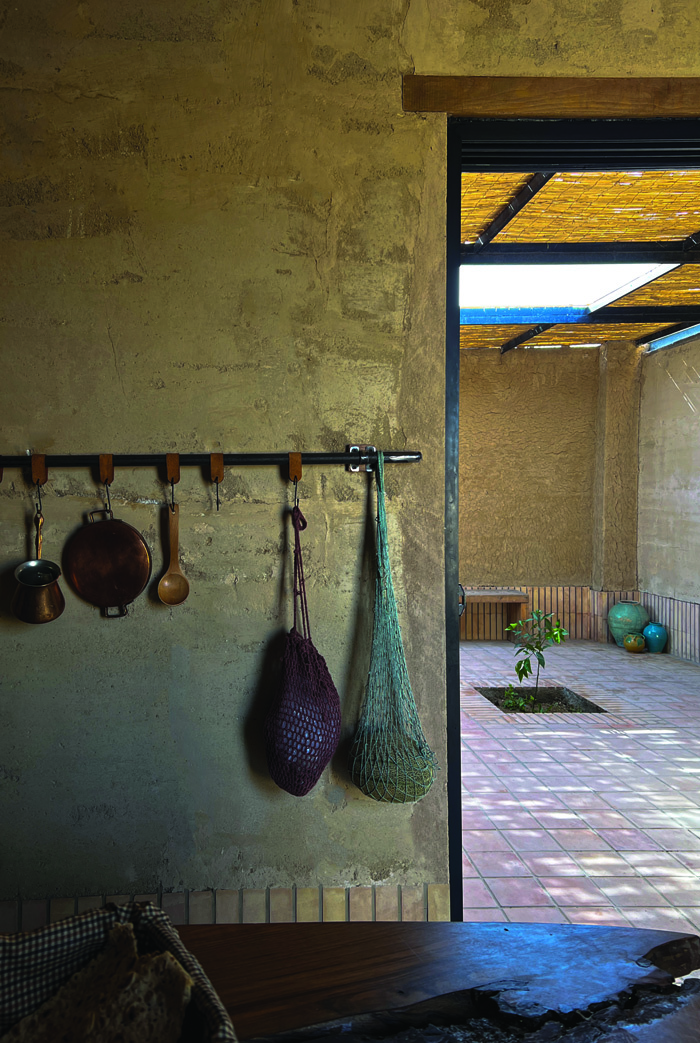
Kitchen detail showing hanging copper pots, woven bags, and rammed earth walls, with a view through to the reed-canopied courtyard beyond
Kitchen — copper pots and a view to the courtyard
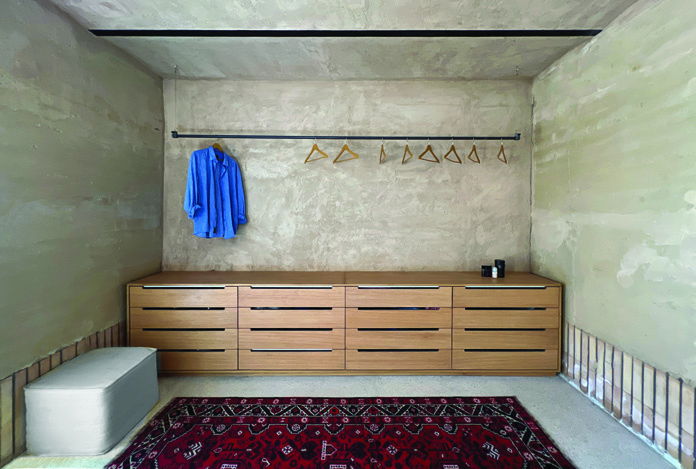
Dressing room with wooden drawer cabinet, clothing rack, rammed earth walls, and a traditional rug on the floor
The dressing room — minimal furnishing, rammed earth walls
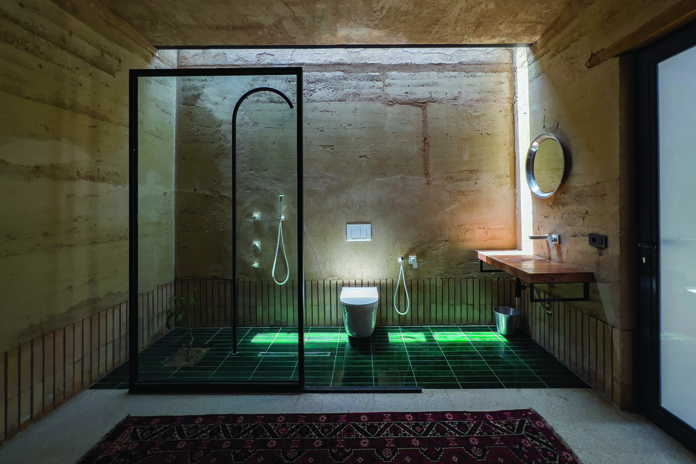
Bathroom with green tile floor, glass shower partition, rammed earth walls, round mirror, and warm underlighting
Bathroom with green tile and rammed earth walls
◆ ◆ ◆

This house, with its earthy bearing and that same humility blended with pride, with low energy consumption and modest cost, gradually took form — to stand firmly in its place, to endure for years in the bosom of its homeland, and ultimately, without polluting the environment, to rest peacefully in the embrace of nature.


Dusk view of the Khaki House showing the warm glow of the interior through glass doors, the rammed earth walls, and the covered passageway between building volumes
Khaki House at dusk — an earthy bearing, a humility blended with pride
Memar Magazine
Iranian Bimonthly on Architecture and Urban Design · Issue 142 · December 2023 – January 2024

Related in Architecture Database

Khaki House, Isfahan