



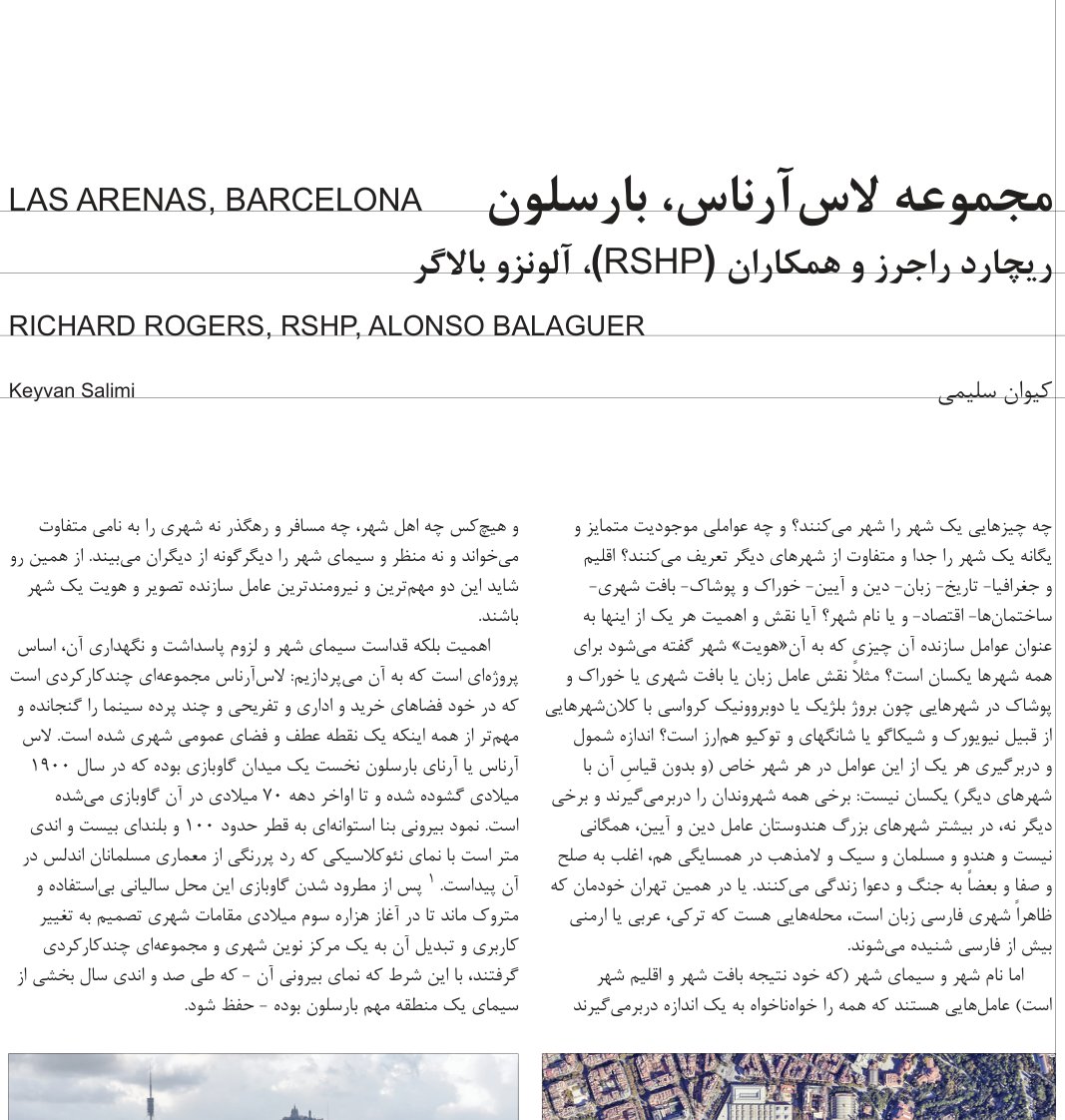
The question of what to do with a building that has outlasted its original purpose — that has become historically significant, architecturally distinctive, and functionally obsolete — is one of the defining challenges of contemporary urban architecture. Las Arenas in Barcelona, a Neo-Mudéjar bullring completed in 1900 at the head of the Gran Via on the Plaça d'Espanya, posed this question with unusual force. It was large, prominent, culturally charged, and entirely unsuited to the uses that the twenty-first century city required of it.
The solution developed by Richard Rogers Partnership (now RSHP) in collaboration with the Barcelona firm Alonso Balaguer is radical in concept and conservative in execution — a combination that is easier to describe than to achieve. The concept: hollow out the interior of the building entirely, retaining only the historic facade, and insert within it a new multi-story commercial and cultural complex. The execution: preserve every element of the exterior that carries architectural value while creating, behind it, a wholly contemporary environment.
The arena's original floor level was excavated to street level, creating a ground floor where the arena pit had been. Four diagonal passages cut through the base of the building at the cardinal points, meeting at a central circular atrium that extends the full height of the structure. These passages — generous in dimension, naturally lit, lined with commercial activity — organize the flow of visitors through the complex and give the interior its spatial clarity. They recall, in their function if not their form, the vomitoria of ancient amphitheaters: the passages through which crowds entered and exited the arena.
Above the historic cornice line, where the original building ended, a new addition rises: a shallow dish-shaped structure, seventy-six meters in diameter, that contains a rooftop plaza, a cinema, restaurants, and viewing terraces. This element is entirely contemporary — a ring of glass and steel that makes no attempt to replicate or extend the historical language of the facade below. The contrast is intentional and, in the event, successful. The historic facade and the contemporary dome are sufficiently different in scale and character that they coexist without confusion.
The rooftop is perhaps the project's most unexpected gift to the city. The terraces look out over the Montjuïc hill, the Tibidabo ridge, and the dense fabric of the Eixample stretching toward the sea. The Plaça d'Espanya, seen from above, reveals itself as a remarkable urban composition: the fountain, the twin Venetian towers, the long perspective of the Gran Via. Visitors who ascend to the roof for the restaurants or the cinema often find themselves pausing, surprised by the quality of the view.
The project raises important questions about the conservation of urban identity. The Las Arenas facade is not merely a historical artifact; it is a spatial reference for the entire quarter, a fixed point against which the surrounding urban fabric orients itself. To demolish it would have been to damage something in the structure of the city's self-understanding. To preserve it while making it serve contemporary purposes required a kind of architectural tact — a willingness to subordinate formal invention to contextual responsibility — that is not always available in the profession.
As Soheila Beski wrote in her editorial "Crisis of Suspension" (Memar 37, 1385): "The city is not merely a collection of buildings. It is a record of shared memory, a landscape of accumulated meaning. When we alter it, we alter the memory. When we erase it, we erase the self." Las Arenas is, in its own way, an attempt to alter memory without erasure — to carry the past into new uses while preserving the spatial and visual cues through which a city recognizes itself.