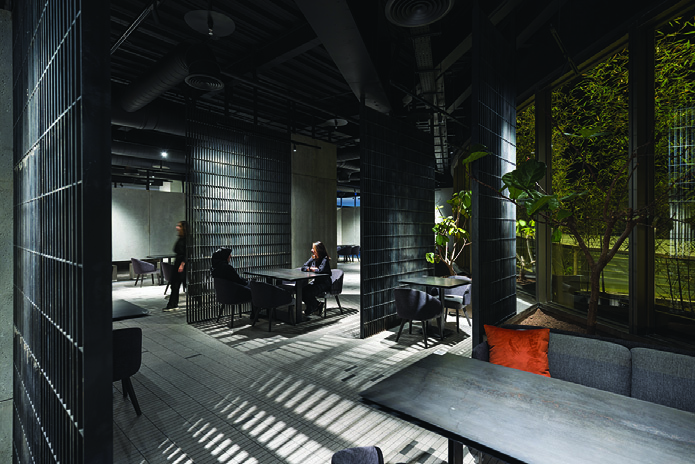
"...We are born of light. The seasons are felt through light. We know the world in the form that light brings into being, and the thought comes to mind that matter is spent light. For me, natural light is the only light—it provides a basis for human agreement—because it has mood and places us in touch with the eternal. Natural light is the only light that makes architecture architecture..." Louis Kahn
"The worship of light is woven throughout the whole of human existence... Even today, most of the time unconsciously, we are under its dominion. Daylight draws us from the half-life of sleep and returns us to living: 'to behold the light of the sun,' 'to be brought to the light' means to be born; 'to depart from the light' means death..." Hermann Usener
"It is only through light that the house becomes human, appears to resemble a human being. It is an eye that opens onto the night." Gaston Bachelard
"...Light and shadow are the loudspeakers of this architecture of truth, calm, and power. Nothing else can be added to it." Le Corbusier
The precious gift of light. Traditional Finnish smoke cabin in Karelia. Perttinotsa house, built in 1884, now in the Seurasaari Open-Air Museum in Helsinki. The focusing light of painters. Georges de La Tour, Saint Joseph the Carpenter, 1642, oil on canvas, 137 × 102 centimeters. Paris, Musée du Louvre.
Materiality and Tactility of Light. Space and light are inseparable, for in the absence of light no architectural spatial experience can exist. Even those spatial experiences perceived in absolute darkness through hearing, touch, or smell depend on an understanding of space established through vision and light. Eiler Rasmussen recalls the powerful auditory perception of Vienna's underground tunnels, which serve as the principal settings for Orson Welles's film The Third Man: "Your ear receives the effect of both the length and the cylindrical shape of the tunnel." All genuine architectural experiences are embodied and multisensory. Every distinctive space and place has its characteristic light, and often it is this quality that most directly conditions our mood. Light can even be one of the defining features of geographical regions—for example, the stark difference between the scorching vertical light of equatorial regions and the melancholy horizontal light of polar regions, the gentle light of a moonlit night, and the warm, colorful, emotional light of sunrise and sunset. The light of the endless summer is magical, while the scant light of the interminable polar winter night appears to emanate from below, as the snow reflects the faintest light from the celestial dome and disperses it mysteriously. Light controls biological processes, and even specific hormonal activities in humans are dependent on light. It affects our mood, activity level, and energy.
Today, in the darkest months of the Scandinavian winter, bright lamps are used in homes and cafés to compensate for the absence of daylight. Light and shadow give personality and expressive power to volumes, spaces, and surfaces, and reveal the shape, weight, hardness, texture, moisture, smoothness, and temperature of materials. They also connect architectural space to the dynamism of the physical and natural world, to the seasons and hours of the day. Paul Valéry asks, "What is more mysterious there than clarity?... What more capricious than the way in which light is distributed over the hours and over people?" Natural light breathes life into architecture and connects the material world to cosmic dimensions. Light also possesses its own mood and expression; it is undoubtedly the most delicate and emotionally potent medium of architectural expression. No other architectural medium—spatial configuration, geometry, proportion, color, or detail—can convey emotional crescendos as profoundly and subtly, from melancholy to exhilaration, sorrow to ecstasy, grief to joy. The blending of cool northern sky light and warm southern sky light within a single space can produce an intoxicating delight. Light and shadow articulate spaces and places, multiplying space into sub-spaces, imparting rhythm, a sense of scale, and intimacy. Light guides movement and attention, creating points of importance and focus. The paintings of Rembrandt and Caravaggio demonstrate the power of light in establishing hierarchy and focal points. Their paintings are figures and objects embraced by the soothing repose of light and gentle shadow. In the paintings of Georges de La Tour (1593–1652) and Louis Le Nain (1603–1648), a single candle flame suffices to create an intimate, enveloping space and a powerful sense of concentration. Until light is bounded by space or defined by the surface it illuminates, it tends to be experientially and emotionally absent. "The sun never knows how great it is until it strikes the side of a building or shines into a room."
Through a mediating substance such as cloud, fog, smoke, rain, snow, or ice, light becomes a kind of luminous virtual matter. When light is perceived as matter, its emotional impact intensifies. The paintings of J.M.W. Turner and Claude Monet are examples of such enveloping atmospheric light, made palpable through the humidity of the air. Alvar Aalto's daylight arrangements, using curved white surfaces, reflect daylight repeatedly, and the chiaroscuro that rounded surfaces create gives light an experiential materiality, plasticity, and intensified presence. This is molded light that possesses the feel of substance. Even the gratifying fixtures of artificial light, such as those designed by Poul Henningsen and Alvar Aalto, articulate and shape light, as if slowing it down, causing it to bounce playfully back and forth among the curved surfaces and edges of the light fixtures. The thin ceiling slits of Tadao Ando and Peter Zumthor drive light into thin guiding blades that cut through the darkness of space like immaterial sheaths or blades of light. In the buildings of Luis Barragán, such as the Capuchinas Sacramentarias Chapel in Mexico City, light often becomes a warm, colored liquid that evokes resonant qualities suggesting a kind of sound—an imaginary murmur. The architect himself writes, "A gentle inner murmur of silence." Light can also mediate weight or weightlessness. In Kjell Lund's St. Hallvard Church in Oslo, the darkness and weight of the space beneath the suspended concrete cylindrical ceiling is intensified by sparse sources of light, while the gallery spaces of Renzo Piano's Menil Collection in Houston, Texas, are immersed in a wandering light that seemingly suspends the force of gravity. In today's architectural profession, unfortunately, light is often treated as a purely quantitative phenomenon; design rules and standards specify minimum illumination levels and window sizes, but do not specify maximum illumination levels or the required qualities of light—for example, orientation, warmth,
structure, ornament, and light in a Bavarian Rococo church create an ambiguous, quasi-jungle-like space. Johann Michael Fischer, Ottobeuren Abbey Church, Bavaria, Germany—view toward the altar within. A space graced with transparent, enveloping, and colorful light. Luis Barragán, Capuchinas Sacramentarias del Purísimo Corazón de María Chapel, Tlalpan, Mexico City, 1955.
Color or reflection. Our buildings often admit far too much light and distribute it too uniformly, thereby weakening the sense of place and intimacy. A space with uniform light and no shadow has an alienating effect. In the final section of the film 2001: A Space Odyssey (1968) by Stanley Kubrick, a room decorated in a simple Rococo style is lit from below through a glass floor, and by reversing the natural direction of light, a sense of disquiet is produced. Human vision is activated and intensified in chiaroscuro. As James Turrell, the light artist, points out, the process of evolution has calibrated the human eye for chiaroscuro and not for bright daylight. Current illumination levels are so high that the full capacity of vision is overwhelmed. Paradoxically, our culture worships sight and observation yet simultaneously weakens visual capacities through excessive light. This is a consequence of associating weightlessness and whiteness with health and survival in the modern era, and a consequence of the desire for an abundance of light. One logical result of this desire is that from the mid-nineteenth century, most modern architects have been obsessed with large glass surfaces and consequently high levels of light. It is no surprise that Luis Barragán, the alchemist of architecture, believed that most modern buildings would be more pleasant with half their windows. "The use of very large windows... has deprived our buildings of intimacy, the effect of shadow, and atmosphere. Architects throughout the world have erred in the proportions they have allocated to large windows or spaces that open outward..., we have lost the sense of intimate life, and have been forced to live a public life essentially away from home." Contrary to the prevailing modern sensibility, the Säynätsalo Town Hall and Sigurd Lewerentz's spiritual spaces create a comforting darkness that facilitates the experience of concentration and religious meditation. In both cases, dark and rough brick that appears to absorb all
reflected light emphasizes the darkness. The deep crack in the brick floor, together with the slow dripping of water drops from the great conch shell in Lewerentz's St. Peter's Church, reflects and underscores the darkness of the space. It is in relation to darkness and shadow that light gains greater value and emotional power. In the very dark primitive smoke cabin of a Finnish peasant, the light from a single, very small window feels like a precious gift—a shining diamond of light bestowed upon the inhabitants against a backdrop of dark straw. The irreplaceable value of darkness and shadow is the inspiring lesson of Jun'ichiro Tanizaki in his book In Praise of Shadows. He notes that even Japanese cuisine depends on shadows and is inseparable from darkness: "And when yokan is served in a lacquered dish in whose dark recesses its color can scarcely be distinguished, it is as though the darkness of the room itself were melting on the tongue." Shadows and darkness are essential because they temper the sharpness of vision, obscure depth and distance, and accommodate unconscious peripheral vision and the fantasy of touch. As Frank Lloyd Wright stated, "Shadow itself is of the light." We are typically unaware of the power of the tactile and embodying components of our visual perception. Although we are unconscious of it, the skin has retained the capacity to sense and distinguish light and color, and these sensory capacities, normally suppressed, apparently become activated in cases of lost or weakened sight. Hence, although light is understood as a purely visual phenomenon, it is also connected to tactile perception. Consequently, James Turrell speaks of "the thingness of light" and remarks, "Basically I make spaces that capture light and hold it for your physical sensing... This... is recognizing that eyes touch, that eyes feel, and when the eyes are open and you give feeling a chance with these works, touch goes out from the eyes like feeling."
Weightless and indirect light in an art gallery. Renzo Piano, Menil Collection Museum, Houston, Texas, United States, 1982–86. The weight of darkness; a space made of benevolent shadow contrasted with light infiltrating through brick walls. Kjell Lund / Lund and Slaatto, Hallvard Church, Oslo, Norway, 1958–66.
Turrell's light works are based entirely on the experiential qualities of light and the characteristics of our perceptual mechanisms, yet they also produce spatial experiences that redirect our judgment of figure and ground, far and near, horizon and gravity. His works are perceptual miracles that transform space into surface, depth into flatness, light into material and form, and color into substance. These imaginary perceptions apparently possess tactile qualities and a sense of materiality, pressure, and weight of their own. The stained-glass windows of the Rosaire Chapel in Vence, France, conceived by Henri Matisse, transform light into colored air, evoking delicate sensations of skin touch, pressure, and oscillation; being present in such buildings is like being submerged in a transparent, colored substance. In these projects, including the D.E. Shaw and Associates offices in New York (1991) and St. Ignatius Chapel in Seattle (1994–1997), Steven Holl, using reflected light and color, creates a sense of the pulsating mixture of color and light—a condition that paradoxically and simultaneously intensifies both the immateriality and the objecthood of light. This is a breath-like, caressing, and healing light that connects us to the ever-changing nature of daylight and displays a cosmic atmosphere. James Carpenter, another light artist, claims about tactility: "There is a sort of tactility in something that is immaterial, which I recognize as more or less extraordinary. With light you are dealing with electromagnetic wavelengths that pass through the retina, and yet it is tactile. But it is not the kind of tactility that requires something you can pick up and hold... Eyes tend to interpret light and import into it a kind of materiality that is not actually there." We simultaneously inhabit two dwellings: the physical world of matter and sensory experience on the one hand, and the mental world of cultural reality, ideas, and intentions on the other.
These two worlds form a continuum—a kind of existential singularity. Beyond utilitarian purposes, the profound task of architecture, as Merleau-Ponty writes about Paul Cézanne's paintings, is "to reveal how the world touches us." The world touches us, and we touch the world, essentially through the medium of light. "Through sight, we touch the stars and the sun."
Tactile colored light as a colored substance. James Turrell, Raemar, 1969, fluorescent light, as installed in the Whitney Museum of American Art, 1980.