If the continuity of the eras of design were possible only on the basis of the linear extension of past achievements, the scope of its development would be confined within the same limits — within the views, values, and known processes of the past historical periods.
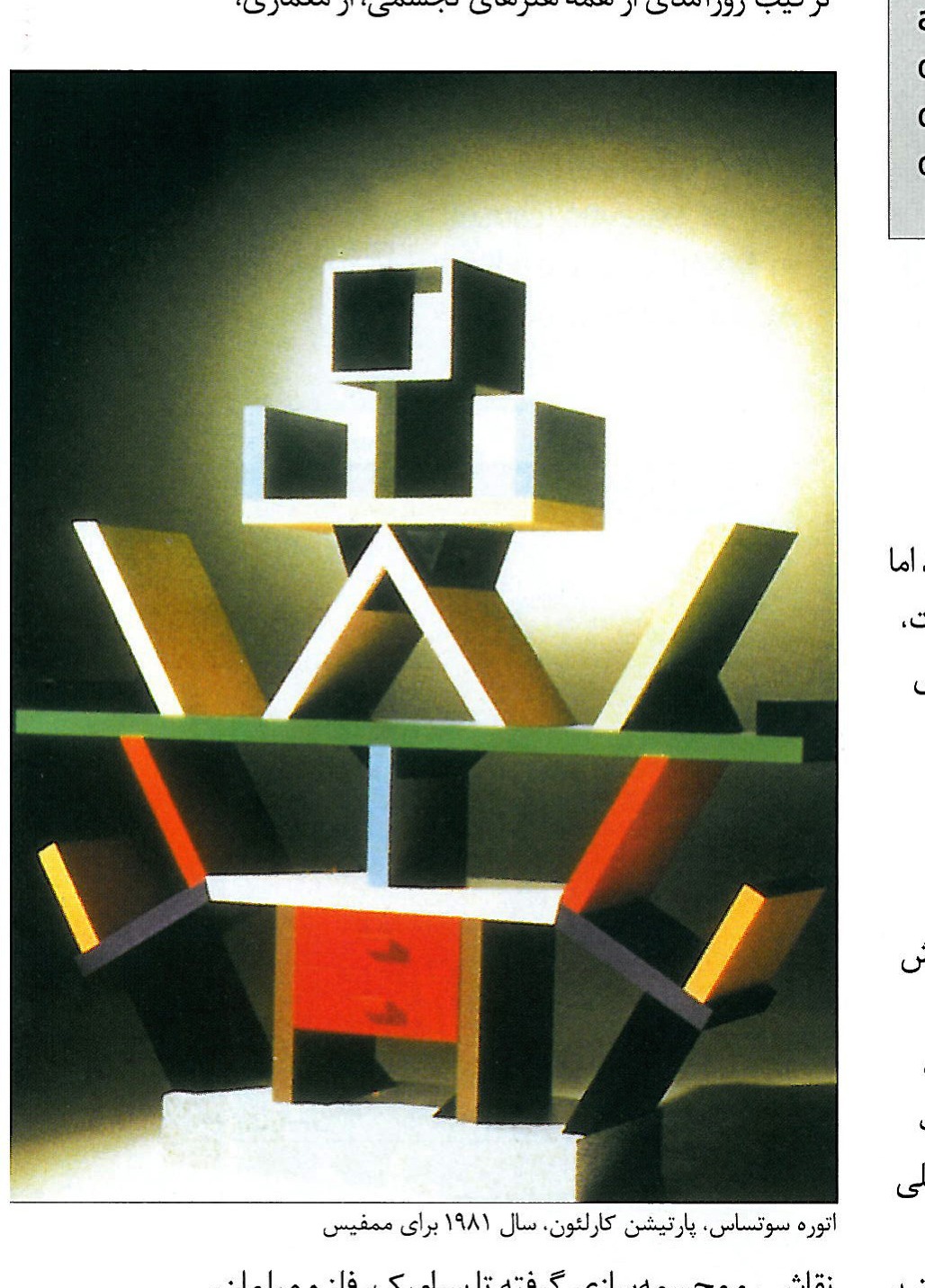
The high-water mark of all the movements and inventions which, after Pop Art and following on from it, are called Post-Pop, gave rise to a wave that came into motion with the gathering of a sizeable number of designers, architect-designers, and beyond that, a number of artists from other fields of the visual arts in the Memphis group. Memphis — beyond the ironic metaphor present in its name (which is at once the name of an ancient city in Egypt, the name of William Tucker's sculpture studio in the 1960s, and a rock-and-roll group) — was founded by Ettore Sottsass in 1980.
Members and composition of the group
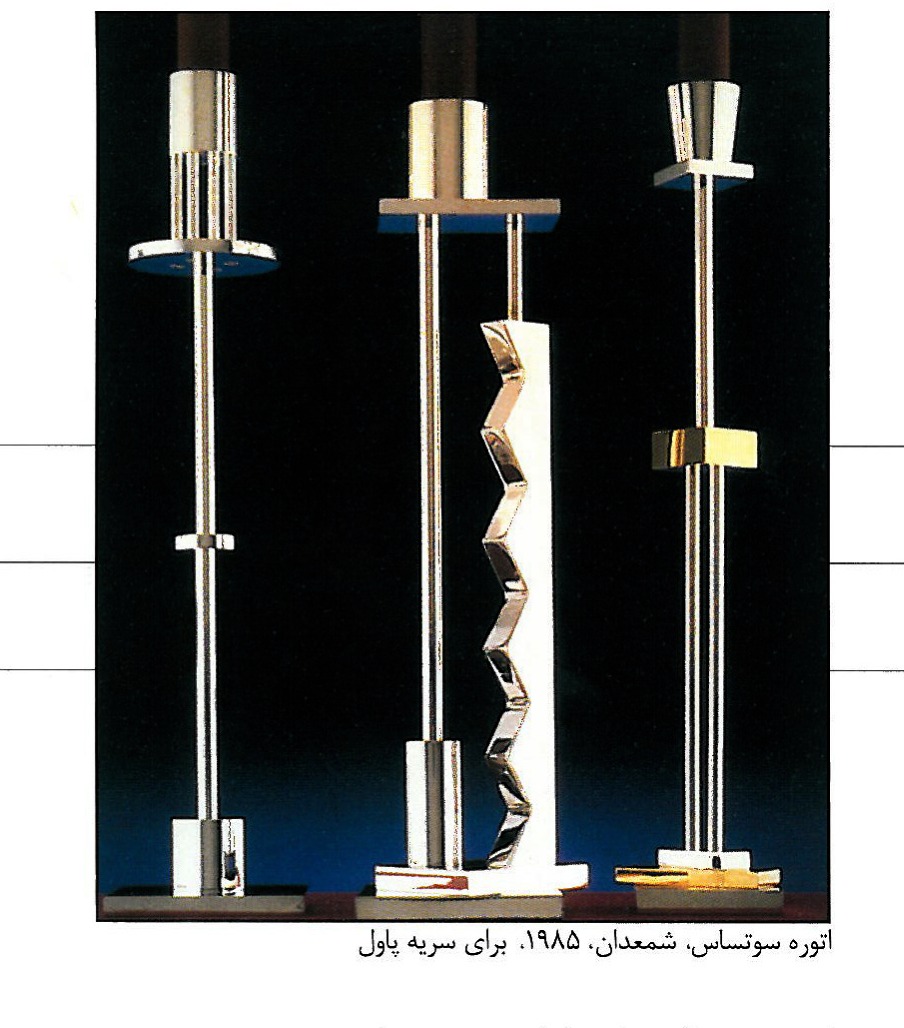
Through the collaboration of figures such as Nathaniel De Pasquier, George Sowden, Andrea Branzi, Michele De Lucchi, and Peter Shire, in the course of five years the Memphis studio became one of the most influential design groups. Wood, used as the principal compositional material, and coverings of dissimilar materials — metal, ceramic, glass, resin, and even building materials — in furniture and products often produced as one-offs, made for a kind of reflection of the American Pop and Postmodern influence.
Function, functionalism, and a new sense of it
From the start, the designers of Memphis tried to transform the meaning of function. As Catherine Hayinger writes in Design Since 1945: 'The Memphis designers do not deny function, but see it from a different angle — beyond the anthropologist, as a marketing specialist.' The Memphis design-thinking, then, is not only addressed to the careful considerations of ergonomics and to such factors as maximum profitability, but is at the same time the embodiment of a new cultural vision and an arena in which a new historical necessity may be exerted: the dynamic exchange of value between form and function.
Although the designers of Memphis used industrial materials, and although their style was no longer an international one, their products were expensive and limited in production, available only in the specialised stores of tradition. The work pursued the spread of a formal language, but the negation of the elementary achievements of functionalism. Sottsass held: 'The quality intended for good design does not mean precise compliance with the historical continuity of design's achievements, but rather submission to historical change, the evolution of anthropological readings, and the principle in design — the human's sense of curiosity in the course of being, and the effort to arrive at its virtual image.'
The cultural setting
Through a decade of variety, where history and culture stand at the threshold of transformation, Memphis as a powerful current carries upon its shoulders some part of that transformation's weight. The breadth of Memphis's influence in the eighties is comparable to the up-to-date combination of all the visual arts — from architecture to literature — in the manifest cultural impact upon product design and in the formulation of a fresh and arresting vision of design.
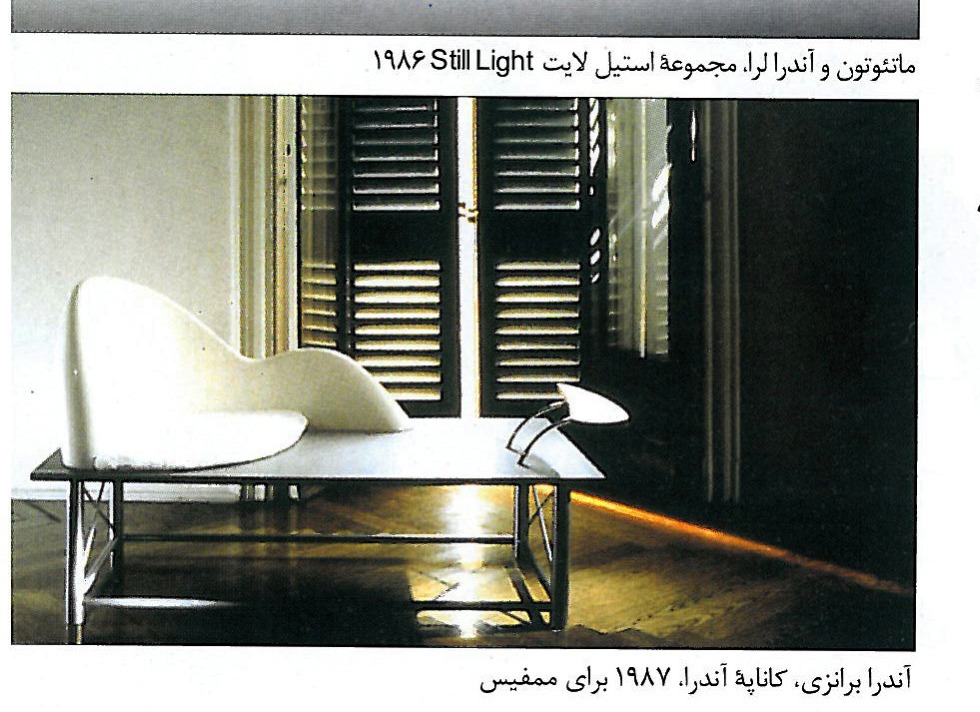
Memphis was able to draw to itself a body of architect-designers, many of them under thirty years of age; architect-designers such as Graves and Hollein, in spite of their differing views, willingly worked with Memphis. The group succeeded in calling on designers such as Matteoton, Xavier Mariscal, Shiro Kuramata, and Peter Shire to collaborate, and held the annual design exhibition in Milan every September — a creative arena of exchange for members of the design community.
Less is bore
Symbolism and the use of pattern and ornament were features of the prewar mood; the rejection of decorative styles in design in the postwar years was therefore in some sense intelligible. But the continuance of design on the large scale — vast buildings with steel-and-glass façades welcomed by American corporations and economic concerns — had narrowed the field for European designers. Against the Bauhaus design — which now seemed dry and geometric — architects and industrial designers turned toward design with an aim beyond mere function, and against Mies van der Rohe's slogan Less is more they raised the cry of Less is bore.
In such a climate, the first Memphis exhibition in 1981 was taken as a reaction against a bitter, declining modernism. They claimed that their aim was not to put forward colour and ornament, but, by using bold colours and rough textures, to seek the creation of spaces full of excitement and imagination. The time had come for functionalism to lose its authority bit by bit. 'Less is more' had now begun to look mournful.
Sottsass, Olivetti, Alchimia
The Italians, for whom obtaining a position in the great postwar movement of urban reconstruction held no great attraction, chose a smaller subject — the design of furniture — a challenge that engaged Italian designers. Ettore Sottsass, born in Austria and educated at the University of Milan, was forward-looking and, in the American view, somewhat cunning. He, who in the 1950s was working for Olivetti and in his free hours studying Eastern art and the arts of the third-world countries, brought into Olivetti's designs a dose of mischievous schemes mixed with a flavour of idealism. As a result, the Valentine typewriter and the first computer made by the Olivetti company (the ELEA) entered Sottsass's design world, and the design of Italy was transformed.
In the 1970s Sottsass joined other designers who felt that modernism held no future for them, and founded the Alchimia studio. The first group reaction Sottsass put forward against modernism, the founding of Memphis in 1981, was in fact the continuation of a movement that had begun a decade before.
The objects and the Memphis signature
Memphis comprised a group of designers, architect-designers, and a journalist, Barbara Radice, who served as artistic director and head of public relations. Memphis's works were a body of unusual objects, produced in limited numbers and very expensive — objects bearing the Memphis signature, with plastic-laminated surfaces, bold and daring colours, and rough, varied textures.
Translation and introduction: Armand Dror.



