



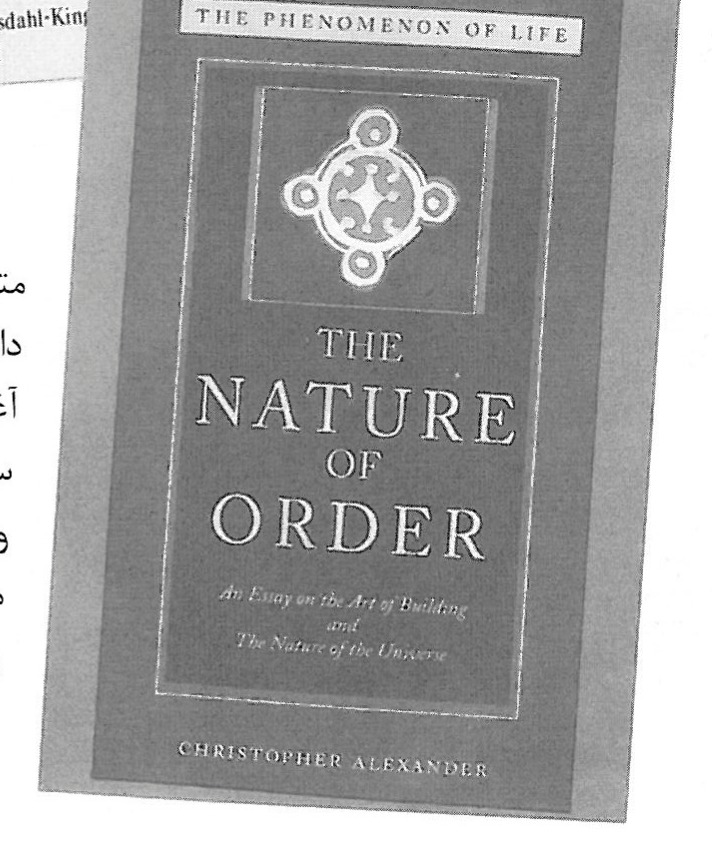
Part 1 — Ever more popular, ever more dogmatic: the sad sequel to Christopher Alexander's work
By William Saunders. Translation by Pardis Forouzi.
Source: Architectural Record, May 2002, pp. 93-94-96.
The Nature of Order, Book One: The Phenomenon of Life — Christopher Alexander. Oxford University Press, New York, 2002. 472 pp. US $75.
A Pattern Language: Towns, Buildings, Construction — Christopher Alexander, Sara Ishikawa, Murray Silverstein, with Max Jacobson, Ingrid Fiksdahl-King, Shlomo Angel. Oxford University Press, New York, 1977. 1,171 pp. US $65.
Fame and popularity can be ruinous for a creative person. Especially when surrounded by admirers, creative people may lose their power of self-criticism, fall into the trap of opinions others form about their work, and start imitating what they once made out of passion, error and creativity. On the other hand, fame can drive a creative person into stubbornness.
One of these examples is Christopher Alexander. Through his first major book, A Pattern Language, he reached early success in academic circles. Then, while his popularity with the general public continued to climb, his standing among specialists declined. His most valuable book — A Pattern Language itself — has been one of the best-selling architecture titles in America over the last decade; but that book and his other writings have gradually been removed from the syllabuses of the architecture schools. The administrators of A Pattern Language's website (launched in 2000) report that the great majority of its visitors are home-builders and home-owners; only a small fraction are architects. While Alexander's current admirers are many and consider his words sacred, what may explain why his recent book — The Phenomenon of Life, the first of a four-volume work known as The Nature of Order — is so saturated with self-aggrandizing illusions and is so trying, is the fact that since the 1980s Alexander's writings have been received both with excessive attention and with excessive indifference.
He has reason to be uneasy. The much-loved author of the flawed yet attentively-read A Pattern Language has now produced a self-deluding, disorienting, disorderly, weak, repetitive book full of contradictions, vague generalities and unsupported maximal claims — as I shall show. In this book Alexander, without any explanation, calls deconstruction "deconstructionalism", makes grammatical mistakes, refers the reader mostly to pre-1980 publications, and so on. In short, I would call this book an uncorrected proof.
Alexander's reputation as a thinker began with his doctoral years at Harvard. In 1963, with Serge Chermayeff, he published Community and Privacy, and presented his thesis on the synthesis of compositional forms. In those happy days, before he was canonised, he wrote his most original and rich essays, including A City is Not a Tree (1965), still studied case by case in some architecture schools. In 1967, animated by an almost evangelical sense of mission, he secured his post as instructor at the University of California, Berkeley, and was commissioned by the National Institute of Mental Health to set up the Center for Environmental Structure. The early research of the centre became the substance of A Pattern Language in 1977.
One of the important virtues of that book is that it shows how certain environmental structures can promote certain skilful qualities. (I almost wrote "certain desirable qualities", but stopped, lest I fall into Alexander's own trap — the trap of refusing to admit that the qualities of life he prizes may not be valued by everyone.) Alexander's ideal life — both in A Pattern Language and in the new book — is a Californian-Mediterranean life: easy, very pleasant, sociable, full of free time for company and self-cultivation, like a holiday. He cannot conceive that some people might prefer a more strenuous, contradictory, agitated life, or that his ideal life might give way to self-regard, self-loss and indifference. In architecture, his preferences run to ornate buildings with elaborate detail and decoration — his exemplar is the Alhambra — and lead him to condemn every minimalist work with great vigour.
A collection brimming with strategies
In any case, if we are after the kind of life Alexander preaches, A Pattern Language offers a large, rich and instructive collection of strategies. Its great strength is the detailed description of the pleasant minutiae of everyday life and of its spaces. Alexander and his colleagues conducted extensive fieldwork through close observation, the gathering of photographs and the use of their own experience.
If we read this book as a varied collection of information from which one might select for use, it is a book of many — perhaps mostly — useful prescriptions. The book introduces ideas worthy of being told and retold. The point that rooms should receive daylight from at least two sides, for example, may seem obvious — yet new offices and houses very frequently neglect this rule. There are less familiar prescriptions, too: to enhance the privacy of small homes by stacking them either horizontally or vertically; to improve the daylighting of row houses by making them broader and shallower; and — most interesting — that people need varying degrees of privacy and social interaction, and that buildings should provide spaces (such as balconies overlooking the street) where occupants can choose between engagement and withdrawal. A Pattern Language, in identifying ideas that the New Urbanists would later codify in the 1990s — multi-use spaces, pedestrian zones and so on — anticipated its own time.
As a varied collection of information, A Pattern Language will always reward study. But Alexander has always wanted his readers to use this book not selectively but as a complete and integral whole, taking on board all of his proposed design principles. While putting forward ideas about creating spaces that increase individual freedom, spontaneity and even some chaos, he prescribes them in an authoritarian voice. Consider the following sentence: "Buildings should always be built on the part of the land that is in the worst condition, not the best." The book seeks to dictate planning and design decisions at every scale, from site selection to window frames. Alexander's idea of maximising individual control, as the book preaches it, leads to the point that to apply many of his prescriptions one would have to abolish public oversight altogether — for instance, the rule that all houses and shops must be owned by those who run or live in them. The contradiction that freedom is to be obtained only through Alexander's prescriptions runs through the whole book. A Pattern Language on its website tells the visitor: "Our emphasis in designing anything — from a single entrance to a whole house — is that it must be done step by step." The truth is that the website demands more of the reader's submission than the book itself; consider that millions of Americans buy how-to books every year — they too want a controlling authority over them.
A unified system for the creation of environments that must respond to our unforeseeable needs and to our diverse temperaments is both impossible and intrinsically self-defeating. Following some of the book's prescriptions — for example, breaking the urban surface into local-transport spaces 75 to 300 metres long — prevents the application of others, such as the rule that "urban fingers" should never extend more than 1.5 km. Were the centre of a town to be designed in compliance with all the book's prescriptions, an entangled bundle of contradictory elements would emerge — a chaotic bazaar of cemeteries, natural springs, carnivals, small museums, playgrounds, animal shelters, hostels, bars, maternity wards, swimming pools, residential buildings and farmlands. Alexander's authoritarian effort to assemble an all-embracing system works, against his best intentions, to extinguish the very spontaneity he so loves.
In the end, A Pattern Language is most useful for those whose indifference to Alexander matches the indifference Alexander expects of us in his ideal world. We can take up his rules according to our own needs, wishes and circumstances. If we were to follow them as our own feelings dictate, the result might be a delightful ruin, full of cracks and astonishing twists accumulated over centuries. Alexander's intentions — preaching the highest enthusiasm for life — present him as a fundamentalist idealist who wishes to set the world right. He becomes so absorbed in promoting a better life that he forgets the messy garments of practical reality, and sinks so far into childlike dreams that his wishes lose all bridle. He recommends, for instance, communal bathing with family and friends, or handing the running of a school over to its pupils. His childlike (if naive) belief is that human beings are essentially good, and his childlike hope is that goodness will reign in his ideal world.
Giving reality to subjective notions
Unfortunately his latest book carries all the faults of A Pattern Language with little of its virtues. Those who liked the earlier book for its concrete details and its proposals for raising the quality of everyday life will be disappointed by the new one's tendency to abstraction and its distance from common experience. The Phenomenon of Life, on which Alexander spent thirty years, recalls the half-mad Mr Casaubon of George Eliot's Middlemarch: through his maturity Casaubon labours to put together a great synthesis of all mythologies; his idealism overruns his powers, and his important but useless project cuts him off from others and from social reality. Alexander's new book brings other literary figures to the reader's mind — Don Quixote, who attacks windmills with all his force in the delusion of fighting imaginary enemies; or King Lear, who desperately needs the loyalty of those around him and demands that the world conform to his image of that loyalty, fleeing into fantasy rather than face the bitter truths of life.
In reviewing a book it is not always proper to dwell on the author's mind and inner life — but Alexander has dedicated a large part of his book to his own mind and inner life: "Some days I think about the theory I have set out in these four books and I can hardly believe it is true. This theory presents an astonishing image of the world; it almost looks like a fantasy." "Saint Theresa struggled with her own faith. In moments of doubt she sometimes saw, just for an instant, that she really did believe — and for this she was forgiven. I have always been in a state like Saint Theresa's. Often I ask myself: do I see the matter clearly in lucid moments and feel that this theory must be true, simply because no other explanation can match it for completeness and persuasiveness; and then, in a more sceptical mood, do I doubt? — for it is hard for an empirical person like myself to believe that the metaphysical part of the matter, especially what I have set out, is real."
This is all so intensely personal — and his analogy between his belief in his own theory and belief in God is so strange and grandiose. But Alexander is right that his contradictory thoughts run through the whole book, in both their metaphysical aspect (what cannot be seen or measured) and their practical aspect.
The Phenomenon of Life claims that the subjective is not really subjective but lies, "out there", in the objective world. Alexander attributes to objects a sense of essence and even feelings: a wave can be full of fury, a plain can be kind. According to Alexander, stones can be ranked by their degree of vitality, because some visual qualities give rise to the force of life and, in fact, are themselves the force of life. Alexander claims to have discovered fifteen such qualities. They include: essential differences of scale, clear boundaries, desired forms, slopes and roughnesses.
And how has he discovered these qualities? By appealing to his own feelings, and by asking which qualities make him decide that one subject more than another resembles the deepest layers of his own personality.
Yet these are essentially terribly contradictory. See how slippery the passage is: "It can be seen that the things I have called alive belong to deep feelings, and awaken these feelings in us." Alexander cannot keep both ends together. He says that things have feelings and arouse feelings — but the only thing he can say about their value is what he himself feels. So he repeats, naïvely and recklessly, throughout the whole book: "If I feel that something exists objectively somewhere, then it really does exist objectively." Alexander's approach is rooted in self-centredness: he wants to make the entire world according to his own taste, so that the world becomes a colony of his mind. "I commit myself to a Western judgement, in a pluralist society, with confidence that my values have aroused greater values in me, and with the maximum confidence I felt about the reality and the reliability of my values, I assumed that others, too, would accept my judgements."
This is the hidden core of Alexander's books: all human beings, in all eras, react in a similar way to similar issues. Alexander can suppose that his feelings are eternal, primordial and universal — but when his students do not accept this thought, he claims that they have been brainwashed. He is then forced to put them under more pressure; and after a few twists and turns they always return to their starting point.
Alexander ends The Phenomenon of Life by recounting a youthful episode at a Buddhist temple. Did he there grasp God and decide to devote his life to what lies beyond worldly existence? No — quite the opposite. He discovered that the temple was made for him: "However strange and improbable it may sound today, I was in that moment certain that they had built the temple because they had known that this blue dragonfly would alight beside me." From that moment on, Alexander discovered that the measure of all things is himself.
William Saunders is editor of Harvard Design Magazine and the author of the book Modern Architecture.
1 www.PatternLanguage.com
2 Deconstruction
3 Deconstructionalism
4 Urban fingers
Part 2 — A new book by a famous author sets off a heated debate: Christopher Alexander in response to Saunders' critique
Source: Architectural Record, December 2002. The text below is an edited version of Alexander's reply; readers can find the full text at www.architecturalrecord.com/inthecause/.
It is unusual for a book reviewer to avoid talking about the actual content of the book under review. From Mr Saunders' criticism it seems to me that he feels The Phenomenon of Life contains material so destructive to today's architectural thinking that, instead of engaging it rationally, it must be hidden — and that architects must not read it.
If that really is the case, then this clamorous attempt to conceal the shortcomings of present-day architectural thought is itself instructive: it shows how far the profession has drifted from recent scientific developments. My book puts forward a proposal, an idea and the corresponding evidence which, taken together, will have wide application in the practice of architecture; and which, if taken seriously, will undoubtedly transform the nature of architecture in society.
The Phenomenon of Life proposes a new and scientific criterion of architectural values, based on twenty-seven years of carefully recorded research. Its most fundamental proposal is that the degree of life-quality in buildings and works of art has an objective and observable character — which can be called "living structure" — and that the presence or absence of this quality is what distinguishes valuable from unvaluable buildings, good architecture from bad. This is a real science, not a manufactured social science nor an imitation of scientific research through stylisation, rhetoric and display. By "real science" I mean a science in which empirical questions are examined; one which, in spite of intrinsic difficulty, is on the threshold of producing generalisable, applicable results — results that, within a decade or two, can leave deep marks on society and have wide use in the analysis and resolution of most fundamental problems of architectural design and planning.
I wrote this book to help establish architectural success on solid foundations, and because I believe that these issues come up unavoidably in the work that architects do every day. In this book hundreds of examples and discussions of the practical difficulties bound up with the subject have been gathered. The arguments rest on the theoretical mathematical background; in the architectural examples, in the buildings that have been built throughout history, the book speaks in plain language and explains step by step the development of the ideas, from first principles to concrete scientific results, empirical techniques and comparison with the other methods used.
Saunders gives no convincing reason for rejecting my theory — although hundreds of pages of my book contain examples, evidence and a subject-matter that interests architects. Furthermore, if a real scientific criterion existed by which "living structure" could be distinguished from "non-living structure", and if that criterion were codified in a form applicable to architecture, this would be of decisive importance for the architectural profession (and for society as a whole) — for it would mark, in principle, the beginning of a road towards solving today's problems and building a better environment. Why, then, does Saunders refuse to discuss the actual content of the book?
Is it perhaps because he avoids an impartial discussion of the book's content because of a bitter fact lurking in it — namely, that if we apply the criterion of living structure to today's stylistic works, we shall, in many cases, arrive at negative conclusions?
This view, which for the first time objectively challenges the priestly mystique of architecture, agrees with the opinion of many ordinary people that the avant-garde architecture now being feted by the press and the academy lacks living structure. Saunders' attack on my book is — and probably most other reviewers' attacks will be — an attempt to ensure that ordinary people and the wider public do not take my book seriously, lest the bubble of late-twentieth-century architecture, with its effort to take the public in, be punctured. It is fair to say that Saunders is the spokesman of the postmodern enthusiasts who today form the great majority of the architectural profession, who have abandoned the recognition that any aspect of architecture conceals a truth, and who pursue images that are merely impressionistic, ideological and superficial — images in which the inward judgement of every individual is given equal weight. This unhealthy stance — which under the influence of Cartesian thought appears self-evident — is precisely what has dug the grave of architecture in the past fifty years. Yet the defenders of this thinking are themselves prisoners of its consequences, since they are obliged to defend their irrelevant position. Hence every line of thought based on the idea that quality and feeling are objective must be excommunicated; for to admit the objectivity of these aspects would expose the poverty of the ideas of many architects and would make the whole of the profession's twentieth-century activity look like a great hoax.
The insulting term "bad science", to which Saunders' essay refers, can only indicate sub-secondary thinking on the question of what science is and how it came to be.
The phenomenon of life defines the criteria of life in buildings and provides generalisable tests by which one may judge how far different buildings possess living structure. The summary of a real value-assessment in architecture may, of course, be tedious for the members of the profession; but those architects who are competent and yet are afraid of this concept can — instead of denying the reality — undertake to refute it. This is a call for a reasoned conversation.