“Impartial Violence,” by Frédéric Migayrou, critic and curator of architecture at the Centre Georges Pompidou, on the architecture of Dominique Perrault — designer of the Bibliothèque nationale de France and one of the principal architects of François Mitterrand's Grands Travaux. Translated from the French original.
Architecture has always been known as an art of representation — a representation that must be marked, and so ordered as to bring forth a feigned continuity in space and form. Architecture has always had to do with limitless extension, with the making of unending lines and corners controlled by measure and the balancing of proportions; as if its history had been built up around this insufficiency of its connection with reality.
The doubts that, after the Second World War, arose about a particular kind of positivism in modernism affected not only the new historicist current bound up with CIAM — which set itself against the forms of a stubborn classicism — but also the very buildings that had turned architecture into a visual art. The ground of revolt that overturned every field of creativity did not spare architecture, even though postmodernism remains a current that leans on the bases of modern rationalism.
The clear minimalism of Dominique Perrault is never a mere style or formal leaning. Its support is precisely this fundamentalist movement, which from the 1960s onward sought other foundations and principles, wanting to return to another beginning for rebuilding the foundations of legitimacy of creation — whether in painting, in writing, or in film. In France, where a neo-modern current directly tied to the Italian Tendenza was long dominant, the appearance of an architecture able to find a way to succeed functionalism and historicism — and not merely to deny the rules of this discipline and the means of its work — had a difficult road before it.
Against the architecture of someone like Jean Nouvel, who insisted on the extraordinary force of the object as an element halting the continuity of the urban tissue, Dominique Perrault truly invents the materials and the substance of a kind of non-architecture, which in its means as much as in its aims, withdraws from the impositions of the conventional way. This withdrawal from conventional architecture means the denial of any identity for it, doubt in every identity-giving principle that would render the practice of architecture uniform, the negation of merely figurative processes, and, in short, the prepared sense of seeing the question as solved. With his early works, Dominique Perrault sought to lighten the philosophical burden of architectural meaning. His effort to remake the tools of the work, so that they correspond directly to the architect's manner of working, has wholly invalidated the whole inherited custom of architectural production.
His minimalism, then, is not a pursuit of “becoming a simple vocabulary” in the manner of John Pawson; rather, it springs more from a determined materialism that wishes to present itself as an open and accessible field within the complexity of the industrial world. So he takes up the preoccupations of an American minimalism — which sought to anchor the intuition of space on the felt play of relations and orders — as a gain. “Neutrality” too has its meaning here; he borrows it from the heart of the French hermeneutic tradition, from the texts of Maurice Blanchot. In Edmund Husserl's philosophy, the neutral state has an ontological importance — a moment of the appearance of an entity, and at its base always lies that from which meaning rises.
If Dominique Perrault begins by tipping over the logic of architecture — or at least of what is traditionally connected to the concept of building and architecture in the field of practice — he rests his method on this discontinuity, which in his view is alone able to produce a common ground: an architecture ready to take on participation.
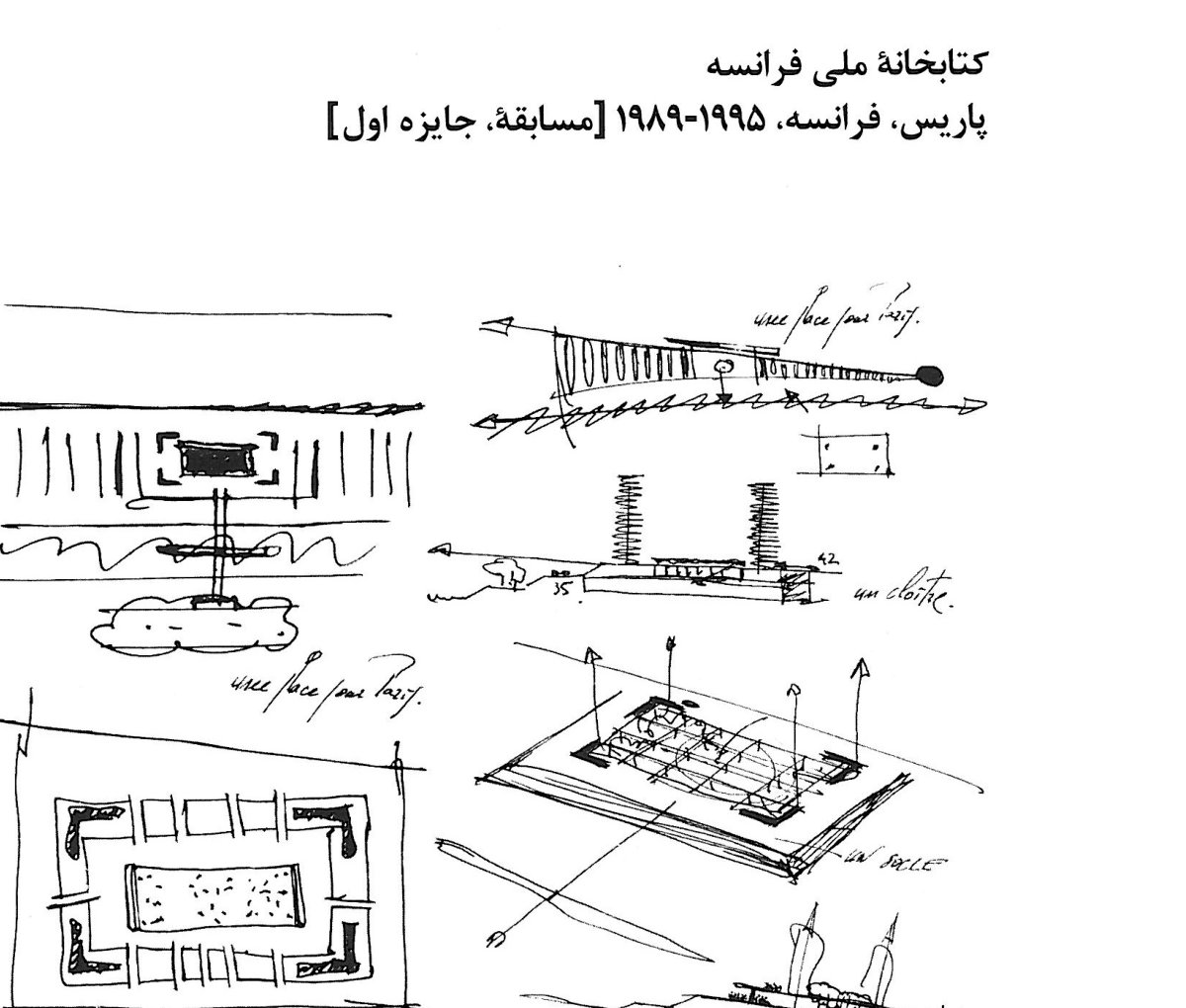
His whole methodology, then, is based on this rule of every primary disposition or arrangement, which arises wholly from mutual relations that, at every moment, build a particular order. The economic frugality of the design process is thereby disturbed. In the first stage, the drawings and the first schemes generate a kind of recognition that defines the lines of tension and the patterns of distribution that, outside any hierarchy of scale, organise the building across the whole site. These drawings — which in Dominique Perrault's work behave like the prominent points of a city — despite their irritating simplicity, recompose all the ways of executing and mastering the brief. They must be able to summarise everything within themselves.
Housing at Marne-la-Vallée is something of a first manifesto: the elevation, as a great inclined plane, leans without any projection — a slope along which the gaze slides, and beneath which the functions and divisions, with which architecture concerns itself, are hidden; the only forms allowed to appear on the surface are a few openings. The wall had already been called into question; Dominique Perrault refused this general validity of any architecture — definitive of the architectural object and its character — through a study of the manner of bounding.
In the case of the Usinor Sacilor Conference Centre, the architectural object does not erect itself; the new programme penetrates the ground, slips beneath the existing building, opening a way for a glass surface that is to be the inverted reflection of it — and for the plastic, kinetic image of this representational architecture.
The second group of projects — the most prominent and famous buildings among the body of work — is directly related to the scale of the briefs. A real strategy of de-monumentalising is carried out, including where Dominique Perrault openly denies the object-like character of his architecture: the conceptual sketch for the Bibliothèque nationale de France, the celebrated Taj Mahal scheme in which the central volume is erased so that only the four minarets define the bounds of a symbolic volumetric space, helps to grasp the truth of this distancing from exemplary architectural work.
Bibliothèque nationale de France — Paris, France, 1989-1995 [Competition, First Prize]
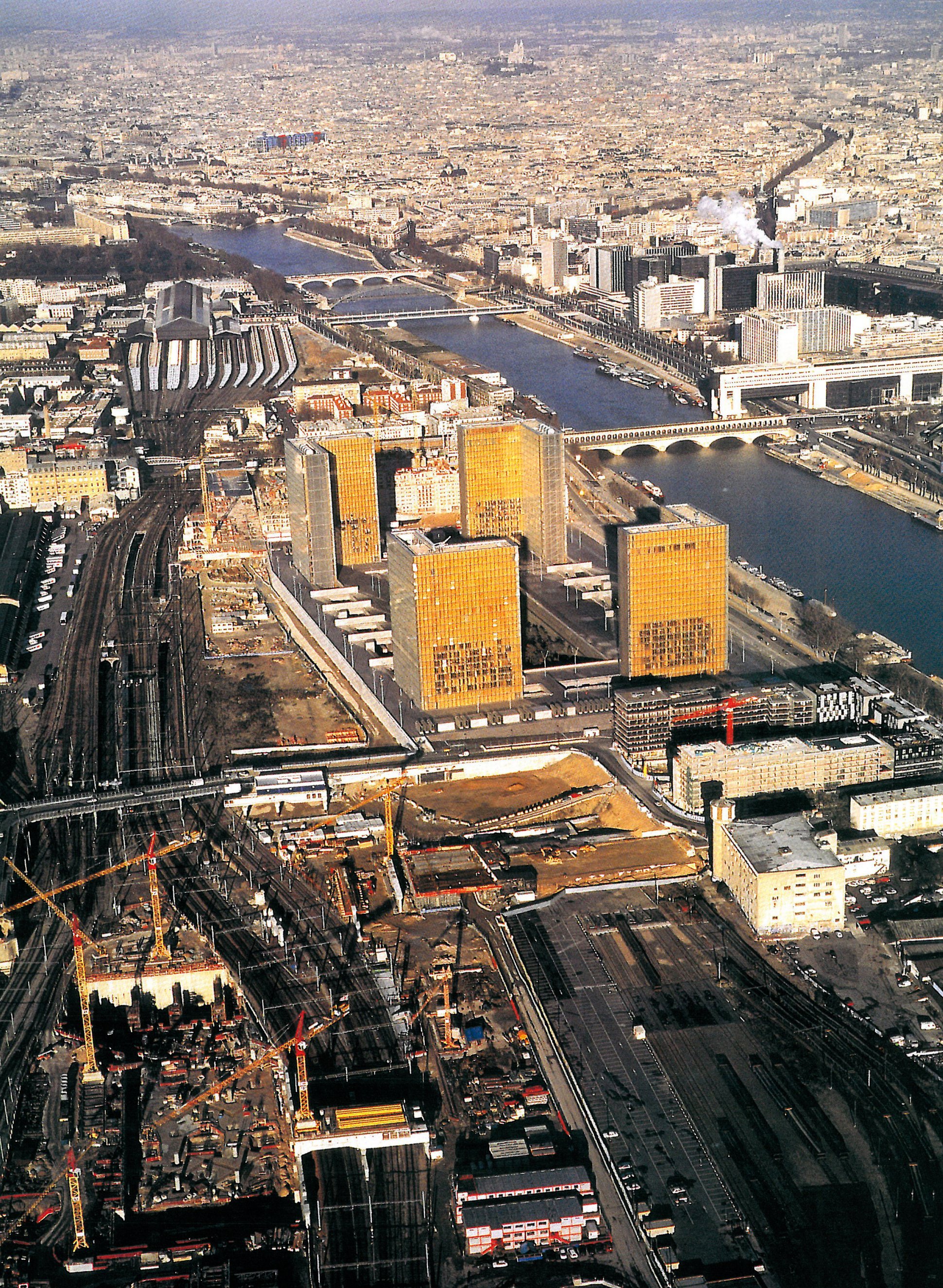
The Bibliothèque nationale de France is the last and most important of François Mitterrand's grand projects. To grasp the place of this project, one must look at it from the urban-planning standpoint. The library is the seed of a new Paris quarter, and likewise its cornerstone; it lies at the heart of the quarter. The wide pedestrian esplanade on its outside is a terrace facing the Seine, and facing too the streets, alleys and squares of the future quarter around it.
The thought of erecting an architectural monument without walls, in the heart of the city and without any boundary or barrier, has called a fresh place into being with its own particular urban context. A public place has been provided for everyone — the esplanade — and a private place for the readers, in the form of a garden. This garden, which is a piece of the original forest of the Île-de-France, sits in the middle of the library and at the centre of the esplanade. The library lies all around this place.
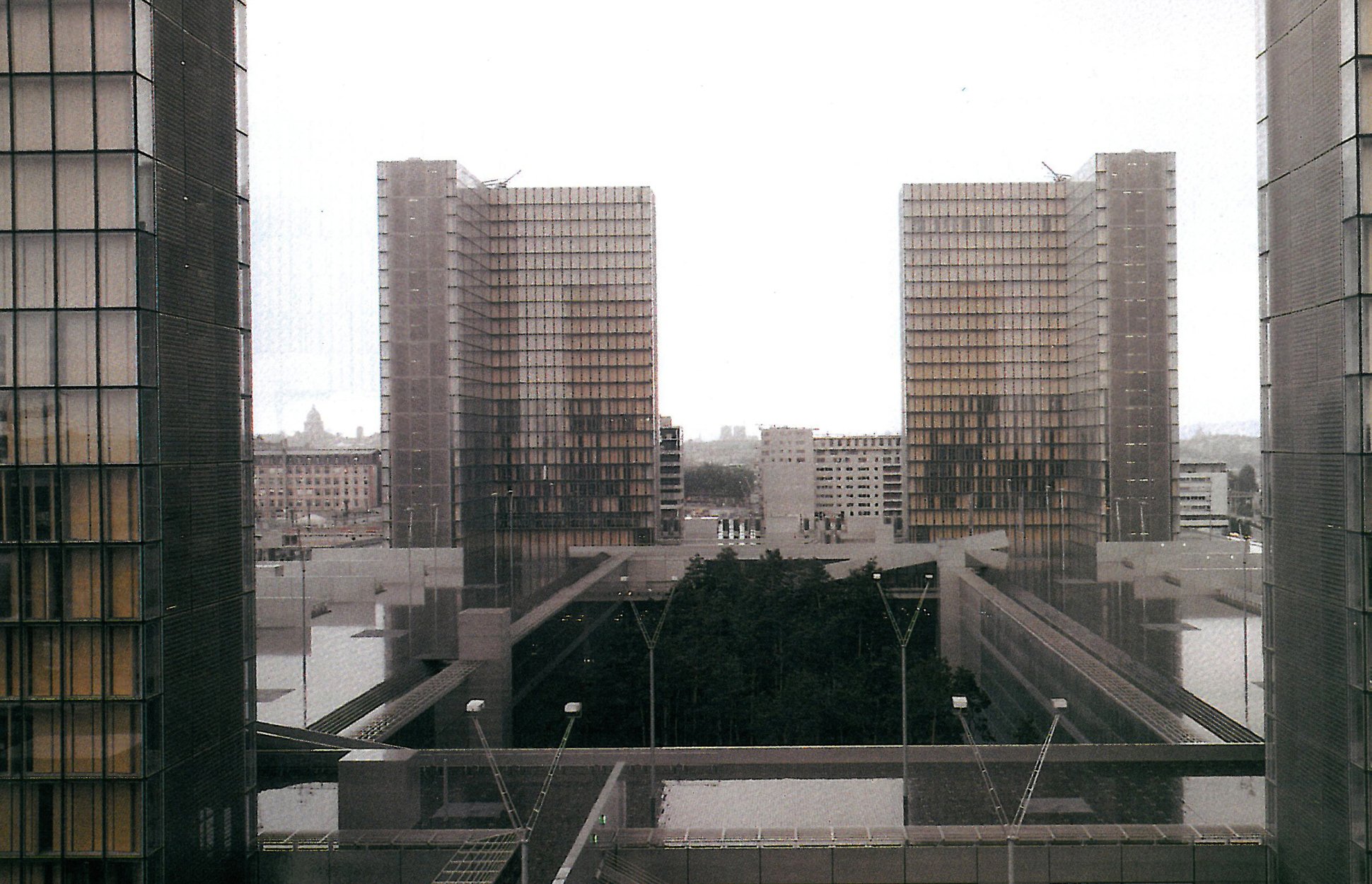
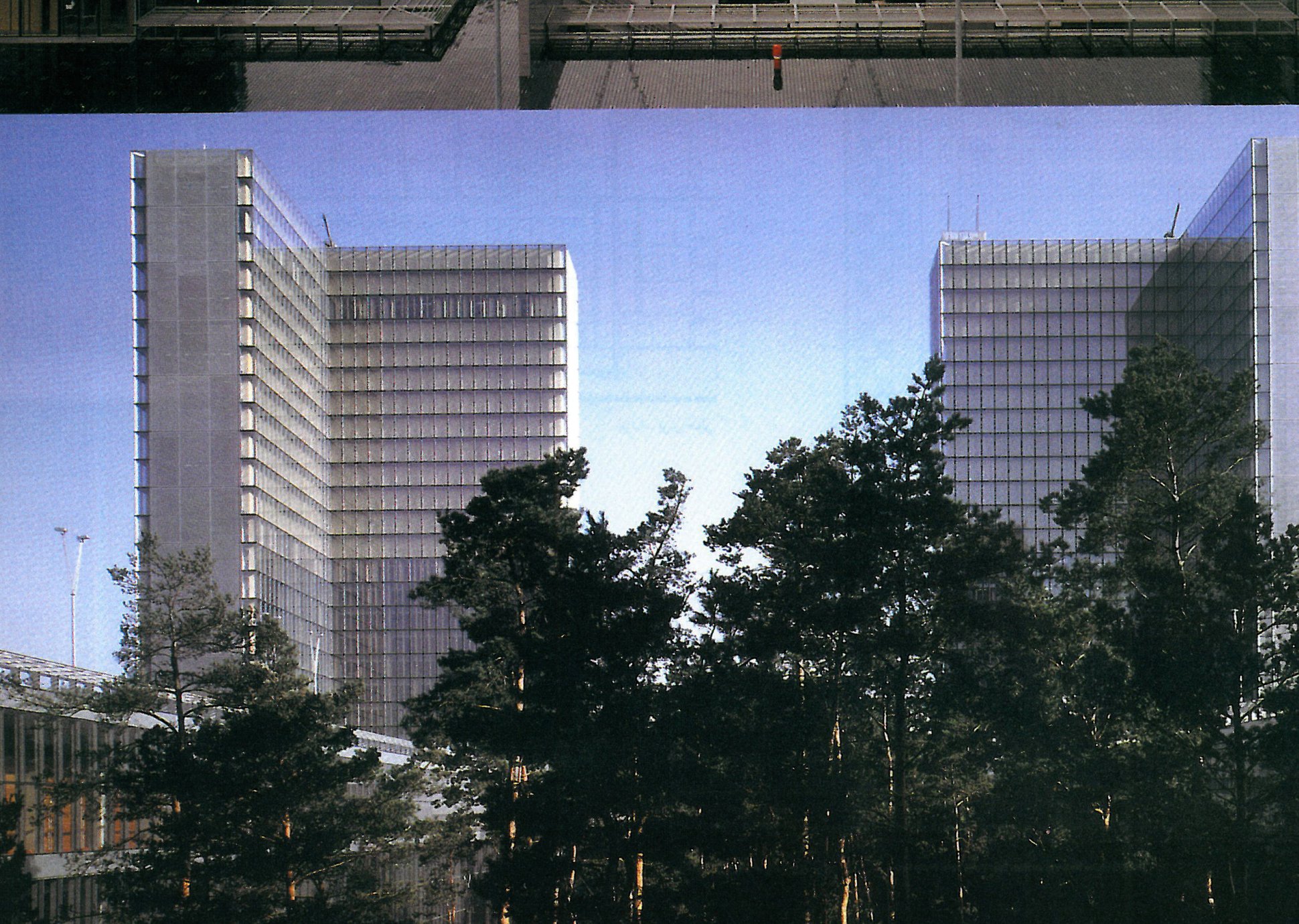
The central courtyard of the National Library is composed of three elements: the esplanade, the east-west wings, and the forest. The most prominent aspect is the making of an exclusively pedestrian zone in the central public space of the city on the left bank of the Seine.
From the start of the project, for the esplanade — the place both for passing and for strolling — we thought of timber, a material that endures in the passage of time. From Japan to Sweden, religious and cultural places built of wood have, from the tenth century to today, not failed. The feeling of touching wood, taking the pedestrian from the hard asphalt of the city toward the natural and the related, has shaped this part. Trees, with their gentleness and softness, stand between the busy esplanade and the silence of the reading rooms. Pieces of brilliant wood and metal trim, like the gallery around a cloister, gather the garden in their midst.
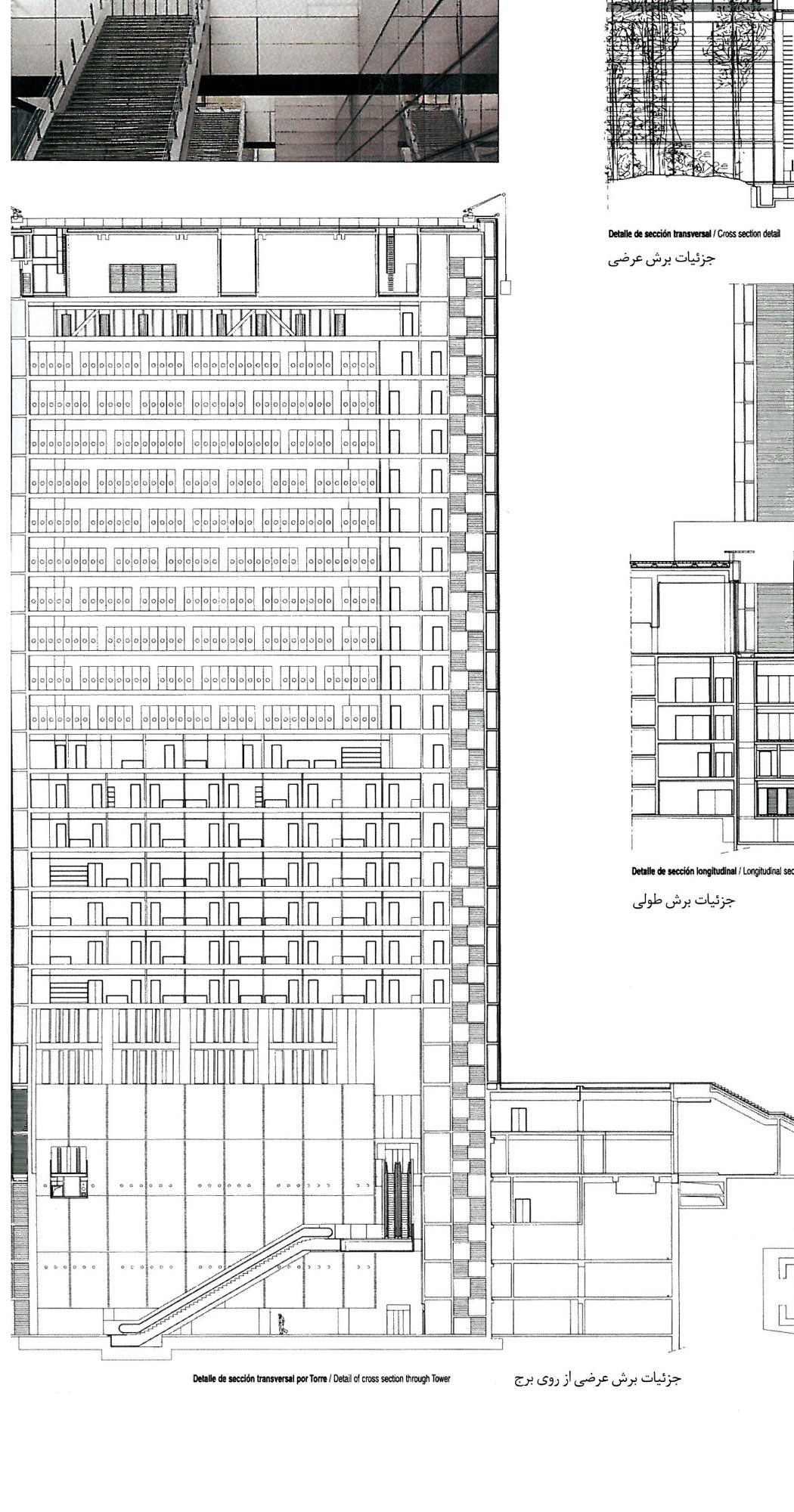
The four library towers — which take the form of an open book — rise at the four corners of the plaza. Three of their corners face the city, and the fourth faces the central garden. Each tower has eighteen storeys, of which eleven are given to the book stacks. With the calm composition of glass façades set against the building, wood replaces every kind of wall. The wooden cabins arranged inside the towers, while bringing their warm tone to the space, also act as an insulating layer against light, heat and humidity.
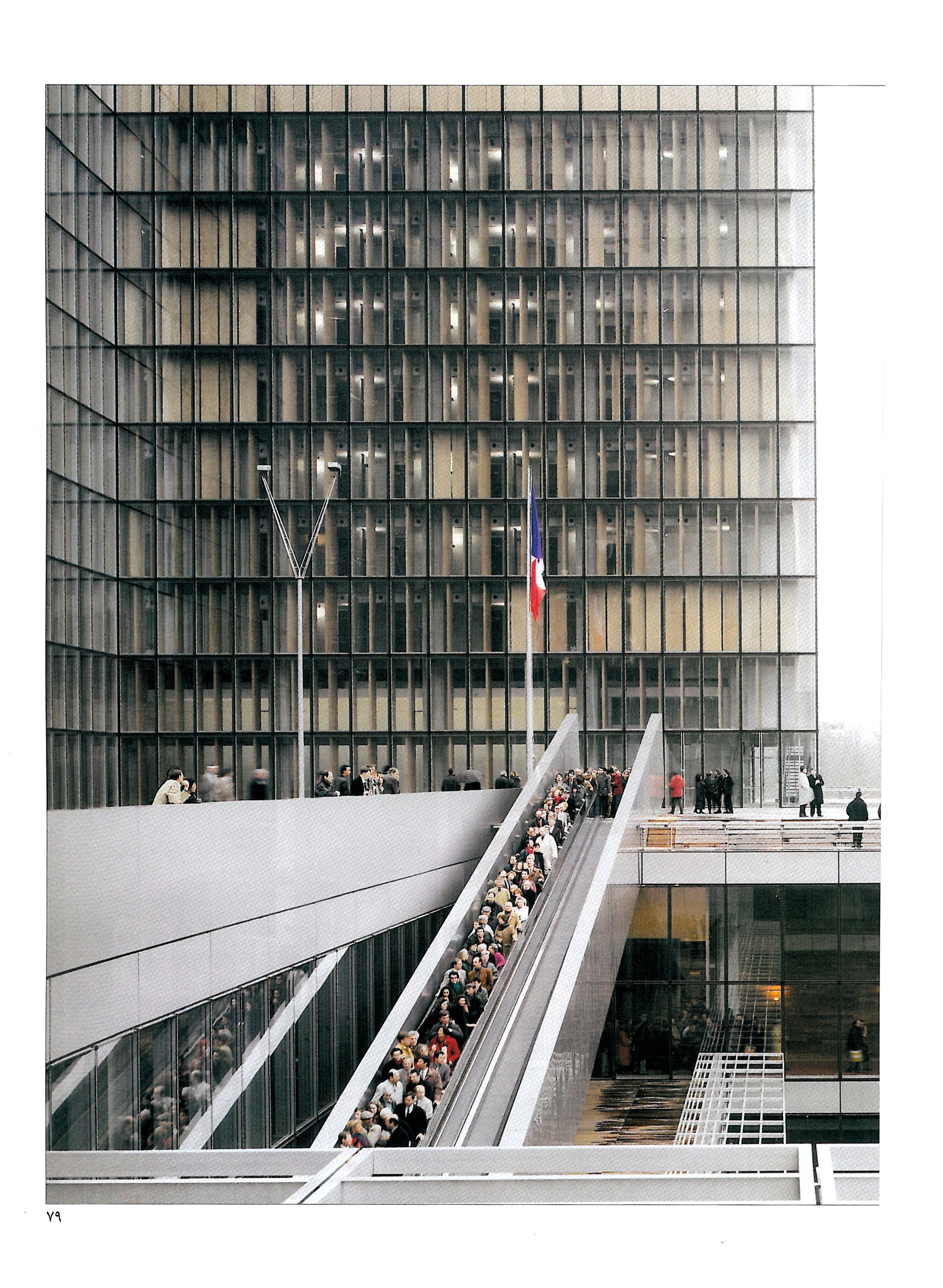
The plaza entrance — escalators rising from the level of the street to the high platform of the library — is itself a public ritual: a passage from the everyday city plane to the cultural space, by a long and broad movement. These escalators, with a frame of steel and glass, work without visual disturbance to the towers' elevation. They act like floating bridges; amid the daily gathering of pedestrians, they set up a spiritual passage to the library space.
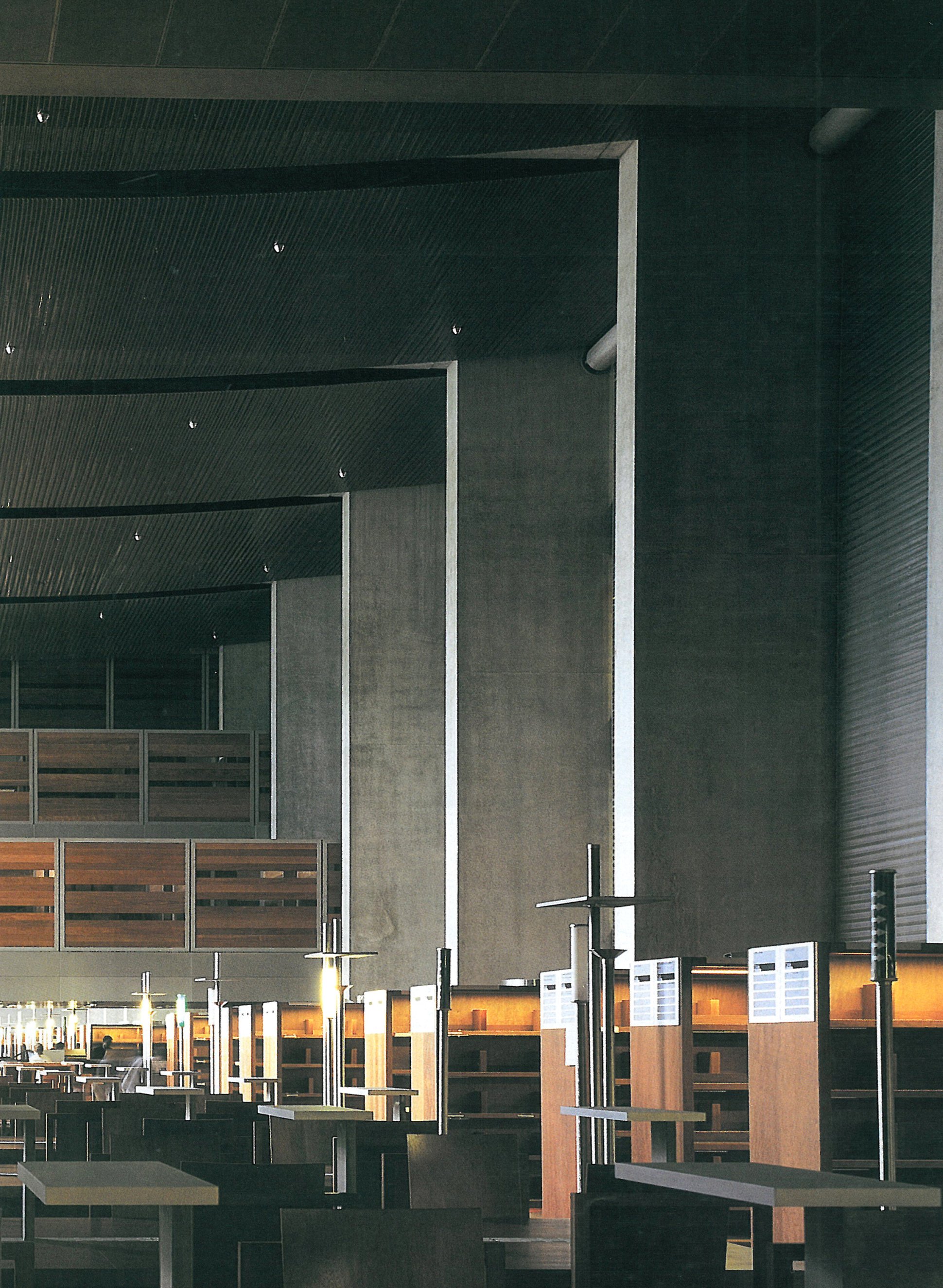
The reading room — largely below ground level — with a composition of striped timber ceiling, intermediate concrete walls, ceiling skylights and alternating rows of timber tables, brings forth a calm, contemplative space for reading. The timber floor, the ceiling lights, the indirect natural light from the central courtyard and the timber bookshelves give the space a monastic feeling — a space which, for all that it occupies the city's central place, withdraws from the city outside. At the centre of the whole composition sits the woodland garden, sending soft, calming light through the reading-room windows.
Centre Technique du Livre — Bussy-Saint-Georges, France, 1992-1995
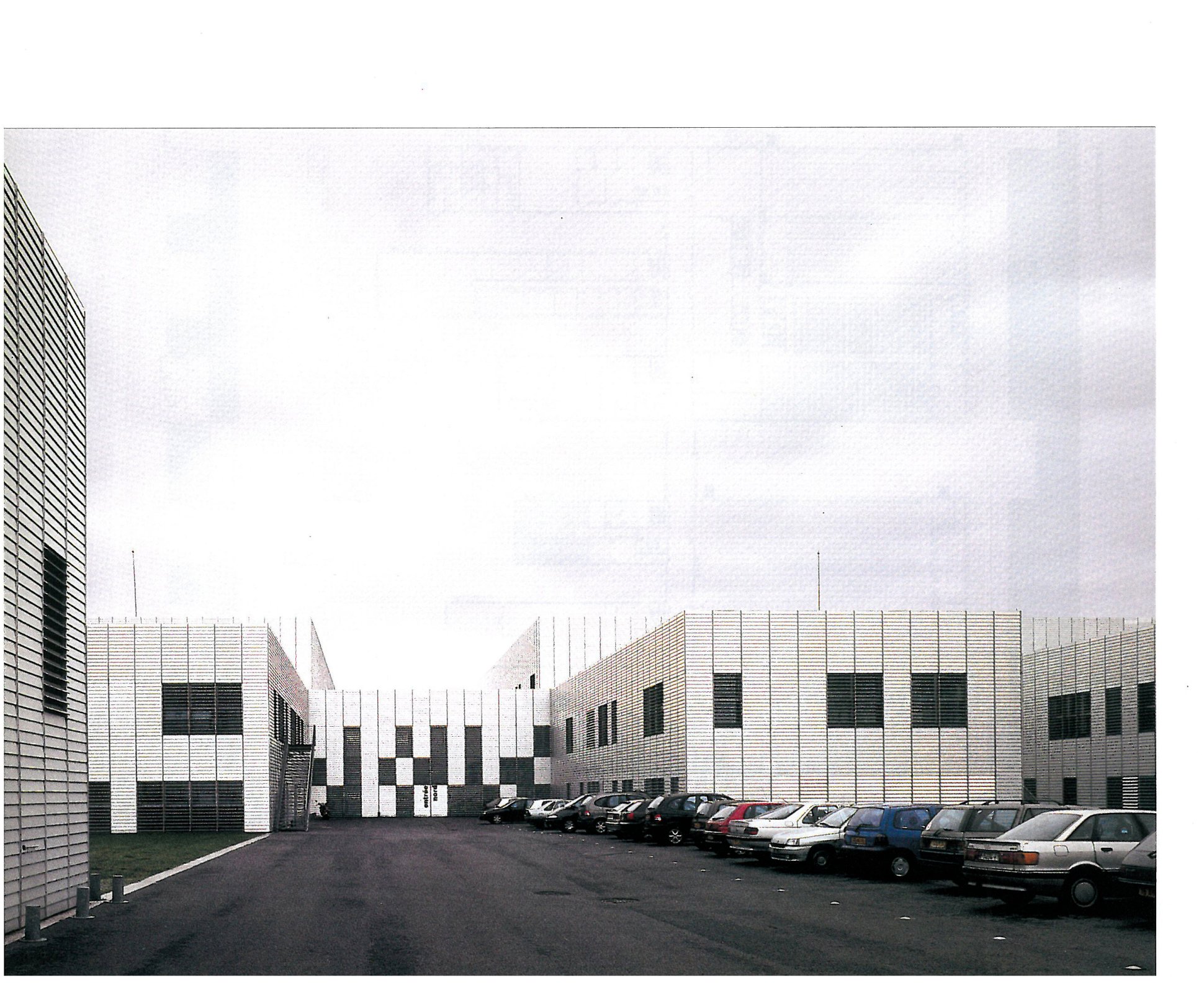
The Technical Book Centre at Bussy-Saint-Georges, on the eastern edge of Paris, forms the principal storage facility for the Bibliothèque nationale de France. While the towers of the Paris library are monumental and symbolic, this building is wholly industrial and functional. A horizontal volume, with a body of large white tile, is set within a flat, wholly open ground. Window and door elements, in confined dimensions, are tuned only to the function needed, with no ornament.
The elevation, with its glazed white tiles, despite being industrial, gives the building a smooth and quiet finesse. This kind of tile, which has its roots in twentieth-century French industrial buildings, is used here so that the building may register as a “place” in the flat agricultural prospect. Only when one approaches does one understand how big this building is.
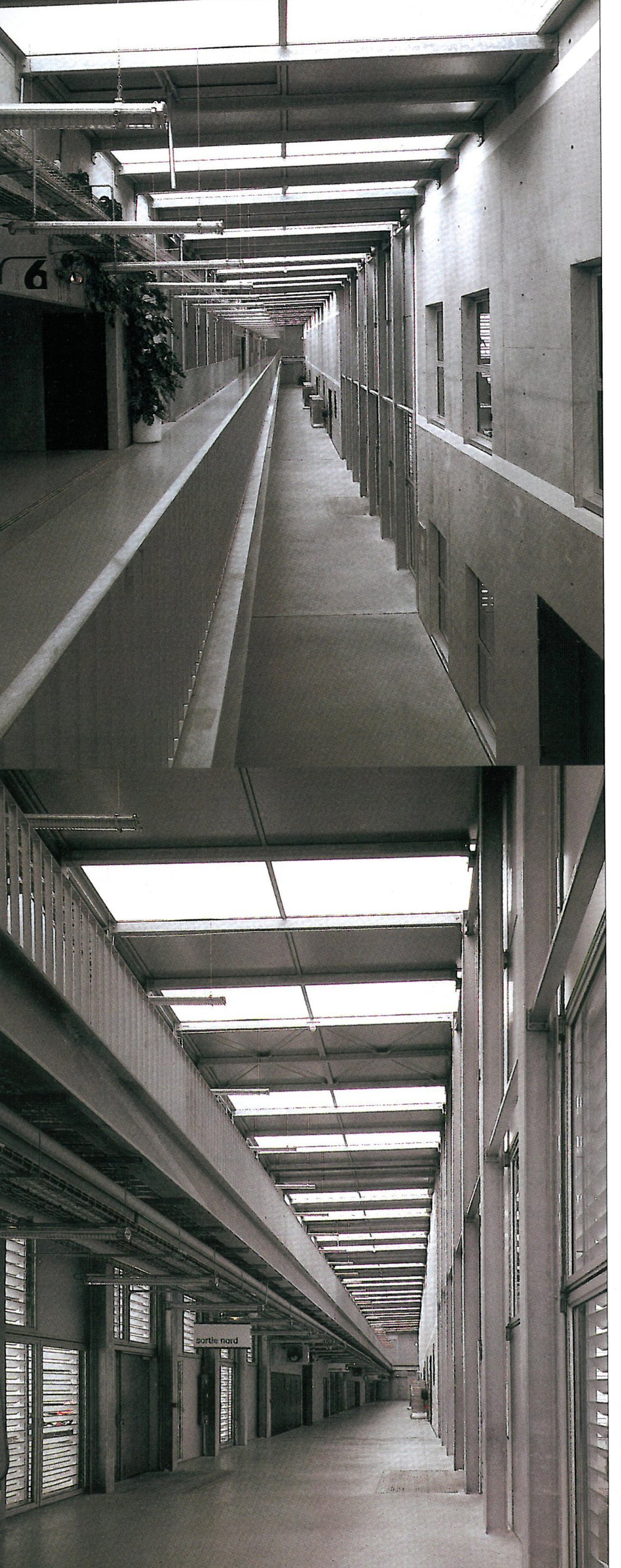
Inside, long ramp-like circulation halls, with light-bringing skylights from the side spaces, provide a dynamic movement for the staff. The stacks, with metal shelves and automated book-handling systems, occupy the upper floors. This function — the keeping and distributing of books — is given to the building as a hidden splendour: a structure that does not appear important from the outside, yet which, inside, with its breadth and the simplicity of its geometry, counts as one of the most important works of Dominique Perrault in the realm of industrial buildings.
From the Bibliothèque nationale de France to the Centre Technique du Livre at Bussy-Saint-Georges, from Marne-la-Vallée to Usinor Sacilor, Dominique Perrault is always after a “neutral” architecture — one that does not display itself in the urban or landscape context but settles where it is needed, and at times comes forward as a “non-architecture.” This minimalism, which Migayrou calls an “impartial violence,” rises not from simplicity but from industrial and philosophical complexity — from the negation of all that turned architecture into a visual art.
Article by Frédéric Migayrou, written for the Centre Georges Pompidou, Paris. Translated from the French source.



