Book reviewed: Philippe Boudon, Sur l'espace architectural: Essai d'épistémologie de l'architecture, Paris: Éditions Parenthèses, 2003. (The original text of this review appeared in Domus, no. 362, September 2003.)
For a long time, semioticians, sociologists, and philosophers have in turn been trying to interpret architecture, and at times extending their interpretation to the various facets of architectural history — from structuralism all the way to non-architect reflection. In any case, the limitation of evaluation by non-architects has always been that architecture, for them, was more a field of research than its subject. For this reason one cannot expect non-architects to attain truthful and scientific knowledge in the field of architecture. They can, at most, offer suggested opinions. Research architecture, or architectural research, is a more complete knowledge. This concept was first stated by Philippe Boudon in 1971 in his book Sur l'espace architectural, and with it he laid the foundation of a new method. Now, in this book, the original text has been reprinted and a detailed introduction has been added that updates the book's concepts and offers a summary and analysis of what may be called the state of the art of architectural epistemology. Boudon emphasizes that this book is concerned with creating a scientific and theoretical subject which does not correspond with the perceived spaces in which a person lives. On the contrary, the specific spaces of architecture are defined by different and expressive concepts that Boudon calls "conceptual space": if architectural objects are generally counted among sensory and perceivable objects, then in order to be received and felt and understood, they must first be thought and conceived.
Boudon was aware that this insistence is, in a sense, idealistic. But he wanted, by emphasizing the distinction, to preserve the separation of thought and conception from perception and feeling and understanding. Perhaps his idea was to preserve, as an instrument, something whose very correctness is open to critique. In this way we can read a built work as the representation of an earlier schema — one that inverts the usual application and shifts the focus away from what is concealed in everyday practice; he has taken this and built his methodology upon it. Certainly the theoretical approach always differs from practical critique, which seeks solutions and thereby blocks the emergence of knowledge. Architectural research, instead, poses the question of how architects render space measurable. This is an ambitious matter, for how can architectural space be defined? Boudon, in his theory of cognition, takes up two issues: first, the "real" space that Zevi and Focillon defined as the space in which one lives. "Interior" becomes an element and matter of architecture (recall Rachel Whiteread's famous project: a concrete cast of the interior of a Victorian house) — and as a result, a problem arises: the "myth" of the "interior" is part of the mental processes from which it is difficult to free oneself. Another obstacle is functionalist thinking and the mind's habit of creating a (mathematical) function for a (regular) purpose and goal. Where the dominance of mental space over specific space leads to excess, this relation will become peculiar (here Boudon rereads Erwin Panofsky's theories on the relation between architecture and scholastic thought) — though, at least in this manner.
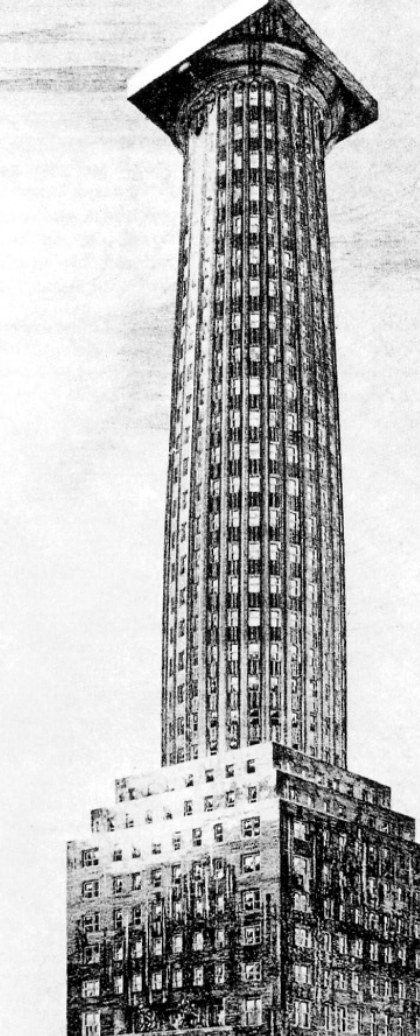
The preliminary question is how mental and real spaces relate to one another, and what instrument helps to clarify and make intelligible the passage between these two realms. For example, scale is one of the instruments of this action. Scale, which is among the foundational concepts, is always raised in the work with great architectural-research precision. This is in part because scale distinguishes architectural space from purely geometric kinds — which can never serve as justification for architectural space. It is true that the new geometries have made necessary a rethinking of the concept of space, and many architects, in order to overcome the dead-end of Euclidean geometry, have turned to topology — but topology has not yet solved this problem. Mandelbrot's serious enchantments likewise do not address the matter of scale (Eisenman's research in this field is a good example). All these problems are knotted up with the movement between architectural space and real space. Boudon's model for coping with this issue presses Frege's theory of meaning into service — the distinction between signifier and signified. In this theory two relations exist: between the mental signifier/signified, in which the concept of scale lies hidden; and between signifier/referent (the signified), in which mental space connects with a specific reality. But it is the first relation that gives the operation its meaning. Vitruvius, in his discussion of reasonable proportions for the public square — in order to facilitate actions and to accommodate the population — chose two architectural scales: one functional (the relation to the number of people) and another related to visibility (facilitating actions). These variables create the determining transition to a specific architecture (the square). Now scale is no longer a single idea but has become multiple. This is the principal contribution of architectural research. The various kinds of scale are: economic (skyscrapers); technical; human (for example Le Corbusier's human proportion); semantic (Loos's Chicago Tribune); and poetic (Perec).
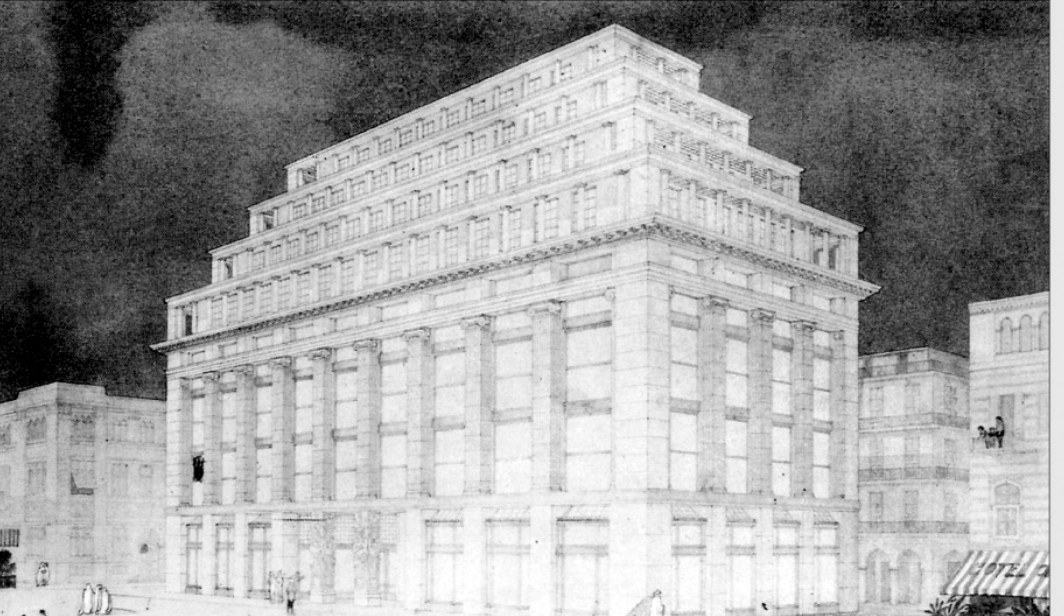
Architectural spaces always have multiple definitions. For this very reason, students of architecture must, by using scale as a complex symbolic operator, overcome single-pattern geometry and the mathematical dominance that accompanies it.
- Bachelard
- Zevi
- Focillon
- Rachel Whiteread
- Erwin Panofsky
- Mandelbrot
- Eisenman
- Frege
- Vitruvius
- Le Corbusier
- Chicago Tribune
- Loos
- Perec



