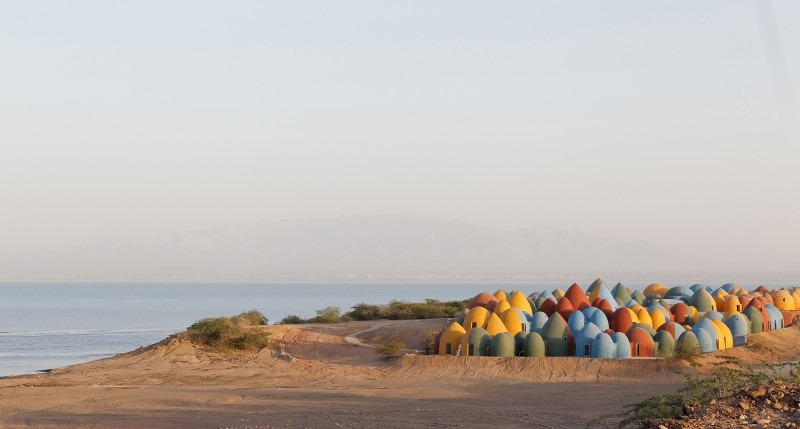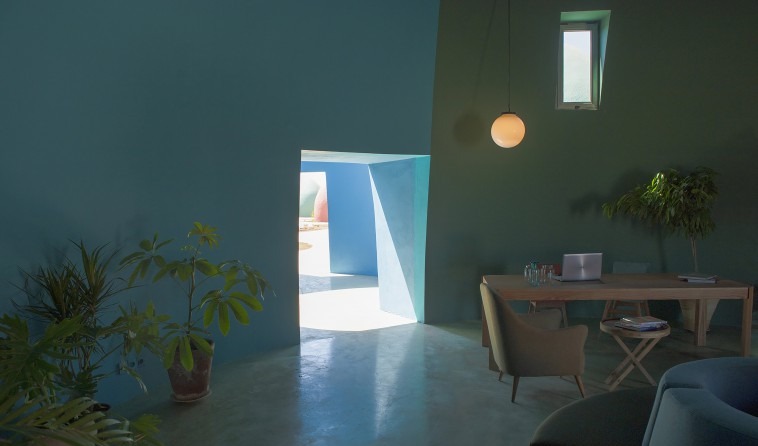
Majara, Hormuz is a cultural retreat undertaken by a private cultural operator, in response to an invitation from local art groups who had for years been making the soil-carpet on the site of this project. Its aim is presence in keeping with the customs of artists and tourists and the empowerment of the people of the island. The Majara project is part of the "Presence in Hormuz" idea, begun in 2015, which uses an urban acupuncture approach to trigger small points across the town and — by stitching them together over time — set off a flow of change and conversation, so that the voice of the islanders may be heard. Those points are: a temporary participation centre in a disused water cistern (2016), the Rong Cultural Centre (2017), the restoration of the historic Jerry Pollack House (2018), and the Majara retreat (2020); and other projects such as a management centre, a technical support centre, an art school and a medical centre are projected for the future, some of them already under construction.
What's to my benefit, what's to the benefit of all
Architecture can act as a connecting ring between the state, capital and the various groups of people; it has the capacity to step out of a passive position in the distribution and allocation of benefits, and to try, to the limit of its ability, to intervene in that distribution among different groups. One of architecture's ways of intervening in benefit distribution is to engage with the economy of the project and with the question of gross domestic product, in order to reach a social optimum. This goal has been pursued in the Presence in Hormuz project — and in the Majara retreat as one part of it — along several paths: 1. Inexpensive construction, which is to the economic benefit of the client. 2. Allocating a greater share of the construction budget to local labour rather than to costly materials, which is to the benefit of the local people. 3. A spatial scenario and organisation that are resilient against the future and able to meet unforeseen needs, which is to the benefit of both the client and the island. 4. The use of Iranian and locally available materials — which, while reducing transport costs, is productive and yields national benefit. 5. Making the ground for the entry of middle-class tourism, in place of the unconventional tourist who spends nothing in the host society and offers an unconventional social pattern to the people.
The Nader Khalilis
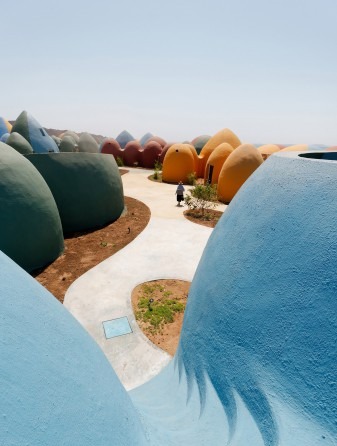
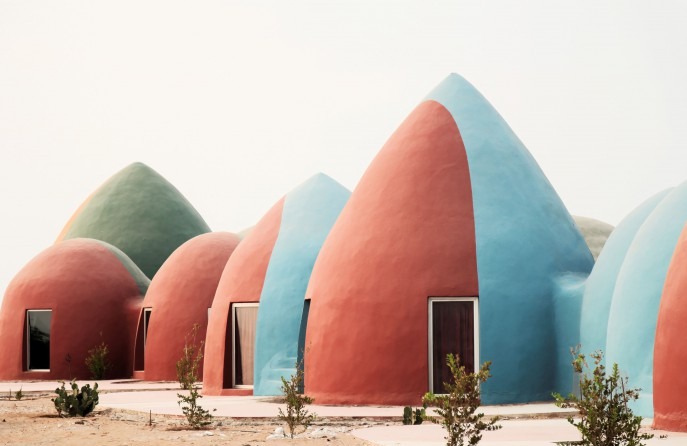
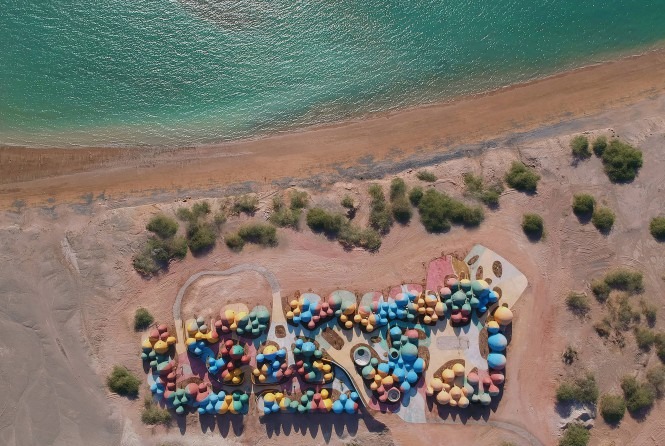
Presence in Hormuz is a process that, before building anything, attended to community participation and trust-building. After the Rong prototype, the Majara project was built as a cluster of earthen domes using Nader Khalili's superadobe method, and instead of a single, monolithic mass it was broken into pieces to reach a human scale. By placing the cluster on the downhill ground it avoids commanding the people as far as possible, and lacks the decisive dominance of large projects. Being fine-grained, in addition to making the project transferable and adding flexibility to its spatial scenario, fits well with the small craft trades existing on the island and makes it possible for them to enter the construction process. The grains, arranged with the structure of an organic neighbourhood — with a public section, a residential section and a neighbourhood centre — sit together; together with the earthen domes (which recall the existing cisterns) they form a familiar, at-home fabric. The project tries to bring Nader Khalili's creativity in using earth for permanent settlements up to date, and — because of the ease of training and the open-source nature of the construction technology — turns the non-specialist forces of the island into earth-masters, in order to lead to the empowerment of part of the islanders; in the old saying, it teaches them to fish.
Swelling of the earth
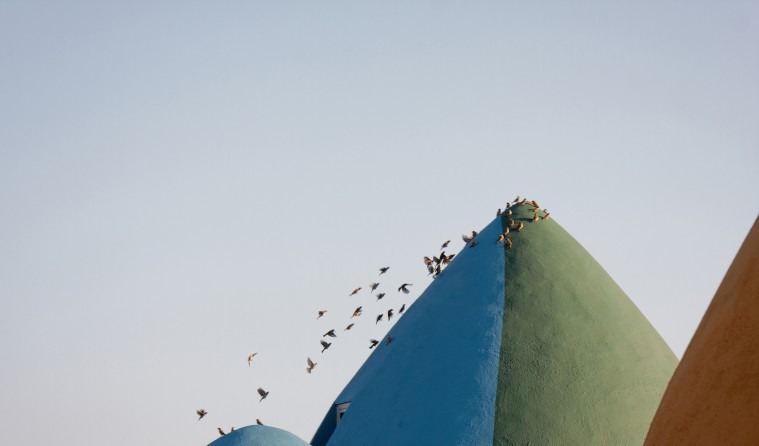
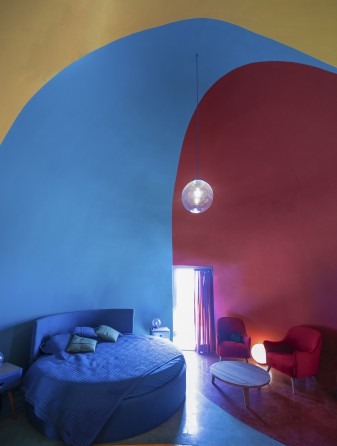
Coloured grains of earth, sand, gravel and stone shaped the salt dome of the island, and Majara has been woven like a carpet of grain knots: the dredged sand of Hormuz pier, mixed with gravel, has filled a line of sandbags that form the dome's grains, as if the very ground had swelled to produce a place to stay. The grains of the domes — in a molecular, organic, flexible structure — are linked in small communities that host flexible, alterable spatial scenarios and together build the whole compound — a compound with indeterminate boundaries that can expand or change if the need arises. The island's topographic lines have been studied so that the figuration of the grains shapes the swelling form from a bird's-eye view. On the third axis, the skyline ties the topographic volumes to arcs borrowed from the cisterns, so that a harmony arises between the retreat's landscape and the island's landscapes. A palette of colours, inspired by alluvial paths between the mountains, has slid over the grain compound and left its trail on the grains, on the spaces inside them and on the paths between them — applied with chemical colours, without using the precious soil of Hormuz itself.
Process-driven beauty, a resilient scenario
Unlike typical coastal projects that chase a better view by building taller and larger, the Majara retreat is not an architectural wish fulfilled in the Soil Carpet camp; rather its form is the result of a process that pursues "research for design," in which strategies from different layers — gross domestic product, host-community empowerment, and the concept of the swelling of the earth — are placed in relation to one another. The designers have tried to accept tolerantly what arises from the combination of these layers, and even to encourage it. The spaces, because they are grain-like, have found functional independence; their spatial organisation is such that most of them have direct access to the public space. With these two qualities, in the event of possible changes in conditions, there is the possibility of adapting the spaces to future programmes.