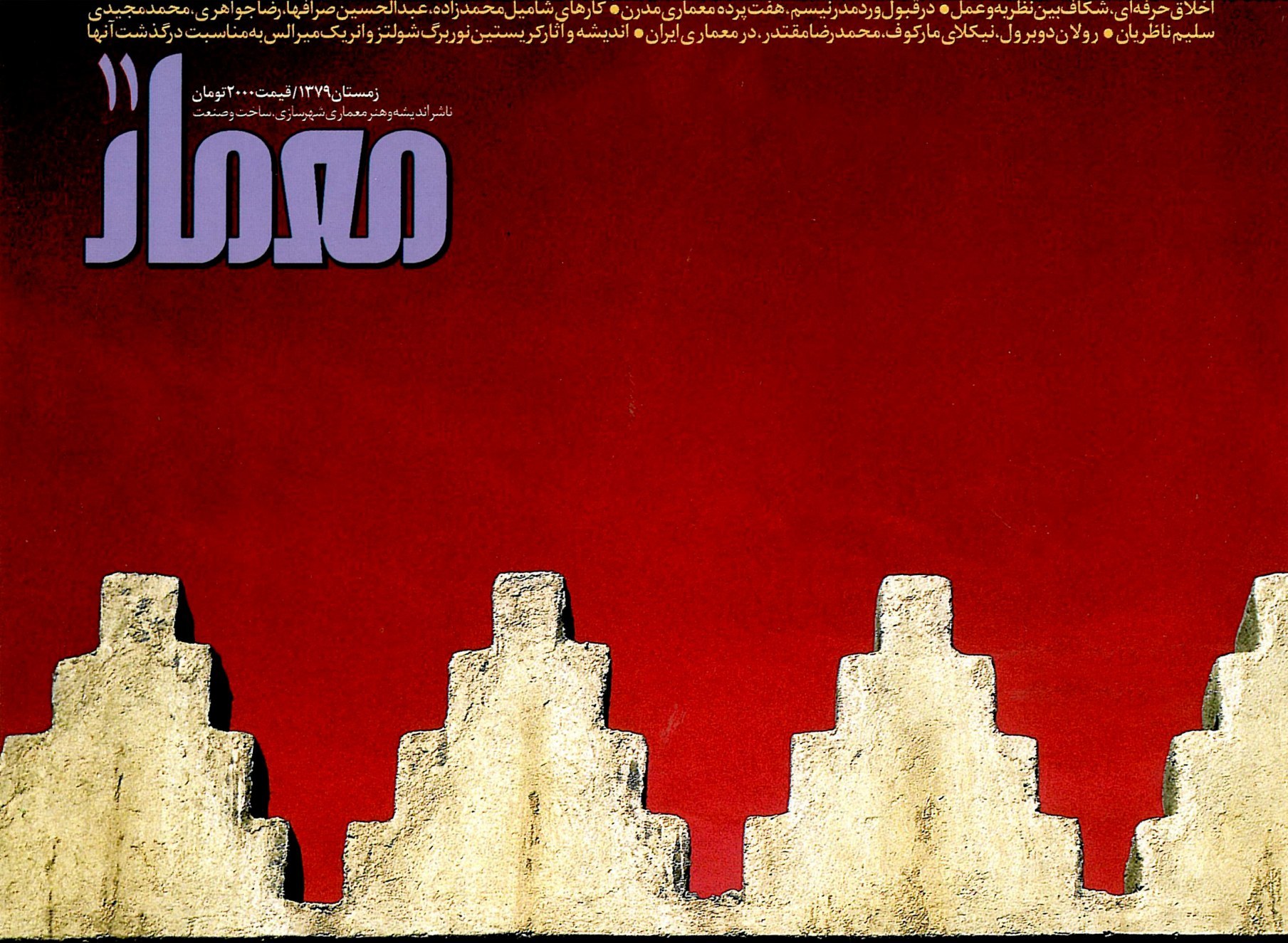
Some observers of the present state of architecture in the West warn that architecture is soon to decline to the level of fashion, and that the work of architects of the future will be worth no more than the designing of fashion. Other commentators regard this trend not as a descent but as a realistic adaptation of architecture to the "media" character of the information economy and the process of globalisation; not only do they not see this adaptation as a cause for anxiety, they on the contrary invite architects to adjust themselves to the new conditions as quickly as possible by understanding them (this issue, p. 19).
Others, voicing concern about the becoming-superficial of architecture, seek to draw the field of architectural understanding close to the field of philosophical understanding. This group is not content that philosophy, in exploring the realm of art, should treat architecture as one of the artistic disciplines while still remaining in the sphere of philosophers' activity; they want to turn artistic creativity itself into a kind of philosophising carried out by architects themselves. In their view, theory — which hitherto was the explainer of the architecture that had come before it — must become the producer of a different architecture in the future (this issue, p. 17).
Both the view-from-fashion and the view-from-philosophy seem a kind of moving away from the core of architecture, and they produce the feeling that the profession of architecture is losing honesty with itself and that its ethical foundations are weakening.
In the recent debate at the Museum of Modern Art in New York (this issue, p. 17) philosophers warn architects in a courteous tone not to let the turn toward philosophy end up costing a betrayal of architecture; not to let the taste for variety and the display of innovation become a kind of hypocrisy that disarms the professional community. These warnings strike at the ethical sensitivities of architects whose honesty toward the truth of architecture has been called into question despite their serious work and their extraordinary effort.
But amidst all this, the signs of a collapse of professional ethics are far more alarming. The news heard these days about a phenomenon called "selling one's signature" is hard to believe. How can one believe that the relationship between the engineer and his client, and the relationship between the body responsible for controlling the engineers' work and the engineer himself, can become so corrupted that, despite all this wrongdoing, neither the engineer feels worried about it, nor the body responsible for control, nor even the professional order. Those involved, in quiet conversation, express their alarm at the unbridled growth of this phenomenon in the recent period — coinciding with the rise in engineering fees; that is, not only has the higher fee failed to increase the level of engineering services, it has brought fresh groups into the ranks of signature-sellers.
To give in to this professional corruption means to turn a blind eye to architecture and to lose what remains of the architectural culture of society, and to push into a corner the few talents that are trying to elevate architecture.
The responsible agencies, and more than them the engineers themselves, must fight the spread of this great blight. Nowhere in the world has a municipality eased itself of the responsibility of controlling engineers' work. The production of every commodity is controlled, and architecture — the largest, most complex and most expensive commodity used by people — needs control more than any other commodity. The Tehran Municipality and every municipality in the country must not leave their hands idle any longer, nor delay in discharging this important legal duty and in observing this great social interest. Likewise, if the Ministry of Housing and Urban Development, which by issuing practice licences for engineers certifies their qualification to offer engineering services and also sets the price of these services, has no supervision over whether these services match the content it has itself approved, what will come of all that ceremony of licence-issuing, background review, examination and ranking — except assistance to an unhealthy current whose news grows more alarming by the day?
The Engineering System Organisation, too, can at the very least undertake to monitor — by choice or by lot — a number of works in their design and execution stages, and to confront its errant and negligent members.
But above all else it is professional ethics itself to which engineers must roll up their sleeves, by expressing their sensitivity toward its rescue. A true professional community is composed of members whose shared feature is commitment to professional ethics — not as display or politeness, but as a spirit and conduct that precisely and without subtraction reflects their scholarly competence and technical ability.
Professional ethics is not politeness. No ethics is politeness. Ethics is the guarding of truth. Architecture is an art, and the truth of art is the creation of greatnesses. Whoever utters the name of art must preserve the sanctuary of greatnesses. In every profession a kind of longing for greatness is latent. A profession is an ability and a skill that cannot be obtained without learning from a master, and a master is one who stands in a rank above every kind of vulgarity, habit and amusement. To stand above, and to uphold the sanctity of that place, is the guarding of truth — and is ethics itself.



