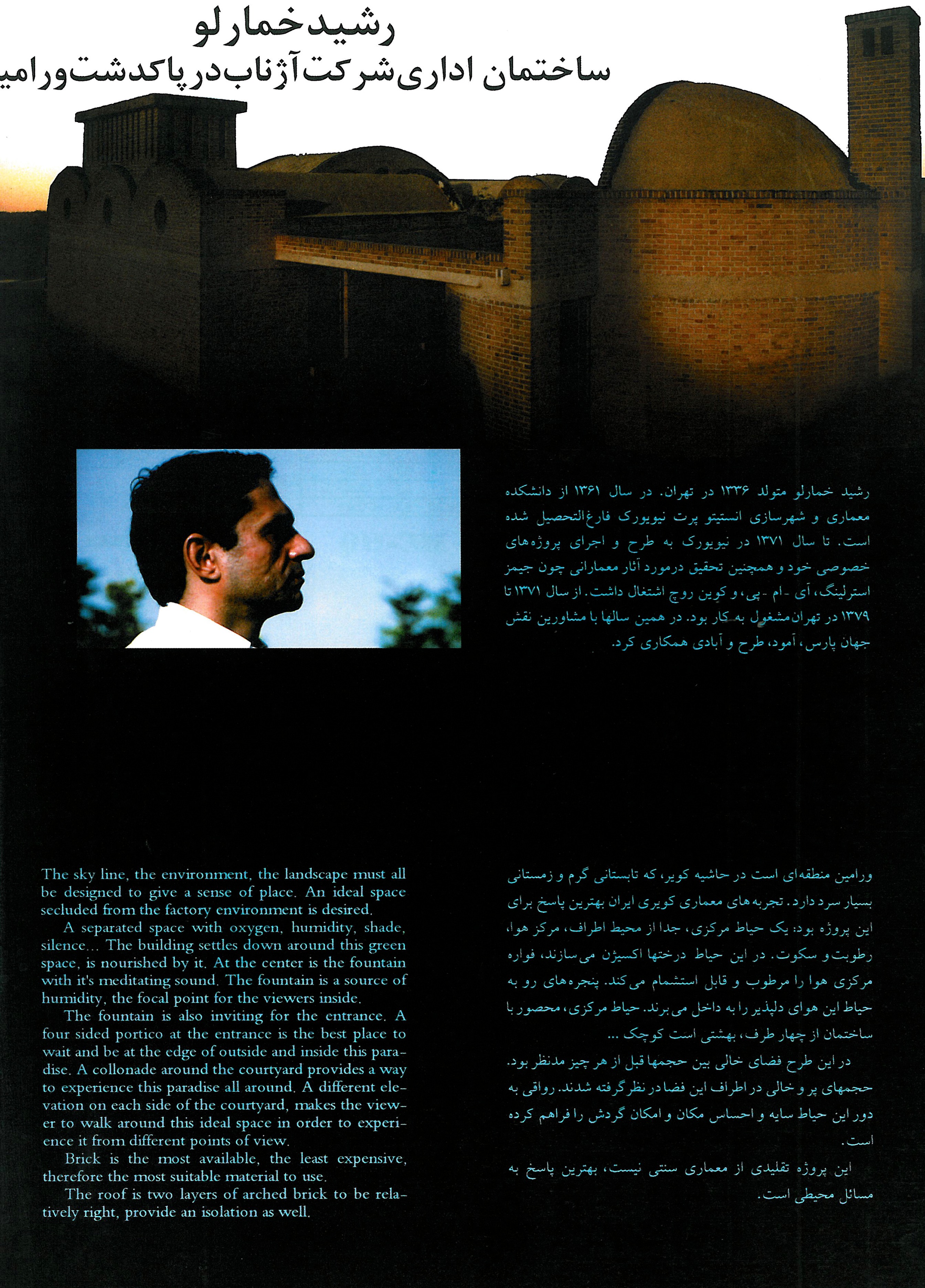
Rashid Khomarlou, born in 1957 in Tehran, graduated from the School of Architecture & Urban Studies of Pratt Institute, New York in 1982. Until 1992 he designed and built his own projects in New York City, and during the same period worked on projects by architects such as James Stirling, I. M. Pei and Kevin Roche. From 1992 until 2000 he practised in Tehran, collaborating with the consulting-engineer firms Naghshe Jahan, Amood and Tarho Abadi, and winning the Tabriz Square competition. In 2000 he opened his practice in San Jose, California.
Varamin lies on the edge of the desert, with hot summers and very cold winters. The experience of Iran's desert architecture offered the best answer for this project: a central courtyard, cut off from its surroundings, where oxygen, humidity, shade and silence could be gathered. The building settles down around this green space and is nourished by it.
At the centre of the courtyard a fountain sits with its meditating sound — at once the source of humidity and the focal point of the view from within. The windows that open onto the courtyard draw this pleasant air indoors; the enclosed courtyard, surrounded by the building, humidifies and makes the air breathable.
The fountain is also inviting for the entrance. A four-sided portico at the entrance is the best place to linger — the edge of outside and inside this paradise. A colonnade around the courtyard gives a way to experience the paradise on every side. A different elevation on each side of the courtyard makes the viewer walk around this ideal space in order to experience it from different points of view.
In this design, the empty space between the masses was the first concern, and solid and void volumes were composed around that space.
Brick is the most available and the least expensive material, and therefore the most suitable to use. The roof is two layers of arched brick, giving it the right proportions and at the same time providing insulation.
A broad, empty horizon — desert and sky; the blazing summer sun and the biting winter cold.



