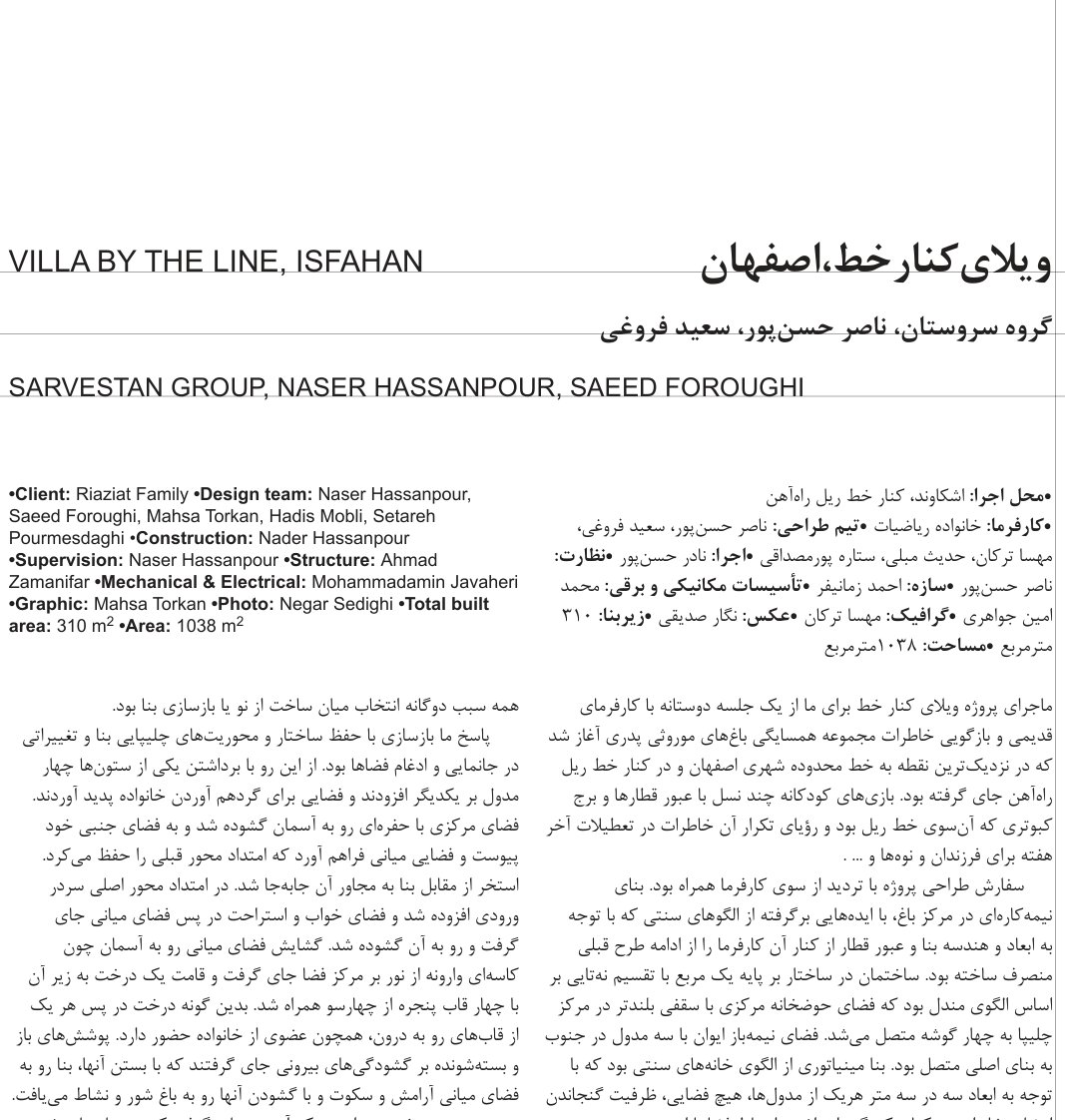
Location: Eshkavand, beside the railway line. Client: Riaziyat Family. Design team: Naser Hasanpour, Saeed Foroughi, Mahsa Torkan, Hadis Mobali, Setareh Pourmosdaghi. Construction: Nader Hasanpour. Supervision: Naser Hasanpour. Structural: Ahmad Zamanifar. Mechanical and electrical systems: Mohammad Amin Javaheri. Graphics: Mahsa Torkan. Photography: Negar Sadighi. Built area: 310 square meters. Site area: 1,038 square meters.
Sarvestan Group, Naser Hasanpour, Saeed Foroughi
The story of the Villa by the Railway Line began for us with a friendly meeting with a longtime client, recounting memories of the inherited family gardens nestled at the closest point to Isfahan's urban boundary line, beside the railway tracks. Generations of children playing as trains passed, a pigeon tower on the other side of the tracks, and the dream of reliving those memories on weekends with children and grandchildren. The commission came with the client's hesitation. A half-finished structure stood at the center of the garden, based on ideas drawn from traditional patterns, but given the building's dimensions, its geometry, and the passing trains alongside it, the client had abandoned the previous design. The building's structure was based on a square with a nine-part division following the mandala pattern, where the central pool-house space with a higher ceiling at the center of the cruciform connected to four corners. A semi-open iwan space with three modules on the south was attached to the main building. The structure was a miniature of the traditional house pattern, but given the three-by-three-meter dimensions of each module, no space had the capacity to accommodate family members together. The connection of spaces from every direction disrupted the demarcation between movement and repose, and opening the building on three sides to the outside made maintaining quiet during rest a challenge. The building's placement at the center of the garden on a platform, with the pool in front of it, divided the open space into several small zones, and all of this
created the dilemma of choosing between building anew or renovating the structure. Our answer was renovation while preserving the structure and the cruciform axes of the building, with changes in the layout and merging of spaces. Thus, by removing one of the columns, four modules were combined, creating a space for gathering the family. The central space was opened to the sky through an aperture and joined to its adjacent space, providing an intermediate zone that maintained the extension of the previous axis. The pool was relocated from in front of the building to beside it. Along the main axis, an entrance portico was added, and the sleeping and resting area was placed behind the intermediate space, opening toward it. The opening of the intermediate space toward the sky was positioned like an inverted bowl of light at the center of the space, accompanied by a tree standing beneath it with four window frames from all four sides. In this way, the tree is present behind each of the inward-facing frames, like a member of the family. Openable and closable coverings were placed over the exterior openings so that when closed, the building faced the intermediate space with calm and silence, and when opened, it faced the garden with joy and vitality. Behind the tree, a perforated brick wall was placed that simultaneously illuminates the space behind it during the day and the space in front of it at night, evoking the brick details of the pigeon tower on the other side of the tracks.
Location: Kianabad Street, between Fourth and Fifth Streets. Client: Kasra Zali. Design team: Sepas Haghighi, Fereidoun Pourtoukoli. Construction: Ramin Khademifard. Supervision: Ozhon Design Studio. Structural: Ramin Khademifard. Electrical systems: Alireza Deylami. Mechanical systems: Ali Mirzavand. Graphics: Ozhon Design Studio. Photography: Mohammad Hossein Hamzelouei. Built area: 600 square meters. Site area: 600 square meters.
Ozhon Design Studio, Ozhon Salimi, Dena Khaksar
The Tetra Food Hall project is a three-story building on the busy Kianabad Street in Ahvaz, housing functions including a coffee shop, restaurant, and bakery. Before renovation, the building had a stone facade with two-dimensional graphics devoid of architectural value, surrounded by tall administrative buildings clad in brick. The client's request to the design team was to design a building that, in addition to creating harmony with the area, would showcase a progressive and novel approach through a critique of the existing condition. With this brief, the design team's main question was how the project could create a distinction in the typological and morphological structure of its urban context while maintaining a dialogue with its adjacent neighbors and visual continuity in the urban skin, and be inviting to passersby. Therefore, as a first step, the previous nondescript facade was demolished and, by preserving its concrete structure in an exposed state, a neutral grid was provided for defining the new skin. Given the need to connect the two adjacent brick facades through this project, the chosen material for the building's cladding was brick with an average color tone of both sides,
selected accordingly. Furthermore, in addition to extending the neighbors' facade, to create continuity between interior and exterior spaces and define an inviting quality, the brick skins were curved inward. As if the urban skin penetrates to the innermost layer of the project, defining the interior spaces. Due to the audience's encounter with this skin, efforts were made to give the brick modules a unique character that would stimulate the sense of touch and play with light and shadow. Therefore, by hand-chiseling them with workers' tools, we tried to make each one, instead of having a uniform factory texture, resemble an artistic work born of handcraft, with no brick resembling another. This decision added a new perceptual layer to the project, visible only at high resolution and close range. The Tetra Food Hall project is a display of dancing brick arches, each striving to extend the city inward, sounding a design harmonious with the music of the city.
Ground floor plan: 1-Entrance, 2-Counter, 3-Takeout, 4-Kitchen, 5-Cashier, 6-Hall, 7-Restroom.
First floor plan: 1-Hall, 2-Counter, 3-Bakery, 4-Restroom.
Second floor plan: 1-Kitchen, 2-Hall, 3-Counter, 4-Restroom.
Roof plan: 1-Hall, 2-Counter, 3-Restroom.
Void between ground and first floor. B-B cross section. A-A longitudinal section. Vertical access staircase.
Location: Bandar Kangan, Golzar Street. Client: Amir Keshavarz. Design team: Melika Khorshidian. Construction: Amir Keshavarz. Supervision: Mohammad Moazeni. Graphics: Chenin Studio. Photography: Arash Akhtaran. Built area: 38 square meters. Site area: 38 square meters.
The "Cheft" door handle and hardware showroom, with a budget of 92 million tomans, attempts to pose questions given its spatial, economic, and construction capacities, and then to experiment in confronting the issues and requirements of the project brief. How can one attract attention when facing the urban edge, without too much commotion? How can one distance oneself from common cliches when facing the issue of the display window (showing)? How can one confront the issue of selection (choosing) in a space inherently prone to clutter? The issue of being seen from outside can be considered one of the important challenges for shops situated on the urban edge. The common response to this issue can be seen as maximum presence and attracting attention through various factors (color, light, sound, etc.). It seems the city and its edges are the last elements considered in this process, or for which a response is envisioned. "Cheft" attempts, amid the surrounding commotion, among colorful lights and giant signs, to be a moment of pause, and by challenging conventional cliches, to communicate with its audience through architecture's formal capabilities in addressing the display window issue and the project brief, and to serve as an occasion for exchange. Conventionally, the shop display window can be considered an element that, at the interface of interior and exterior space, sits on the inner edge of the shop
and tries to attract the attention of the audience outside the shop. "Cheft" attempts, by disrupting this cliche and bending it, to activate its intermediate space and, instead of creating a display window, to approach the space becoming a display window, and by thickening parts of it, to inject different layers into the display. The space becoming a display window enables the audience to freely circulate in the space and interact maximally with products. Simultaneously, behind and within itself, it provides storage space, and at the corners, for maximum use of storage space, it transforms into doors. The thickening of the display simultaneously enables a different approach to showing door handles given their varying characteristics. The door handle showroom is a space filled with elements of different sizes and colors whose coexistence holds latent potential for clutter and crowding. Creating the space-as-display and its thickening creates the opportunity that, in presenting cabinet handles, only one specific size of each model is installed on the display, and the audience, if interested, can pull the handle to examine its different sizes. The varying thickness of the display also enables showing handles of larger sizes. The space becoming a display, by virtue of its unity and continuity, has a significant effect on the ease of comparison and decision-making for the audience.
Location: Sharifiyeh, next to the police station. Client: Vahid Abdollahi. Design team: Nafiseh Rashidi, Fatemeh Hakimian, Sadaf Gholizadeh, Vahid Sadraeifar. Construction: Vahid Abdollahi. Supervision: Amirahmad Rezaei. Graphics: Sajjad Rezaei. Photography: Peyman Rajabi. Built area: 1,500 square meters. Site area: 1,700 square meters.
Through conversations with the client and site visits, we realized that one of the most important issues was the building's invisibility in its context, because this greenhouse, due to its location in an industrial fabric and being surrounded by garages and repair shops, and lacking a proper entrance, had no opportunity to attract an audience. Therefore, the main focus was on creating a distinction between this building and its surrounding fabric and introducing it as a "greenhouse." In addition to using cement cladding on the exterior facade and interior walls — besides economic considerations — it provided an appropriate opportunity for having the desired color. The earthy color of the walls, combined with the green of the frames (drawn from nature's color palette) and the landscaping, is the first step toward shining and creating distinction between the greenhouse and the gray surrounding fabric. The gentle, fluid form without corners or breaks is another element through which we attempted to separate this building from the lifeless surrounding space. Given the greenhouse's location beside the road — the thoroughfare of vehicles — every effort
was made so that the redesigned space, by creating an attractive display window, would generate an unexpected and enticing image even from afar for passersby and passing vehicles, such that upon seeing this space in the vast existing fabric, even without the intention to buy, they would visit this place. Continuing, the entrance corridor, which blurs the boundary between outside and inside and connects the audience from the exterior environment to the cozy and pleasant interior space, brings a good shopping experience for its customers. The forecourt area, paved with pebbles, provides the opportunity to view this greenhouse's exhibition. In this way, this beautiful urban facade clearly introduces the complex's function and entices people to discover the interior space. Since this complex is a place for housing and displaying plants, the effort was to let a sense of gentleness and tranquility flow through the different sections; this complex is not only a place for buying flowers and plants, but a place for having a good feeling and memory.
Exterior area-01, Entrance-02, Pause/Foyer-03, Cozy corner-04, Restroom-05, Exhibition-06, Storage-07, Greenhouse hall-08, Staff break room-09.
Complex plan after renovation, scale 1:200. Complex plan before renovation, scale 1:200.
ASP Towers, Tehran. Unit 103, Villa.
Location: Kurdistan Highway, Hakim Highway, Sheikh Bahaei, 64th Street West (Ayenevand), ASP Towers, Unit 103. Client: Mr. Keyvanloo. Lead designer: Saeed Farshbaf. Design team: Saeed Farshbaf, Marjan Naraghi. Detail design: Dariush Ghorbani. Construction: Behdad Kamalian. Supervision: Arshia Taghizadeh. Electrical systems: Mr. Engineer Souri. Electrical construction: Mr. Mohammadi, Mr. Faraji. Mechanical systems: Mr. Engineer Nikkhoo. Mechanical construction: Mr. Golkar. Presentation: Matin Rostami, Sara Maleki, Marjan Naraghi. Glazed brick design: Mansoureh Amini. Lighting design: Noorsafarm Lighting Company. Furniture: Neshiman Group. Kitchen design: Escan Wood. Photography: Parham Taghiof. Built area: 378 square meters. Site area: 492 square meters.
The villas within the ASP Towers are one of the rare successful built typologies in Iran, whose residents typically have no intention of leaving and, if possible, strive to retain these villas. In the current situation, given Tehran's limitations, this villa quality is rarely found in a complex or in the urban fabric. The ASP Towers are one of the city's older spaces and hold a share in Tehran's collective memory. Given the considerable time since the complex's commissioning, most villas undergo renovation. The lifestyle in these villas, which house various amenities, has created unique conditions. Since the design idea began from the relationship between the courtyard (outside) and the home (inside), and its strategy took shape by expanding the connection between the limited courtyard and the light-well boundary, the question was posed as follows: how can a definitive boundary be transformed into an active, multidimensional space; how can the courtyard space be separated from the home and its boundary be transformed into a mediating (intermediary) space? The mediating space — the intermediate space can play an evolutionary and mediating role in enhancing the relationship between inside and outside and the quality deprived from these spaces, such that through this space, the weaknesses of the interior and exterior spaces are remedied. The intermediate space can represent a reflective and simultaneously virtual-like quality of the opposing space
it represents. Functionally as well, the intermediate space serves as green space, semi-open space, and definer of entry spaces, which also represents the connection between the project's outside and inside. By examining the existing plan and the stated needs, we attempted to address the project's weaknesses, including the limited connection between interior and exterior spaces, the lack of light penetration into the depth of spaces, the view and lack of privacy of the villa's living room courtyard from the apartments above, and the lack of coherence between public, private, and courtyard spaces. The organization of interior spaces between three zones — courtyard, intermediate space, and interior — was simultaneously shaped through the mediating space, and in places that were the end of the interior space, we attempted to represent the outside as reflective surfaces of the courtyard space, which in some sections are revealed through mirrors at various angles, and on other surfaces their manifestation through glass separates different spaces. The material concept for this section relates to the unique character of the blue-green glazed tiles of the ASP Towers complex as the distinctive and shared material in common areas and villas. Additionally, in another way, we sought to increase the reflective quality in the space (the spectrum of green and blue colors in the form of glaze) to reinforce the reflection and abstract merging of opposing spaces (interior and exterior).
Before renovation. After renovation.
1-Guest reception, 2-Public television room, 3-Dining, 4-Bar, 5-Pantry room, 6-Kitchen, 7-Changing room, 8-Changing room restroom, 9-Private television room, 10-Room with use as
multipurpose space, 11-Laundry, 12-Master closet room, 13-Master bathroom and restroom, 14-Master bedroom, 15-Bathroom and restroom, 16-Bedroom, 17-Courtyard dining, 18-Barbecue.
Location: Tabriz-Ahar road, Varzaghan junction, toward Varzaghan, Batchai area. Client: Bayan Azizzadeh. Design team: Hasan Ebrahimi Asl, Ebrahim Safdari, Mohammad Hossein Ramgar. Construction: Hasan Ebrahimi Asl, Mohammad Hossein Ramgar. Supervision: Hasan Ebrahimi Asl. Structural: Jalal Nezakat. Electrical systems: Salman Davari. Mechanical systems: Ali Akbar Kheradmand. Graphics: Ebrahim Safdari. Photography: Hasan Ebrahimi Asl. Built area: 22 square meters. Site area: 1,000 square meters.
Red Soil Architecture Office, Hasan Ebrahimi Asl
Batchai is a vernacular settlement created from the renovation of a 15-square-meter rural farmhouse garden in a village of the same name, in the mountainous summer pasture area 25 kilometers from Tabriz. The project's goal is to provide shelter for residents whose lives occasionally pass on the farm and among trees and crops. The building was constructed in the middle of approximately 1,000 square meters of agricultural land, which also had neighbors of similar type and use on three sides. The beginning and end of the site had an elevation difference of about 3 meters, and we tried to adjust the site grading based on this elevation difference and slope angle. The project included renovation of the existing building and terracing of the site. Considering all factors, an intervention and volume addition of 8 square meters occurred in the building's body, and the rest of the interventions were interior design, renovation, and the project's facade. The meaning of Batchai is "a deep or sunken river," which created the metaphor for our first question: can this sinking also occur in the building itself? Can the building's skyline align with the site's skyline or context? These questions led us to merge the building's skyline with the line of nature — in other words, combining nature and the skyline, or the building's disappearance and sinking into nature and transferring nature to the building's roof (by placing straw on the roof). In our interventions, we focused on two fundamental principles: a) achieving a vernacular atmosphere and sense of place by reinterpreting and reconstructing local methods and developing the Azerbaijani architectural pattern; b) compatibility with Azerbaijan's cold climate using local materials
and passive methods. The worst wall or exterior envelope of a building in Azerbaijan's climate is the roof, which in winter, by radiating long-wave radiation, causes heat loss from the interior space, and in summer, by absorbing direct solar radiation, increases the interior temperature. Using straw bales, in addition to conceptual-metaphorical goals, can significantly address this deficiency, and beyond climatic performance, plays an important role in creating a vernacular image and continuing the development of the Azerbaijani architectural pattern. In shaping the interior space, the presence and perception of fire, as in most parts of Iran, is a satisfying element for the people of Azerbaijan, and beyond functional and climatic justifications, in many cases it also has a ritual and symbolic role, and has existed since ancient times under the name "korsi" in the vernacular architecture of this region, playing an important role in gathering the building's residents. On this basis, we divided the spatial arrangement into two sections: the kitchen (and its service space) and the living space (gathering around the fire pit). The fire pit, apart from functional considerations, serves as an element for bringing people together; following the customs of this land and climate, this gathering takes place by sitting on the ground and congregating around the korsi. Finally, we also had an eye toward the possibility of creating space in the vertical axis, or a section-oriented approach to spatial division, and to this end, the space above the kitchen was used for nighttime rest, which, due to the ascent of warm air upward, can also have climatic justification.
Location: Abdolrazagh Street, Ahmadi Fesharaki Alley, No. 27. Client: Hasan Akbarian. Design team: Afagh Asayesh, Zhina Haghighat. Construction: Bahar Akbari, Tomaj Moghaddaszadeh. Supervision: Bahar Akbari. Structural: Tomaj Moghaddaszadeh. Electrical systems: Hossein Khorzani. Mechanical systems: Mehdi Delavari. Graphics: Morvarid Moayed, Afagh Asayesh. Photography: Hesam Ravanfar. Built area: 360 square meters. Site area: 480 square meters.
This project is the renovation of a historic house for use as a boutique hotel. Derakht House is a simple, minimally ornamented mansion built for the semi-affluent bazaar class of its time, and it is evident that in each era, fundamental changes in the form of demolition and reconstruction in a newer style were made to each wing of the house. This very factor has given the northern wing a structure belonging to the first Pahlavi era and the other sections a late Qajar architectural pattern. Preserving the distinct character of each space was the project's first priority. Old courtyard houses, if not subjected to misguided alterations, possess a complete form. Our approach to renovation was to return the facades and spaces of the house to their original era while adding spaces and addressing the functional-spatial needs without disrupting the house's form. The symmetry of spaces, both in facade and plan, did not allow us to make wholesale alterations to the ground floor.
On the other hand, nothing was to be taken away from the large courtyard of the house, which was its strong point for the hotel's profitability and distinction. The number of stairs to the roof for adding a function on the second floor was too great given the building's height, making the addition of a second story seem impossible. But the courtyard and the basement offered suitable options for design and even for completing the building's original form. The north and south wings, through basement excavation, gave added spaces to the house. And the garden — a space that in historic houses was always flat — took on a modern, stepped form to support the newly established spaces. The southern wing of the project has three rooms, each connecting to the adjacent room through two doors. Another design orientation was to utilize and strengthen this capability in the project, so that not only would the spaces remain interconnected, but it would also add value to the project. The doors remained in place so that the spaces could be combined or separated as needed.
Location: Ayeneh-Khaneh Boulevard, Jahangirkhan Qashqaei Street. Client: Marjan Takesh. Design team: Morteza Hasanzadeh. Construction: Farhad Bahramipour. Supervision: Iman Aminlari, Morteza Hasanzadeh. Construction supervisor: Mahtab Amini. Structural: Behrang Nazari. Electrical systems: Ali Bohlouli. Mechanical systems: Abolfazl Jafari Fesharaki. Construction drawings: Sara Kolbasi. Graphics: Nahal Tafazoli Yazdi. Photography: Mohammad Hasan Ettefagh. Built area: 230 square meters. Site area: 230 square meters.
Iman Aminlari Architecture Office, Iman Aminlari
This project is the renovation and design of a cafe gallery intended to provide an appropriate space for hosting art exhibitions to properly showcase the works of contemporary artists. Marajan Gallery is a place for increasing interaction between artists and audiences from different social groups. Its location beside the Zayandeh Rud, Ayeneh-Khaneh Boulevard, and the historic Khaju and Joubi (Choubi) bridges has been among the main design challenges. Since the gallery's most important duty is presenting works to the audience and allowing the artwork to dominate the space, the gallery's design approach is such that, while maintaining simplicity, it inspires a new generation of artists, invites audiences, and even arouses the curiosity of passersby. Given that the gallery space has a significant impact on the visual perception, wayfinding, and spatial navigation of visitors, a curved form was used to maintain fluidity and continuity in movement and
to create minimal disruption in the visiting experience. The formation of curved, suspended walls is aimed at creating semi-open and multifunctional spaces to provide a flexible platform for displaying artworks, conversations between artists and visitors, and even friendly gatherings at the cafe. The curved lines and sectional arches are evocative of and redefine the arched vaults of the historic bridges adjacent to the project, and create the possibility for users to experience diverse visual sequences. In the ceilings of the semi-open spaces with suspended bodies, traditional mirror-work has been drawn upon to evoke images of past architecture for the audience — and of course it is a reference, however subtle, to the Ayeneh-Khaneh palace in the project's vicinity, of which today no trace remains except the street's name. These mirror-works are not visible from the pathway or at the initial point of entry into the space; the user, while present and circulating within the space, discovers them through the reflection and shimmer of light on the floors and walls.
Location: next to Malek Ashtar Street, Natanz Bazaar. Client: Mahyar Abednazari. Construction: Sahar Karami, Niloufar Yadegari. Supervision: Mahyar Abednazari. Structural consultant: Seyed Sajjad Hasheminasab Zavareh. Electrical systems: Majid Voshoshadi. Photography: Mohammad Hasan Ettefagh. Built area before renovation: 55 square meters. Built area after renovation: 76 square meters. Site area: 76 square meters.
This project is the renovation of a shop and a workshop in the traditional bazaar of Natanz to provide a social spatial setting functioning as a cafe. Cafe Sarv is the result of renovating two buildings in the historic fabric of the garden-city of Natanz. Two valuable buildings that were renovated with back-and-forth oversight from the Cultural Heritage Administration and the municipality. Considering all the overarching guidelines and Cultural Heritage Administration requirements, including partial demolition and mandatory use of brick materials, the cafe function took shape within these two buildings under these conditions. Our goal was to create a high-quality communal space with a cafe function in the bazaar row. Meanwhile, on the site and beside the project, several important historic buildings are located that have been places of public gathering on various occasions from past to present.
In order to create this communal space, we decided that a portion of the project's vacant land should be annexed as a courtyard, and with this change — which meant three separate spaces needed to connect with one another by virtue of being placed in a single unified brick container — we decided to create an opening and a passageway that is simultaneously suitable for pause in the corridor, where the addition of mirrors facing small sales shelves in the corridor can be the reason for this contemplation. Due to the historic nature of the project building and the importance of preserving valuable remains, no intervention was made in the building's cross-section in this historic space, and only a decision was made to intervene in the ground section, and we created a pit that, with the annexation of the courtyard and reshaping of the ground, gave the project three sections, each with its own designated function.
After renovation: 1-Kitchen, 2-Corridor, 3-Hall, 4-Pizza oven, 5-Courtyard, 6-Main passage.
Adding a metal oven in the space of the mud-brick kilns.
Subtracting to create a connecting and passage space.
Subtracting from the ground section. Adding metal doors and windows.
Adding cabinets.
Before renovation: 1-Shop, 2-Corridor, 3-Workshop, 4-Kiln, 5-Abandoned land.
Plan before renovation and after renovation.
Zagros Petrochemical Headquarters, Tehran. ZAGROS HQ, TEHRAN
Location: West Vanak Street, opposite Aftab Park, No. 170. Client: Zagros Petrochemical Company. Architectural design team: Ali Mansouri, Mona Khatami, Sara Nikkar. Construction supervisors: Faraz Beigi, Amin Amirtabar. Technical office and construction oversight team: Mahyar Taleb Hassani, Faraz Pirouzmandi, Afif Rahmani, Mona Tabatabaei, Reza Naziri, Omid Naziri. Mechanical systems designer: Fanous Ghamari. Electrical systems designers: Maryam Pakdaman, Ali Piltan. Graphic presentation team: Mina Rahimipour, Afif Rahmani. Photography: Mohammad Hasan Ettefagh. Built area of intervention scope: 2,250 square meters (including ground floor lobby and first through fourth floors of the existing building). Total building area: 3,500 square meters on a site area of 800 square meters.
Although the city of Tehran does not specifically and officially have a central business district (CBD), due to the quality and type of urban services and accessibility, some of its areas are gradually and through informal or formal processes being converted to office use. In these areas, buildings are continuously constructed with residential use permits and, in the long term, with the settling of actual users, undergo use change. This use change primarily occurs in the form of interior renovation and use adaptation, and due to procedural complexities, the exterior facade of buildings is typically accepted by users as a given that cannot be changed. The builders of these residential buildings, with a side glance at the future use of the building, also refrain from constructing complex and heavy interior layers, and thus the removal of the building's interior layers is usually easily achievable; however, the original mechanical and electrical components of the building, due to major changes in the nature and layout of the use, are useless in the new use and require major changes. The Zagros Petrochemical building, on Vanak Street (as an important part of Tehran's office districts), was constructed with a residential permit and simple, adaptable initial construction in 2014 and was acquired as a whole by Zagros Petrochemical Company (as the first user) in 2019. In the project definition by the client, the scope of intervention was determined as the first through fourth floors plus the ground floor entrance lobby. With the definition of office use in the building and the removal of all interior partitions, it was possible to lay out the entire floor area as partitioned office spaces. In contrast, the macro design approach was based on concentrating the partitioned work spaces in two northern and southern sections instead of uniformly covering the entire floor area with the various uses required of office spaces, with leisure/service spaces in the project's middle zone in close relationship with the central light-well and existing vertical connections. In the initial construction of the building (as a two-unit residential), the central light-well was planned with the minimum dimensions specified in municipal regulations between the two units.
Given the fixedness of the building's exterior walls as a given, the main potential for connecting interior spaces with "outdoor" qualities was identified in the central light-well, and this element was enhanced in the project with maximum transparency of walls, terracing, the creation of a figurative secondary staircase to strengthen vertical connection, and the addition of a green wall. Thus, the residential light-well was transformed from a regulatory obligation into the focal point of functions and the building's visual memory. The new spatial divisions and interior form of the project were shaped by drawing a defined set of decisive lines: the blue zone as an expanded boundary for defining the leisure/communal space, the thin black line defining the partitioned office spaces, and the thick black line defining the boundary between outside and inside and its extension. In interaction with the program received from the client, in each northern or southern office zone, one enclosed room was planned for that section's management. With exterior finishing of wool panels and white paint from the inside, these spatial droplets with thick, shelf-compatible walls serve as the soft core of the other partitioned office spaces. With the goal of defining the existing northern and southern walls of the project as shared elements available to everyone, and also to differentiate existing construction from added elements, the office rooms were separated from the perimeter walls in most locations, and circulation around the office spaces within the building became possible. On the fourth floor, the company's management section was located, and with the elimination of the blue zone due to the floor's different program, the entire floor was finished in neutral whites, grays, and blacks. The green wall extends to this floor, and the light-well staircase at its highest level connects to the conference hall foyer on this floor, providing secondary evacuation for users of this communal space. This same minimalist approach was applied in the entrance lobby with a similar range of materials as the fourth floor.
Location: Hengam Island, Qil Village. Client: Sajjad Gharghi. Field research: Saba Keyvan Shokouhi. Conceptualization: Saba Keyvan Shokouhi, Ali Gharghi, Mohammad Reza Karfar (with thanks to Shima Saghandali, Omid Fattahi, Sara Pouresmaili). Construction: Ali Gharghi, Mohammad Reza Karfar. Workshop supervisor: Azim Nemati. Electrical and mechanical systems: Faisal Tazeh. Carpentry: Isa Nazari, Pouyan Shadpour, Mojtaba Moghadasi, Saeed Mirhosseini. Presentation: Ali Gharghi, Alireza Lotfalikhani, Sanam Naz Allameh (with special thanks to Vandad Farhadi). Photography: Negar Yaghmaian. Built area: 111 square meters. Site area: 300 square meters.
"Kenar" Guest House is the renovation of a sustainable ecotourism guesthouse. The approach to this project was on two levels: one, structural reinforcement, redefining the spatial order, creating complete amenity and comfort infrastructure for an ecotourism guesthouse relying on maximum use of existing natural and man-made capacities; and the other, creating a spatial foundation for designing a pattern of uses and life flow that, in addition to meeting travelers' accommodation needs, would have an impact on the growing tourism of the island. The most important actions taken are as follows: Understanding and recognizing the latent values of nature and the building and actualizing them (opening up spaces for wind circulation; converting arches buried in masonry walls into new openings...). Designing and implementing optimal water and electricity transfer infrastructure relying on efficient energy use (using alternative capacities for providing consumable water; creating new equipment for consumption management such as water meters...).
Respect for the existing context and fabric of the island and village (not exceeding one story height, observing all sight boundaries...). Optimal use of materials, recycling materials (soil and wood from the old ceiling...) and reuse in renovation; as well as restoring all furniture (doors, windows...) and reuse in the new building. Learning from the context and using locally derived methods and solutions in structure and details (wall and ceiling construction, switches and outlets...). The prerequisite for this kind of approach to the project was readiness for the entry of new information and knowledge and acceptance of a level of "improvisation" in the process.
3x1 House, Tehran. 3x1 HOUSE, TEHRAN
Location: Shemshak, opposite ASP buildings, Alborz Shemshak Complex. Client: Babak Lavasani. Design team: Ali Entezari, Mohammad Shakouri, Amir Masoud Darikavand, Mehrad Ghaderi. Construction: Ali Entezari. Supervision: Gera Studio. Electrical and mechanical systems: Meisam Kia Shemshaki. Graphics: Amir Masoud Darikavand. Photography: Did Studio. Built area: 90 square meters.
The first concern and question that arises for us when confronting a renovation project is why the lifespan of buildings should be so short and so much time and wealth destroyed. Through diagnosing this challenge, we arrived at architectural standards that have not been updated, where the process of personalization at individual and social levels has not occurred, and given the abundance of such apartments and the fact that their owners usually cannot afford heavy expenses, we face a multitude of urban apartments that cannot respond to users' needs, and we must seek a solution where the limitations of floor area do not hinder their function and can respond to the tastes of various individuals to avoid premature renovation. I believe that if we are to find the role of architecture and architects in this, it is necessary to examine the architectural reasons for updating and dynamizing the prevailing standards. In this project, which is a 90-square-meter apartment shown in the photographs, a suitable opportunity was provided for a practical response to this challenge. First, we tried, by examining the client's needs and desires and adding general needs, to determine the required per capita areas. 1- At times, a large master bedroom with all amenities was needed, with easy access to kitchen, entrance, and living room. 2- At times, two bedrooms with the same access were needed. 3- At times, a smaller bedroom and a larger living room were needed. Upon examination, it became clear that only one of the desires was achievable, and our challenge was to achieve all three; therefore, having walls that could be moved and
a plan that could have this dynamism was examined. Having a single continuous wall, parts of which are doors and parts of which are hinged and can be removed, or that can convert existing spaces into one another so we could simultaneously fulfill all three desires and simply have the required spaces according to the type of use. In this project, given the narrow frontage and great depth and having a structural level difference, having two permanent bedrooms was not feasible, as one of the bedrooms would be without a light-well or window, and since a guest bedroom was needed only occasionally, having two simultaneous bedrooms was not necessary. By changing the configuration of spaces, we shared their area allocation, and our architecture took shape through the contraction and expansion of spaces, such that we simultaneously have a 90-square-meter unit with one master bedroom, a 90-square-meter unit with two bedrooms, and a 90-square-meter unit with one smaller bedroom and a larger living room. The formation of this process took shape through the possibility of moving a part of the kitchen as a mobile element, a connecting corridor, and three doors, where the corridor's functional role as a connecting passageway and sometimes in its new role as a dressing room shaped the work process, and by adding a functionless space as a terrace that in certain configurations serves the living room, kitchen, and master bedroom, the connection of these two spaces with the outside was achieved. I believe we have been able, through architectural techniques, to create a dynamic space that can respond to the needs of various users and multiple needs of a single user simultaneously, taking a step toward extending the lifespan of this unit.
Location: Safadasht, Khoshnam Village, 16-meter Banafsheh Street. Client: Reza Ghorbani. Design team: Khorshid Mazaheri, Marzieh Nozari. Construction: Raavi Studio and On Studio. Content and graphic architects: Marzieh Nozari, Sajjad Hosseini, Asal Karami. Chief supervisor: Raavi Studio and On Studio, Bizhan Bahmani, Amir Lakpour. Mechanical systems: Reza Goudarzi. Electrical systems: Reza Goudarzi, Mojtaba Shokouhi. Photography: Parham Taghiof (Persia Photography Studio). Built area: 1,000 square meters. Site area: 2,000 square meters.
Raavi Studio and On Studio. RAAVI STUDIO + ON STUDIO
The project was a secondary residence for a young four-member family who were frequent weekend entertainers and, due to the villa's proximity to the father's workplace, it also needed to accommodate work meetings within the home. The project therefore needed to simultaneously possess the characteristics of a villa and the qualities of a house. Thus, the main idea took shape around the client's need for a "house-villa-office." We therefore had to incorporate qualities not found in the typical typology of Tehran's gray apartments. The main issue was responding to the need for a new residential house typology in contrast to the usual and conventional residential typology. Therefore, we changed the conventional type, created an interaction between user and project, and shaped the project based on the circulation path. We removed the plans from their usual configuration and redefined the conventional typology of residential houses. We eliminated boundaries and, along the circulation path from the observer's perspective, defined various sequences as layering, and in this way presented new qualities of existing spaces within a home. The structural foundation of the house was based on defined sequences and adjacent spatial layers formed on a regular grid. Along this circulation path, the audience, as the most important factor in spatial perception, moves among the sequences, experiences, and connects the spaces. Subsequently, we tried to strengthen the existing capacities of the building, namely the openings and wide glass walls, and to eliminate superfluities as much as possible. As a
result, all intermediate walls were removed to the extent possible. Also, to define an always-green space, we responded by converting the central patio of the house into a central courtyard — a place of repose alongside a water feature and evergreen plants with a ceiling of sky — and so the light-well was transformed into a central courtyard that, like the heart of the house and a distribution box, spaces branch from it, take new life from its greenery, and shape the overall architectural structure of the house. The overall strategy for space formation was based on defining semi-open and open spaces, converting enclosed spaces into public and private semi-open spaces and public-private open spaces. In this way, we so blurred the boundary between inside and outside that the building's spirit merged with the garden's beauty, and we drew the courtyard into the heart of the house and then onto the first floor roof, and by defining multipurpose spaces, we presented a different quality. We dedicated the first floor space, with a separate entrance, to the father's personal office, where the definition of a movement layer (dark color of floor, ceiling, and walls) guides the audience to the upper floor. An extensive portion of the first floor space was dedicated to a spacious terrace for entertaining; the northern terrace was designated as private for rest and jacuzzi use, and the southern terrace as semi-private for formal and business guests. In this way, spaces were defined with private, semi-private, and public layers.
Epidermis Villa, Tehran. EPIDERMIS VILLA, TEHRAN
Location: Shahriar, Namaz Square, Razzaghdoust Street, Laleh Alley, No. 20. Client: Mahmoud Hassankhani. Technical director: Mohammad Motamedinia. Construction: Mehdi Khaef. Supervision: Mohammad Motamedinia, Roza Bamani. Steel structure: Kaveh Pashaabadi. Mechanical and electrical systems: Ramin Roozban. Graphics: Roza Bamani. Photography: Soroush Majidi. Built area: 380 square meters. Site area: 1,200 square meters.
Miani Space Design Group, Kazhal Kouchakpour, Roza Bamani
Epidermis is the renovation of a recreational villa in Shahriar along with its grounds. The client's request was to repair the existing facade and its grounds with minimal demolition to the building and the landscape trees. Initially, the question arose of how the existing condition of the building and grounds could be considered as the design context and, with minimal intervention, leveraging the potentials, expand the space and create a new structure. In line with this issue, in the villa, a semi-transparent structure is placed like a shell over the existing structure without merging with it. This structure, by sitting atop the roof, creates a spectrum of open, semi-open, and enclosed spaces and attempts to activate the roof by adding living space. On the other hand, this shell is attached to the building facade in such a way that the previous condition is visible behind it, and it takes enough distance from it to create a traversable space between the new and old shell. This space, like a semi-open space, extends around the entire perimeter of the building and enables the use of
surrounding views under the shelter of shade. The new structure is created from the superimposition of these two old and new structures. This idea redefines the client's request for designing the building's facade as a spatial shell. To activate the roof space, a staircase and void are added inside the building, connecting the roof to the ground floor and strengthening the physical and spatial connection of floors with each other and with the roof. This same idea extends to the grounds, where the new structure is placed over the old with respect to the location of existing trees, and in areas where it encounters dense clusters of trees, it is completely split open. These splits in the grounds provide the basis for separating sitting, playing, service, and sports spaces. In this project, by adding a layer to the existing condition, a new identity has been given to the spatial structure of the building and its grounds.
Mint House, Kashan. MINT HOUSE, KASHAN
Location: Amirkabir Street, Nana Square, Mahdieh Lane, Sajjadieh Dead End, No. 114. Client: Hossein Sajjadi. Construction: Hossein Khodaverdian. Supervision: Rouhollah Rasouli, Faezeh Aref Nazari. Structural: Mohammad Reza Saraji. Graphics: Faezeh Aref Nazari. Photography: Mohammad Hasan Ettefagh. Built area: 200 square meters. Site area: 400 square meters.
White on White Studio, Faezeh Aref Nazari, Rouhollah Rasouli
Mint House is the renovation of an ordinary villa-style building for an average family in the city of Kashan, with a very limited budget. The client's main goal was to relocate the restroom and bathroom from beside the courtyard to the interior space, add a bedroom if possible, and completely remove the old building's elements. In the ground floor renovation, given the inefficiency of the project's old spatial organization, we tried to reorganize the new space according to the client's wishes with minimal demolition of interior partitions and the addition of a few limited partitions. Since the project's old structure was solely load-bearing walls, to remove the interior walls, 2 existing columns at axis 4 (4a, 4b) were replaced and 3 columns (2a, 3a, 3c) were added on this floor. To separate the public space (living room and kitchen) and private space (bedrooms and bathroom), the project plan was defined in 2 eastern and western sections. The project's limited floor area had made adding a third bedroom problematic! The project's solution was a staircase that defined access to the roof from within the building. The client's insistence on maintaining interior roof access
gave us the idea for forming the third room! By keeping the old staircase's landing levels and demolishing the stairs, a bedroom was defined on 3 levels. A resting space, a work space, and a sleeping space. This room, in line with the project's name, was painted mint green. The project's basement was another potential that had remained unused for years, and access to it had even been blocked over time — and unfortunately, the client strongly insisted on filling in this space! What we could do was a barter: remove the old elements from the upper floor as much as possible and in return, obtain permission to keep the basement! In the basement renovation process, we tried, while preserving the initial characteristics of the building (arched ceiling and walls with stone bases), to provide a space compatible with contemporary living for the eldest child of the family. Creating a garden pit in front of the basement not only provides light for this section of the space but can also be used as an extension of the living space. As a result, this section was converted from a lightless space into a 40-square-meter suite with independent public and private spaces.
White Trio (Commercial-Office-Residential), Kashan. WHITE TRIO, KASHAN
Location: Imam Hossein Square, beginning of Amirkabir Street, corner of Makhmali Alley No. 8, No. 59. Client: Mr. Kheyran. Construction: Hossein Khodaverdian. Supervision: Rouhollah Rasouli, Faezeh Aref Nazari. Structural: Mohammad Reza Saraji. Graphics: Faezeh Aref Nazari. Photography: Mohammad Hasan Ettefagh. Built area: 240 square meters. Site area: 110 square meters.
White on White Studio, Faezeh Aref Nazari, Rouhollah Rasouli
"White Trio" is a small-scale project on one of the main arteries of the city of Kashan that was once, for a brief period, the home of Sohrab Sepehri. But the project was handed to our office in a condition that not only had no poetic trace, but over time had been crammed with three different functions solely for the purpose of profitability! The history of the building's use has been as follows: Original ownership: Residential (basement + ground floor + first floor). Second ownership: Residential (basement and first floor) + Commercial (ground floor). Current ownership: Residential (first floor) + Office (basement) + Commercial (ground floor). As a result, the project's main issue was not creating a distinctive architecture but rather achieving a solution for maintaining the relative independence of uses, particularly in the project's access routes. A secondary constraint was preserving the western wall in its current position with minimal alteration, as any demolition of this wall would oblige the client to implement a setback in accordance with the street-widening plan. With the goal of separating access routes, the commercial section's access was first moved to the main thoroughfare, and the residential and office sections' access to the side thoroughfare. Given the project's financial and spatial constraints, and since the project was designed with the aim of profitability and not for the client's personal use,
our approach was not the creation of a distinctive space but rather the creation of added value at minimum cost! Ground floor: The designation of a cafe function on the ground floor reinforced the need to maintain the connection between the courtyard and the commercial space. On the other hand, given the project's location along the urban thoroughfare — which is at the disposal of the commercial space — the open courtyard space is an inviting area that can channel the urban flow toward the interior. Basement: On this floor, since the exact type of use was not specifically defined, providing light and ventilation for the basement was the only main issue. Creating a garden pit was the project's solution, which, given the limited courtyard surface, had its ceiling covered with grillwork. First floor: Sohrab Sepehri's residence on this level was the pretext for creating an active space alongside the project's functional architecture. Creating a wall that would, for a brief moment, direct the audience's mind toward the building's former resident was sufficient for us. The spatial organization of the project on this floor corresponds to the project's area in the simplest possible form. Given that in the city of Kashan there is no need for bedroom light wells, convincing the client to place the bedroom on light-receiving walls was impossible. This constraint led us to create an opening in the ceiling that not only provides light for the room but also creates dynamic frames on the floor and walls at various hours of the day from the shadows of trees placed on the roof — frames reminiscent of a period of Sohrab's visual art! In designing the project, using minimalist details in structure and cost-saving, our effort was to create unity and coherence of the project's expression in form, materials, and details inside and outside the building.
Location: Vozara Street, between 16th and 18th Streets. Client: Paya Wealth Management. Design team: Reyhaneh Miraftab, Samin Mostafaei, Soroush Zeydanian. Construction: Kando Engineering Group. Supervision: Olgoo Architecture Office. Structural: Afshin Masoudi. Electrical systems: Engineer Mardani. Mechanical systems: Iman Ilbeigi. Graphics: Mahsa Esmaili. Photography: Mohammad Hasan Ettefagh. Built area: 3,000 square meters.
A 1990s office building adjacent to a bank with office use was purchased by a holding company for renovation. Since the new owners could not purchase the bank, structural reinforcement was not feasible due to legal issues, but lightening the building was adopted as the only possible solution, leading to the removal of blocks from the ceilings, reduction of floor slab thickness, and relocation of the facade wall from the cantilever edge to the main beam axis. The building, on the margin of Vozara Street — one of Tehran's busiest streets — is in an office fabric with highly heterogeneous edges, both in terms of density and in terms of materials and opening geometry. Considering the view from inside, providing an open facade is futile because the outdoor conditions are disheartening and the building is increasingly enclosed by the surrounding density at every moment. Therefore, a perforated movable aluminum second skin was used, which is both part of the interior architecture and eliminates the need for curtains, while also reducing the mechanical load and enabling window cleaning. The second skin and the corridor behind it constitute the boundary of the building's encounter with the city and
are continually changing state. During the day, it is solid and impenetrable; at night, it is a semi-transparent source that allows light to pass through, illuminating the surroundings and revealing the interior; and at any time, it can be retracted to establish the connection between inside and outside. The space between the two skins has different conditions from the interior and exterior and is the growing ground for plants that thrive in semi-shade conditions. Therefore, the semi-open space around the plan becomes a source of producing diverse conditions and images for the inside and outside, and a place for experiencing semi-open space alongside the office space. The client's field of activity is capital management, so we tried to make the building itself express the management of its capital, and the original skeleton was used without alteration as much as possible. Apart from the concrete skeleton and the repair of its surfaces, most renovation interventions are in white, and a temporal duality of what was and what is flows through the space, traceable in the exterior and interior from the main and secondary spaces. The role of mechanical systems in the project is active, organized as new three-dimensional lines over the old skeleton surfaces, generating the geometry of the ceilings.
Location: District 11, Neauphle-le-Chateau Street, opposite the Embassy of Italy, Henri Corbin Street, intersection of Hashemifar, No. 12. Client: Private. Design team: Anousheh Ahmadi, Pantea Parhami, Hooman Nouri Doust, Mina Nabavi, Katayoun Tehrani. Construction: Kaveh Maadi, Naeemeh Beigi. Supervision: Bagh-e Irani Architecture Office. Structural: Masoud Daryoushi. Electrical systems: Ashkan Sajjadi. Mechanical systems: Danial Komilian. Graphics: Niloufar Kaveh. Photography: Did Studio, Kamyar Minoukadeh. Built area: 1,529 square meters. Site area: 356 square meters.
The Henri Corbin building, on a street of the same name in the old Sheikh Hadi neighborhood, consists of three residential floors and five commercial units from the first Pahlavi era. The residential section of the building on the first and second floors, while maintaining its use, was converted from two residential units of 280 square meters each into six residential units ranging from 60 to 120 square meters, two of which were converted into duplex units by creating a vertical connection between the two floors. The basement floor, which included the old building's storage rooms, still contains storage and utilities in the northern section, and from the south has been connected to the southern courtyard, where, with the excavation of the courtyard pit, this space is now level with the courtyard. The five shops beneath the building were converted into a cafe, patisserie, and art store. As a point of connection with a combination of residential, commercial, and cultural uses, an attached gallery volume was designed and executed on the roof of this building. To access the gallery, a vertical path begins from the eastern side of the building and, through stairs, bridges, and pathways around the southern courtyard, reaches terraces that form part of this project's design objective. The historical background of this area and the presence of important buildings and cultural centers such as Vahdat Hall, Tehran's City Theater, the embassies of Italy and France, adjacency to the Roudaki zone and Shahriar pedestrian street, as well as the residence of Dariush Shayegan and the founding of the Iranian Institute of Philosophy by Hossein Nasr on this street — which has made it known as Tehran's street of philosophers — have
enhanced its identity, cultural, and social values. This building, like many other buildings of this era in central Tehran, was vacated and abandoned by its owners since the late 1970s. Its commercial units included a confectionery, a coffee shop, and a carpentry workshop. The interaction and connection of this building's owners and residents with the urban environment and the possibility of inviting, attracting, and providing services to the public through the commercial units formed the initial nucleus of the idea for renovating this building and its new physical program. With the goal of reviving life in central Tehran and expanding the urban fabric regeneration project, a new physical program was defined for this building and attached volumes were added to it. The purpose of defining, designing, and executing such projects is to bring a new segment of the population back to central Tehran and to neighborhoods that have lost their identity as residential-commercial areas with urban amenities and have taken on an administrative-commercial character. By creating multifaceted projects where residential use is an important and necessary component, a portion of the population returns for living and alongside it, working and leisure, to these neighborhoods, and in addition to revitalizing the neighborhood, they increase feelings of hope, belonging, and attachment toward the neighborhood among old residents. Through this process, the inclination to sell or abandon property by owners of old buildings decreases, and the renovation of such valuable buildings for their preservation and revival will increase.
Location: Shahrak-e Gharb, Iranzamin Boulevard. Client: Barsin Najibi. Design team: Mohammad Ali Razizadeh. Graphics: Mohammad Ali Razizadeh. Construction: Sadegh Kalami. Photography: Did Studio. Site area: 40 square meters.
Typically in takeout cafes and restaurants, we encounter a specific spatial typology. Commercial boxes on the margins of main streets, whose walls are all closed, containing a service-workshop space, serving their audience through only one wall. The project's issue is changing the service wall and creating a waiting space. By removing the boundary between interior and exterior space and reorganizing the service space and transferring part of
it to the mezzanine above, a waiting space is defined that works with the urban fabric and creates a micro urban space. The interior walls prepare themselves to serve the audience and create greater interaction with the space. The project's ceiling starts from the service space, encompasses the mezzanine; organizes lighting, signage, and the roller shutter; and strengthens the opening toward the urban fabric.
Location: First entrance of Sadra, Persian Gulf Complex, Honarshahr-e Aftab Cultural Cinema Complex. Clients: Pourya Bagheri, Mohammad Zanoubi. Lead architect: Amirhossein Ashari. Design collaborators: Zahra Jafari, Amir Irani Doust Haghighi. Construction and structure: Pourya Bagheri. Construction structure: Pourya Bagheri. Supervision: Amirhossein Ashari. Graphics: Sara Nazemi. 3D: Zahra Jafari, Amir Irani Doust Haghighi, Sara Zahmatkesh Fard Shirazi. Research: Elnaz Amini Khanimenei. Coordinator: Asma Sirjani Asl. Photography: Navid Atroush. Built area: 160 square meters. Site area: 160 square meters.
Ashari Architects Group. ASHARIARCHITECTS
This cafe is located on one side of the lobby of a cultural and artistic complex, with no view to the open outdoor space. Through brainstorming with the client, who was passionate about music and theater, we arrived at the project's question: how can one create an intimate, private, hangout-like space for artists and art enthusiasts that can simultaneously interact with people outside the cafe without compromising the cafe's spatial privacy? In response, we drew inspiration from shadow play, one of Iran's ancient performing arts. In shadow play, by shining light on puppets, their shadows would fall on a screen and the story would take shape through these very shadows. In designing the Goosheh Music Cafe, we also used semi-transparent walls made of frosted glass that, in addition to separating the cafe space from the complex's lobby, can serve as a display screen, projecting the shadows of people within. In this way, each image can narrate its own story, and by seeing these shadows, interaction between people inside and outside the cafe comes to life and can serve as a trigger for people's imagination.
We placed the cafe's stage (the most important interior element) directly behind the transparent walls. This caused all the different events inside the cafe — concerts, performances, lectures, performance art, dance, and so on — to appear as a show of shadows from the outside, and in addition to visual appeal, it arouses the curiosity of people outside the cafe, drawing them toward it. We also suspended these walls so that, by making the feet of people inside the cafe visible, the two-way interaction between people outside and inside is strengthened. All of this caused the cafe's main facades from the outside to resemble a shadow play performance, with people playing the role of its puppets. At the same time, this narrative quality in the facade varies at different hours, keeping it alive and dynamic. The interior layout of the cafe is centered on the stage, such that the stage itself sits at the shared boundary with the cinema complex's lobby, at the outermost section of the cafe. Chairs and seating are oriented toward the stage, and the kitchen is located in the most secluded corner of the cafe. The entrance and takeout counter are also positioned between the seating hall and the kitchen.
Location: Sepidan County, Komehr Village. Client: Ponezar Recreational-Accommodation Complex. Design team: Farshid Rouzi Talab, Mohammad Sadegh Kaveh. Construction consultant: Mohammad Hasan Tajik. Presentation: Ahmadreza Dehghani, Maryam Shirvani, Abbas Hojjati. Construction team: Hashem Khosravani, Ali Mohammad Montazeri. Photography: Farshid Rouzi Talab. Built area: 7,000 square meters. Site area: 44,000 square meters.
Shid Architecture Studio (Farshid Rouzi Talab - Mohammad Hasan Tajik)
In the highlands of northwestern Fars (Sepidan County), a few minutes past the village of Komehr, a piece of land named Ponezar with an area of approximately five hectares sits in a wide valley, where a recreational/accommodation project is to take shape through various scenarios. Ponezar is formed from the aggregation of several parcels with different characters, such as an apple orchard, grassland, poplar grove, a spring, and a farm adjacent to a river. Our proposal for the main project was to divide these parcels and distribute different ideas among them to achieve the project's main goal. Our questions for the farm section were: how can we engage audiences with its space in a fresh way by highlighting this section's characteristics and emphasizing the natural values of the landscape? With the goal of reducing the share of construction in the site and defining a platform for the formation of events and social activities, how can we take a step toward the main project's long-term goals? Subsequently, the idea of borrowing from the labyrinth in the farm section was proposed as a space for experience and discovery. This idea, by interweaving themes such as events, festivals, or collaborative work, could create a six-month annual cycle as a platform for forming social interactions, with the other six months providing an opportunity for breathing, planning, and negotiating with potential applicants and organizers of various events. Flexibility in planting and space-making techniques allowed readiness to accept new forms of relationships and occurrences given unpredictable situations, and to stay away from repetition. This section of the project is therefore a temporary and flexible situation within a broader, more comprehensive plan centered on the theme of leisure and temporary accommodation. With a fresh definition of the room in the landscape, or in other words a "field room," we proceeded to shape ideas in the farm. First, we arrived at the definition of a "communal space" at the heart of the cultivated area. A place that, with the necessary flexibility, could play an active and prominent role for gatherings and film screenings, day and night. Among our five proposals for creating empty spaces or rooms in the farm, this section took priority, and after passing through the entrance section and traversing the corridor, we would reach this part. In the second section of the work, with the possibility that a metal structure (scaffolding) offered us,
we could imagine ourselves in a position standing on a high platform watching the landscape. The third space is the proposal of a summer bath that provides the possibility of bathing in an unconventional way in the farm: settling into water-filled cauldrons buried in the ground. A place for immersion and nighttime daydreaming. The fourth space is for sleeping among the corn in the most minimal condition possible. A rudimentary room with a mosquito net and a short stone wall. An unmediated encounter with the boundless night sky, mingled with awe and silence. The fifth space is the sunflower farm, which took shape at the edge of the corn field. Distinct from the character of the corn, yet simultaneously adding an enchanting condition to the overall plan. A place for play and playfulness. The working method was such that sometime after planting the corn, by trimming the corn stalks, the room spaces were created. To complete each micro-space, we used fabric, scaffolding, netting, and stone. We used existing stones in dry-stack fashion to create the perimeter of each room. Given the uncertain and unknown nature of the project, the design team actively participated in the execution of the spaces, and the work process from ideation to action took shape as a collaborative and collective activity. With the assumption that architecture can be an opportunity for opening new windows, in this crisis of collective experiences, we tried during the thinking phase — by distancing ourselves from the usual dos and don'ts and challenging the logical world — to strive to discover different and unusual arenas. The farm is full of fresh moments, and the project's main characteristic is the unknown. By presenting a new version of the room in the landscape, the project constantly moves the people within it through a space of searching and discovery. Given the farm's daily changes, the project invites its audience to a deeper understanding of time and their relationship with nature — perhaps something like a window to the ever-changing world.
119/119. Observation platform section. Bedroom section. Bath section. Communal space section.
Kia Lab, West Azerbaijan. KIA LAB, WEST AZARBAIJAN
Location: Ghareh Ziaeddin city, Enghelab Square. Client: Kia Laboratory, Dr. Golnaz Naseri. Lead architects: Davoud Borujerdi, Saba Omari, Hamed Kalateh. Guest architect: Iman Enayati. Construction: Behrouz Ershadipour, Majid Mokhtari. Supervision: Davoud Borujerdi. Structural, electrical and mechanical systems: Behrouz Ershadipour. Graphics and presentation: Hadi Kouhi Habibi. Photography: Parham Taghiof. Built area: 1,200 square meters. Site area: 250 square meters.
Building-City. In the design of the Kia Laboratory project, the effort was to create interaction between the building and the city by adding a new function that serves as an urban hangout, making the boundary between the city and the building imperceptible. In this way, the user encounters a built work that is both a building and a city, and the boundary between the two is not easily recognizable. The building-city idea took shape after field surveys and interviews with the residents of Ghareh Ziaeddin (the project's context). The residents considered the presence of safety and the absence of spaces for coexistence as two characteristics of their context. In the traditional urbanism and architecture of Iran, there are examples where the stair is the element of vertical connection between two urban spaces, or the connector of an urban space to an architectural space. In the ruins of the old city of Mourcheh Khort, stairs connected two urban spaces or led an urban space to an architectural space. In the old fabric of Nain, stairs take the user from the passage to the upper floor of the hosseiniehs. The Jarchi Mosque in Isfahan has stairs adjacent to the bazaar passage
that provide audience access to the upper floor without needing to enter the mosque's courtyard. In the Kia Laboratory design, the stair leads from the passage to the first floor of the building. Residents can access the first floor through this stair without needing to enter the ground level. The first floor is an empty space and a view of the street.
Stork Nests. Ghareh Ziaeddin is the city of storks. Storks are so revered that the residents have created folk tales and proverbs about them. "Li le ein artkh balasi diyerem" or "Haji li le balasi Ismailin qina tasi" are among these proverbs and folk tales. Storks build their nests on infrastructure that the city has prepared for them. The body of Kia Laboratory is faithful to the geometry and body of the context up to approximately the level of the neighbors' roofline. From this level upward, the shaping of the building's body becomes different.
1-Laboratory technical, 2-Radiology, 3-Storage, 4-Kitchenette, 5-Staff restroom, 6-Tube washing, 7-Elevator, 8-Staircase, 9-Stair access to shared space, 10-Entry filter, 11-Reception, 12-Electrical room, 13-Waiting area.
14-Men's blood draw, 15-Women's blood draw, 16-Pap smear, 17-Men's sampling, 18-Women's sampling, 19-Microbiology, 20-Pathology, 21-Public corridor, 22-Shared space, 23-Lab management, 24-Clinic, 25-Corridor.
Third floor plan. First floor plan.
Second floor plan. Ground floor plan.
Location: Noor, opposite Si Sengan Forest Park. Client: Dr. Mohammad Reza Moltaji. Design and build: Delta Consulting Engineers. Designer: Ahmadreza Heydari. Design team: Tohid Hashemi Shahraki, Fereshteh Makaremi, Mohammad Hossein Koushesh. Technical design (Phase 2 architecture): Robert Keshishian, Naghmeh Nouh Jah, Reyhaneh Karimian, Mousa Soltanian. Construction manager: Mohammad Reza Heydari. Construction collaborators: Seyed Nasreddin Rezvani, Meisam Afshar, Mehdi Goudarzi, Arastu Keyhani. Structural: Samir Ostakh, Hamed Movahed. Electrical systems: Pedram Vakili. Mechanical systems: Hossein Kamrava. Supervision: Delta Consulting Engineers. Graphics: Fereshteh Makaremi, Danial Jalilian, Yousef Salemi. Photography: Ehsan Tahvilian. Built area: 5,400 square meters. Site area: 7,500 square meters.
Delta Consulting Engineers, Mohammad Reza Heydari, Ahmadreza Heydari
Passing through most coastal roads of the north, one sees that constructions along the shoreline have marred and blocked the public's view of the sea. Doubt about the rightness or wrongness of building regulations in such special locations had also cast doubt on entering the design and execution of this project, although one of this project's characteristics is its public nature, which means it remains within the public domain and, unlike privatizations that are exclusively available to a limited number of users, is not removed from public access. With observance of sea and road setbacks, only 15 percent of the southern portion of the land was available for construction, and this factor created a limitation in determining the building's footprint on the site, restricting the available options. Initially, we tried not to dedicate the ground level to enclosed space so as to have a space with an unobstructed view at this level, which proved unfeasible. Therefore, the main idea of the design was based on arranging the spaces in a way that would achieve maximum possible transparency in the southern and northern facades, so as to have the least obstruction in the connection to the sea from the road side. Setting back from the eastern and western edges of the site and creating an aperture in the middle of the volume was also in this direction, so that movement toward the sea would be possible without needing to pass through an enclosed space.
The main diagram of the design led us to a simple frame that we tried, from an execution standpoint, to give maximum delicacy and minimum mass. After stabilizing this diagram, environmental parameters arising from the proximity to the sea and the southern movement axis, taking into account the project's spatial needs, were influential in shaping its architecture and added an atmosphere to the form and space. Creating the suspension of the volume in relation to the context by elevating it from the ground, as well as the peripheral porches of spaces on the first floor, are patterns related to the region's architecture that existed in our subconscious. The simple frame covered in white paint and the wooden roof atop it, by establishing a connection with the region's indigenous materials, play a role in creating a sense of the building's belonging to the northern part of the country. Furniture and decorations were selected by the operator after project delivery.
Undulating wooden roof atop (establishing connection with regional indigenous materials).
Lobby / Restaurant / Spiral staircase / Elevator / Terrace and coffee shop / Accommodation section.
Entrance stairs / Lobby / Parking entrance and exit ramp / Food court hall / Restroom / Mother and child room / Dressing room / Elevator.
Parking entrance exit ramp / Lobby / Kitchen / Cooking and preparation space / Prayer room / Lobby / Utility rooms / Storage / Caretaker's quarters / Parking / Parking entrance exit ramp.
Stairs and elevator for vertical access.



