A new direction in architecture after the collapse of the Eastern Bloc — Poland. Selected and adapted from Domus 804, May 1998. Farsi translation by Farzaneh Taheri.
Polish Architecture after 1989
Bremy Krulikowski
After 1989 Polish architecture began to speak a more humane language. It diversified. It was gradually understood that the social mission of the architect was to meet the needs of a particular client, not of an abstract humanity. As the technology of prefabricated panels declined under the free-market economy, the “new language” of the state — or the “honeycomb” — disappeared. The removal of the censor's dam created conditions for criticism to flourish, with a real effect on the design market. The greatest stylistic variety — against the Socialist period — is to be seen in housing, and above all in single-family houses.
Developers have, along with architects, transformed their expression in the housing field. Archetypes have returned — above all the archetype of a gabled roof with a more or less steep pitch (“one must have a roof overhead”) that began to reappear around 1980. The basic model is still the Polish “manor house,” built in many variations of historical narrative, including the Cubist handling of the “national style” in the first quarter of the twentieth century and narratives that modernise even neoclassical columns and blocks (as in Jacek Płaszczycha's manor house at Popieljów, begun in the early 1990s). Among forms linked to architectural tradition one also finds the “castle” with its towers, and even “palace” complexes, which are more open to a psychological than an architectural reading. Architects, meeting a demand for social standing, security and psychological reassurance, concluded that the complete following of the client's taste was a feature of the Socialist system that had not only been unwelcome but had also not produced good results: it had yielded vast spaces without form or identity that led either to depression or to aggression.
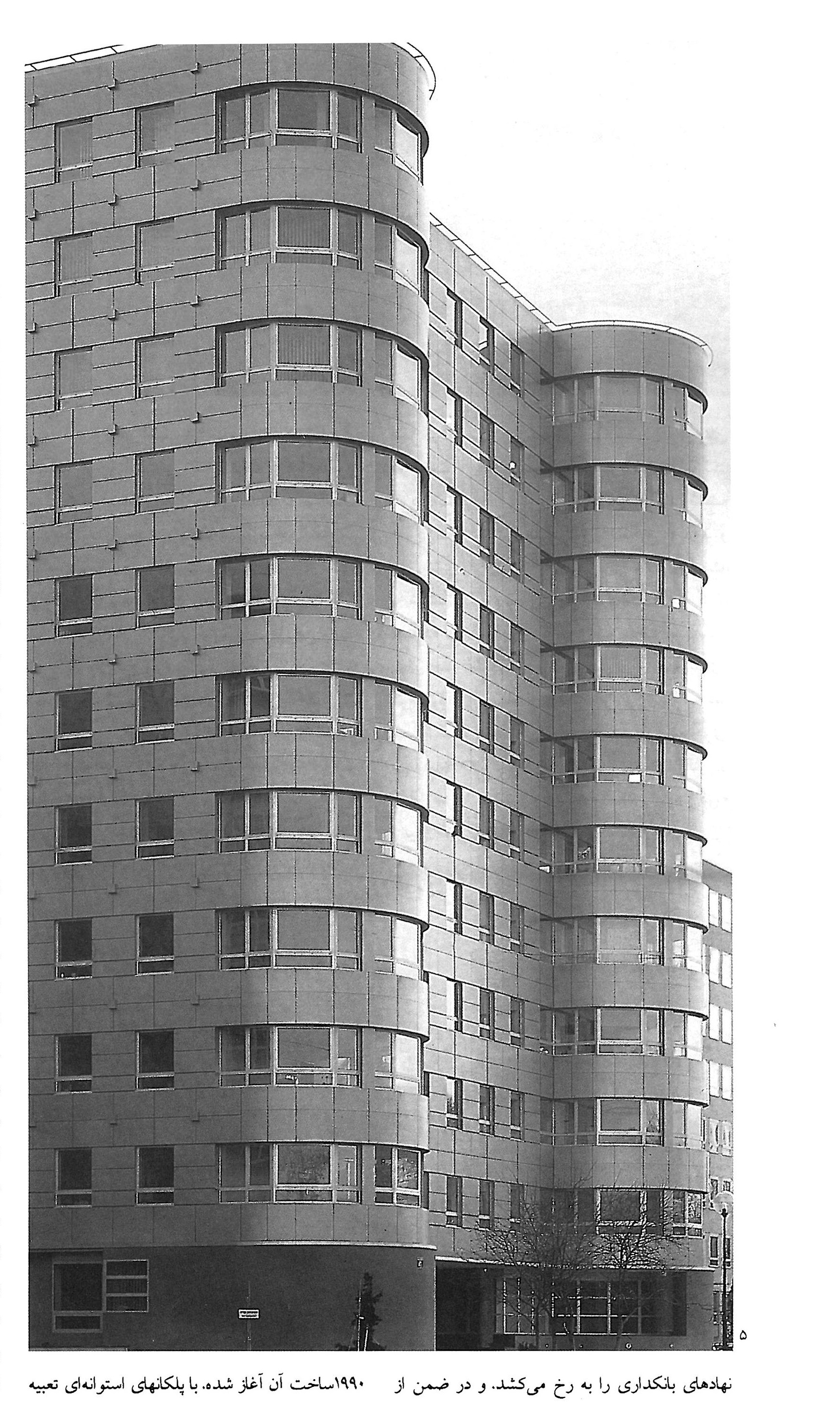
After several years of complete freedom — a freedom exploited above all by the wealthier clients — lighter technologies have appeared, first and foremost the all-timber house (the so-called Canadian house), in which architectural forms have again been standardised, though less than before. In multi-family housing, after an early-nineties moment of collaged masses and spectacular forms, a new simplicity has arrived with a neo-modernist language of forms that also nods towards local tradition — above all in Warsaw. Here we should mention the first executions (from 1997) of the JEMS team (Czykowski, Jagiełło, Miłobędzki), with their apartment complex at the centre of the pre-war WSM estate in Żoliborz; Wojciech Szymborski and Jacek Zielonka, with a bank and apartment block on Sobieskiego in Warsaw; and Piotr Szaroszyk's apartment block in the Grochów district of Warsaw. All of them sit on the street and at corners, making or completing the traditional urban fabric for streets and squares.
Unlike the 1980s, when architectural forms developed in religious architecture, the 1990s have been a period of fewer new churches and so, from that point of view, a more reflective period, leading to a more balanced relation between expression and narrative. The church now being built at Radogoszcz in the Vskhód district of Łódź is an interesting case: the leading Łódź architects Zdzisław Lipski and Jakub Wujek — whose work on prefabricated panel estates dominated the 1970s — returned, in the middle of the nineties, more or less completely to the Romanesque and to its simplicity, roughness, symmetry and spirituality.
The sacred place is not always the church building. On the fields near the village of Lednica, between Poznań and Gniezno, a piece of conceptual architecture stands: the “Third Millennium Gate.” This open steel structure in the shape of a fish, designed by the Wrocław architect Anna Boryska, was not only a symbolic element but the stage for hundreds of thousands of young people who gathered there during John Paul II's visit to Poland in 1997; it will continue to play a role for many years to come. Kraków's “Gate of the City of the Dead” has a metaphysical dimension too: Romuald Loegler, the most famous Polish architect in Europe, designed it. He considers it the most important achievement of his life: in the project one finds the essence of a way of making that rests on geometric precision, the handling of light, and a symbolism deeply rooted in Christ's saying “I am the way, the truth, and the life.” The path passes under canopies, through a large glass door in the façade, and into the interior, where light rules.
Among Loegler's many projects of the 1990s one should mention the extension to the Academy of Economics in Kraków; in it the architect has sought to establish a relation of creative dialogue with the surrounding historical environment through scale and material, rather than through direct citation of forms. Loegler refers, in word and deed, to Einstein's saying that “the glory of the Most High is in geometry” — that is, that the conversation is with the harmony of geometry. For that reason his work creates both beauty and a mood.
Wojciech Jarząbek has formed a different kind of relation with the monumental architecture of Wrocław, referring to Wrocław's Expressionist tradition. In the Solpol department store next to the Gothic church of St Dorothy, he has used his own deconstructivist language and arrived at a light, almost carnival-like, popular mood that has drawn the admiration of some (even art historians) and the anger of others.
These few examples cannot convey the great variety of what has been built, and one can only summarise a few points about the different kinds of architecture. Banks and office buildings, which have become emblems of the system's transformation, have created new spatial and qualitative signs in the Polish townscape. Two banks in Kraków designed by Marek Dunikowski and Partners, and the “Saturn” office building in Warsaw by the JEMS team, cannot alone give a complete picture of the variety of technical attitudes. Dunikowski's atelier deploys a language that states classical principles, affirms the stability of the banking institutions, and is nonetheless modern and open to the city, its inhabitants and its visitors. The JEMS building is tall and gleaming and stands above the buildings around it: attractive, steady, and dignified.
In the nineties architectural ideas have flowed unhindered — deconstructivism and neo-modernism can be seen in almost pure forms in many projects. Many of our good architects use different architectural languages freely, depending on the context. Commercial space — shops, restaurants and above all their interiors — has become a special field of experiment. Plurality is becoming an irreversible reality. Czesław Bielecki has sought generalisation and has proposed the creation of a local version of the “new international style.” All the same, reality — incoherent and non-uniform — does not easily submit to any single style. An existing concept can be used to describe it: the situation of the last ten years of change can be described as “post-totalitarian” — that is, the search for and revival of values, among them architectural values, on the ruins of totalitarianism.
Professor Jacek Damięcki, a long-time teacher at the Warsaw Academy of Fine Arts, proposed in 1996-97 a concept that tied these two approaches together: a concept based on the creation of a “twin city,” Warsaw-Łódź. It is a proposal to resolve the main dilemma of a contemporary city — whether to live in it or outside it — and, at the same time, a new strategy not only for the region but for the country and for Europe. By the 1990s the conviction had emerged that architecture was needed; this has been confirmed by growing collaboration between world-famous and Polish architects. The most striking example is the Centre of Japanese Art in Kraków, designed by Arata Isozaki and the JET Atelier (K. Ingarden, J. Ewy and others). The structure, expressive of Japanese culture, sits admirably in its surroundings and in the ingenious location of the royal Wawel castle, whose architecture was also the work of Italian architects.
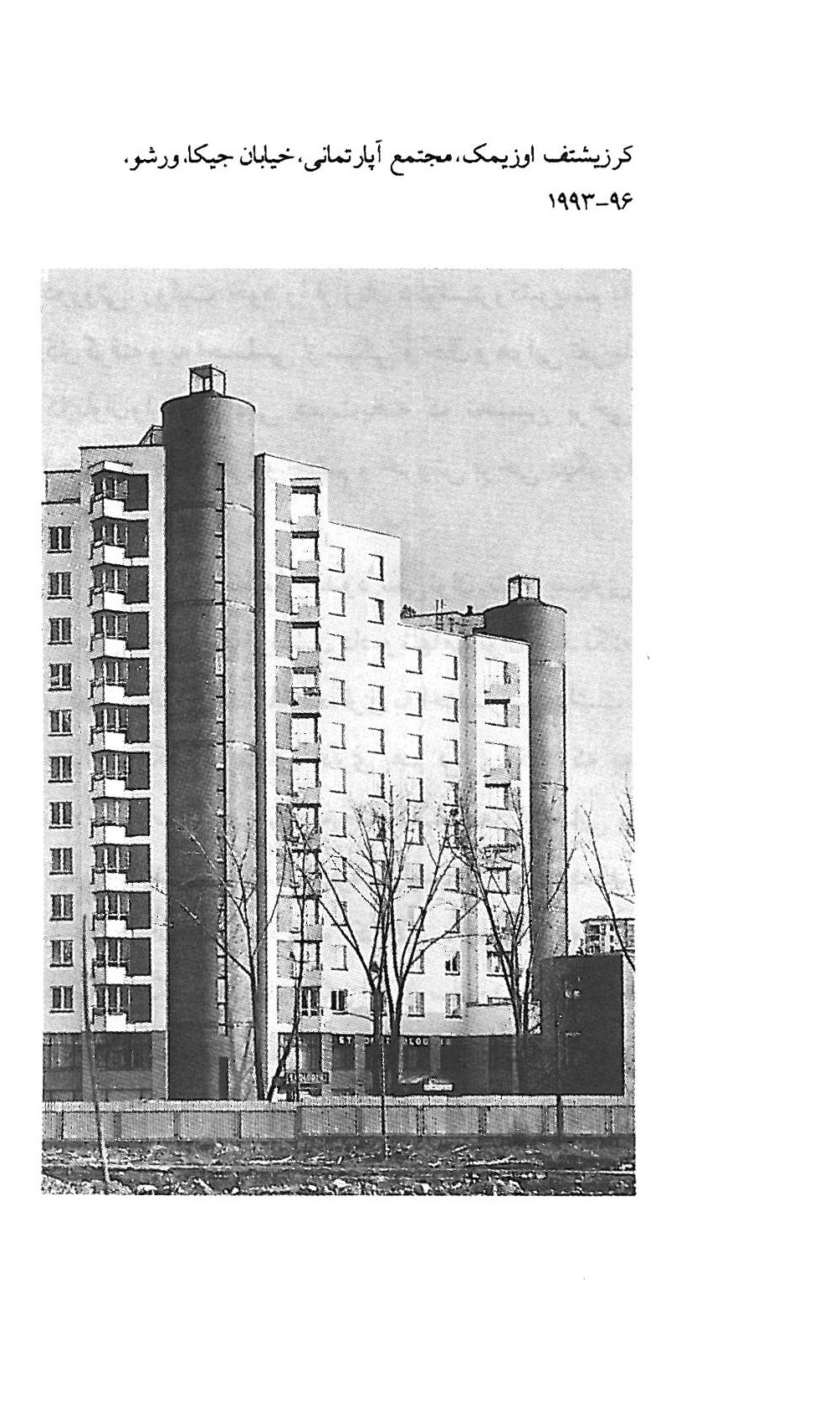
Apartment complex, Warsaw, 1992-96
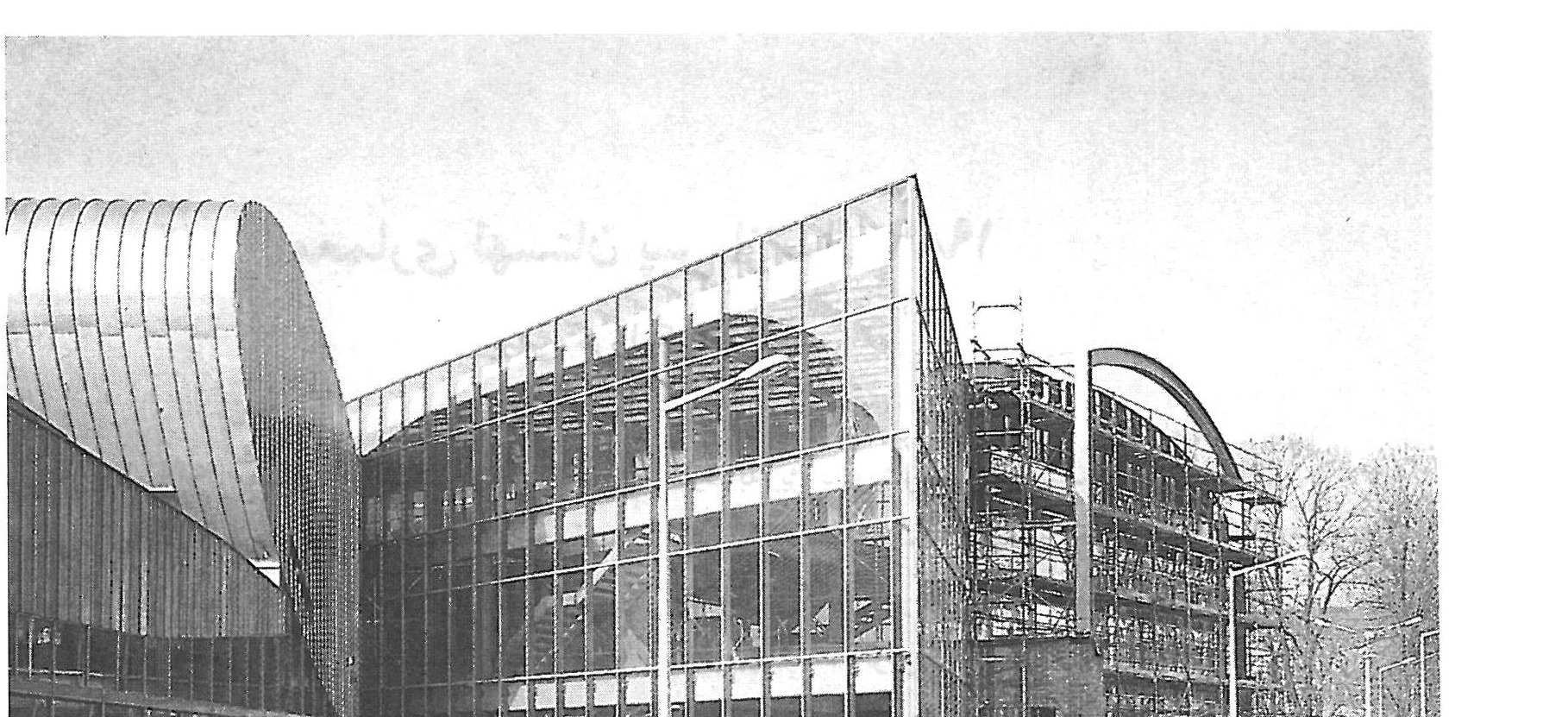
New culture centre of Kraków University, under construction
Bank apartment complex, Warsaw, 1997
JEMS, apartment block, Warsaw, 1992-96
Residential Complex on Hożjosza Street, Warsaw
Design: JEMS architects — Olgierd Jagiełło, Maciej Miłobędzki, Jerzy Szczepanik-Czykowski — with Wioletta Popiel-Maknicka, Janusz Wróbel, Urszula Kuś, Jerzy Blomberg. Structure: Kalman Pakowski and Piotr Kapla. Contractor: Budrex SA.
Żoliborz, the Warsaw district where this residential complex stands, was built in the 1920s and 1930s. Its plan took the “garden city” as its inspiration, and some of the most interesting examples of Polish avant-garde architecture can be found nearby. The site is ringed by the gardens of single-family houses, and touches the streets only in two small sections.
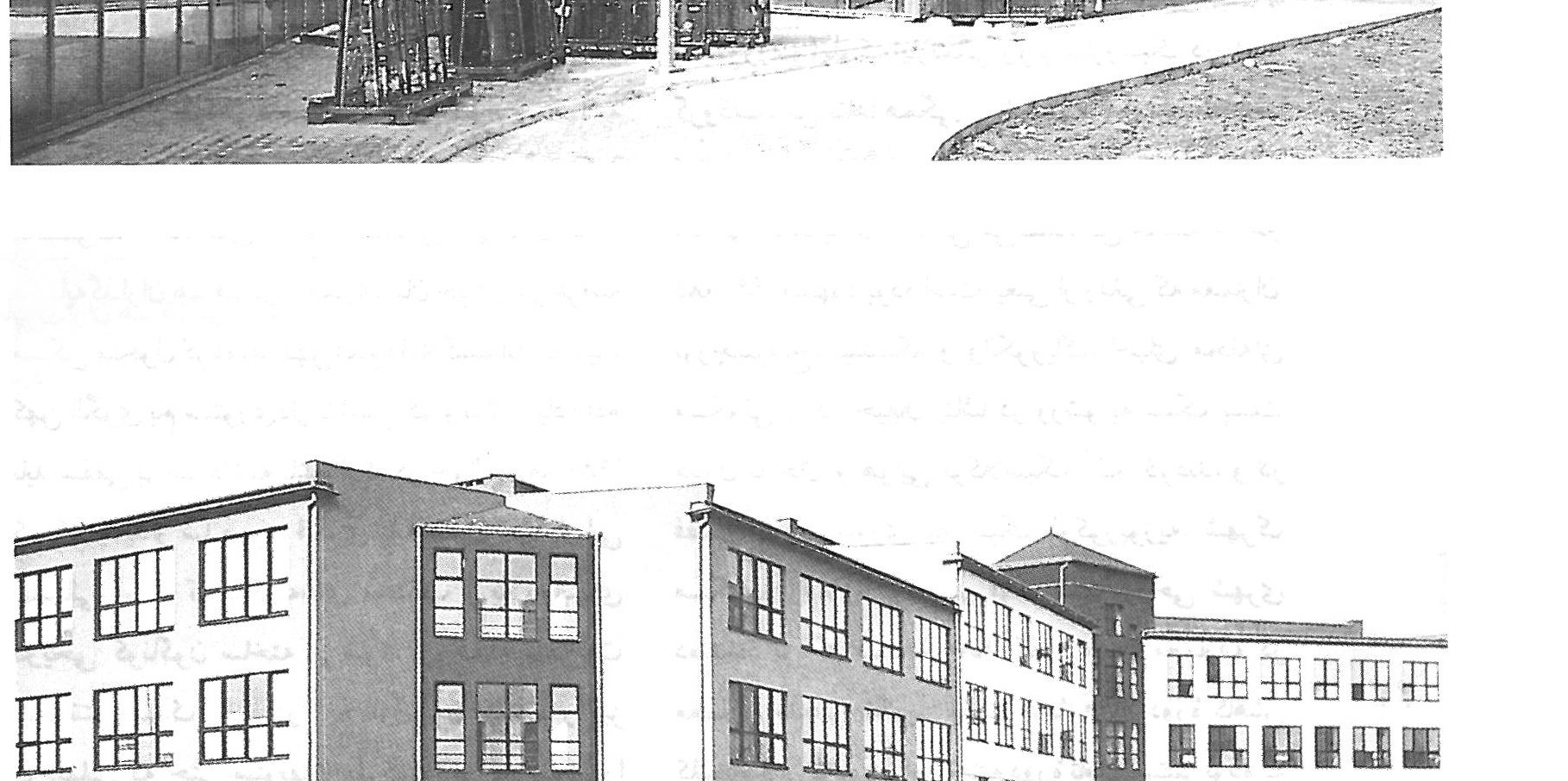
The architectural identity of the estate is a contemporary interpretation of the residential architecture of 1920s Żoliborz. The buildings are of concrete and ceramic; ceramic detailing — as in the neighbouring buildings — has been used sparingly in the entrance arcades, the walls and the courtyard railings. The plans of the buildings respect the irregular triangular site, and existing trees have been kept wherever possible.
The complex consists of five single-family terraced-house blocks and four small multi-family “urban villas.” The whole ensemble is organised along internal pedestrian streets. An underground passage connects the individual apartment buildings to the basement car park, so that there is no vehicular traffic in the estate.
The repeated rhythm of the glazed bays plays an important role in the architectural composition of the northern part of the internal street. The bays are framed in reinforced concrete; the large glazed surfaces are protected by a system of louvres. On its eastern side the street is bounded by two-storey multi-family houses whose ground floor is set back, forming entrance arcades that enlarge the space of the street. In plan, the arcade walls are built along a curve, finished in fired brick in two shades of grey. The wall ties the individual elements of the buildings to the gatehouse and runs on round the enclosure. The ceramic colour pattern of the walls is repeated in the paving of the street. Stairs and entrance halls are faced with two kinds of stone.
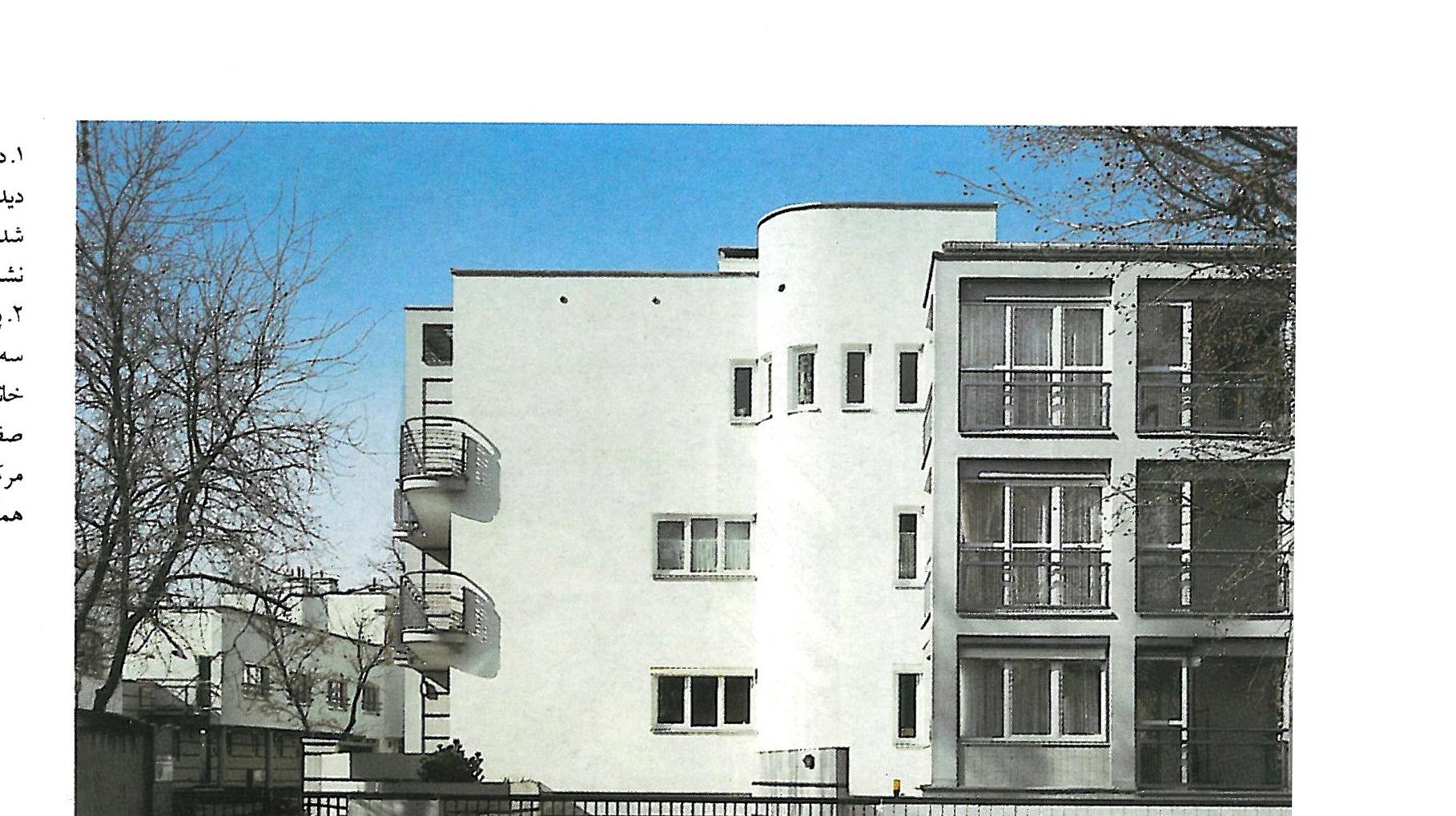
Residential Complex, Warsaw (JEMS Architekci) — view of an urban villa
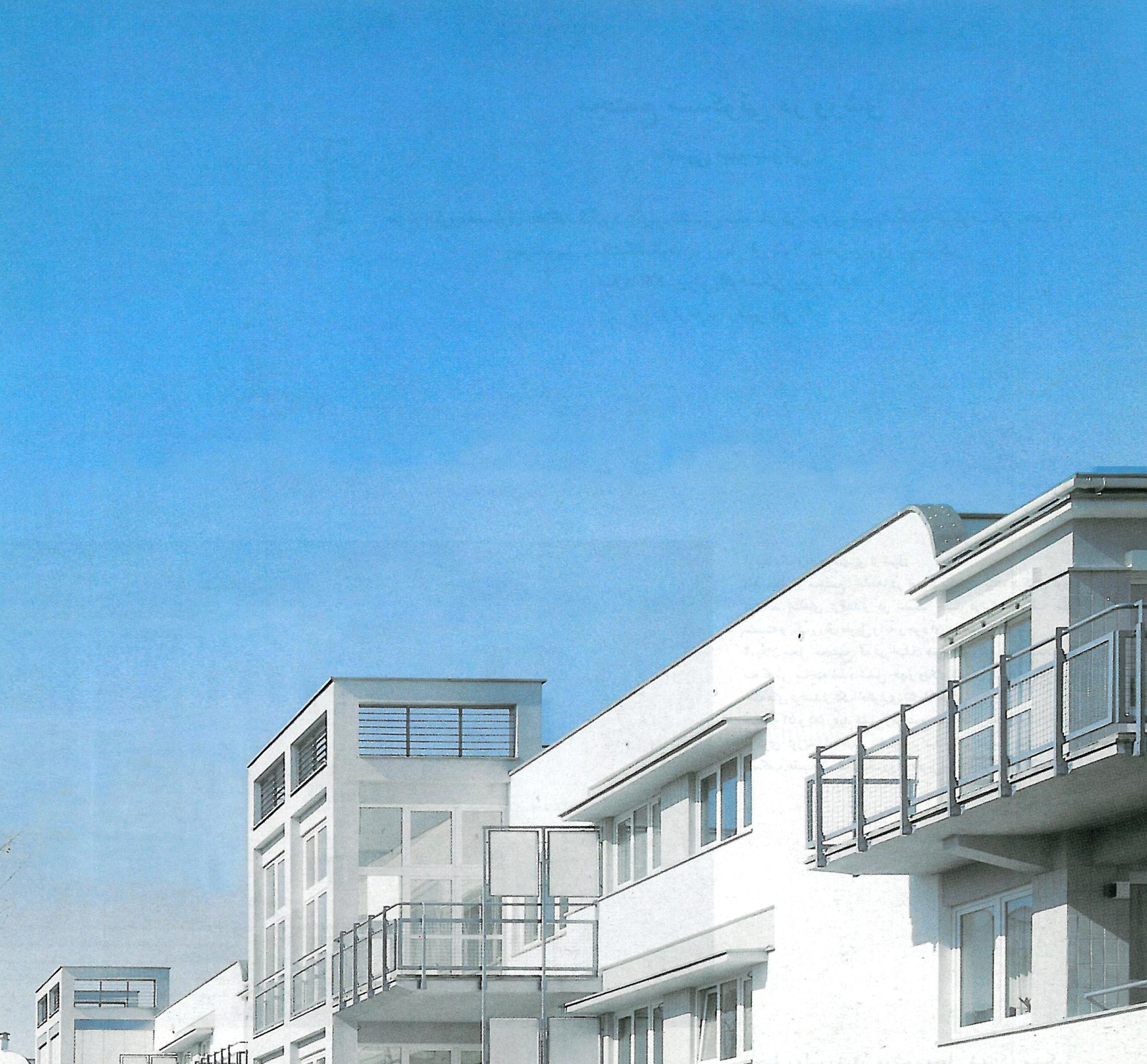
Residential Complex, Warsaw (JEMS Architekci) — view along the central pedestrian way
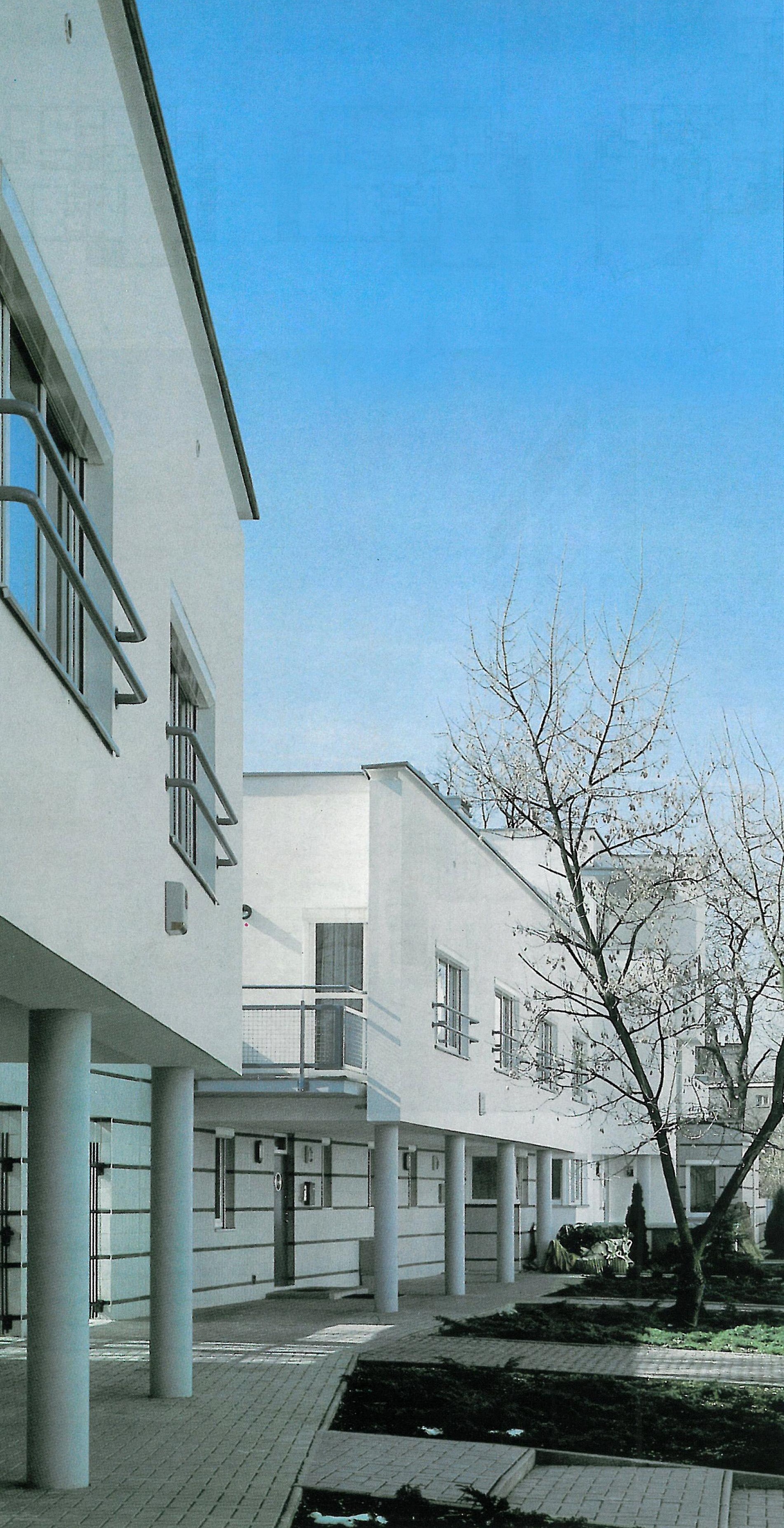
Residential Complex, Warsaw (JEMS Architekci) — housing blocks along the central passage
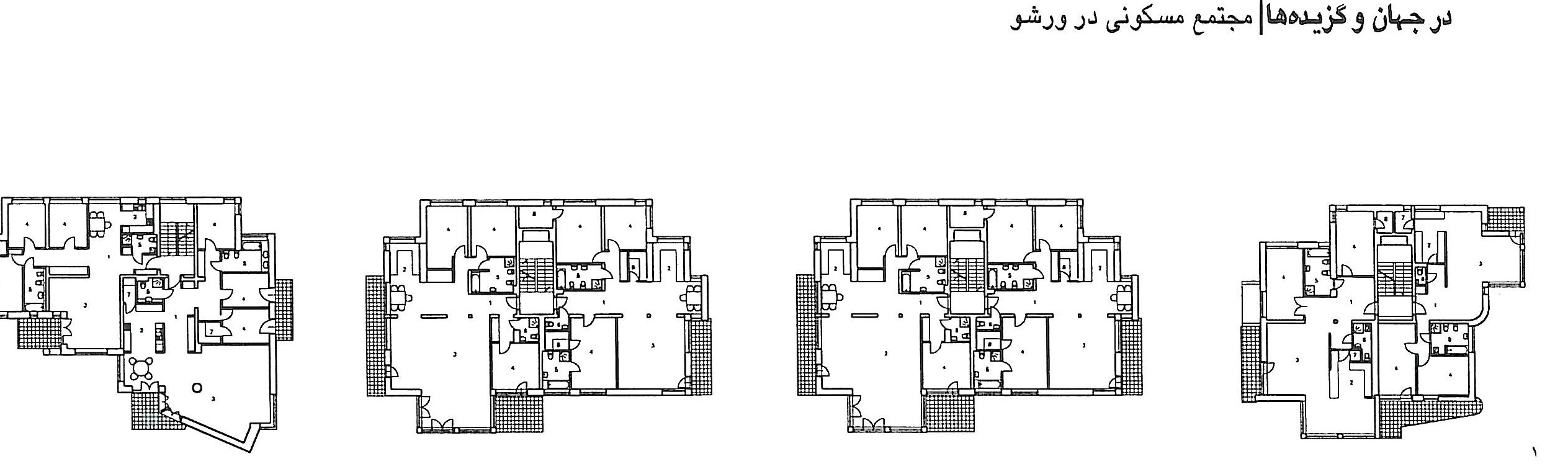
Residential Complex, Warsaw (JEMS Architekci) — apartment unit plans
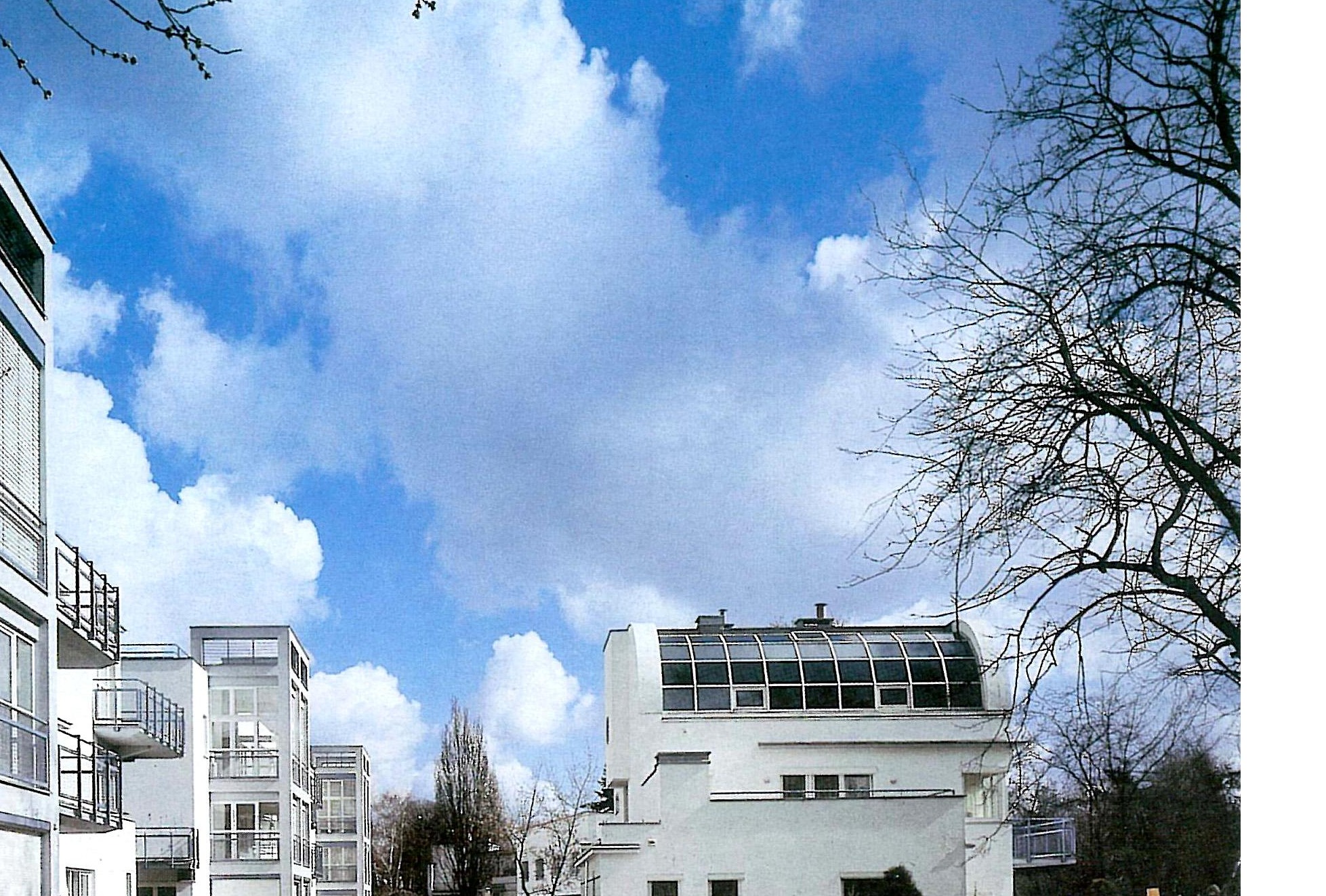
Residential Complex, Warsaw (JEMS Architekci) — view of the complex
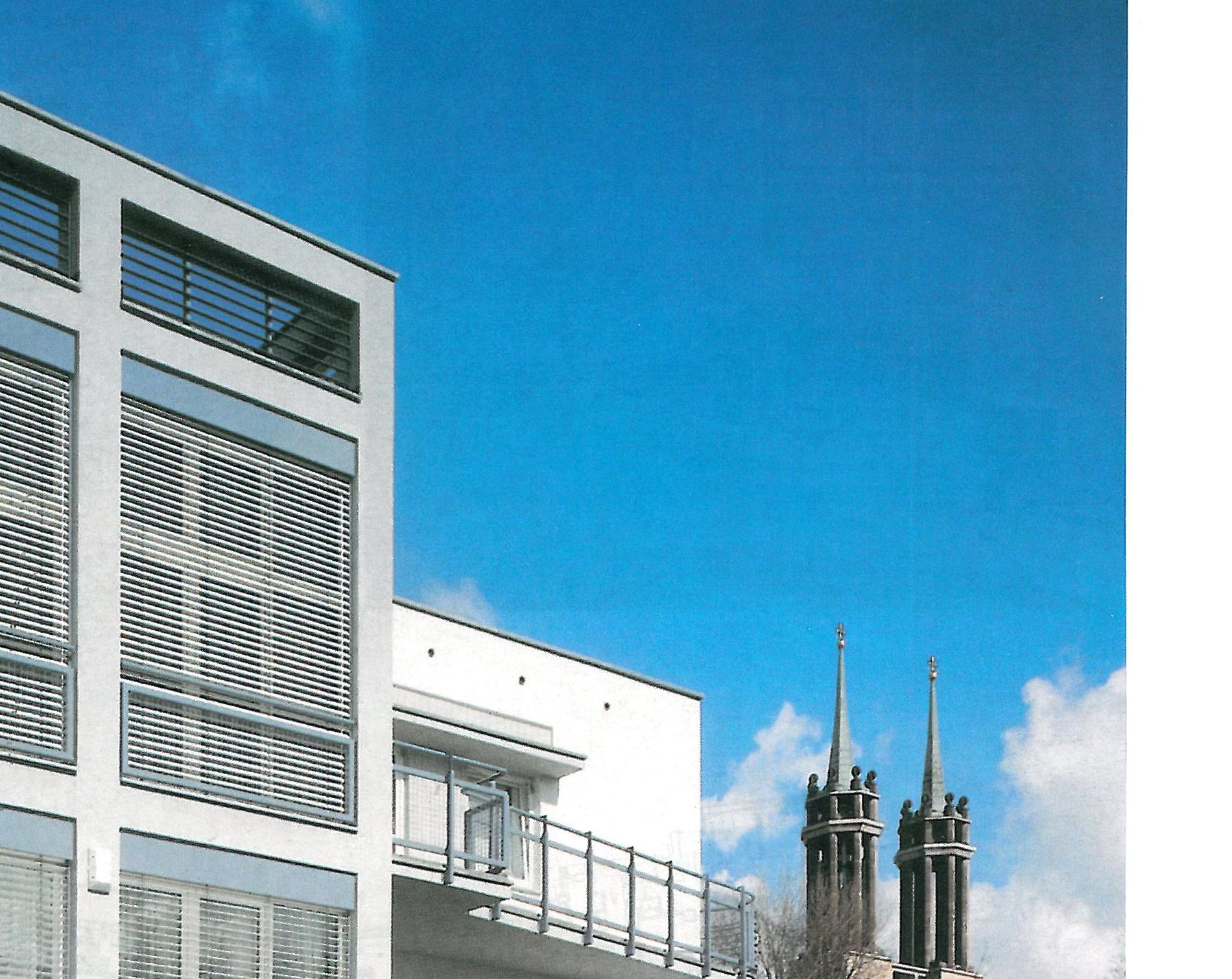
Residential Complex, Warsaw (JEMS Architekci) — a residential block
Poland's Enduring Craft Tradition
The craft that had been a tool — a weapon, even — in the hands of the dissidents, whom the ruling political system set out to crush, found new life in 1989. Since then it has been able to revive the arts and values of craftsmanship and of a respect for materials or simple making, thanks to the efforts of a new generation of young artists.
Representative works include the “Manhattan” series of glasses in lead crystal using a particular layered process (by Katarzyna Halas-Leszykowska); the “Salomoniana” series of glasses and decanter, again in lead crystal with geometric ornament; and a round vessel, also by Halas-Leszykowska, of lead crystal worked entirely with vertical engraving.
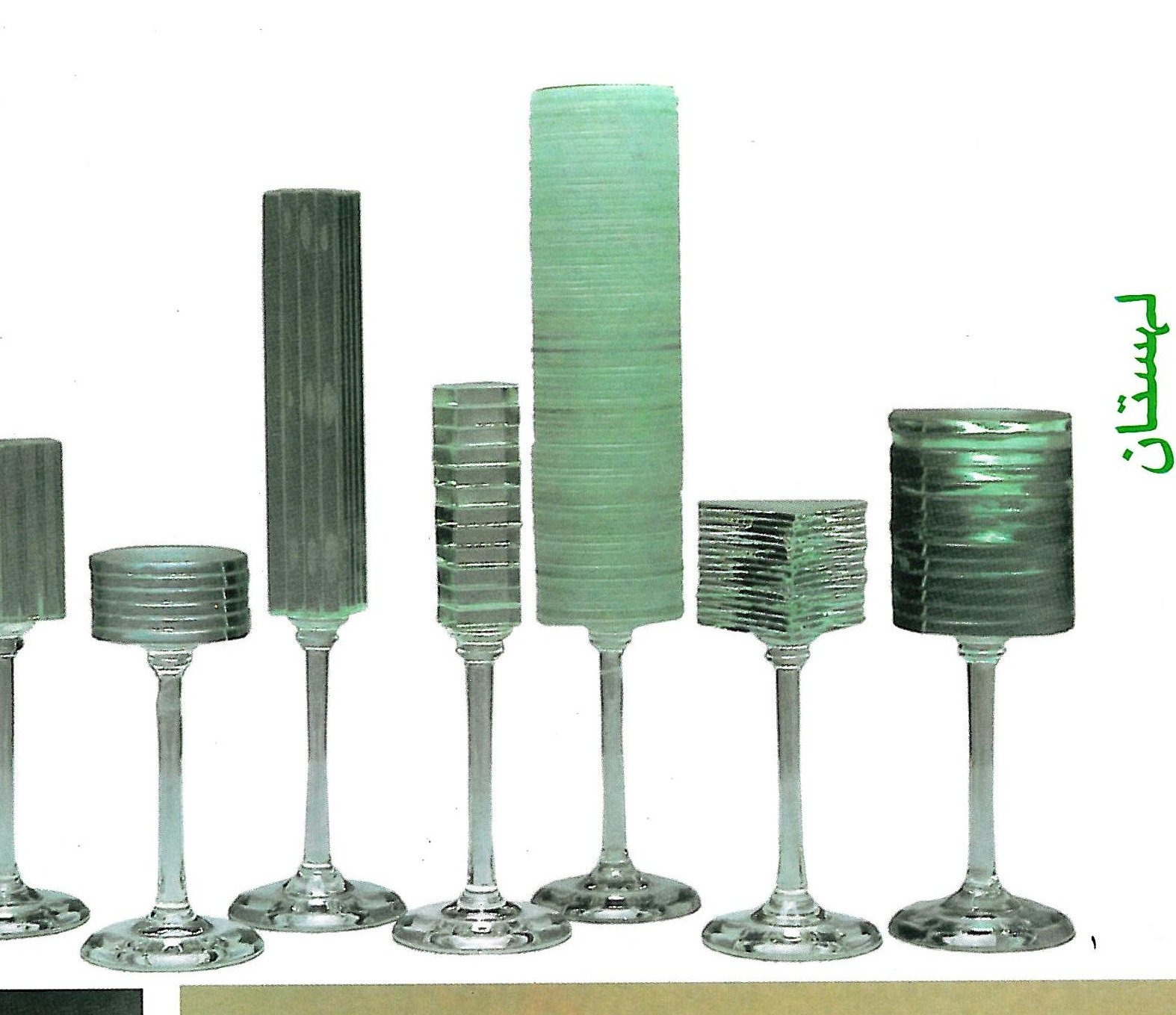
Katarzyna Halas — 'Manhattan' series glasses, lead crystal
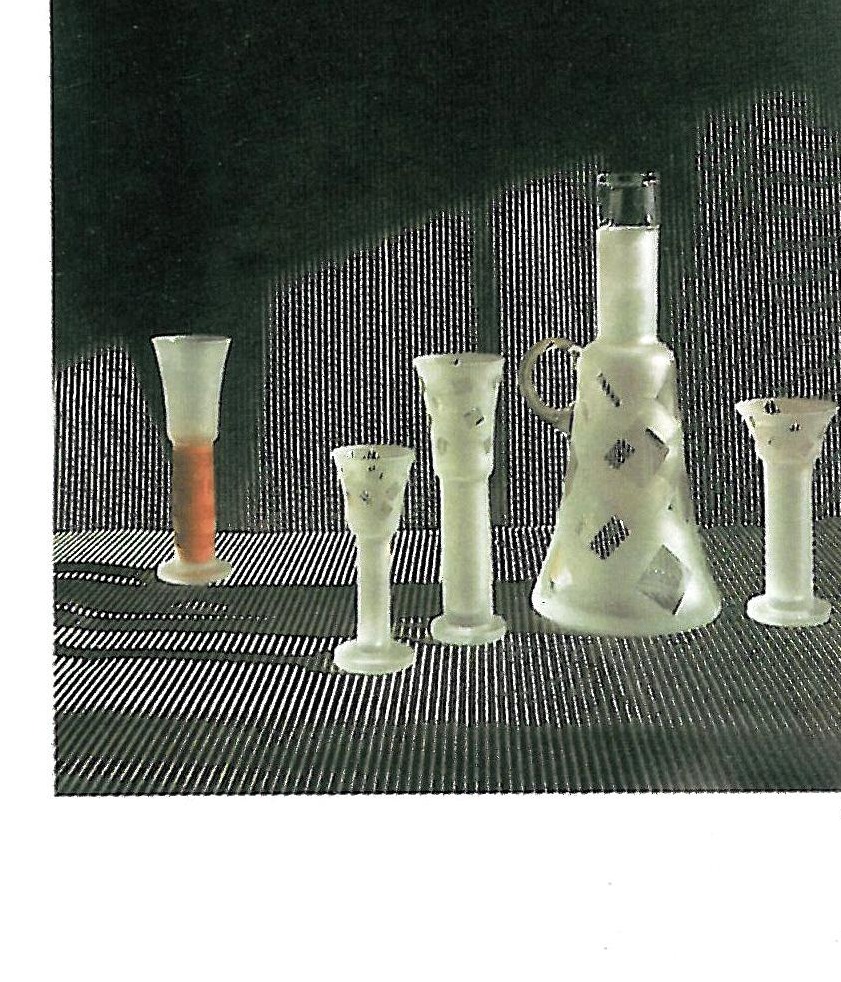
Katarzyna Halas-Leszykowska — 'Salomoniana' series glasses and decanter, lead crystal
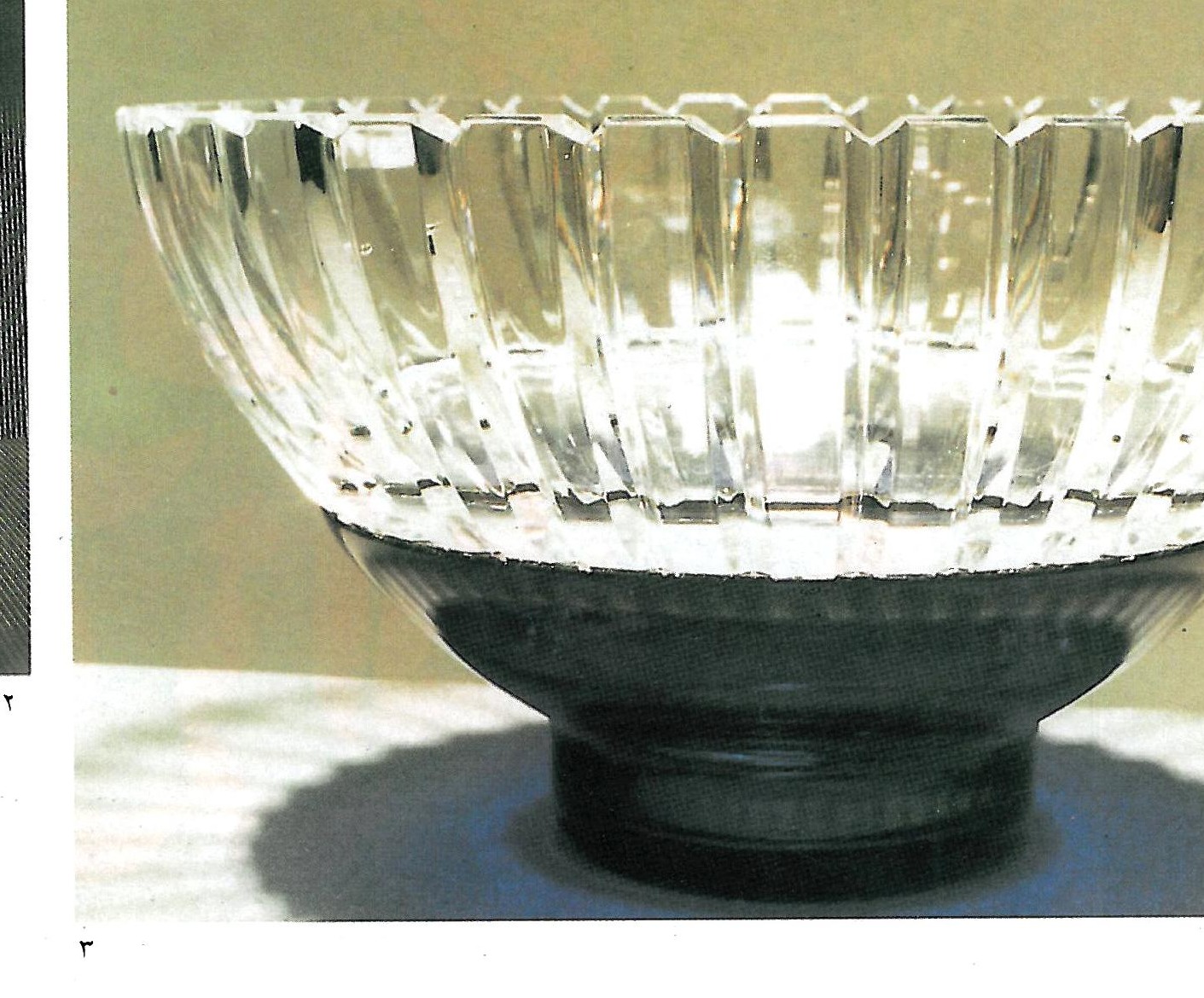
Katarzyna Halas-Leszykowska — round vessel, lead crystal with vertical engraving