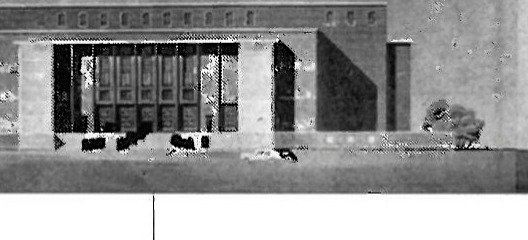
Roland Dubrule and the Turbulent Years of Modernism — Sirus Samii (trans. Kamran Goshtasb)
For years I tried to uncover Roland Dubrule's share in the face of Tehran. Apparently he had been at work in Tehran in the 1310s (1930s). In those silent years when Reza Shah was filling in the moats and pulling down the gates and building the airport, the opera hall, the post office and the prison — remaking the face of the city forever, and, by opening roundabouts, squares and tree-lined avenues, closing the route of the camel — those years when he wanted a city modelled on Paris, even though before his exile he had left Iran only once, for a political trip to Ankara.
In my research into the architects who realised the Pahlavi-era modernisation project, I encountered Dubrule's name several times. The question of which of the important buildings — or the inconsistencies attributed to him — were really his work was one whose answer seemed out of reach. Many a restaurant, school and office were ascribed to this man; Dubrule's name was certainly on everyone's tongue.
I must confess that my infatuation with his name and his admirable repute influenced all my efforts to gather documentary evidence. My infatuation doubled when I read an article in the magazine Abadi: at the end of it I saw a photograph of a young Dubrule surrounded by an enthusiastic circle of architects from the School of Fine Arts. The article itself was the memoirs of engineer Keyhan, who had studied in the fledgling School of Fine Arts under Dubrule; but of Dubrule's works nothing was said. Still, we owe him much for some of the information — among other things the fact that Dubrule later married an accomplished violinist, a relative of one of his students named Hamlet Hartounian.
Then I came upon the plans of the Tehran Ministry of Justice Palace that bore Dubrule's signature. They were found under a staircase in the Ministry itself — the building in the end was built to the scheme of a Czech architect: shadow-play perspectives of astonishing grandeur, enormous views of the building guarded by stone lions, utterly modern schemes both for their simplicity and grandeur and for a new reading of classicism — visible in the use of columns, the architrave of the entrance, the roof and truss — and at the same time showing the designer's own taste. Whether in the stairs, in the use of concrete, or in the great barrel vault recalling the Milan rail station, this artistic taste is the very one that created the masterpieces of Greek civilisation and the engineering wonders of the twentieth century. These sketches of a building that was never built speak, more eloquently than any building, of that era of suppressed hopes between the two wars — a time when both buildings and future stood above life.
I obtained these drawings after much searching on rooftops and down back alleys, after many cups of tea and many late-night telephone calls, from a man who claimed to have found them; he said that, ruined in currency trading, he was obliged to sell the drawings to a trustworthy person. Evidently I was a suitable bait. In all my digging in the archives of the ministries, the Plan Organisation and the Cultural Heritage Organisation, I never came upon drawings that so precisely and powerfully depicted that post-First-World-War era of ambiguity and hope.
Now forget for a moment the violinist relative of Hamlet Hartounian and the face of new-Tehran architecture, so that you may understand how I searched for a trace of Roland Dubrule in history books and travelogues. Forget also that the drawings bore the signature of Gabriel Guevrekian — an architect of international renown. Forget that Guevrekian was a pupil of Mallet-Stevens and secretary of the famed International Congress of Modern Architecture, and that his professional life ended at a university in Illinois. Disregarding all these and the other forgotten truths, you may understand what the endless interviews with old architects and with rather-less-sharp foreigners who had spent some time in Iran meant.
Throughout all my searches in that brief Tehran spring, throughout all those fleeting years when I was researching the architectural history of the city, I never once saw an account of Dubrule's works that was in the least satisfactory. Most of the stories I could not even in credulous good faith accept as correct — among them the tales of a Belarusian merchant who, fleeing the Bolsheviks, swam across the Aras on the icy Christmas Day of 1917, took his chance training King Faisal's hounds and then entered the service of the Iranian Shah in the same role. For that reason I kept up my research until I returned to America. I wrote to archives and French professors, but all I received were polite and brief negative replies.
I searched for Dubrule on three continents, until one day, by pure chance in a library in Santa Fe, New Mexico, I saw a Paris telephone directory. I looked for the name "Dubrule," and at the bottom of the page — after "Dubrule, Monique, pouillé Mesrine" — I came upon "Dubrule, Richard, architect, 67 rue Verniou, Paris." I thought that this person might have information about his namesake colleague. I sent a letter with the warmest of greetings — not knowing whether I would get any reply. A few weeks later I got a letter asking whether I meant the architect Roland Dubrule, who had worked in Iran from 1935 to February 1942. Richard Dubrule wrote that he was Roland Dubrule's son — himself an architect — and that he had drawings and photographs of his father's works.
It was only a few months later that I was able, on a trip to London, to go through the Channel Tunnel and see the city of Reza Shah's dreams — along streets his feet had never reached — at 67 rue Verniou. That was when I met Dubrule's son and tried, as best I could, to explain why I had written to him without expecting a reply, and why I felt obliged to meet him and to learn something about his father's seven-year stay in Iran. I gave him some information about my research, told him about that magazine article, showed him the young photograph of his father, and asked after his violinist mother.
Richard Dubrule, in reply, set aside his hesitation toward this inquiring Iranian — questions that had not been posed in fifty years — and his uncertainty about a researcher resident in America studying the public architecture of Tehran; and he believed, at least for a moment, that I had spent a day of my time on the Channel Tunnel to ask about forgotten buildings raised long ago in a distant country. Richard Dubrule, in reply, thanked me for the gift of his father's drawings, said his mother enjoyed good physical and mental health, and agreed to show me a collection of papers that would document those memorable years of his father's life in Tehran rather fully and clearly.
In his workshop I heard stories of the young Roland Dubrule and the tale of his coming to Iran. Dubrule, of Swiss extraction, had studied at the Beaux-Arts in Paris. After graduation he entered an important architectural competition. According to his family, his scheme had the greatest chance of winning — until the watermark of his drawing sheet revealed his nationality, and that cost him the first prize. It is said he was so crushed that he gave up working in France. Apparently he was too attached to his country to work in such conditions. Disheartened by injustice in a country built on liberty, equality and fraternity, he came to the Iran of a Cossack-turned-king, and taught at the fledgling School of Fine Arts.
This was a very strange reaction. I wonder what brought him from Paris to Tehran. Perhaps it was an opportunity to realise the dream of marrying white, shining temples to modernism — to build buildings that would gently usher this ageing country into the twentieth century. Perhaps it was for the sake of his memories: memories of childhood tales of René and the hunchback, butchers' apprentices and dervishes, wizards bartering new lamps for old, enchanted forests thick with brambles and sleeping beauties, small fairies, near-sighted witches and soft-hearted executioners, doorless towers and blonde princesses.
In any case, the architecture of Tehran profited greatly from that decision — not only because Dubrule trained several generations of Iranian architects and brought at least one wandering Iranian architect back to his homeland, but because of the design of buildings that to this day still preserve those "above life" years before the Second World War.
I spent two brief hours at 67 rue Verniou with Dubrule's son. I pounced eagerly on the projects and memories and turned over, in a bag, early sketches, articles, plans, perspectives and dated black-and-white photographs. After his self-imposed exile in February 1942, Dubrule had with great care catalogued his projects in a country to which he never returned. The drawings — from fully matured building schemes to elevations and perspectives drawn in dream and wake — had been left at different stages. Among the drawings were four small, square black-and-white perspective photographs, which — years after they had been taken — had been found under the Ministry of Justice steps by the man who claimed to have been ruined in the stock market.
Tehran never acquired the adjective "thriving." The Stock Exchange building was never built either, even though Reza Shah razed the whole Oud-Lājān quarter to build a stock exchange at least larger in size than its New York counterpart. A similarly failed attempt was made to build an opera hall, whose half-defective shell later came into the possession of a bank. But the Ministry of Finance, the casino and the Ministry of Justice were built; though they do not resemble Dubrule's schemes in façade, both ministries are in practice shaped by his ideas. The compositional layout of the annexes and courtyards of the Ministry of Justice — whose sensible resemblance to a broken cross was mistakenly attributed to the Germans — was built with an eye to Dubrule's drawings, though the building was completed, by degrees, in neoclassical style by a Czech architect known only as Sewá. The preliminary plan of the Ministry of Finance also differs only slightly from what Dubrule drew in 1316 (1937-38), though the drawings bear Mohsen Foroughi's signature. In the case of the Ramsar casino, however, my mind could not establish any resemblance between its modern additions and the drawings I saw in that dust-covered bag on that winter day.
Even as I speak hesitantly of Dubrule's influence on buildings bearing others' names, I can speak with certainty of buildings unquestionably designed by Dubrule, yet often ascribed to others. The list is long, and striking for the seven years he spent in Iran.
These works bear witness to Dubrule's character — he was, after all, a man who, in his thirties, for a matter of principle, left Paris for Tehran. They also bear witness to the policies that meant to bring Iran into the twentieth century and equip the country with modern buildings. Of course, beside Dubrule — who spent seven of the most productive years of his life building banks, stadiums and cotton warehouses — there were many other architects who, in the same anonymity, gave shape to the modernisation, and built cinemas, arsenals, museums and lifts-equipped houses, and even produced a miniature copy of the Eiffel Tower.
Dubrule's list of works includes such dissimilar buildings as the Amjadiyeh sports ground, the Melli Bank in Sari, the Cotton Warehouse, the Manzariyeh sports ground, and the Ebtehaj, Panahi and Izadi residences. The list does not include the Nourbakhsh School or the Ministry of the Interior, and the Ferdowsi School, the radio transmitter or today's Soren Restaurant certainly have no place in it. But the University Club, the School of Fine Arts, and the master plan of the University of Tehran (with Maxime Siroux) belong to this list.
Of all the buildings that Belarusian merchants and Armenian café-keepers attributed to Dubrule, the Faculty of Fine Arts of the University of Tehran was the only one he actually designed — where he himself taught — a grand, majestic building with classical proportions and modern plant-ornamentation.
In that dust-covered bag a particular understanding of beauty runs on, repeating itself again and again — an understanding of beauty resting in simplicity and permanence, which absolutely affirms the importance of the building and of its particular era. Dubrule must have had at least a dim sense of the importance of his buildings and their historical place. His drawings for the first university, the first stadium, and the Sari branch of the Melli Bank all seem to have been designed with full awareness of the significance of these buildings and their role in shaping modernisation. There are no signs of a dome or a pointed arch; no sign of legendary Persian architecture or of the shining past of Iranian architecture. Only accidents like columns, the lintel beams of an entrance, the posts of a roof or a wall come into view. Each of these buildings — even where most of it is not associated with Dubrule's name — is memorable and will remain in memory.
It is this very grasp of beauty that spreads its wings over his work — whether in the stadium, in the educational buildings, in the villas, or in the universities and banks. Perhaps the best instance is the 3-, 5- and 10-metre diving boards of the stadium — Dubrule's balanced, measured sentence. For three whole years I searched the streets of Tehran for the author of this short, eloquent phrase, followed broken leads and contacted athletes and officials, until at last, in a dusty bag at 67 rue Verniou, I found my answer.
In that bag I also saw photographs of the house Dubrule built early in his career in Iran for Ebtehaj — a modern villa without extra decoration, a scheme unnatural and almost absurd for a relatively arid highland plateau, but wholly fitting for those turbulent years of modernism — years that had to bring a bold new era.
At 67 rue Verniou I heard the stories that remained of those seven fleeting years of Dubrule's stay in Tehran, and I obtained information that in all my searching in old magazines and older memoirs — during the fleeting years I had returned to Iran and had thrown myself into documenting its architectural history — I had not come across. Not only did I find documentary evidence of the architectural projects he had built, or that had never been built, but I also gained information about his life, his friends and his feelings. In two fleeting hours at 67 rue Verniou I learned more about Dubrule and those years full of hope than I had in two full years of research in Tehran.
I heard the story of Dubrule's friendship with Foroughi, and of Foroughi's insistence on his return — years after Dubrule had left Iran, after he had left Syria, after he had returned to Paris — in the peak years of oil prices, when money poured into the country like water and Foroughi was the most influential architect of that period. Dubrule never went back to Iran. He was too attached to the country to return.
I understood how a young Swiss architect, at the start of his career, could forever change the face of a city in seven short years and, in answer to the king's longing for modernisation and for emulation of a city he had never seen, leave behind mementoes.
Years later, when I at last put pen to paper and tried to reconcile this architect's anonymity with his incredible share in the face of Tehran, I could not refrain from recalling a story about a Kurdish prince. The tale was told me by someone wearing a seal-ring bearing the inscription "Khan of Khans." Apparently the prince had summoned a famous architect, who worked for a year and built the most magnificent building one can imagine. In reward, the daughter of a princeling was given him in marriage, and he was bestowed a Kashmir robe, a piece of land, and a title and honour. But that was not all: in return for creating the most original edifice conceivable, both his eyes were torn from their sockets. According to the man with the ring, they blinded him so he might not build another building of such splendour.
As I reviewed Dubrule's life — that watermark on a drawing sheet that led him to Iran, his marriage to Hartounian's violinist relative, the enduring building he made for the School of Fine Arts, the splendid stadium and its 5-, 3- and 10-metre diving boards, the buildings he did and did not build, the anonymity of that workshop behind the Italian embassy and his unreasonable love for a country to which he never returned — I could not shake the thought of that blinded architect. I myself do not know why. Between these two stories there are very few points in common: Dubrule was never rewarded with gold and a Kashmir robe and a title and a princess's daughter, even though he built the most enchanting buildings for Reza Shah. Between the two stories there is but one resemblance: Dubrule never again built buildings like those he left in Iran. As if he could no longer see.
The Value of Roland Dubrule's Legacy — Homeira Ettehadi
For years, in Europe, I have been following with interest the published materials in various magazines about the pioneers of modern architecture in Iran — the history of the founding of the university and the memories of the students of the earliest classes of the School of Fine Arts. These discussions are a survey of the transformations of our traditional society in architectural form, and also of that exceptional era of "firsts": the first university, the first apartment block, the first reinforced-concrete bridge, the first lift...
Those transformations of that time — which brought public access to hygiene and welfare (piped water, electricity, roads) — have, against the crowding of today, a calming clarity, full of hope and confidence in the future.
Today, I, a Tehran-born, have no clear picture of my own city. Even the northern mountains of the city — which once, in their bare nakedness, were the obvious end-point — appear, when seen through the smoke and pollution, revealing new neighbourhoods unknown to me. Referring to history and to others' memories helps me find a few markers and arrive at a mental map of my own city.
Three years ago I had the opportunity to meet, in France, with some engineers of the earlier generations — or their relatives. Many of them kindly placed their memoirs at my disposal. One of those I met was Richard Dubrule, son of Roland Dubrule.
André Godard and Maxime Siroux are familiar names to those interested in Iranian art and architecture, but Roland Dubrule's name is less often met; even in various articles, some of his works have been attributed to others.
Roland Marcel Dubrule was born in 1907 in Armentières, in the north of France. From age 17 he began apprenticeship at architectural offices and building sites, and at 18 he entered the École des Beaux-Arts with the highest marks. Dubrule's educational record attests to his prolific energy and exceptional capacity: from 1932 he took part in eleven different architectural competitions as trainee or collaborator (Zurich Hospital, Shanghai Municipality, the Bern Master Plan, the Stockholm Royal Palace Master Plan, etc.). He graduated in 1932. The following year, when for non-professional reasons he did not win a competition in which he had taken first place, he was so crushed that, after winning the competition for the Tehran Stock Exchange building, he left his country for Iran at once.
Dubrule began his work in Iran with the Batignolles Construction Company — one of the foreign construction firms based in Tehran, active in the new projects of Reza Shah's era. According to existing records, he drew the scheme for the Ramsar Casino in 1936 for this firm.
At the General Department of Buildings of Iran, Dubrule drew the preliminary and working plans of the Ministry of Justice Palace; and after the transfer of the technical office of this firm to the Ministry of Industries and Mines, he also took on the design of the plans of the new Ministry building. Dubrule and Foroughi founded their own technical office in 1938. He collaborated in founding the Industrial Technical School of the Ministry of Industries and Mines, and taught architecture there; many of his students there later joined him at the School of Fine Arts.
While holding the post of consultant at the Ministry of Foreign Affairs, Dubrule took second place in the competition for the new Ministry building, and after the completion of the skeleton construction, took over completion of the executive works, supervision of the site, and the preparation of the Ministry's furnishings (1938). In the capacity of control engineer, he also oversaw the construction of a hospital for the Ministry of Finance. Dubrule began collaboration with the then Ministry of Education in 1937, and from 1938 worked there as Chief Engineer. The 3,000-seat Manzariyeh Stadium, the expansion of Amjadiyeh Sports Park, and the plans for the University of Tehran were his main activities for that Ministry. Besides the Students' Club Building (1318 / 1939-40) and the Faculty of Fine Arts (1319-1320 / 1940-41), he oversaw the supervision and management of other university sites — including the faculties of engineering and law. In 1941, with the collaboration of the young designer engineer Foroughi, he completed the Faculty of Law building; and from 1940 he was appointed to head the technical office of this Ministry for the construction of 12 primary schools in Tehran.
During his years in Iran, Dubrule also prepared a master plan for the ministry quarter, and took second place in the limited competition for the Ministry of Finance building and first place in the new competition for the Tehran Stock Exchange building. At the outbreak of the war, in late 1939, Dubrule volunteered for the French Air Force; five months later he returned to Iran, and in 1942 he left Iran for good. After that, for three years, as head of the Urban Planning Department of French-protected Syria, he prepared the master plans of the main Syrian cities. In this post Dubrule succeeded another Frenchman whose name is also familiar to us: Michel Ecochard. He returned to France in 1945. All the same, until the last years of his life he kept his friendship with many of his Iranian colleagues — but he no longer accepted offers of work in Iran.
The effect of the activity of foreign engineers in Iran is a broad discussion, and one outside the scope of this article. They brought new concepts in some respects; but on the other hand the wave of modernism made our traditional architecture look small in our own eyes. This effect has remained to this day. Dubrule's works, too, were in tune with this transformation. At a glance his type and manner of work might be called "modernist and constructivist." His larger schemes — such as state buildings and the Stock Exchange — have a symmetrical façade emphasising a central section; his other schemes — with more varied programmes (residential villas, sports stadiums) — though fully functional in plan, differ in volume and in materials used from the state projects.
The Present Condition of the Buildings
When it was agreed that I should prepare an article about Dubrule's activity in Iran for Memar, I went again to see his known works in Tehran, so that direct contact with the buildings would help me in writing. The truth is that the present state of the buildings, and of most of the buildings of this period of Iranian architecture — such as the remarkable buildings of the Rah-Ahan quarter, the scattered residential buildings remaining from well-known architects, and the University of Tehran complex — above all betrays the absence of a proper policy and planning for preserving, maintaining and respecting these works.
Take, by way of example, a look at the University of Tehran complex. The founding of the University of Tehran was the symbol of the first step toward giving young Iranians access to the latest scientific advances of the age. The new technical possibilities of that era transformed every traditional society, and the buildings of that period are the reflection and memento of this page of our architectural history. The architecture of this complex brought together some of the founders of new Iranian architecture: André Godard, Maxime Siroux, Mohsen Foroughi and Roland Dubrule. Each of them played an important role in completing the major projects of this period. The University of Tehran and its neighbouring buildings — the Museum of Contemporary Art, the Carpet Museum (which in turn brought together major architects of the second and third generations), Laleh Park, the International Hotel, the many publishers and bookshops of Enghelab Street, the cinemas of that area and so on — form, functionally and in urban space, a kind of wide cultural precinct within this crowded neighbourhood. Until the completion of Tehran's great musalla, this precinct even hosts the Friday prayer. The effect of the countless visitors on the economic life of this area plays a decisive part in the vitality of this cultural heart of the city.
The image of this complex in the minds of the neighbourhood's residents, the brilliant young of our homeland who are admitted with pride to this university from every corner of Iran, the foreign guests, and the throngs of worshippers, is in some way a reflection of our cultural standing and of the value we set on it. Unfortunately one must say that, in the eyes of a passer-by, an ordinary citizen, or an architect, this important historical complex does not at present offer a proud picture of the value of learning and culture in our society. The worn condition of the buildings and the site, the repairs and additions made without any regard for its architectural and historical standing, recall a forgotten square on the city's outskirts. Surely here, too, we face a heap of daily problems and difficulties; but why is it that at the very place that is the symbol of learning and teaching, our technical, cultural and managerial capacities are not equal to an intelligent solution of the existing problems, and such a complex is not attended to as it ought to be? Are we without knowledgeable, interested people familiar with history and today's needs? Can we not, by taking long-term interests into account, pay the due of one of the country's foremost scholarly institutions? Where is the problem? Do we not feel that we are neglecting what makes comparable centres elsewhere succeed? Do we, as architects, prefer to speak of the latest theories of the day and advanced technologies, and forget what is really our main duty as architects — raising the quality of life of real clients?
Gathering information about the history of the buildings of our cities is a necessary task, and happily many interested people have set themselves to it. But, as architects — not as historians only — the real aim of such studies is to exploit this information for working out the right method for the preservation and growth of valuable spaces.



