The opening questions
What are the signs of architecture? What kind of sign is architecture itself? What do the elements of architecture point to? How may one read architecture as a sign?
Peirce and the three signs
Charles Sanders Peirce (Charles S. Peirce), the American philosopher (1839-1914), is the opener and the leading figure of semiotics, and after about a century from the writing of his semiotic works, his classification of signs remains worth citing. Gilles Deleuze regards this classification as the deepest and the most varied system of sign-classification yet made.
For Peirce, a sign is that which expresses one thing in place of another, and is divided into three kinds: icon, index, and symbol.
Icon rests on a formal resemblance between signifier and signified. The photograph of a tree, by virtue of its formal likeness to the parts of the tree, is an iconic sign. Portrait paintings and naturalistic paintings are likewise iconic signs on the basis of formal resemblance. Cubist and surrealist paintings, lacking a formal resemblance with an objective subject, are not iconic signs.
In index, the relation between signifier and signified rests on understanding and inference. Smoke is the sign of the existence of fire; here there is no formal resemblance between smoke and fire — rather, by seeing the smoke we infer the presence of fire. The footprint on the soil is the index of the human's passing; the dampness of the earth is the index of rain.
In symbol, the relation between signifier and signified is conventional. Words and utterances are conventional signs and so are symbols. The word 'table' has a conventional, not a formal, relation with the table itself. City signs, musical notation, the Morse alphabet, black clothing in mourning and white in celebration — all rest on a social convention.
The three signs in architecture: drawing, model, façade
But under which of these signs does architecture fall? Architectural drawings are, from one viewpoint, iconic signs, since they resemble architecture itself: the plan represents the architecture; the elevation resembles the elevation of the building; the section displays the difference of levels; the perspective is a view of the building itself. But the most evident iconic side of architecture is the model: the model, at any scale, is iconic, since it sets up the most obvious formal relation with the building itself. The larger the model's scale, the more iconic it is.
On the other side, architectural drawings are also symbolic. The lines of the plan, section, and elevation; the signs within the drawings such as hatching — all rest on prior convention, and so are symbolic. In Phase I drawings, by attending to the composition of lines, surfaces, and volumes, we strengthen the iconic side; in Phase II drawings, we use symbolic signs to the maximum. The drawing oscillates between iconic and symbolic.
The indexical side of architecture
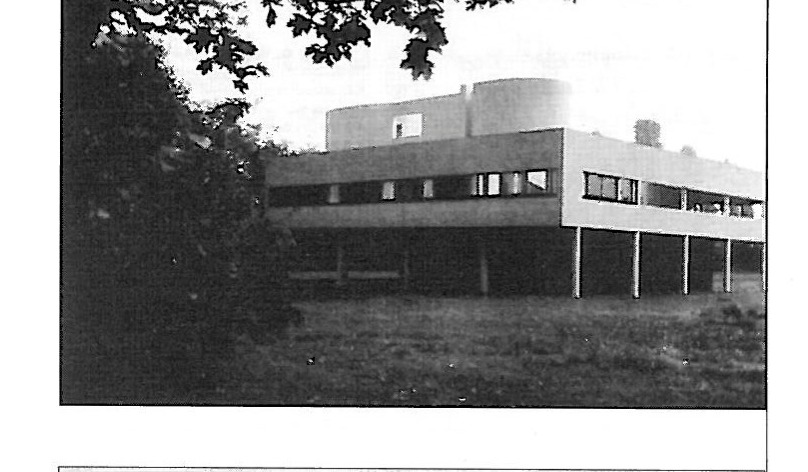
The indexical side of an architectural work is also notable: an architectural work introduces us to the social, political, economic, and cultural condition of its makers. The plan-form of the church bears its religious assumptions. The arrangement of state palaces and mosques displays the structure of power. Villa Savoye bears Le Corbusier's modernist suppositions about the human, nature, and the machine; the Eiffel Tower expresses the pride of the modern human in the age of technology.
The elements and spaces of architecture are often indexical signs: the staircase is the marker of entry into another level; the door represents another space; the low corridor ceiling indexes a narrow, transitional space; the basement indexes a safe, dim, hidden space.
Explicit and implicit metaphors
Metaphors in architecture are signs. Metaphors can be divided into explicit and implicit. Explicit metaphors, which are iconic, have a direct formal resemblance to another subject: Frank Gehry's Chiat/Day building resembling a camera; Robert Venturi's poultry shop resembling a duck.
But implicit metaphors are indexical: these metaphors do not rest on an explicit formal resemblance — the formal resemblance is shaped in our reading. In the Sydney Opera House, the resemblance of the wings of the opera to the wings of seabirds, or to the sails of coastal boats, is shaped in our reading. The same is true of Daniel Libeskind's Berlin Museum extension, and Mirmiran's National Library — both of which use implicit metaphors.
The plurality of signs in pre-modern architecture
Pre-modern architectural buildings carry within them the iconic, indexical, and symbolic signs together. At Persepolis, the stone ornaments along the staircases — representing the ceremonial procession — are iconic. The use of natural patterns (flowers and stems) in the arabesques of mosques, and the depiction of religious figures in the bodies of churches, share this same quality. The cross used in ornament — itself a symbol, since it is conventional — is at once iconic (a formal reading) and indexical (it points to something).
There is an indexical reading of sacred architecture — Islamic, Christian, Hindu — as well: the dome's allusion to the layers of heaven and paradise; the indexical reading of the knots and the complexity of arabesques and tile-work pointing to such concepts as 'the unity of being', 'unity in plurality', and 'plurality in unity'. Abstract ornament in modern architecture is also indexical; the abstract design distances itself from being iconic and takes on an indexical character.
The plan of the city: a compound sign
The plan of the city is not only an iconic sign of the city's three-dimensional being, but is also an indexical sign — it expresses the relations among human beings and the framework of their life-world (Lebenswelt). In this plan we read a society's mode of life, its prevailing values, and the kind of thinking of its members. The grid-city of Priene in ancient Greece, the closed medieval city with its walls and towers, the citadel of Bam with its hierarchical structure, the dispersed Tabriz of pre-Constitutional times with its scattered quarters — each presents particular relations.
Modern architecture: the dominance of icon
In modern architecture, the iconic side is stronger. Because of the rationalist and machine-like approach to architecture, the indexical and symbolic signs are used less. Modern architects, by minimising ornament (which could carry symbols and indexes) and by paying less heed to concepts and metaphors, made their architecture simpler and at the same time more iconic.
Postmodern: iconic / indexical
Postmodern architecture, in protest against modern architecture's rigid approach, is iconic / indexical. The repetition of arches, vaults, and the ornament of pre-modern architecture in the postmodern setting is at once iconic (since it is a formal reading) and indexical (since it recalls particular memories and concepts).
Postmodern architects, by re-reading symbols and metaphors and using them in their architecture, strengthen the indexical side of architecture. Ando, by his attention to traditional Japanese architecture and the use of its concepts in a fresh way, makes an indexical architecture; Botta, by attending to the vernacular architecture of his region, draws on its signs and symbols.
High-Tech: strengthening the icon through detail
In High-Tech architecture, which gives importance to detail, architects such as Piano and Rogers, by attending to the fine details of architecture and the presence of technology in their works, strengthen the iconic side. The Pompidou Centre by Renzo Piano and Richard Rogers, with its attention to construction details, has reinforced its iconic side.
Deconstruction: now iconic, now indexical
Deconstructionist architecture, given the breadth of its proponents (Eisenman, Hadid, Himmelblau, Tschumi, Libeskind), is at times more iconic and at times more indexical. Eisenman, Tschumi, and Libeskind, by attending to philosophical and theoretical concepts in their work, make a more indexical architecture; the architecture of Himmelblau and Hadid is more iconic.
Indexicalising and the openness to interpretation
By attending more and more to symbols, concepts, and metaphors and using them in the architectural work, architecture becomes more layered and more enigmatic. It is here that architectural elements — from column to wall to window — each point to something and recall something else. Likewise, the artistic handling of concepts such as light, shadow, freedom, transparency makes the architectural space more memorial and more layered.
On the other side, if we look at the architectural work as a text, by indexicalising it the openness to interpretation rises: a conceptual / indexical architecture carries within itself the possibility of varying readings. From this architecture one can have varying readings, and the symbols and metaphors and concepts can be interpreted in different ways. Travelling within this text / architecture, the viewer / traveller, against the background of his pre-conceptions and his pre-suppositions, reads / sees the corners of the work in his own way.
These varied readings add to the layeredness and to the air of mystery of the architectural space, and lend the work its freshness; the traveller, too, takes pleasure in his journey within this text and feels that freshness.



