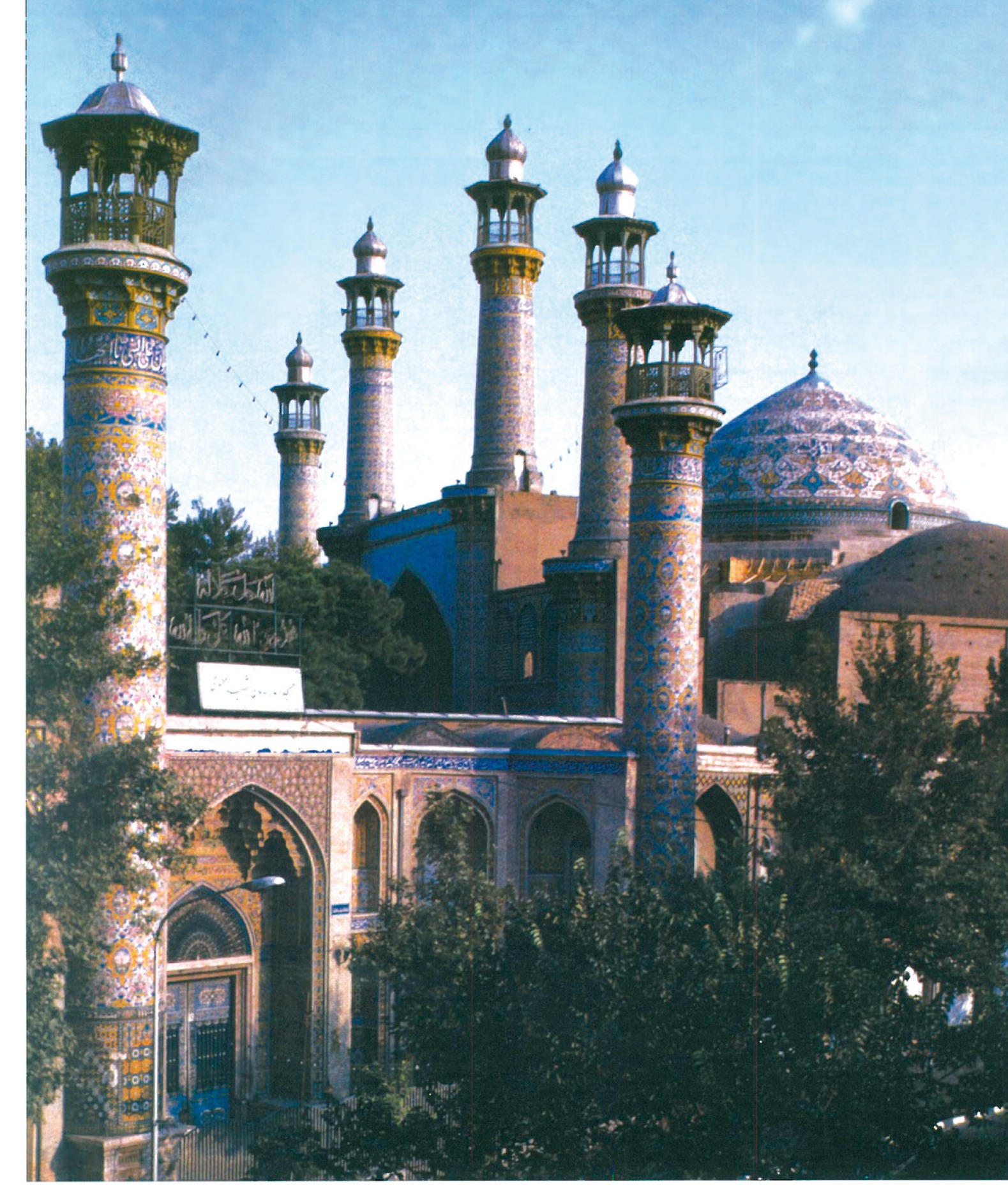
Tehran's best mosque and one of the finest edifices of Iran, Sepahsalar's was completed in 1883. Adjacent to Baharestan, the house of national assembly, downtown Tehran, it still homes a number of students of theology.
The best existing mosque in Tehran, and perhaps one of the finest historical architectural monuments of Iran, is the Sepahsalar Mosque-Seminary. Like every important work of art, the more one looks at it, the more new angles of depth and richness of architecture can be discovered within it.
Mirza Hossein Khan Sepahsalar, in 1296 AH (1879 CE), on a piece of land that was once part of a garden he owned and which he had purchased from the royal court, began the construction of the mosque-seminary. Although the diverse skills of various artisans required different designers and executors, in reality he himself supervised the project and had Master Hossein Qomi, the architect, as his principal collaborator. From 1297 AH, due to the fall of the Sepahsalar from his position, the building was suspended, but in the same year, work was resumed on a new basis. He also composed and wrote the mosque's endowment deed, which exists in two forms: the comprehensive endowment deed (a book of 79 pages) and the abridged endowment deed.
The Mosque-Seminary Building
Sepahsalar Mosque-Seminary, located in the southeast of Baharestan Square in Tehran, lies south of the National Assembly (Parliament) building. It has two tall minarets, each over 40 metres high, that rise above the compound wall. The domed structure reaches a height close to 35 metres. The southeast corner entrance vestibule, with a 25-metre niche, incorporates carved calligraphic panels and colourful tilework familiar to all who know Sepahsalar.
The overall spatial organization of the courtyard is formed by surrounding chambers: not just four iwans of the standard type, but a series of smaller rooms and cells on the upper storey that function as student chambers. The courtyard has 14 connected chambers each containing eight steps. The teaching chamber (classroom) was oriented on a north-south axis with a gypsum dome and decorations.
Sepahsalar Seminary is one of the most beautiful and least known masterpieces of traditional Iranian architecture. The building's remarkable quality — from the calligraphic inscriptions by Master Gholamreza Naqsh-Basteh running around the entire perimeter, to the tilework executed under masters Hossein Qomi Mahdi and Mohammad Sadegh Kashani, and the stone and woodcarving by Masters Ibrahim and Esfandiar — represents an unprecedented concentration of artistic talent for the late Qajar period.
Spatial Organization
The mosque proper (the prayer hall) lies at the south, with a square plan covered by a dome. The teaching halls, or hojreh chambers, are arranged on two levels around the courtyard, each with an octagonal plan and gypsum decoration on the ceiling. Only a fraction of this seminary was damaged in the earthquake of 1347 SH (1968); the rest of the vaults remain completely intact.
The seminary is a compact octagonal structure on the main axes; on its four primary sides, the iwans open directly onto the courtyard. In the middle of the courtyard is an octagonal pool, approximately 2 metres by 30 centimetres deep, with a fountain at its centre. Around it, small gardens with pomegranate trees provide shade.
Architectural Details and Ornamentation
The spaces within this building, from the corridors to the staircases at the four corners, attest to a taste for clarity that is rare among Qajar religious buildings. The tilework and gypsum stucco display a finesse of execution that rivals the best of the Safavid period. The muqarnas (stalactite vaulting) of the main iwan entrance ranks among the most elaborate in Tehran.
The stained-glass windows in the prayer-hall dome admit coloured light into the interior, creating an atmosphere of contemplation. The calligraphic panels relate to Quranic verses and religious traditions.
Restoration History
In 1378 SH (1999), the comprehensive restoration of the mosque began. In 1382 SH (2003), the Cultural Heritage Organization took over with a research team. The study examined all existing elements, from foundations to the building structure, and prepared restoration plans according to the degree of damage.
Tasks carried out included structural strengthening of vaulted ceilings using FRP (fibre-reinforced polymer), use of gold leaf in hojreh chambers, restoration of calligraphic panels and ornamental plaster, installation of new mechanical systems, and tile restoration techniques matching the originals in colour, material, and pattern — all with meticulous attention to the building's authentic character.



