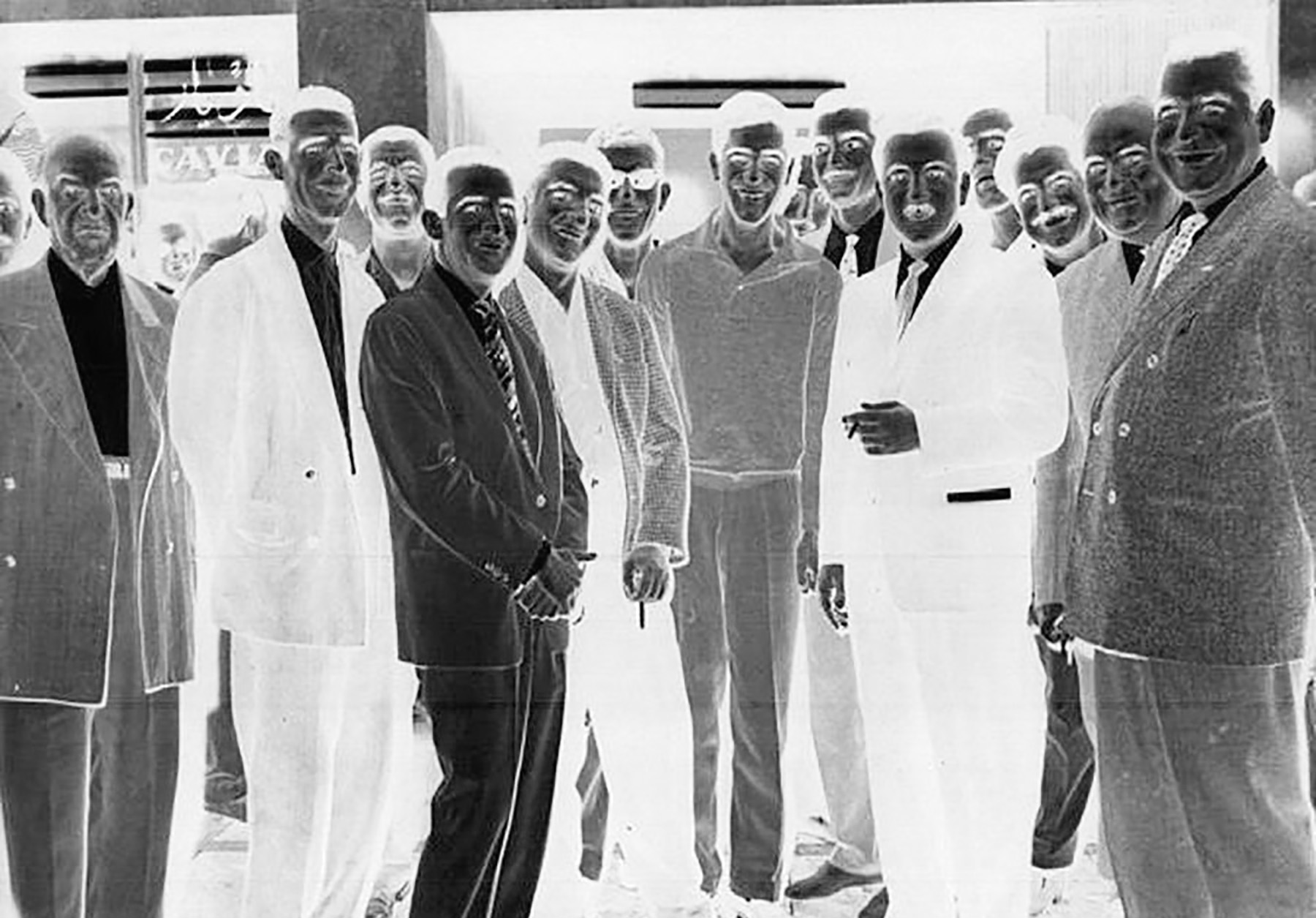
In these days the game has changed. It is not easy to distinguish the genuine and the deep-rooted from those who, in appearance, set the current. We have gone astray if we close our eyes to the existence of the principal figures and groups in the current of contemporary Iranian architecture — or at least if we lack the capacity to see and recognise them. In an era in which display and publicity have the first word, finding and bringing to view the pure from the impure is very difficult. I shall recount a great institution which was begun seventy years ago by the resolve and perseverance of certain individuals; which has come through ups and downs and has striven to preserve itself — and it is self-evident that the course of its life is an inseparable part of the history of contemporary Iranian architecture. Amir-Nosrat Monaqqeh (1302–1394 SH / 1923–2015 CE), who in 1325 (1946) graduated from the Faculty of Fine Arts of Tehran University, was the founder of this institution and, for more than two decades, stood directly alongside it; afterwards, his long-standing colleagues continued it.
The years after the Second World War were a period when the offices and organisations of architectural design in Iran were few, and predominantly the graduates in architecture — whose number did not even reach fifty — sought work in the building departments and engineering offices of the ministries, doing drafting and design and participating in development projects. These offices and institutions were mostly run under the supervision of non-Iranian engineers; the Iranians tried, by following and learning the system and method of work, to have a greater share in the country's construction and to play a more prominent role. Amir-Nosrat Monaqqeh began his professional activity in the building department of the Ministry of Labour, which had just been founded; in parallel with this, he set up a private office with two friends and classmates of his — Ziaeddin Pejhan and Farhang Moayeni. In 1329 (1950) Monaqqeh left Iran for further study about healthcare and educational buildings, with destinations in Switzerland, Sweden, and France, and stayed in Europe for two years. 1333 (1954) is the time of his return and presence in Tehran; in addition to his activity in the building department of the Ministry of Labour, he opened an office under the title "Amir-Nosrat Monaqqeh — Architect" on Arbab Jamshid Street. In this same period he received the renovation and programme-revision project of the Karaj steel-smelter, which opened the door to a closer acquaintance with a young student named Yousef Shariatzadeh — who later took his place among the most prominent architects of the last half-century in Iran.
Yousef Shariatzadeh (13 Esfand 1309 SH — 10 Aban 1380 SH / 4 March 1931 — 1 November 2001) had Mazandarani roots and was born in Tabriz. He spent his childhood and youth in Tehran and Mazandaran, completed his primary education at Kherad Primary School and his secondary education at the high schools Firouz Bahram, Adib, and Sharaf; in 1328 (1949) he entered the field of architecture at the Faculty of Fine Arts of Tehran University and began his studies in the Foroughi atelier. Like others of his generation, he was drawn into work at various architectural offices from those very first years of study. For a period he worked at the offices of the engineers Houshang Seyhoun and Abdolaziz Farmanfarmaian, and finally at the Litchfield-Whiting firm — which was a factor in his gaining experience and elevating the quality of his architecture in the professional world. In the autumn of 1334 (1955), he abandoned the architecture faculty in Tehran and went to Italy with the intention of continuing his studies, and spent a short period in that country's university milieu; in the middle of the year 1335 (1956) he returned to Iran.
The beginning of his collaboration with Amir-Nosrat Monaqqeh goes back to the year before the trip to Italy and the preparation of the Karaj steel-smelter project; and their more serious collaboration was resumed after Shariatzadeh's return to Iran. Despite great differences in outlook and personality between the two, an extraordinarily constructive collaboration took shape between them from the outset, which is examinable as an example and a successful model. Perhaps one may look at this process in this way: Amir-Nosrat Monaqqeh had a very sociable and extroverted personality, and his high capacity for establishing connections and securing architectural projects was widely known; from the other side, Yousef Shariatzadeh was a reticent and introverted man who spent the greater part of his architectural time in the architectural atelier. The mutual respect between these two laid the foundations of a professional institution which continued even after the end of their own lives. With the passage of time, and on account of the expansion of the work and the number of forces engaged in the projects, since the space of the original office was limited, in 1337 (1958) a building at the address of Pahlavi Street / Damascus Street was chosen for the office.
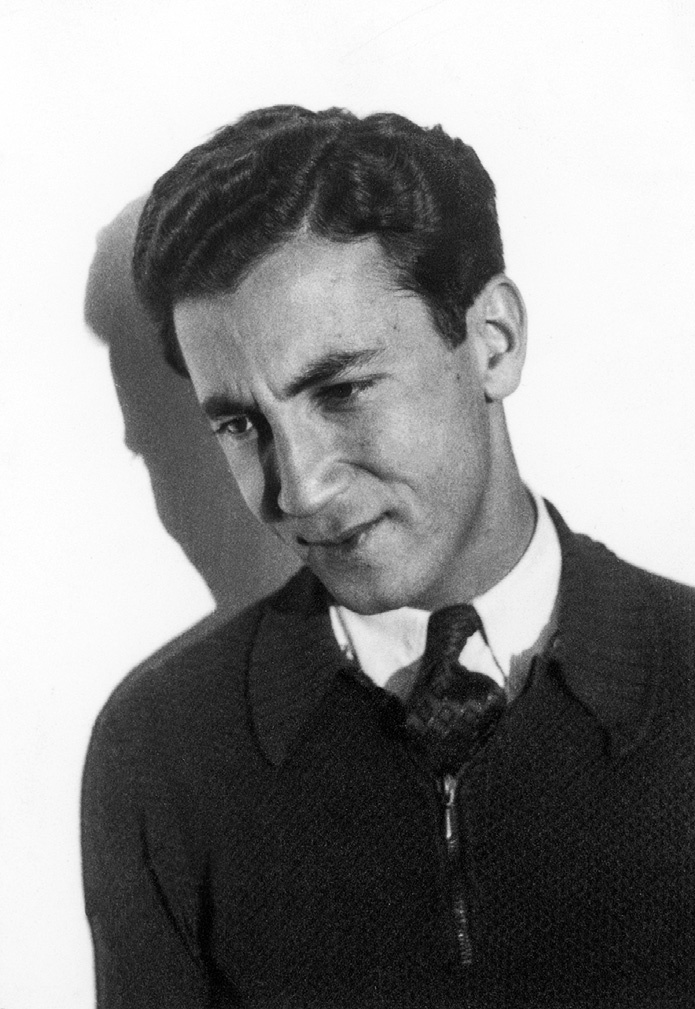
A subject worth investigating concerning the collaboration of these two architects is their professional and systematic view of architecture, the outcome of which can be sought in teamwork. In the statement of Monaqqeh himself and of those people who worked beside one another for decades, architecture begins with precise study and the factors influencing the design, and over time takes shape, in cooperation with structural and mechanical teams and — most important of all — the construction team and the other related disciplines, and turns into reality. With the growth of the firm and the increase of projects, the teams of structure, mechanical services, electrical services, and site-supervision colleagues were permanently installed in this office and were in close communication; and the direction of the teams was the responsibility of these two architects. In these years, besides small-scale residential projects in Tehran and other cities, projects belonging to the Ministry of Labour and the Social Insurance Organisation were entrusted to this firm — among them the design of and supervision over the construction of the 300-bed Gendarmerie Hospital of Tehran, the 300-bed Isfahan Hospital, the central building of the Ministry of Labour and Social Affairs (Social Security) on Eisenhower Street, and the design of and supervision over the construction of the Air France building on Shahreza Street.
From the closing years of the 1330s (early 1960s), younger architects and engineers joined the group, who over time were trained under this system and were able to make their presence more prominent; in the later years, in the absence of the two original principals of the office, they continued the course of its life. Among the most important of them, who joined this current in the early years of its formation, was Mohsen Mirheydar (1315–1400 / 1936–2021). Mirheydar was a native of Kermanshah and an entrant of 1335 (1956) at the Faculty of Fine Arts and in the Seyhoun atelier; he joined this firm in 1337 (1958). He began with drafting and the completion of preliminary details, and later became a partner (from Khordad 1350 / June 1971), and in further years became the managing director of this architectural-engineering institution. In the 1340s and 1350s (1960s and 1970s), architects such as Dr. Mohammad Mirzaali Tehrani — and students and graduates such as Bahman Farahvashi, Bahman Forhat, Alireza Aman (1320–1401 / 1941–2022), Mohammadreza Moghaddam, Yadollah Razzaghi, Farhad Diba, Nosratollah Majlesi, and many others — joined this group; their collaboration continued for more than several decades; and, despite their intermittent separations from this complex and the setting-up of their personal offices, they have always remained committed to collaboration with, and presence in, this original house.
In the middle of the year 1341 (1962), Yousef Shariatzadeh — together with Mohsen Mirheydar, Mohammad Tehrani, and several other colleagues in the fields of architecture, structure, and mechanical services — left the office and moved to a building at the intersection of Eskandari and Forsat Shirazi streets, and attempted to set up a new organisation. This short period of separation from Amir-Nosrat Monaqqeh coincides with the creation of several of their distinguished projects. The Rivoli Cinema, to the design of Yousef Shariatzadeh and Mohsen Mirheydar — given the context of the time of its design and construction — presented a pioneering plan and architecture, and after the passage of sixty years still announces its presence on the eastern edge of the old Shemiran Road; and the other, the Hazrat-e Amir Mosque in North Amirabad, is to the design of Messrs. Shariatzadeh, Tehrani, Mirheydar, and others. The Amir Mosque, with a deconstructive design in its time, and far from the prevailing patterns of mosque design in that period, was carried out. Its modern architecture is not covered by a dome, and the rise of the building's form in the space of the prayer hall has emphasised the elevation of the space of prayer. This building had a modern concrete staircase as a single minaret which has been demolished in recent decades.
On the other hand, this period was, for Shariatzadeh, a time of relative respite from the profession; for after the passage of fourteen years, in Bahman 1342 (February 1964), he defended his diploma project at the Faculty of Fine Arts of Tehran University and, with a distinguished rank, became an architectural engineer. The title of his project is "Village" (Roosta), in which he treated the subject of regional urbanism and, in continuation, rural urbanism. In the course of the studies of the project, which began on the basis of population statistics and the conditions of city-dwelling and rural and tribal life in Iran, large-scale points such as physical, economic, and social factors and the history and roots of rural life were examined; then smaller-scale subjects such as rural economy, employment possibilities, and the definition of programmes for the villagers — for the raising of the quality of life and the prevention of their rapid migration to the cities — were raised. In his studies, which are presented in the form of a booklet, he sought to find answers for subjects such as the preservation of land and natural resources, the reasoned and fundamental use of agricultural resources for meeting individual and social needs, an outlook on the productive process in the direction of the advancement of the regional economy, and the distribution of population according to work possibilities — and the meeting of technical, sanitary, educational, and recreational needs in the villages. The outcome of his effort was the presentation of a sample design with a precise programme of economic development and many facilities for the village, together with a calculated and flexible programme; alongside it, his designs displayed an example of the architecture of spaces and buildings and the internal and circulation components of the village.
The year 1343 (1964) is the time of Shariatzadeh and his colleagues' return to their original house on Damascus Street; and in its train we witness the expansion of the renewed collaboration of this group under the name of the firm "Amir-Nosrat Monaqqeh — Yousef Shariatzadeh," and many projects from various governmental organisations and institutions flow toward this firm. Finally, in Ordibehesht of 1346 (May 1967), this firm is registered under the name of "Amir-Nosrat Monaqqeh — Yousef Shariatzadeh Consulting Engineers," and is placed among the consultants of the Plan and Budget Organisation. In 1347 (1968), the central building of this consultancy on Zartosht Street, Yazdan Alley, is completed, and this engineering organisation is installed on three floors — basement, ground floor, and first floor — and Yousef Shariatzadeh himself lives on the upper floor of this same brick building, which was constructed to his own design. The 1340s and 1350s (1960s and 1970s) are the peak period of activity of this engineering group. The Youth Palace in the Zarrabkhaneh district (1343 / 1964); the projects belonging to the Tobacco Company, including the athletic club and the central offices of this company in the various provinces of the country (1344 / 1965); the projects related to the Tabriz machine-building complex, including the administrative building, the factories, the athletic club, and the educational and health centres of the factory (from 1344 / 1965); the buildings related to the Tabriz tractor-manufacturing factory (from 1346 / 1967); the restaurant, motel, and petrol station complex Shami Shop in Takestan (1346 / 1967); the health centres of the Social Insurance Organisation in various cities of Iran (from 1348 / 1969); and several other important projects — these are a display of its broad capacity in carrying out small- and large-scale projects.
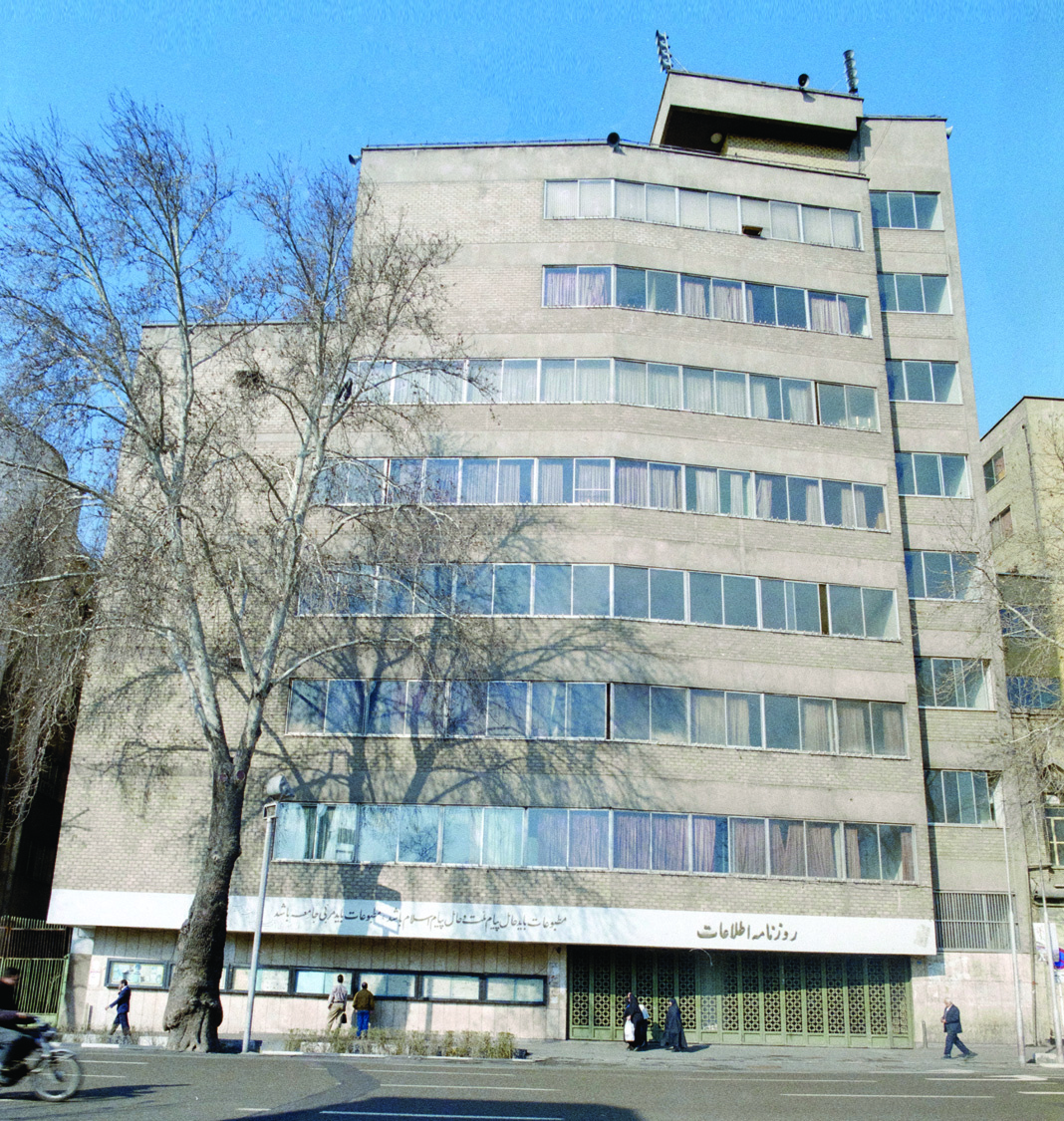
In the interval of these years, two new partners are added to this founding group; and the original consultancy is dissolved, and in 1349 (1970) a new consultancy under the name "Banyan" — with the partnership of Amir-Nosrat Monaqqeh, Yousef Shariatzadeh as architect partners, Engineer Ahmad-Ali Abolfazli as the mechanical-services engineer, and Engineer Iraj Vakili as the structural engineer — forms a capable team; and in Khordad 1350 (June 1971), two further members — Mohsen Mirheydar and Jahangir Raees-Dana — are added as partners of the Banyan consultancy. In these years, the projects related to the Tabriz machine-building and tractor-manufacturing complexes are in process, together with a number of other important projects. Among the most important of them in the early half of the 1350s SH up to 1358 (1979), one may mention the design and construction of Building No. 2 of the National Iranian Oil Company (1351 / 1972), the vast National University of Kerman complex (from 1351 / 1972), the banknote-printing house of the Central Bank of Iran (1353 / 1974), the buildings related to the University of Science and Technology — including the faculties of Materials, Chemistry, Mechanics, Architecture, and Civil Engineering (1354 / 1975), the central office building of the Ettelaat Newspaper printing-house (1354 / 1975), and the hangars of the government aircraft at Mehrabad Airport (1356 / 1977).
With the occurrence of the Revolution and the imposed war that followed, Amir-Nosrat Monaqqeh left Iran for two decades, with the intention of life outside the country. The thread of affairs in many engineering institutions came undone, and most building projects remained half-finished. For Banyan, a government-appointed director was selected by the Plan and Budget Organisation. In this stagnation, the original partners leave the Banyan consultancy, and its projects proceed with limited capacity. At the insistence of a number of past clients, and on the proposal of the Plan and Budget Organisation, the former partners decide to set up a new institution and to try to bring order to the remaining projects. Finally, in the summer of 1362 (1983), Pir-Raz Consulting Engineers was founded by Mohsen Mirheydar, Yousef Shariatzadeh, Yadollah Razzaghi, Alireza Zarrinfar, Ali Eghbali, and Ahmad-Ali Abolfazli; and the past projects, the most important of which is the Kerman University complex, were resumed at this consultancy.
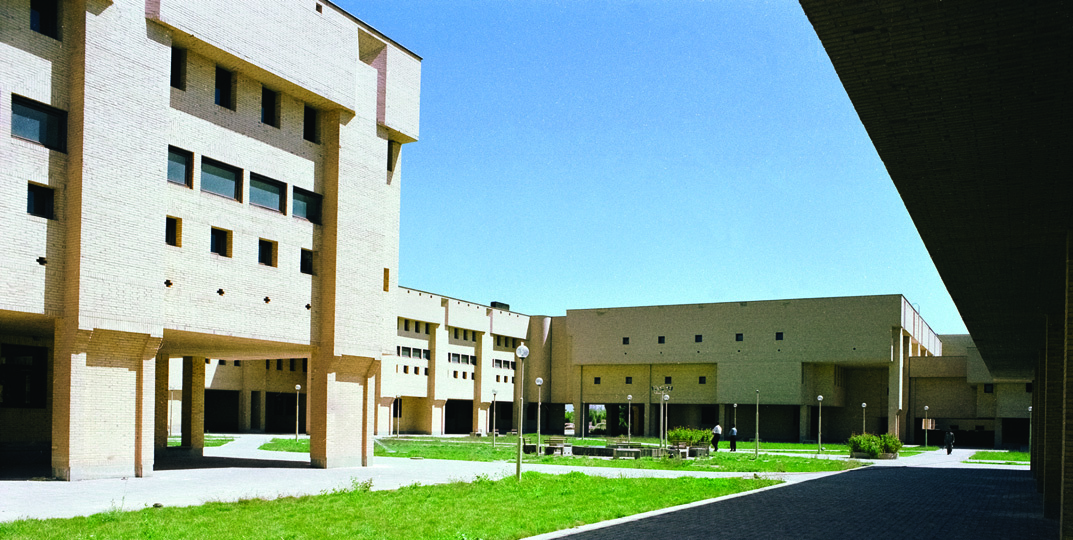
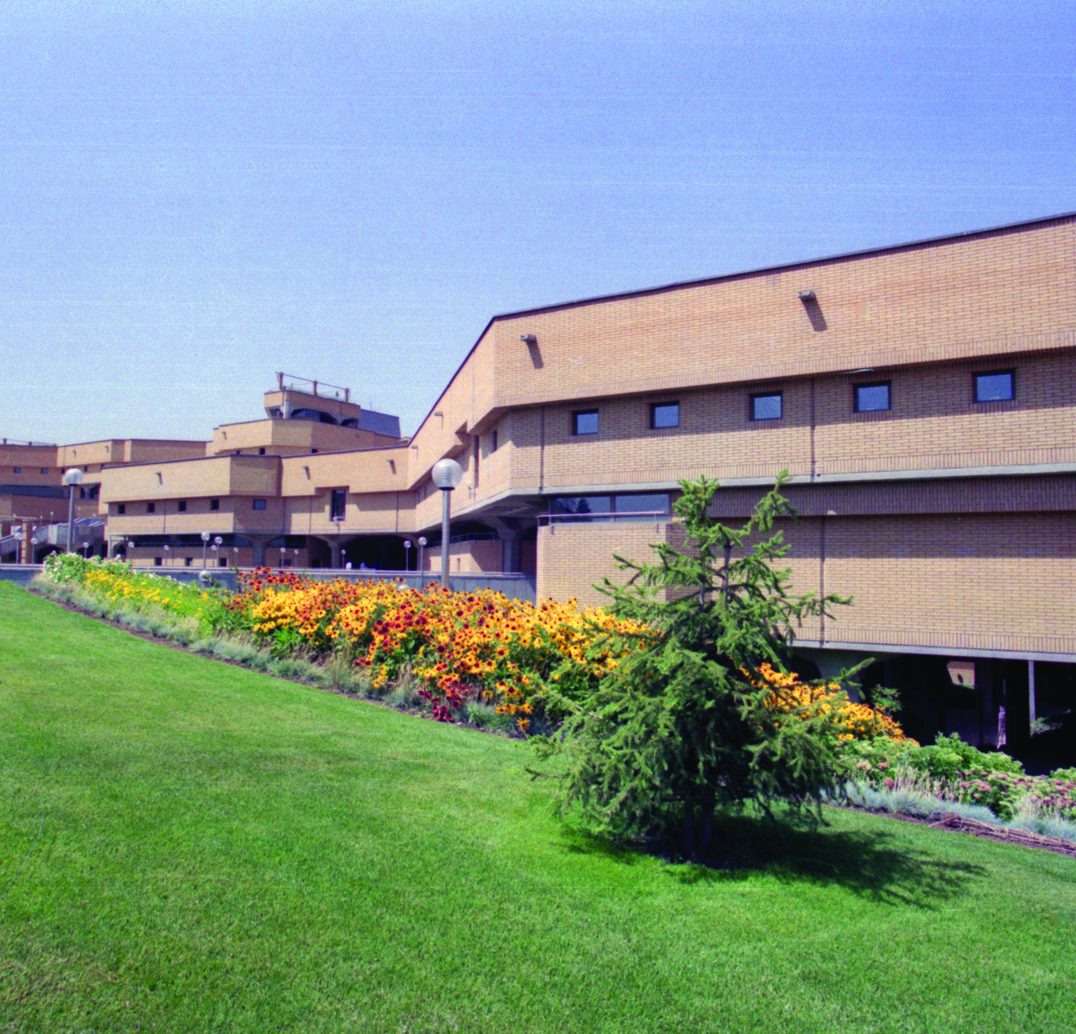
The design of the Kerman National University (today Shahid Bahonar University of Kerman) project — which one may consider as a thread of the human-centered architectural outlooks of Shariatzadeh and his colleagues — began in 1351 (1972), and its growth and life have an inseverable bond with the life of Pir-Raz. The initial design of the campus over an extent of 400 hectares took shape with consideration of factors such as the flexibility and the expansion of the design in various time-periods. A complex the colour of the desert, a living mass whose scale does not swallow the users; many units of which even the smallest component has been designed. Modulation, proportion, attention to light and proper view, attention to structure and mechanical services, materials and details in tune with the climate, and — more important than that — the comfort of the users in living amid the buildings, are characteristics that can be observed in this complex and in many of Shariatzadeh's small and large works — such as the buildings of the University of Science and Technology, the welfare and training centre for the employees of the Plan and Budget Organisation in Nooshahr, and, finally, in his last enduring work — the National Library of Iran.
A knowledge of five decades of professional activity and of the small and large designs of Shariatzadeh — the creation of which was made possible with the collaboration of a capable team — is beyond the scope of this article. An architect who began with study at the architecture faculty, and in fleeing from that system of teaching continued his experiences in study, precision, and perseverance in professional work; and over the course of his life, like a sparing master with a particular personality, left an effect on the people around him. An architect who set his foot against the loud current of the period, and a current-setting name in the field of Iranian architecture remained. Close to a quarter of a century after his passing, redoubled effort and time are required to examine and codify his individual personality and the type of his architecture. In the words of Amir-Nosrat Monaqqeh, who had begun his collaboration with him seventy years before, and who — after the passing of that old colleague — never removed his image from before his eyes: "Shariatzadeh was the best architect in Iran." Perhaps Monaqqeh's saying is not an exaggeration, and few examples like Shariatzadeh and his team of associates have appeared in the body of architectural engineering in Iran in the contemporary period. An institution which, with order and continuity, designed and executed important projects of the country, and like an educational centre nurtured many in the course of the profession — each of whom was able to be influential in Iranian architecture — and without doubt Shariatzadeh was among the lofty and constructive pillars of that system. A person who lived architecture in its whole and its parts, and considered it a combination of science, beauty, art, function, and the knowledge and awareness of environment and space — and finally was committed to its correct construction. The result of this is enduring in his projects.
* Architect-Researcher (Project of the Oral History of Contemporary Iranian Architecture)
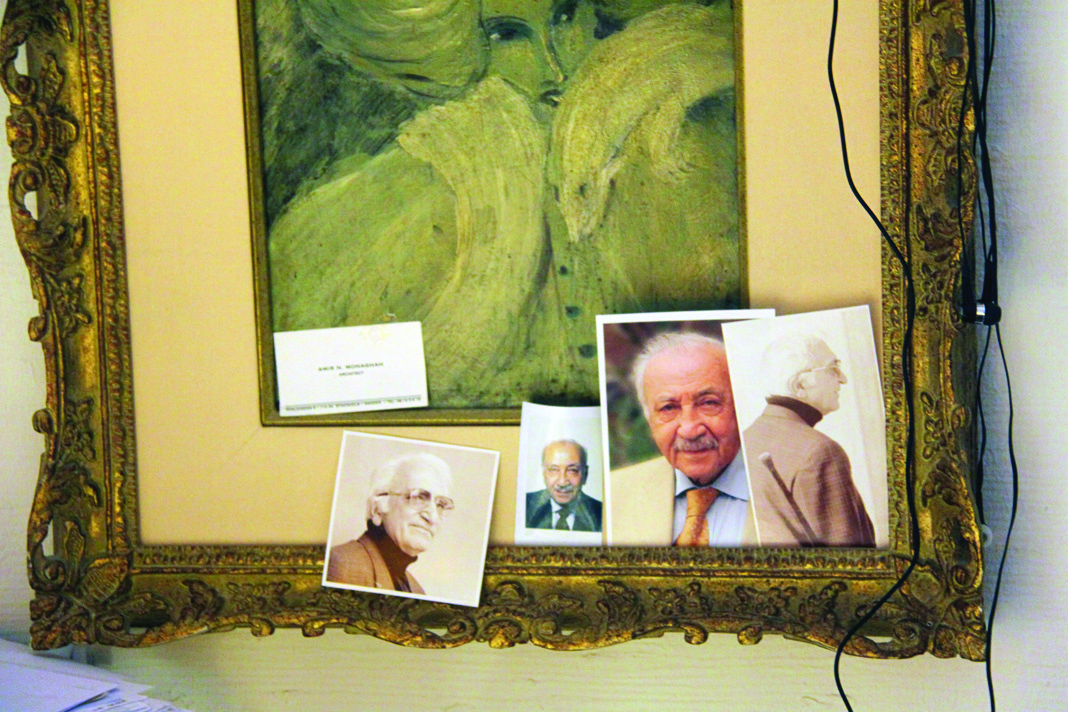
Amir-Nosrat Monaqqeh — 1389 (2010), image of the wall-hanging beside Amir-Nosrat Monaqqeh's work-desk in Stockholm.



