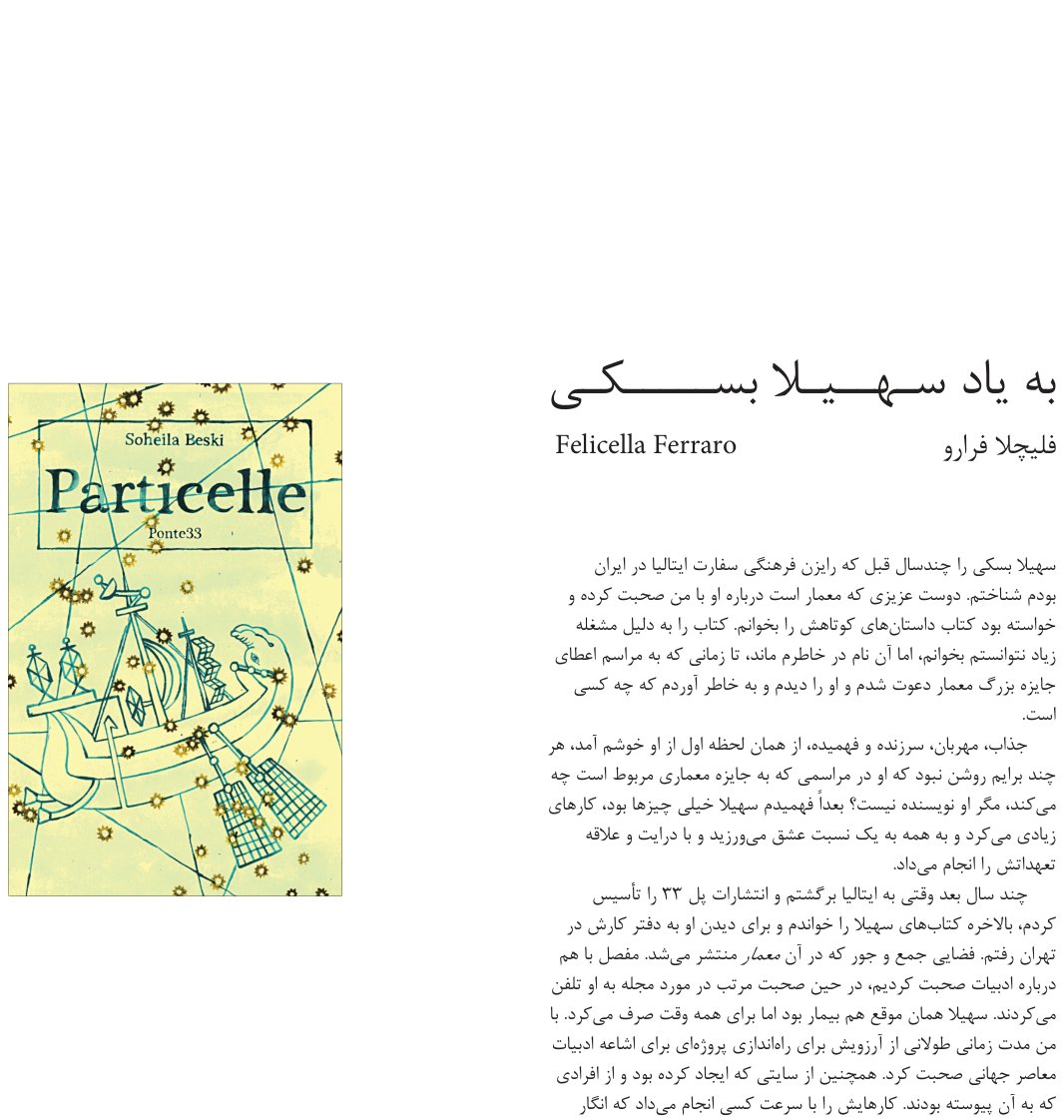
I came to know Soheila Beski several years ago, when I was the cultural attaché at the Italian Embassy in Iran. A dear friend who is an architect had spoken to me about her and asked me to read her collection of short stories. I was unable to read the book due to my many commitments, but that name stayed with me — until I was invited to the ceremony for the grand Memar Prize, where I saw her and remembered who she was. Charming, warm, vivacious, and perceptive — I liked her from the very first moment, though it was not immediately clear to me what she was doing at a ceremony related to an architecture prize. Was she not a writer? Later I understood that Soheila was many things; she did a great deal of work, and she loved all of it equally, carrying out her commitments with intelligence and devotion. A few years later, when I returned to Italy and founded Ponte 33 publishing house, I finally read Soheila's books and went to visit her at her office in Tehran — a compact space from which Memar was published. We spoke at length about literature; throughout our conversation the telephone rang continually with calls about the magazine. Soheila was already ill at the time, yet she gave time to everyone. She spoke with me for a long while about her dream of launching a project to promote contemporary world literature, and also about a website she had created and the people who had joined it. She carried out her work at the pace of someone who knows, as if in their bones, that not much time remains. A year later, Ponte 33 published the book under its Italian title, Particella. I went to see her to show her the Italian edition of her book with its gleaming cover designed by Iman Rad. She was captivated by the cover. By then she could no longer keep up with the literature website. She asked me to continue my work and to translate as many books as I could. We said our farewells and promised each other we would meet again soon — but now I am in Tehran for a piece of work, writing these brief notes in a hotel, and Soheila is no longer here. She left a few days ago, for good, in her customary manner and style: precise and discerning to the very last moment. Goodbye, Mrs. Beski — on behalf of Ponte 33, we are glad that we were at least partly a part of making your dream come true, and we will try to keep the commitment we accepted that day. The day when the telephone kept ringing and you kept answering, holding your book in your hand, to feel it as close to yourself as possible.
Whenever, during conversations or meetings, her discomfort — her illness — would strike, her breathing would grow short and she would need relief, a device for instance — she absolutely never said what many people say in such moments: "Oh well. This is life. We're all going to die." Not like so many who fear death and, with feigned indifference in their words — a self-deceiving manner — want to hear words of hope from those around them. The first time or two I was taken aback. I could not believe this perhaps composed manner of dealing with that illness. I thought it was for our sake. Or that she had simply grown accustomed. But I think I was mistaken, because I saw this same manner in other circumstances as well. Her extraordinary and — for us and our society — remarkable discipline and rigor: was that what it was? Our personal acquaintance also began with precisely this quality of orderliness and discipline. Before speaking of this characteristic of Soheila Beski — this rare and precious quality among our own artistic community — let me say that I have no intention here of recounting Soheila Beski's biography, which you can read everywhere. Nor do I intend to speak of her books, which — a few of them — you should read for yourselves, and judge. Nor will I mention which books she published abroad. All of this exists everywhere to be read. I will speak instead of that very characteristic of hers — her discipline and orderliness. I prefer that. We are lacking in this quality, and perhaps many people do not know about it, or did not notice it in their dealings with her. And I will speak of the process of her award — which perhaps will not be spoken of again elsewhere, and is better recorded here. The first signs of that orderliness appeared in her invitation to us: the invitation to serve as juror for the "Iran Literature Prize." When in Iran you are invited to jury a literary or artistic competition — whoever you may be, and whoever the organizer — it is as if you are an orphan and they are magnanimously patting you on the head. They telephone and say: come! They send messages through friends, and recently even write to you on Facebook. They act as if they are doing you a favor you don't deserve. Beski also invited me to jury the "Iran Literature Prize" — an award for the best novel and the best short story collection of the decade of the 1380s SH. The plan was to make a decision after completing this stage about continuing into the next decade. In subsequent conversations I came to understand that she harbored deep grievances about the manner in which literary prizes were judged and awarded in Iran. She wanted to do better — and, taking all circumstances into account, her approach was indeed better. The results were better too. I will say how. But she had perhaps not reckoned with the nauseating pettiness. And with the increasingly sickened economic climate. In any case, her method ran counter to the ways of many others. Unlike several experiences I had had until that point, Beski did not simply telephone and get an address. She first sent a package containing a detailed text about what she intended to do, a kind of formal invitation, several of her own books, and several issues of Memar magazine. After that initial meeting and discussion with the other jurors, we discussed the execution of the work. For this, she had assembled all the books of the 1380s decade — the rare ones at higher prices. She had listed them all, and we read the books on a rotating basis according to the list. The competition prize, too, she had set neither as cash, nor as a gold coin, nor as a plaque. The winning book was to be translated into English. Two reasons led me to accept the task of judging. One was this. The second was the jurors themselves. The choice of jurors also bore the mark of that same discipline and orderliness. There was one jury panel inside Iran and one outside. Inside, we were four (later three — one juror moved to the external group); and those outside were not Iranians abroad who typically have little connection to Iran and its literary scene. Two of them were professional translators of Persian-language literature abroad — into German and English. The German-language translator is, in fact, entirely German. Beski's intention was that in the second stage, the books would also be assessed from the translator's perspective and the text from the perspective of its translatability. I said the results were more fruitful than awarding a gold coin or a plaque: at least two writers — whose names I will not mention — had their books go abroad, and as far as I have heard, those relationships are still ongoing. A second round was also held, for the short story collections of the 1380s. All the books were read. In the first stage we were unable to find a single collection in that decade that was wholly acceptable. So we decided to select individual stories — we chose individual stories — and the announcement was to be made; but then the exchange rate went to seventeen or eighteen and it was no longer within Beski's capacity or the prize's means to cover the cost of translation abroad. Throughout this entire period she herself — despite an illness that had robbed her of her peace, the kind of illness in which one must await the end — read all the books, disagreed on details, agreed on others, managed Memar magazine, organized the Memar Award ceremony — and the holding and conduct of the ceremony itself bore the mark of that rare discipline and orderliness. During the proceedings I thought I was attending a ceremony in Germany, perhaps. It had none of the usual time-wasting of our events, none of the customary sloppiness — and with several hundred guests, at that. This discipline of Soheila Beski's also had a cost for us. During our collaboration I came to realize that she simply had no tolerance for mediocrity, for gossip, or for the mutual flattery game — and had withdrawn from it, working abundantly within her own domain and under her own watch. Hence, for example, publishing books abroad rather than seeking praise here. Only once did she say that she might not be able to continue, and she asked me: would you be willing to carry on as secretary of the prize? It did not come to that. As I said — as far as it pertains to our shared collaboration — I can repeat that her exemplary discipline and orderliness could not prevent two things: the pettiness of the literary-artistic community (which we saw in relation to the Iran Literature Prize, and the silence of friends); and the enslaving and devastating affliction of third-world economies. It did its work. May its memory endure.



