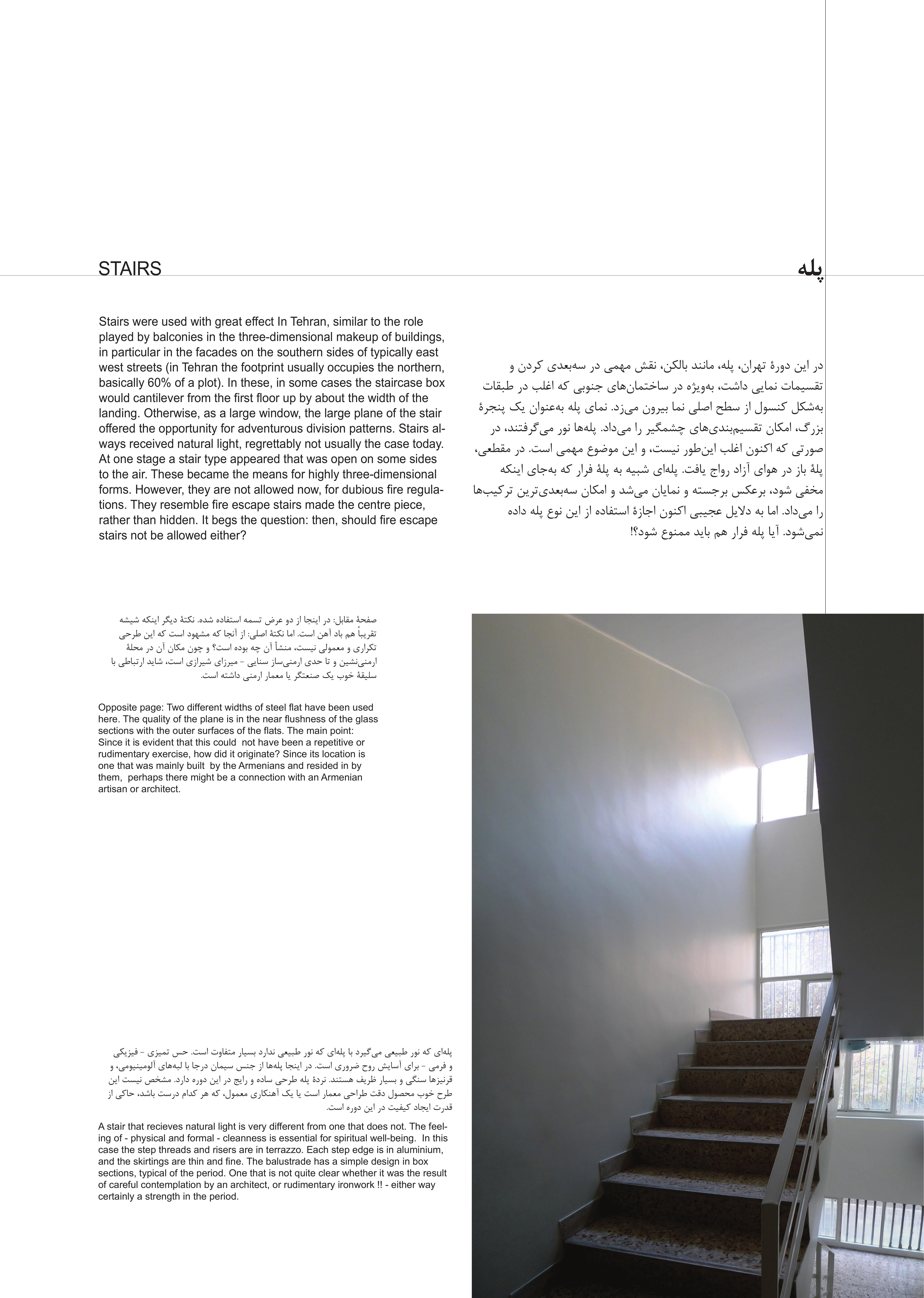
Stairs were used with great effect In Tehran, similar to the role played by balconies in the three-dimensional makeup of buildings, in particular in the facades on the southern sides of typically east west streets (in Tehran the footprint usually occupies the northern, basically 60% of a plot). In these, in some cases the staircase box would cantilever from the first floor up by about the width of the landing. Otherwise, as a large window, the large plane of the stair offered the opportunity for adventurous division patterns. Stairs al- ways received natural light, regrettably not usually the case today. At one stage a stair type appeared that was open on some sides to the air. These became the means for highly three-dimensional forms. However, they are not allowed now, for dubious fire regula- tions. They resemble fire escape stairs made the centre piece, rather than hidden. It begs the question: then, should fire escape stairs not be allowed either?
A stair that recieves natural light is very different from one that does not. The feeling of - physical and formal - cleanness is essential for spiritual well-being. In this case the step threads and risers are in terrazzo. Each step edge is in aluminium, and the skirtings are thin and fine. The balustrade has a simple design in box sections, typical of the period. One that is not quite clear whether it was the result of careful contemplation by an architect, or rudimentary ironwork !! - either way certainly a strength in the period.Khederi [S] # 54. Opposite page: Two different widths of steel flat have been used here. The quality of the plane is in the near flushness of the glass sections with the outer surfaces of the flats. The main point: Since it is evident that this could not have been a repetitive or rudimentary exercise, how did it originate? Since its location is one that was mainly built by the Armenians and resided in by them, perhaps there might be a connection with an Armenian artisan or architect.Sanaii [E] # 83. Opposite page: A corner of the vertical mass of the staircase box has been cantilevered at the point of a shift of angle in the street line. The shaft has been set against the narrow horizontal bands of the deep balconies. The depth of the balconies is itself the result of the squaring up of an irregular site plan; fine lines have been implemented overall; the sky blue colour of a balcony soffit is original, an example of a preference in the period for painting balcony soffits in bright colours.Bahrami [S] # 16. The open stair as the main feature; the role of the cantilevered mass is important in emphasizing the depth of the deep recess in which the stair occurs. The stair’s solid parapets and the small box like termination point are also part of the aesthetic scheme. The asymmetric and energetic jutting out of the staircase from within the large recess in the main mass; the stair seems to stand free within the deep recess, while its landings on the right hand side seem to float. An elegant move occurs in going from the first floor to the ground floor, and in the thin sloping roof above this section of the stair; note the thin horizontal shades on the right hand windows, and the small shift of a narrow width of the right hand side mass to the left.
![Full-page view of a stair window at Khederi [S] # 54: tall blue glass divided by tan steel flats laid in non-repeating diagonals between two balcony slabs.](https://pub-2d7bd563aeb64af5a9da7459b4586df1.r2.dev/memar-78/stairs-002-khederi-diagonal-window.jpg)
![Sanaii [E] # 83 — corner residential block with a tall narrow glazed stair shaft between two stacked open balconies and a sky-blue painted balcony soffit.](https://pub-2d7bd563aeb64af5a9da7459b4586df1.r2.dev/memar-78/stairs-003-sanai-balcony-corner.jpg)
![Bahrami [S] # 16 — Modernist building with an open cantilevered staircase emerging from a deep recess at the corner of the south facade.](https://pub-2d7bd563aeb64af5a9da7459b4586df1.r2.dev/memar-78/stairs-004-bahrami-cantilevered-stair.jpg)



