Before this, they raised that green vault and the sky's blue arch — the horizon of my eye was the beloved's brow, a perfect arch. — Hafez
According to the mental habits and experiential customs of those of us who live in this era, the word "room" generally conjures in the mind a rectangular, enclosed, roofed space with one or more openings onto the outside — a space in which we rest or engage in other pre-assigned activities that are sometimes, given new needs, subject to change and transformation. What we today call a room was probably, in the mind and experience of primitive humanity, a safe refuge from natural hazards — somewhere out of reach, perhaps in the earth's depths or a mountain cleft — which gradually transformed into a man-made shelter of natural materials, and has traversed an evolutionary course throughout history. By this logic, I believe that the mental states and experiences of the room's inhabitants have also changed and transformed in step with this evolutionary journey. One might assume that the mental habits and experiential perceptions — the understanding — of room-dwellers, for example during the Qajar period in Tehran or the Safavid era in Isfahan, differed in some degree from the understanding of inhabitants of the same spatial unit in the rural houses of Gilan or Hormozgan. Undeniably, one dimension of a room's character is bound to the activities assigned to it and is usually named or described accordingly: bedroom, workroom, living room, reception room, kitchen (cooking room), storeroom (storage room), waiting room, operating room, inpatient room, and so on. Although this dimension shapes an important aspect of users' lived experience in any given room, and although rooms vary in their quantitative and qualitative specifications, these labels carry only a general and here purely functional connotation for spaces described by such terms — they do not express the variety of dimensions or the primary defining characteristic of the phenomenon. For me,
it is my imaginings about the room — which are certainly different from your imaginings about it — that, by repeatedly redefining my mental image of it, give shape to new mental states; and additionally, it is my personal experiences in encountering rooms that, by reproducing my conceptions of the room, form new images of it in my mind. If, by inducing a Renaissance perspective, the room is reduced to a three-dimensional space visualized or fixed from the viewpoint of a generic observer — and validated in this way — an unforgivable injustice is done to freedom of apprehension of space: to the fluidity of the mental states and varied experiences of diverse observers or recipients, in giving shape to their multiplied, infinite, and personal imaginings and conceptions of this phenomenon. The history of modern art and the artistic experiments of artists in creating modern works of art demonstrate that the mental states and personal experiences of no two artists imagine, conceive of, or represent the room in the same way — examples of which are abundantly available. In truth, no two visitors to the space of a room share the same perception of it either; one's understanding of it will differ according to changes in gender, age, season, and with the passage of time — at different hours of day and night, with changes in light and other quantitative and qualitative factors. Children's conceptions of a room are also entirely different from those of adults, and children's drawings offer compelling evidence of this claim. In
Harun al-Rashid in the Bath — Kamal al-Din Behzad; Trinity — Masaccio
truth, the deconstruction of phenomena toward the activity of the human mind and human experience with them — and the enablement of personal perception of those phenomena — is what liberates them (here, architectural space, or more specifically the room) from a generic, typological, abstract, fixed, and rigid viewpoint, and opens them to the depths of complexity and variety in the perceptions that arise from the construction of personal mental states and the interplay of individual experiences. As noted above, the Renaissance painter visualizes or represents the room in three dimensions, from the fixed viewpoint of a generic observer — which is different from the two-dimensional representation of rooms in Persian miniature painting and the simultaneity of being able to view several rooms at once in the Herat School. Children — whose minds have not yet grown accustomed to the mental and experiential habits of adults — conceive of and depict space, or its unit the room, in yet another way. Persian poetry, too, is filled with imaginings about arch, room, vista, and spatial or natural elements of this kind — saturated with the mind's play upon space, in word and image. In truth, the Persian poet endeavors to link these spatial and natural elements to human themes, through the lens of his own poetic and amorous mental states and experiences, and to give them form — through games of visual language (see the Hafez verse at the opening of this piece). And then there is the variety of our experiences of a space called "room," which I will attempt to address with only a single example. Compare the agonizing and sorrowful experience of a prisoner in a narrow room with only a slit onto the outside, with the ardent experience of lovers in a room open to a beautiful, enchanting garden. These are in truth two entirely different human experiences, bound to the manner in which their subjects reproduce their understanding of the room, and they confer upon it entirely different meanings. In Sadeq Hedayat's novel The Blind Owl, the narrator's strange experience in a room with an aperture onto the outside is rendered in the author's imagery. Accordingly, in my view, the phenomenon of the room cannot be reduced to or confined within functions, nor to a generic and typological unit of space, nor to an abstract, three-dimensional, purely quantitative enclosed precinct. This phenomenon, like all others, does not fit within general, determinate, and dogmatic descriptions. Along these same lines,
the room cannot tolerate the limitation that the framework of the signifier-signified structure of language imposes upon it through applying absolute and uniform words such as room, chambre, Raum, or their equivalents in different languages — a framework inadequate to describe the variety of dimensions and the acquired complexities of this phenomenon. The individual imaginings of architects — diverse and ever-evolving; the imaginations of spatial audiences; as well as their personal or shared experiences — which, as noted, are multiple and subject to change; and likewise the totality of qualitative and quantitative factors of each room and the nature that contains it, geographical, historical, and cultural presuppositions — all of these play an effective role in producing and reproducing the conception and image of the room, and in interpreting it in all its dimensions and complexities, and will add to the breadth of its facets and the conceptual richness of this phenomenon. Let us return once more to childhood experiences, in which the desire for enclosure manifests, for instance, in behaviors such as taking refuge in a wardrobe or under a table during play. This need — visible, for example, in each of our periodic desires to retreat into some safe corner —
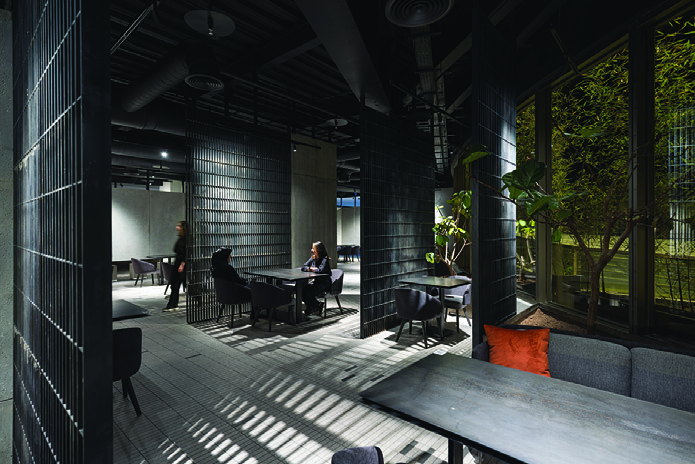
all of this speaks to our need for enclosure, just as sometimes breaking free of enclosure becomes an urgent necessity for us — such as the need for a welcoming opening onto a beautiful view. The role of the room, then, is redefined for us as a regulating space that modulates our engagement with the space outside. The range of instances of this role-playing can be traced across the breadth of diverse human experience throughout history and across geography — which in truth expresses one dimension of the story of architecture's fundamental transformations. Technical and structural developments in architecture have also always influenced these fundamental changes. From the nomad's tent in Iran to the Eskimo's igloo at the North Pole; from the Iranian five-door room to the semi-transparent Japanese room; from the dark historic rooms with their heavy walls to the all-glass modern rooms of Europe — all are instances of how the relationship between enclosure and openness has been redefined throughout architectural history, on the basis of technical and structural developments and architects' ideas in each era about how to create space. Each of these deserves an occasion of its own.