



The inferno of the living is not something that will be; if there is one, it is what is already here, the inferno where we live every day, that we form by being together. There are two ways to escape suffering it. The first is easy for many: accept the inferno and become such a part of it that you can no longer see it. The second is risky and demands constant vigilance and apprehension: seek and learn to recognize who and what, in the midst of the inferno, are not inferno, then make them endure, give them space.1 — from Invisible Cities, Italo Calvino
Unlike many ancient Iranian cities, the brief history of young Tehran offers few luminous moments that can be ranged in line with pride. The crowded, chaotic, at times contradictory, and ever-mutating fabric of contemporary Iran's capital is difficult to classify. Following Tehran's history through its short two-hundred-year life reveals a story marked by many highs and lows. In the past century alone, the city has experienced staggering population growth: from two hundred thousand inhabitants at the turn of the century, Tehran today, crossing 13 million, has become the Middle East's third-largest metropolis after Cairo and Istanbul.
More than half of Iran's population is under thirty, and although Tehran's median age is higher than the country's, its young, educated population has a high capacity for participation in the public sphere and could make public spaces and urban life flourish. Yet public space in Tehran differs in essence from received assumptions.
The freedom to make and remake our cities and ourselves [...] is one of the most precious yet most neglected of our human rights.2 — David Harvey
To understand the subversive spaces that resist public space, we must first look at general definitions of the public sphere. Above all, for Habermas the public sphere is defined by three conditions: guaranteed freedom of access for all citizens, freedom of assembly, and freedom of expression of opinions.3
Habermas sees modernity as an unfinished project4 whose realization would have a profound effect on the world, and whose path to realization passes through people's communication and interaction with one another. The public sphere is the agent that makes such communication and interaction possible.
Put simply, public space is space accessible and open to all, in which the free exchange of opinions and ideas takes place, and since it is the space of ordinary daily life it is deeply tied to the idea of democracy and its practical realization. The public sphere is the place of appearance and disclosure5; the possibility of being seen and acting within it is what makes it function as a vital democratic space. Although in practice the public sphere never seems perfectly all-inclusive or wholly integrative, under any conditions it remains a site for the potential realization of democratic activity — even if it must change its nature and become subversive and underground.
Lefebvre's idea of the right to the city is rooted in this same concept. David Harvey holds that the right to the city is more than each citizen's individual access to urban resources. It is the power to «change ourselves by changing the city.» The right to the city is not an individual right but a collective and shared one, since changing urban equations inevitably depends on the collective exercise of power.6
The surface of the city is a function of the underlying social structure of the society of which the city is a part. Shifts in social structure can, depending on their degree and kind, transform the city entirely. In pre-revolutionary Iran, for example, the state's will to project a modern, advanced, modernized Iranian self manifested in measures aimed at shaping new public spaces in the capital.
With the 1357 (1979) Islamic Revolution, fundamental changes began, and great shifts in social structure and the imposition of new ideological laws completely altered the face of Iran's cities. The state sought to bring cities into line with an ideology drawn from a disciplined version of Islam. In Tehran — the capital of the newly founded Islamic Republic and the principal stage of the people's struggle during the revolution — rather than the public sphere serving, as it had during the revolution, as the site for the urban, social, and political inclusion of varied groups, new selections produced a long and broad process of citizen exclusion. Large and important public spaces gradually became closed, interior spaces given over solely to ideology. From then on, one could appear in the public sphere only by complying with the new conditions. Gradually, those who could not fully accept those conditions were driven back inside the closed spaces of their private dwellings.7
A summary historical survey of public space shows that this space carries an internal contradiction within itself: in nearly every spatial and temporal context it has been more or less monopolized by a particular group of participants and so can never in practice be truly democratic. Nancy Fraser uses the term «counterpublic» for the spaces that those excluded from the official public sphere establish as their own public realm, in order to meet the unmet need for a space of social activity.8 In Tehran, this kind of public space makes up a large share of the public sphere. The counterpublic space must be able to withstand coercive constraints, and for that reason it is highly dynamic and in constant change — its users must continually redefine the structure and interpretation of physical space to remain adaptable to unstable conditions.
With the social transformations after 1357, people gradually moved more of the activities they had once carried out in the public sphere into safe, protected private spaces, so that they could continue what the official public sphere was suppressing. As a result, even ordinary, everyday activities that find room to appear in the public sphere of many other cities surface in Tehran in different, complex ways — to a stranger encountering it for the first time, it can seem strange.
The concern of the Subversive Tehran project is to visualize the strategy by which Tehranis adapt themselves to the city — the way they reclaim their right to the city, taking parts of it as their own to carry out activities no longer permitted in the public sphere. As the freedom to appear in the public sphere has been curtailed, many people have withdrawn from any participation in it and instead have found or invented alternative ways to keep interacting with their like-minded peers.
The public sphere takes its meaning from the presence of the people who use it; the concept of public space and democracy is redefined by individuals and their lived experiences. Time, not space, must be regarded as the primary substrate in which architecture is conceived [...] By placing time as the principal substrate of architecture, space becomes active and social and is freed from rigid formalism.10 Subversion is fluid, and its temporal dimension is vital to its spatial realization; that dimension is what grants it immunity against control.
Saskia Sassen classifies such phenomena under the heading of «open source urbanism.» Cities are never finished or complete, and their incompleteness means they can be remade at any moment by thousands of small momentary interventions. Today's urban fabric, however controlled and repressed, still answers back — as Sassen puts it, the city responds. The methods by which people deploy hidden spaces to assert their right to the city may seem trivial when examined one by one, but when seen as a network of hidden spaces, one cannot ignore the wide and direct influence these small acts have on the city, and how they challenge the present state of Tehran.
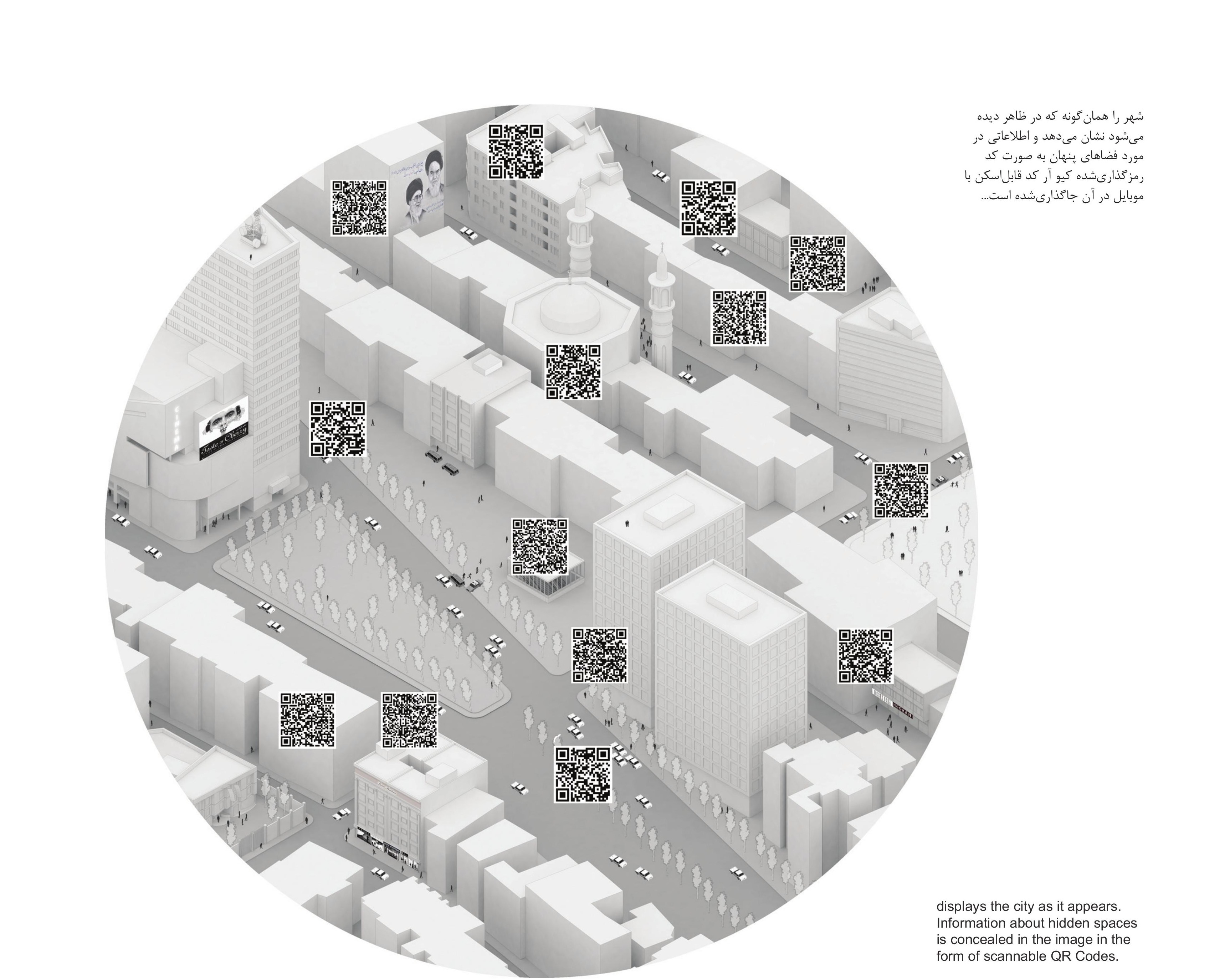
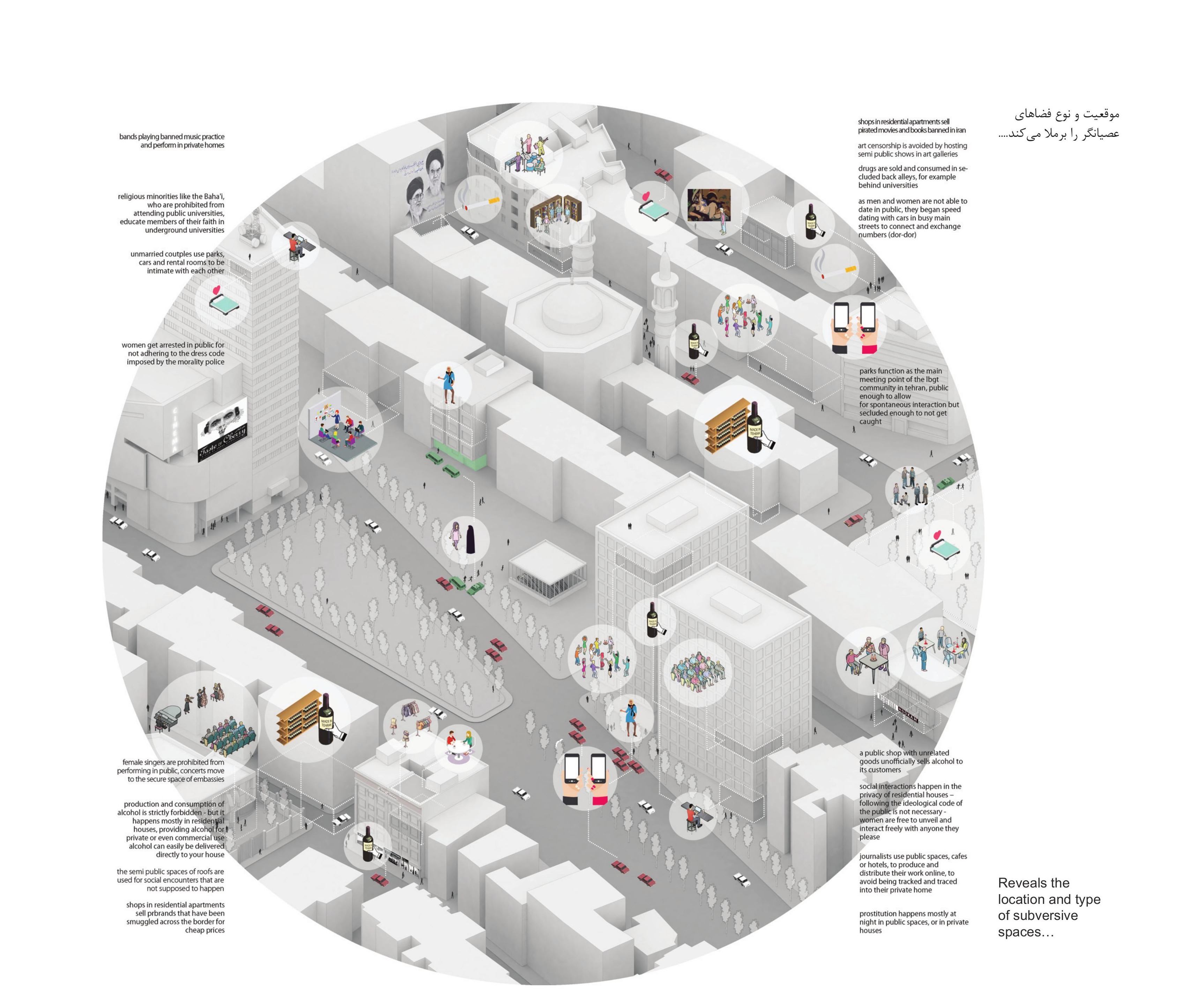
This project, through isometric views of imaginary neighborhoods in Tehran — like a snapshot that is a fleeting and fugitive slice of time — shows how micro-tactics of instability are applied to the city so that certain activities can endure and become generative. In this process, new kinds of public space emerge. The first image shows the city as it appears, but information about hidden spaces is embedded in it as an encoded code (a QR code scannable with a mobile phone). The second image reveals the location and type of subversive spaces. The last image displays the networks between these spaces and their vital relation with virtual space. Because these spaces typically arise in the hidden, private, or underground layers of the city, they are fugitive, flexible, and constantly changing. An activity may begin in a particular space but quickly relocate, or even cease to exist — because it has been traced, or because better alternatives have taken its place.
Like any emergent system, the city is a function of time.9 — Steven Johnson
The city is dead; long live the network!12 — Thomas Sieverts
To push the vocabulary of this study one step further, we can call this appropriation of space the «software of people's actions» running on the «hardware of the city» — hacking the city.11
The primary form of subversive space is fixed physical space, gradually morphing into the more fluid counterpublic space that can be reached only when one holds the right information (such as a contact or a phone number). The natural next step is the control of digital content on the internet; as elsewhere in the world, the spread of smartphones, high-speed mobile internet, and most importantly social networks has given a large share of the population easy access to information that was not previously available in the public sphere with such ease. Unlike the physical city, restrictions people may face online are much more easily bypassed (for example via VPNs and proxy servers), and so the internet has become an important factor in keeping certain subversive spaces alive, with its use expanding alongside restrictions and becoming harder to control.
In some respects the digital public sphere has completely replaced urban public spaces. The clearest example is political discourse. Many of the country's senior politicians are members of the social network Twitter. This is unremarkable elsewhere in the world, but in Iran it is a paradox: the same politicians are involved in filtering Twitter, Facebook and similar platforms. Both they and their opponents have a freer opportunity to surface in virtual space — particularly for views that cannot easily be voiced in the official public sphere. The digital public sphere carries a share of the participatory burden of urban public space.
Access to many of these hidden spaces is not easy because it depends on the individual's social ties to the place they wish to enter. The more contacts, the easier the access. With the right phone number, almost anything can usually be reached. A stranger arriving in Tehran without sufficient social ties may never encounter the galleries that show nude art or the underground rock concerts, but such events are normal and routine in Tehran and are even tolerated — they may simply not be fully visible or accessible.
If we push the idea of hacking the city one step further, the question arises: might subversive spaces ultimately become part of digital space on the internet and disappear in the physical world? In recent years in Iran, despite the absorption of physical subversive spaces into digital space, one cannot conclude that physical space will vanish entirely.
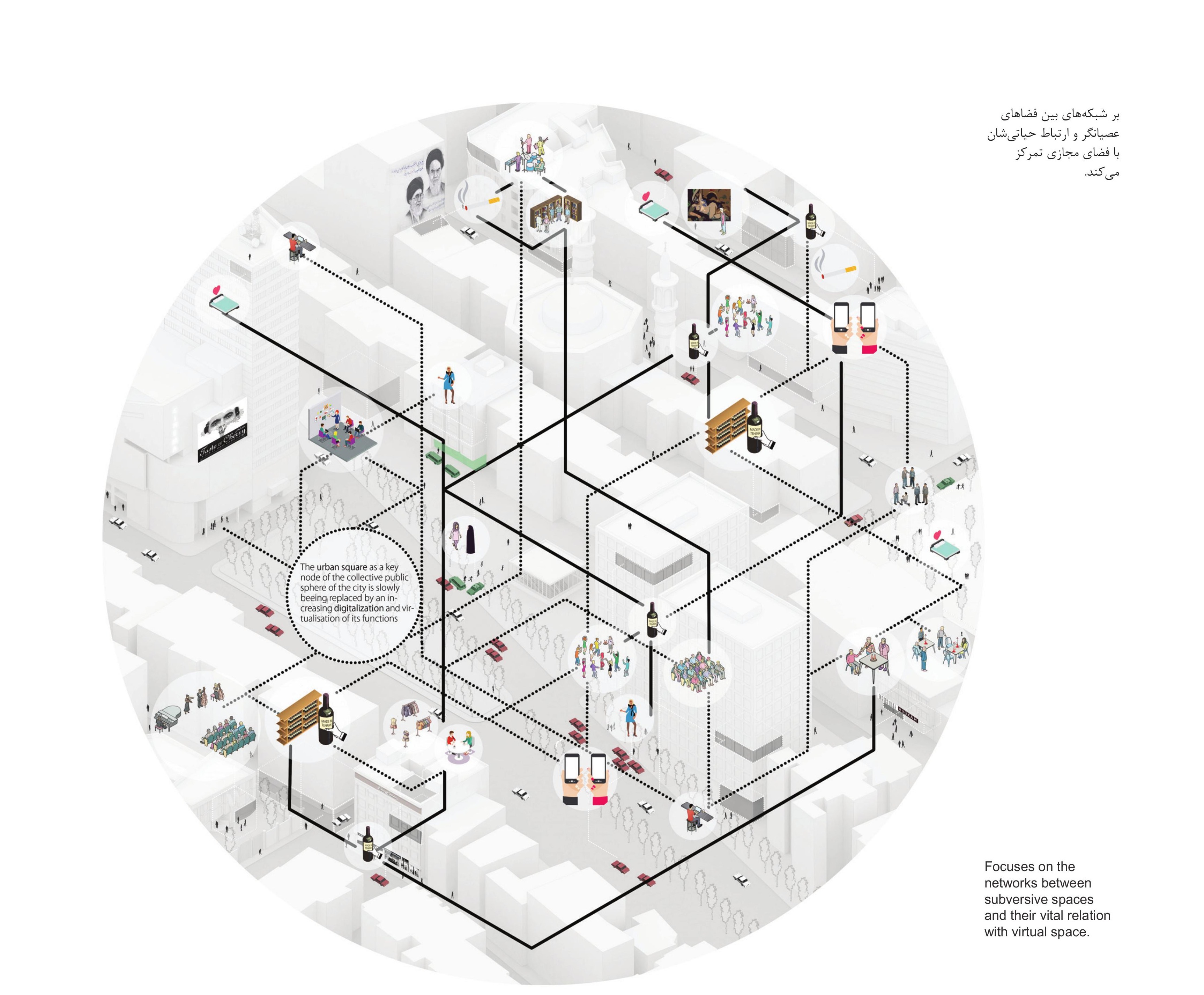
What this means is that the nature of these spaces moves away from «space of places» and toward pure «space of flows.» Manuel Castells sees the dominant paradigm of today's society as a flow circulating among goods, resources and most importantly information,13 the last of which is most important for understanding counterpublic spaces. Yet the virtualization of counterpublic spaces and their reduction to mere information — even with ever-growing digitalization — is impossible, because «space is the material support of social processes, which in turn use space over time.»14
In the case of Tehran's subversive spaces, too, digital space generally does not replace physical spaces; it opens new doors onto safer and more stable channels of communication that ease access to physical counterpublic spaces. Especially marginal groups in society — those not even named in print publications or in formal public spaces — turn to the internet to act and express themselves more safely. Digital space allows them to participate in a public sphere located within the «intangible meta-structure of the internet.»15
Creating public spaces of a subversive nature — hosting activities whose possibility has been formally denied — can be understood as hacking the city, whether those spaces are physical or digital. Small subversions, taken together, build networks that enable people to interact with one another, fulfilling the very reason for the public sphere's existence — so that perhaps one day the harsh veil that holds the city in screen may be lifted.
Notes
- 1 Italo Calvino, Invisible Cities. Houghton Mifflin Harcourt, 1978.
- 2 David Harvey, «The Right to the City»; in New Left Review, No. 53, 2008.
- 3 Jürgen Habermas, The Structural Transformation of the Public Sphere: An Inquiry into a Category of Bourgeois Society; Cambridge, 1989.
- 4 Jürgen Habermas, «Modernity versus Postmodernity»; in: Passerin d'Entrèves, M. (ed.): Habermas and the Unfinished Project of Modernity; Cambridge, 1997.
- 5 Gill Valentine, «Children should be seen and not heard: the production and transgression of adults' public space»; in: Urban Geography, Issue #17, 1996.
- 6 David Harvey, «The Right to the City»; in New Left Review, No. 53, 2008.
- 7 Asef Bayat, «Tehran — Paradox City»; in New Left Review, No. 66, 2010.
- 8 Nancy Fraser, «Rethinking the Public Sphere — A Contribution to the Critique of Actually Existing Democracy»; in: Robbins, Bruce (ed.): The Phantom Public Sphere, Minneapolis, 1993.
- 9 Steven Johnson, Emergence: The Connected Lives of Ants, Brains, Cities, and Software; London, 2001.
- 10 Till Jeremy, Ursprung unbekannt.
- 11 Saskia Sassen, «Open Source Urbanism»; in: New City Reader, Issue #15: Local, Oxford, 2010.
- 12 Thomas Sieverts, Mastering the city: Exhibition at Netherlands Architecture Institute.
- 13 Manuel Castells, The Information Age, Vol. 1: The Rise of the Network Society, 2nd ed., Oxford, 2010.
- 14 M. Castells, «An Introduction to the Information Age»; in: The Blackwell City Reader; Malden, 2011.
- 15 http://www.archplus.net/home/planetaryurbanism (accessed: 42015/7/1).