



Boroujerdi-ha Mansion, Kashan Imam mosque, Isfahan Aqa-Bozorg mosque, Kashan Sepahsalar mosque, Tehran
In historical heritage of Persian Architecture there is a number of prominent entrances such as the Ivan or veranda of Masjid- Shah Mosque in Isfahan, the hashti or 8-sided vestibule be- hind the Ivan of Sepahsalar Mosque, the hashti of the Borou- jerdi residence and the hashti of the Agha-Bozorg Mosque in Kashan. However in contemporary Iranian architecture one rarely comes across entrances of any significance or compa- rable to those of older buildings. It seems difficult if not impossible to envisage an archi- tectural space without a defined entrance. On the other hand presenting a somewhat clear picture of the concept of en- trance is also extremely difficult. From the term entrance one can envisage an area in between the interior and the exterior that is clearly definable from a spatial point of view. Based on this definition not all openings or doorways can be consid- ered as entrance and one cannot present a clear argument regarding the spatial features of this element. To clarify this we shall compare a number of well known Persian and European pieces of architecture belonging to different periods. The Chehel-Sotun entrance in Isfahan, consists of a simple timber roof carried by 20 columns. This roof leans on a brick building on one side and is open on the remaining three. In this case the entrance area is a semi-open space that can be
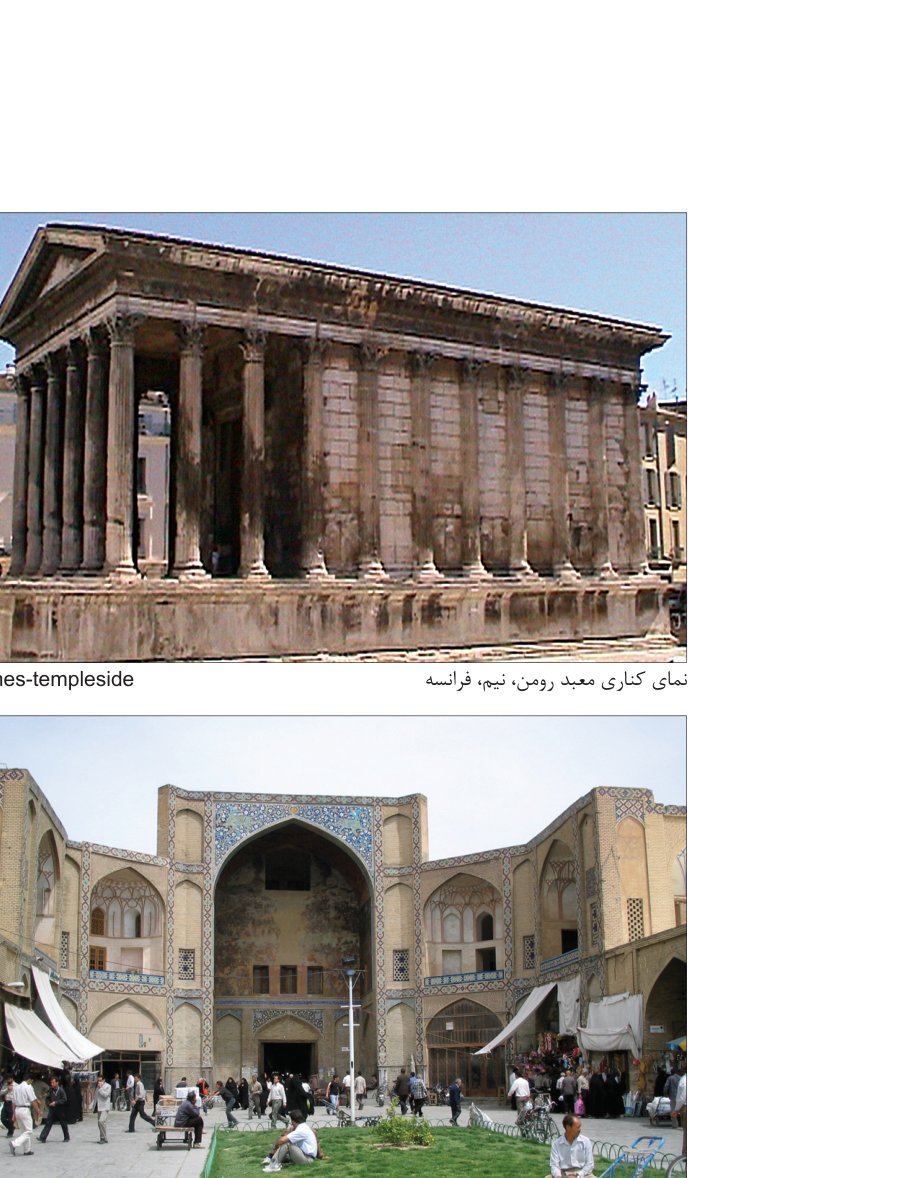
clearly distinguished from the main building through its typol- ogy and use of materials. In the history of architecture one comes across a large number of such spaces. The Pantheon in Rome built in the early second century AD is a good exam- ple of this kind. In some cases the entrance area is located outside the building but its form and volume make these two indistinguish- able. The Carre D’Art building in Nimes in the South of France (1984 – 1993) designed by Sir Norman Foster is a clear exam- ple of this kind. This building sits opposite a two thousand year old ancient Roman temple and its typology is undoubtedly influenced by the form of the existing temple. Another type is Ivan and similar structures which consists of an opening in the structure that draws exterior into the heart of the building. The Ivan of the Jamee Mosque in Yazd and Sant’Andrea Church in Mantua, Italy designed by Leon Battista Alberti (second half of the 15th century) are good examples of this kind. In some buildings the entrance and the main building merge into one, like Sir Norman Foster’s Reichstag Dome in Berlin (1995 – 1999), the glass pyramid of Louvre designed by I.M.Pei (1989) and Mies Van der Rohe’s National Gallery in Berlin. L’Institut du Monde Arabe in Paris, by Jean Nouvel
(1987 – 1988) is another example where the entrance is not that prominent from the exterior but is revealed from inside. Though to develop some kind of spatial categorization for entrances plausible, in fact it escapes all forms of classifica- tion. For example in Boroujerdi Residence the entrance is not one room but rather a series of spaces. An ivan, two 8-sided vestibules or hashtis, three fragments of passageways with a non-axial geometry connects outside to the inside. Here entrance is essentially a system which includes the central courtyard and the Ivan. Therefore access to the heart of the building is through a sequence of open, closed, concentrated and linear spaces. In such a complex, entrance cannot be separated from the main body of the building even though it is clearly a prominent and distinguished element. Contrary to this, in a recent project designed by Sir Norman Foster the spiral movement of the form defines the entry area from inside and entrance does not present itself as an independent ele- ment. Entrance is a link between exterior and interior and is therefore closely tied to arrangement of the external and internal spaces. In many architectural pieces design of the entrance begins with the definition of the external space. Baroque and Safavid Architecture are clear examples of this methodology. In Versailles Palace the entrance seems a part of a large urban project of its surrounding. Sometimes even appears that entrance is drawing people to the outside of the building and not in. The gateway to the Isfahan bazaar, particu- larly on the Square side, is designed in such a way as to draw the pedestrian to the main axis of Abassid complex. In residential buildings entrance forms a border between private and public life, but in public building it becomes a bor- der line between two aspects of public life. Numerous exam- ples show that the most accurate definition for an entrance is a boundary between two spaces where one is distinctly smaller than the other due to its overall dimensions. The boundary belongs to the smaller space. Entrance is intertwined with symbolic connotations, more
so than any other architectural element. All languages use spatial metaphors to demonstrate abstract concepts because our visual and spatial senses dominate all other senses. Phrases such as front, back, above and below are used to de- scribe matters such as grade and rank and degree of success in business. “Entrance” and its synonyms such as door, entry, portal, and threshold are also used in everyday speech. In different cultures in some cases entries into important or holy locations, or even private places, take on a form of sacredness and become paired with specific customs; such as removing shoes or bowing one’s head before entering. In holy sites such customs are more important and more elaborate so there is more emphasis on the entrance as a border between two worlds, terrestrial and a celestial one. In most styles entrance is a space more elaborately de- signed, so much so that one can see a summarized version of the popular style. So doorways to Gothic and Baroque churches, an Ivan of a mosque and the entrance of a Greek temple are all great aides to the discovery and definition of dif- ferent styles and trends. In Modern architecture entrances have been used to emphasis on creativity and innovation so the process of entry and the discovery of every space are just as important as the overall architectural product. The BO18 Club in Beirut by Bernard Khoury (1998) is built under ground. Entry is through a staircase dug deep like Ali Baba’s cave. The roof opens at night like the bonnet of a car and provides a visual connection between outside and inside. The club’s underground location, its entrance and the removable roof give it an almost magical atmosphere. The entrance of the Bellinzona project in southern Switzer- land is another interesting example. Here the entrance takes the shape of a modernized cave. In the Church of St. Mary in Lisbon, designed by Alvaro Siza (late 90s), the most impor- tant expressive aspect appears to be the entrance with its tall wooden doors set on the main axis of the building, creating a very powerful impression.
كليساي مريم مقدس، آلوارو سيزا بلينزونا رواق ميدان سينيورا Santa Maria church, Alvaro Siza Bellinzona Pizza Singnoria
پانوشت: 1- Pantheon 2- Nimes 3- Leon Battista Alberti, San Andrea- Mantova 4- Reichstag 5- I.M.Pei 6- َAurelio Galfetti - Bellinzona 7- Igreja de Santa Maria- Alvaro Siza