
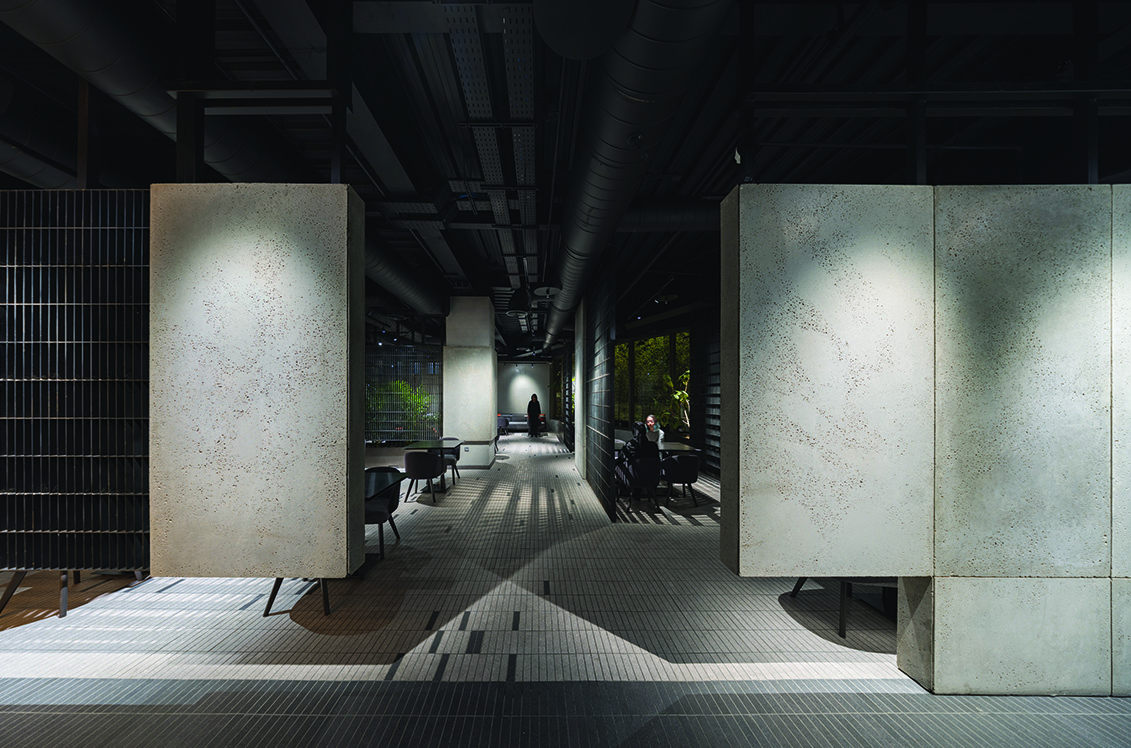
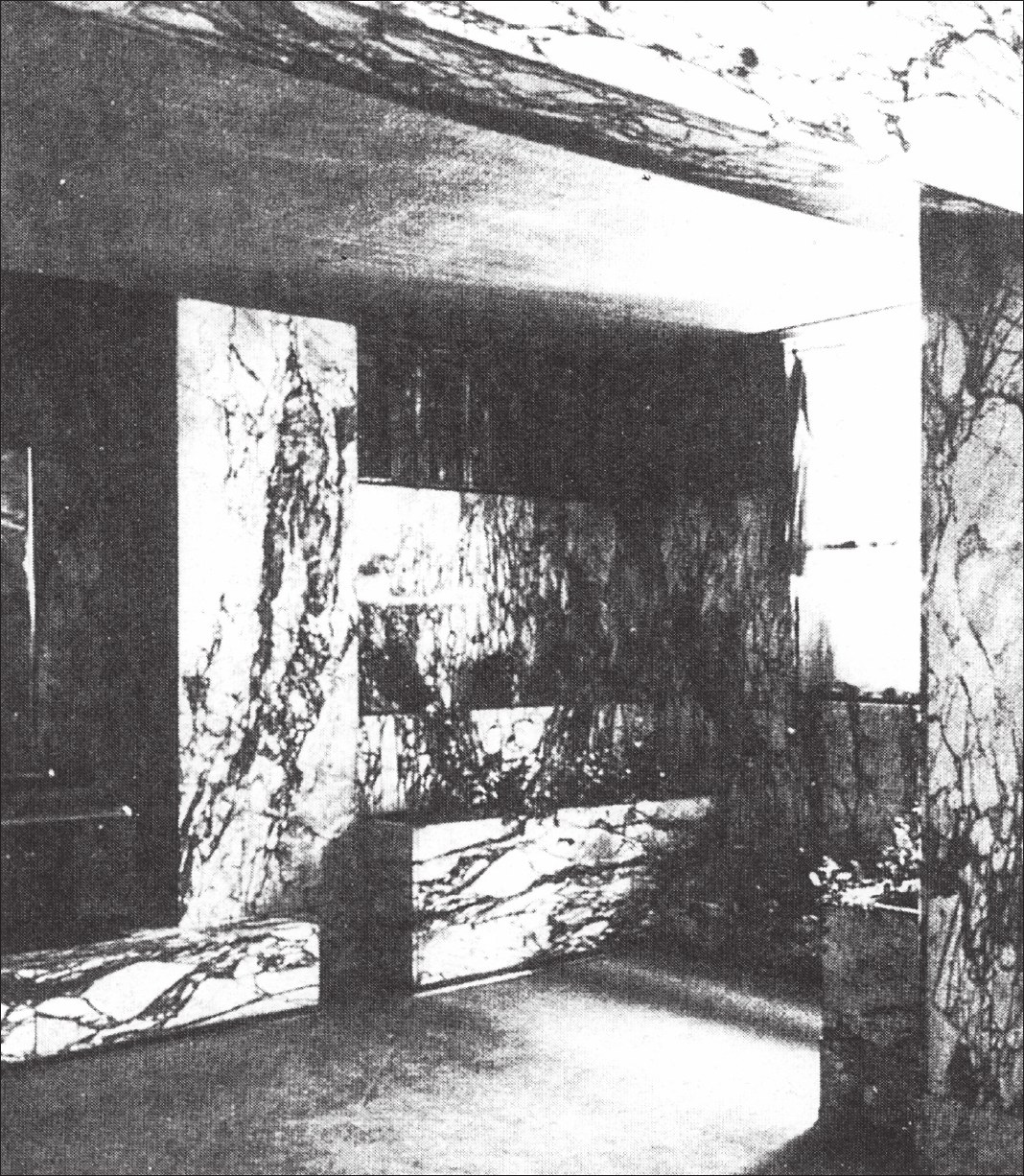
That materials have equal value for the artist does not mean that they are equally suited to all of the artist’s purposes. Strength and constructability call for materials that may not be compatible with the building’s real purpose. Here the architect’s task is to make an intimate, habitable space. Carpets are intimate and habitable. So the architect decides to spread one on the floor and to hang up four carpets, which are to form the four walls. But you cannot build a house out of carpets. Both the carpet on the floor and the tapestries1 on the wall require some kind of structural framework to hold them firmly in their proper place. Inventing that framework is, of course, the architect’s secondary task.
Architecture has taken this correct and logical path. Because this is the order in which humankind learned to build. In the beginning was cladding. Against the terrors of the weather, humankind sought shelter, and in sleep wanted shelter and warmth. It sought to cover itself. The roof is the oldest architectural detail. In the beginning it was made of animal skins and textiles, a meaning preserved even today in the Germanic languages2. This roof, if it was to be a fit shelter for the family, had to be held firmly at any cost. In a short time walls were added to it, to give protection on the sides as well. And so the idea of building took shape, both in humankind and in the individual.
There are architects who go about this differently. Their imagination creates not spaces but sections of wall. What the sections of wall leave over are the spaces, and afterwards whatever kind of cladding is thought most suitable is added to the spaces. This is art achieved empirically.
But the artist, the architect, first feels the effect they want to produce and then sees with the mind’s eye the spaces they want to create. The effect they want to produce on the viewer, whether fear or terror, as inside a prison; fear of God, as inside a church; respect for the power of the state, as inside a government building; piety, as with a funerary monument; homeliness3 as in a dwelling house; congeniality4 as in a tavern: what brings this effect about is material and form.
Every material has its own formal language, and no material can lay claim to the forms of other materials. Because forms arise from the usability and the method of production of each material, they take shape with the material and out of the material. No material permits intrusion into the domain of its own forms. Whoever wants to do so is branded a forger by the world. But art has nothing to do with forgery, with lies. The paths of art may be troublesome, but they are clean, at any rate.
The tower of St. Stephen’s Church5 could have been made of cast concrete and set up somewhere else – but then it would no longer count as a work of art. And what holds for the tower of St. Stephen’s also holds for the Pitti Palace6, and what holds for the Pitti Palace also holds for the Farnese Palace7. With this building we are right in the middle of the architecture of Vienna’s Ringstrasse8, our own. A sad time for art, a sad time for the few artists among the architects of that time, architects who debased their art for the sake of the crowd. Only a few were in a happy position, in that they had found generous clients who gave the artist the chance to carry on their work. The luckiest of them was perhaps Schmidt9, architect and designer of the Vienna City Hall. Hansen10 (1828-83), architect, and one of the designers of the Vienna Ringstrasse, followed their path, someone who, though without much pleasing feeling, sought peace of mind in terracotta11 building. Poor Ferstel12, 1828-83, architect, a leading figure in late-nineteenth-century Viennese design, must have suffered terrible torment when at the last minute they were forced to nail precast concrete onto the whole façade of their university. The other architects of that period, with a few exceptions, lacked such morbid feelings.
Is the situation different today? Allow me to answer this question. In architecture, imitation and substitution still reign. In fact, more than that. In the last few years several people have defended this practice – one of them under a pseudonym, admitting that the subject had occurred to them somewhat vaguely – so the substitute architect can no longer stand silently aside. Now self-assurance13 is nailed onto the façade of the building, and vertical stone is hung beneath the cornice14, together with an artistic justification. Come, you heralds of imitation, come you makers of ridiculous carvings, botch up the windows of your houses and your sturdy beer halls of paper and paste15. A new spring dawns in Vienna, the soil is freshly manured.
But is a living room hung entirely with tapestries not an imitation? After all, the walls are not made of tapestries. Certainly not. But those tapestries claim only to be tapestries and not bricks. They do not want to be mistaken for bricks; they show this neither through colour nor through their pattern, but clearly display their significance as the cladding of the wall surface. They fulfil their purpose in keeping with the principle of cladding.
As I said at the beginning, cladding is older than building. The reasons for cladding are manifold. First protection against bad weather, such as the use of oil paint on wood, iron and stone; then for reasons of hygiene, such as glazed tiles to cover the wall in a washroom; then it is a means to a particular effect, such as the coloured painting of statues, papering the wall, veneering wood. The principle of cladding was first stated by Semper16, and its scope extends to nature as well. The human being is covered with skin, the tree with bark.
But the principle of cladding also has its own law. There is no need for alarm. It is usually said that laws bring all development to a standstill. And besides, the old masters managed very well without a law. Certainly. But where theft is unknown, there is little benefit in making a law to prevent it. When cladding materials were not yet imitations, there was no need at all to make a law. But now it seems to me the time has come.
But this law runs as follows: the possibility of mistaking the cladding material for the thing clad must in all cases be ruled out. This phrase, applied to each individual case, is understood thus: wood may be painted any colour except one – the colour of wood. In a city where the exhibition commission has decided to paint the old wood in the Rotunda17 “like mahogany”18, where in this case graining19 is the only colour decoration of the wood, that phrase is a bold statement. It seems there are people around who have considered this refined. Not to me. Nor do I consider it beautiful. Because trains and tram cars, like every form of carriage, are the only wooden objects that display pure colours. Now I dare to state that I prefer to see this kind of tram car – especially those that run on the electric lines – that is, in absolute colours, rather than have them follow the exhibition commission’s principle of beauty and be painted like mahogany.
But a true sense of refinement rests in our people, though buried and hidden. Otherwise the tram company could not count on the fact that the brown third-class car – the colour of wood – would arouse a less refined feeling than the green second- and first-class car.
I once expressed this unconscious feeling to a colleague in a more or less theatrical way. On the first floor of a building there were two apartments. The tenants of the first apartment had mullions20 and transoms21 that were otherwise painted in grained brown or in white. We made a bet that we would invite several people to stand in front of the house and, without drawing their attention to the difference between the mullions and transoms, ask them on which side Herr Blunzengruber22 lived and on which side Prince Liechtenstein, the two parties to whom we had taken the liberty of letting the apartments. The side with the knotted wood was unanimously assigned to Blunzengruber; since then my colleague chooses only white.
Grained wood is, of course, an invention of our century. In the Middle Ages wood was mostly painted bright red, in the Renaissance blue, in the Baroque and Rococo white for the interior and green for the exterior; our farmers have kept this true sense well enough to work with absolute colours. How attractive the green gates, green fences and green shutters are against the freshly whitewashed walls outside the city. Unfortunately some villages have adopted the taste of the exhibition commission.
We may recall the moral indignation in the camp of the substitute applied arts when the first oil-painted furniture arrived in Vienna from England. It was not the paint that angered those good citizens. Even in Vienna, as soon as softwood came into use, it was oil-painted. But the fact that the English furniture had dared to show its oil paint frankly and freely, instead of imitating hardwood, really made the hair on those peculiar personalities’ necks stand on end. They turned away as if they had never used oil paint. Apparently, the gentlemen are of the opinion that furniture and buildings in knotted wood had until then been seen as hardwood.
If such considerations in my general outline concerning those painters prefer not to name anyone, I may perhaps be assured of the gratitude of my fellow tradesmen23.
When the principle of cladding is applied to plasterers, it reads thus: any ornament may be used in plasterwork except one – bare brickwork24. We might imagine that there is no need to state something so obvious, but just recently my attention was drawn to a building whose plaster wall had been painted red, and its joints white. That favourite kitchen decoration that imitates stone blocks belongs to the same category. And likewise all the materials that cover walls – wallpaper, tarpaulin25, textiles and tapestries, tiles and stone blocks – which must not be used for representation.
A cladding material can keep its natural colour if it is the same colour as the material it covers. So I can paint black iron with tar26, I can cover wood with another wood (veneer, marquetry27, and so on) without needing to paint the top wood; I can put a layer of metal onto another metal by fire or by galvanizing. But the principle of cladding forbids copying the underlying material with something coloured. Hence iron may be tarred, oil-painted or galvanized over, but it may never be hidden with bronze paint, in other words a metallic paint.
Here I must mention chamotte28, also known as greg or firesand, and the artificial stone slabs which imitate terrace plaster29 (mosaic) on the one hand and the Persian carpet on the other. Certainly there are people who would believe it – the factories surely know their customers better.
But you imitators and substitute architects, you are mistaken. The human spirit is too lofty and exalted for you to deceive it with your tricks and petty tactics. You have our wretched body at your disposal. That body has only five senses with which to tell the genuine from the fake. And where the sense organs no longer suffice, your domain30 begins, there is your realm31. But you are mistaken once again. Paint the finest marquetry at the highest point on the ceiling, and our wretched eyes will believe the lot32. But the heavenly psyche33 does not believe your deception. In the finest marquetry painted34 ‘like intarsia’, only oil paint is felt.
Footnotes:
1- tapestry
2. The German word Decke means both ‘ceiling’ and ‘blanket’.
3- homeliness
4- congeniality
5- St. Stephen
6- Pitti
7- Farnese
8- Ringstrasse [a ring-shaped boulevard around the historic fabric of Vienna. Tr.]
9- Friedrich von Schmidt, 1825-91
10- Theophil Hansen
11- terracotta
12- Heinrich von Ferstel
13- aplomb
14- cornice
15- papier mache
16- Semper
17- Rotunda
18- mahogany
19- graining
20- mullions
21- transoms
22- Herr Blunzengruber
23- fraternity
24- bare brick
25- tarpaulin
26- tar
27- marquetry
28- chamotte
29- terrace plaster
30- Domain
31- realm
32- lot
33- psyche
34- Intarsias