



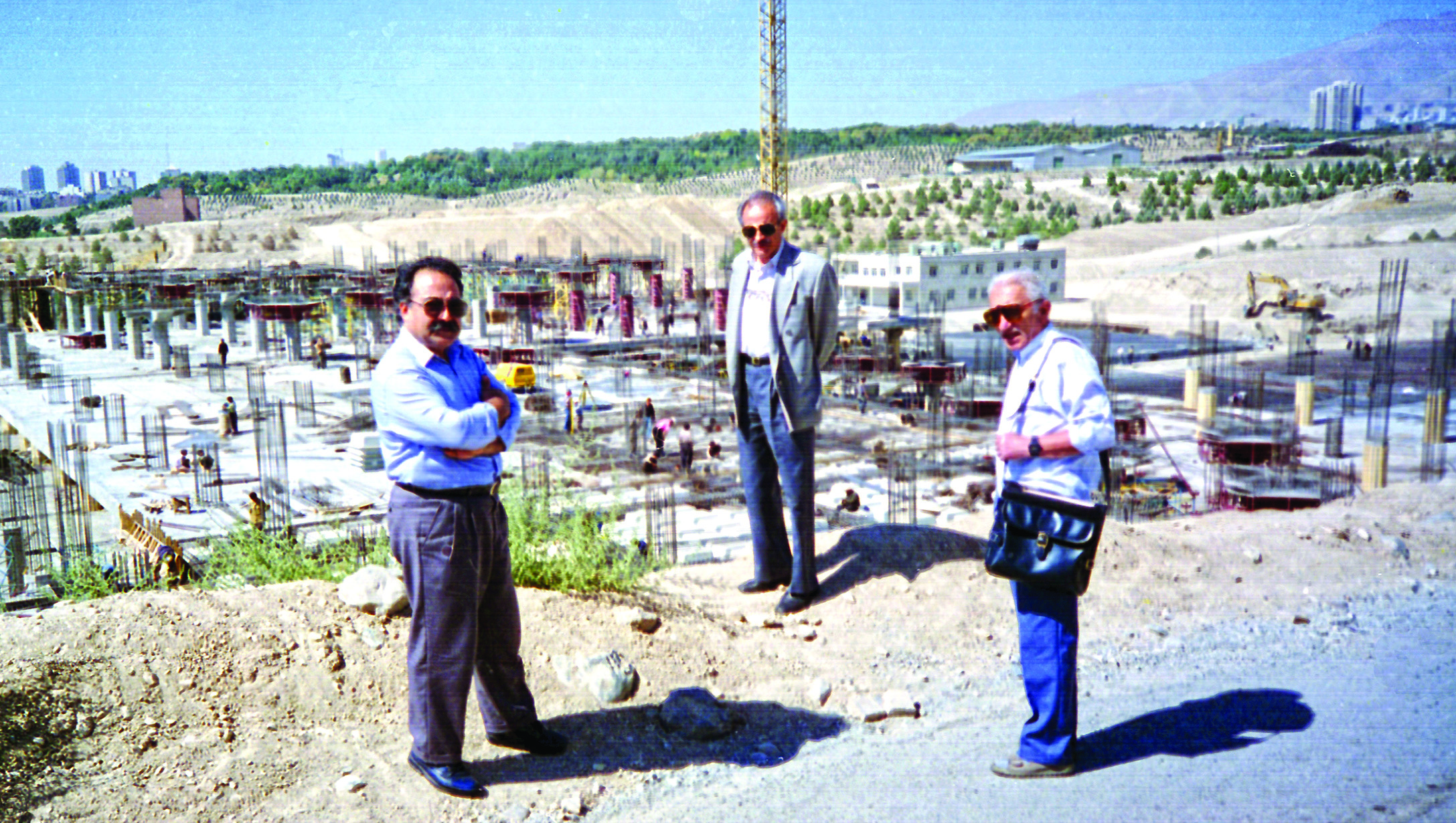
My first meeting with Yousef Shariatzadeh was the day that — together with Nosrat Majlesi, and through Alireza Aman — we were introduced to the firm "Amir-Nosrat Monaqqeh / Yousef Shariatzadeh" to begin an internship. We were both second-year students at the school of architecture, and following the customary practice in architectural ateliers we assisted Alireza Aman, an upper-year student, in carrying out his projects; that is how we served our internship.
In the firm's architectural atelier, located in the basement of a building on Damascus Street, a workbench was assigned to each of us, and we began the required exercises with pencil. At first we drew or corrected architectural details and gradually moved on to drafting plans (mostly in pencil and then in ink with a rapidograph).
At that time, Yousef Shariatzadeh oversaw the firm's architectural design. He was based at the center of the atelier hall, opposite the entrance. Given our extreme respect for Shariatzadeh's professional standing and the introduction made earlier by Engineer Aman, the first days were accompanied by a certain anxiety and shyness.
In the atelier, after Yousef Shariatzadeh, Dr. Tehrani was in charge of producing the architectural designs. Among the other colleagues in the architectural atelier — some who had been there longer, some who arrived later — I remember Engineer Fasihi, Alireza Aman, Karim Javaheri, Manouchehr Zartoshti, Nahid Khajeh-Nasiri, Maryam Dara, and the engineers Saidi and Iraj Vakili, both structural designers. Engineer Amir-Nosrat Monaqqeh, the head of the firm, occupied a separate room on the ground floor, equipped for meetings, conferences, and the other necessities of management.
Perhaps because of the small number of us at work in the atelier, the working atmosphere was managed in a thoroughly friendly manner. Without doubt, the warm collaboration between Tehrani and Shariatzadeh was effective in creating these relations, and Shariatzadeh's belief in teamwork was also evident in his manner of dealing with colleagues.
My collaboration at that firm continued from 1345 to 1348 SH (1966 to 1969). In 1349 (1970) I presented my diploma project, and in the autumn of that same year I graduated. After military service in the years 1349 to 1351 (1970 to 1972), and until 1355 (1976), I worked in architectural activities and ran the architectural office "UG" together with Nosrat-ollah Majlesi and Kamran Shahin-far, devoting myself mainly to the design of and supervision over the construction of residential houses.
In 1355 (1976) I joined Banyan Consulting Engineers, which had been established five years earlier under the regulations of the Plan and Budget Organization for architectural consulting firms. Banyan was based in a building on Zartosht Street that had been designed by Shariatzadeh and built by the architect Shansi; the company occupied three floors — basement, ground floor, and first floor. My collaboration with Banyan continued as an employee until 1357 (1978) and for a further period as a shareholder until 1360 (1981).
In 1362 (1983), as members of a group of consulting engineers, we founded Pir-Raz, which received a ranking under the new regulations of the Plan and Budget Organization for qualifying consulting-engineering firms; my collaboration with Pir-Raz continued as a shareholder and member of the board until 1388 (2009).
Over the long span of my collaboration with Yousef Shariatzadeh (thirty-two years), I drew the greatest and most abundant capital of my professional life from his particular outlook on architecture, and I learned a great deal from him: continuous, exacting work; the right method and approach in carrying it out; and the necessity of gathering and completing one's information before beginning to design. Worth mentioning are Shariatzadeh's attention to and mastery of the features of Iran's past architecture and how it bore upon a design, his modesty, and his sparing speech.
I witnessed his energy and his tireless spirit in producing designs. On most days, when work hours had ended and he was leaving the atelier, he took his designs-in-progress home to continue working on them. When he was traveling, he brought back on his return a collection of studies and drawings for the projects underway, or — if his trip was prolonged — he sent the initial sketches on A4 paper by fax or by post so that work could continue and the first and second phases and the completion drawings could be carried forward in the firm.
The particular outlook Shariatzadeh brought to projects, and his manner and style of working, are things I have rarely seen in other architects. He never put pencil to paper extempore, without having complete data in hand — the physical program of the design, full climatic information, the functional and spatial requirements, and the codes and standards governing the scheme. What he designed was the process of analyzing a great mass of information that gave rise to the form and the volumetric, spatial, and constructional characteristics of the project. I am certain that, if this approach were taught to students in schools of architecture as part of the method of producing designs, the work of Iranian architects and the prevailing architecture of Iran would find its own different and reasoned manner and style.
Shariatzadeh strictly avoided drawing attention to himself or being subject to praise and laudation, and he never agreed to interviews. For this reason we have seen little critique and analysis of his works, or eulogy and overstatement about him. Relying on teamwork, he directed and supervised designs continuously from beginning to end of their execution. Among his distinctive qualities were his command of and grasp over the other engineering disciplines related to architecture (mechanical and electrical services, methods of construction, structure, and international codes and standards). He believed that every architect must have command of this information — to such a degree that, when preparing the preliminary design, he becomes aware of the needs and requirements they impose, and even, when consulting with other engineers and specialists, he can put forward his own desired proposal and choice.
Shariatzadeh was also critical of the way teaching was conducted in schools of architecture. He held that, beyond learning theories and carrying out academic exercises, students needed to be educated in practical work and acquainted with construction techniques and means of execution. Influenced by this same thinking, he engaged seriously in work and activity outside the school during the early years of his student days and remained, for a long time, away from university studies. Even after working with Engineer Amir-Nosrat Monaqqeh, Mohsen Mirheydar, and Mohammad Tehrani — and at Engineer Monaqqeh's encouragement and insistence — he presented his diploma project in 1342 (1963) and graduated. His projects and those of his colleagues — among them the Gendarmerie Hospital in Tehran, the Rivoli Cinema, the Ministry of Labor and Social Affairs building, and a number of residential houses, all of them completed before his graduation — bear witness to his belief in the necessity of working during one's student years.
After a short stay of a few months and a presence in the schools of architecture of Italy, he returned to Iran. In 1343 (1964) — with the founding of the Amir-Nosrat Monaqqeh and Yousef Shariatzadeh firm — he continued his professional and study activities, and the complex of hospitals of the Social Security Organization, the Tabriz tractor-manufacturing and machine-building industrial complex, the Ettelaat newspaper building, and numerous residential complexes were the fruits of that collaboration.
The vast list of his projects produced at Banyan Consulting Engineers and then at Pir-Raz Consulting Engineers between 1362 (1983) and 1380 (2001) — the year of his death — are all the outcome of the particular approach that he and his colleagues brought to the work, profession, and art of architecture.
Shariatzadeh regarded an architect's command of Western architecture and of the art of Iran's past as a prerequisite for designing, and he held that taking account of, attending to, and studying the social and financial factors of a project, the materials and means of execution available at the project site, climatic conditions, and sunlight all had a bearing on architectural design. With command of this information, and under its influence, he arrived at the architectural scheme and its volume. The lack of attention to these matters, and formalism and imitation of Western architecture, he considered a means of making the production of a design easy and casual. He believed that an architectural design must be like a tree whose roots are in this same water and soil. In the course of designing every project, he sought a precise understanding of those who would live, dwell, work, and carry on activity within the space of the scheme, and was attentive to what sort of people, with what culture and social background, would receive the outcome of his work and his art.
Saving energy — whether the energy drawn from the environment or the energy required to execute the design — and the orientation of the project relative to the geographical axes, and the optimal use of the angle and height of sunlight, were factors that occupied his attention. As a result, the apertures and openings placed on the various facades of his projects are not uniform under the influence of these factors and do not share the same characteristics. He always considered the design of identical facades with a glazed envelope to be an imitation of Western architecture and a waste of energy and a disregard of the climatic factors of Iran. With regard to the trees planted in the area around the building, he showed care and exacting attention. A notable example is the control of sunlight by means of deciduous trees (such as poplar and Tabrizi poplar) on the western frontage of the National Library building: in winter, when the warmth and light of the western sun are welcome, the trees are bare of leaves; and in summer, when the harsh sun and its angle of incidence are disturbing and bring heat, they are full of leaves and place the building's facade in their shade. Beyond these factors, he also gave full attention to the constructional details of his designs as they bore upon the saving and conservation of energy.
With his knowledge of Iran's past architecture, Shariatzadeh sought to identify and consider the factors that shaped it, and — while innovating in the design — to make use of them. Instead of imitating past architecture (which, unfortunately, is the prevailing practice), he kept its traditions and operations in view in his own designs. An example is the use of natural light at suitable directions and angles for the interior spaces of the National Library. The lateral and ceiling skylights, placed at height in the spaces, supply maximum brightness for the reading halls, and — by providing apertures in the floors of the upper stories — light and brightness have been carried to the depth of the spaces.
One can say with confidence that, among the consulting-engineering firms and offices whose period of activity coincided with the working years of Banyan and Pir-Raz, Shariatzadeh and his colleagues delivered the greatest volume and number of projects for which they undertook consulting services from the beginning to the end of execution, including the preparation of As-Built drawings.
After a long period of close collaboration with Yousef Shariatzadeh and of acquiring knowledge and experience at his side, I am of the conviction and belief that his way of thinking and his outlook upon art and architecture are the most complete, most comprehensive, and richest form of an architect's approach to this profession and art. It is a way and a method that can serve as a model for architects who seek to attain the best result in their work and activity in architecture.