Note from the editor: the three interviews were published in Persian in the original magazine. The English text below is the editorial summary that introduced the piece for international readers; the full Q&A is in سه گفتگو.
In this issue we have three interviews. The first two, with two famous cultural personalities of our profession — Ar. Mohammad Beheshti, and Ar. Akbar Taghizadeh — whose points of view are of high cultural and professional value, because of the high responsibilities they have had during their careers; and one with Ar. Mohammadreza Khoshfekari, who has also had a career in the Cultural Heritage Organization, but who is today in charge of the renovation works the municipality of Tehran is carrying on in the central core of Tehran’s Bazaar.
Interview with Mohammad Beheshti
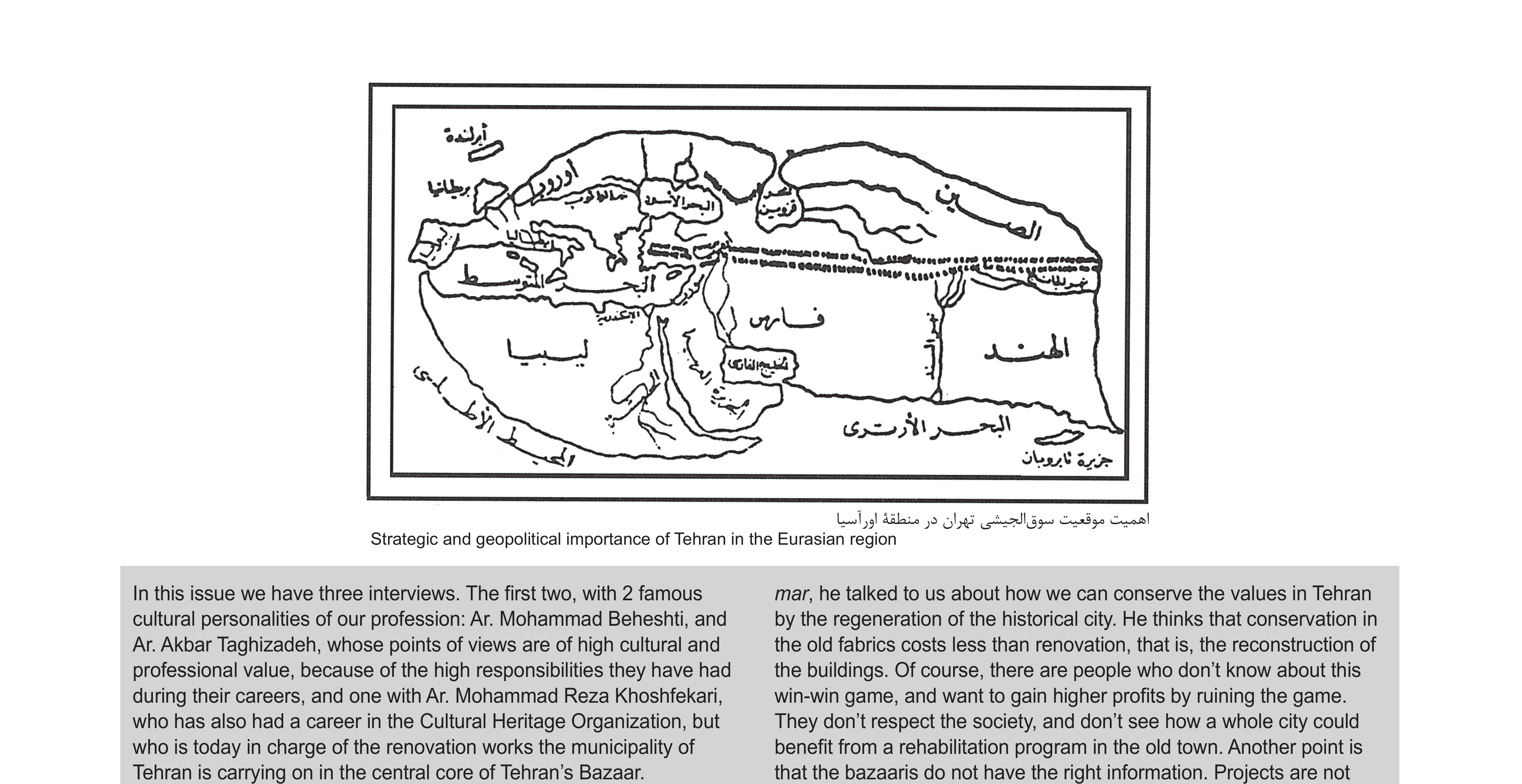
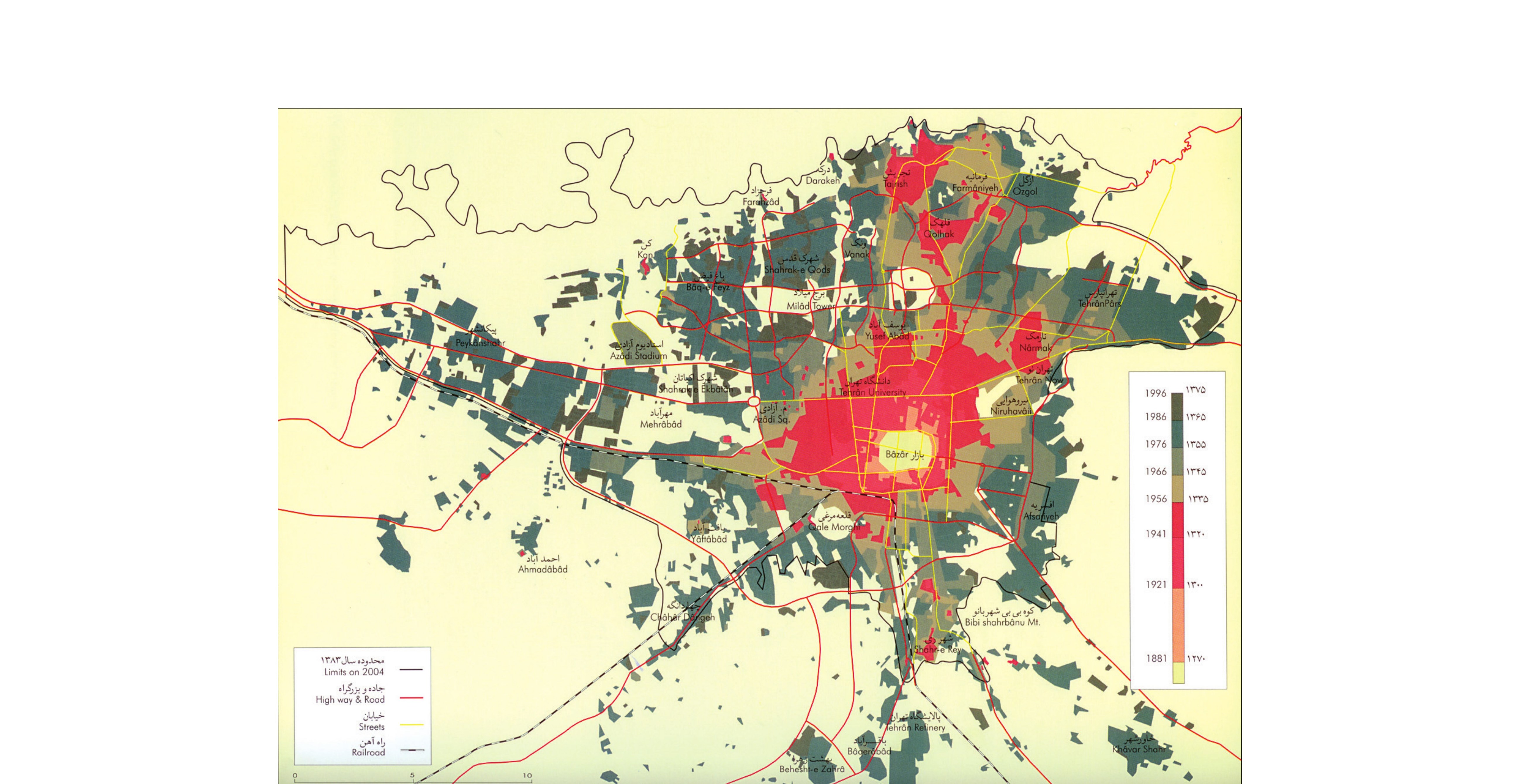
Mohammad Beheshti, late Head of the Cultural Heritage Organization, who has also had great contributions to the growth and international fame of Iranian cinema, and to the creation of many of our cultural spaces in Iranian cities, has a deep philosophical vision of our society and its values, and looks into Tehran’s history and geographical conditions with a strategic long-term perspective. He says why he thinks Tehran is situated in the best geographical point, and counts all the advantages of such a settlement. He talks about the natural values of an area which has interacted with human settlements for 8000 years, and whose nature should have been respected during its late developments during the 20th century.
He also looks into the harm the process of modern urbanization has done to the city; the generic urban planning, not taking into account the topography and the river-valleys; and the mismanagement which has guided the city into a Civilization Crisis, during the last decades when immigration into Tehran has had a great impact on the extension of the city into a metropolis with low, mediocre qualities of life. “It has also been our fault — us the experts, and us the urban management — who have made mistakes, while thinking that we have all science and knowledge in our service! We still believe to be able to decide for everything, while the complex nature of the city has and will have its response!”
But Beheshti is an optimist. He believes that the Civil Crisis will soon be replaced by a ‘Civil Spring’, where our next generations will demand better qualities in the physical and cultural life of the city. He says that during the last decades people have been moving around the city in search of opportunities, each family changing house at least 5 times, while for a civil life at local level you need a sustainable urban development with people who live in the same houses for generations. He notices the change that has taken place in our cinema: 40 years ago, a film like ‘Gheisar’ had its location in an old neighborhood; then, places in films were anonymous — any street or backstreet could do; but today we again have films where cultural identity of places and people is an issue.
“How many Qanats of Tehran’s 1300 qanats have been neglected and left to themselves? What has become of the underground of this vast metropolis? How many black holes might open to devour the wild city we have built?” says Beheshti, and adds: “If we think sustainable, build sustainable buildings, and gain a better knowledge of our city’s nature and people, the costs will decrease and we will have a happier city!”
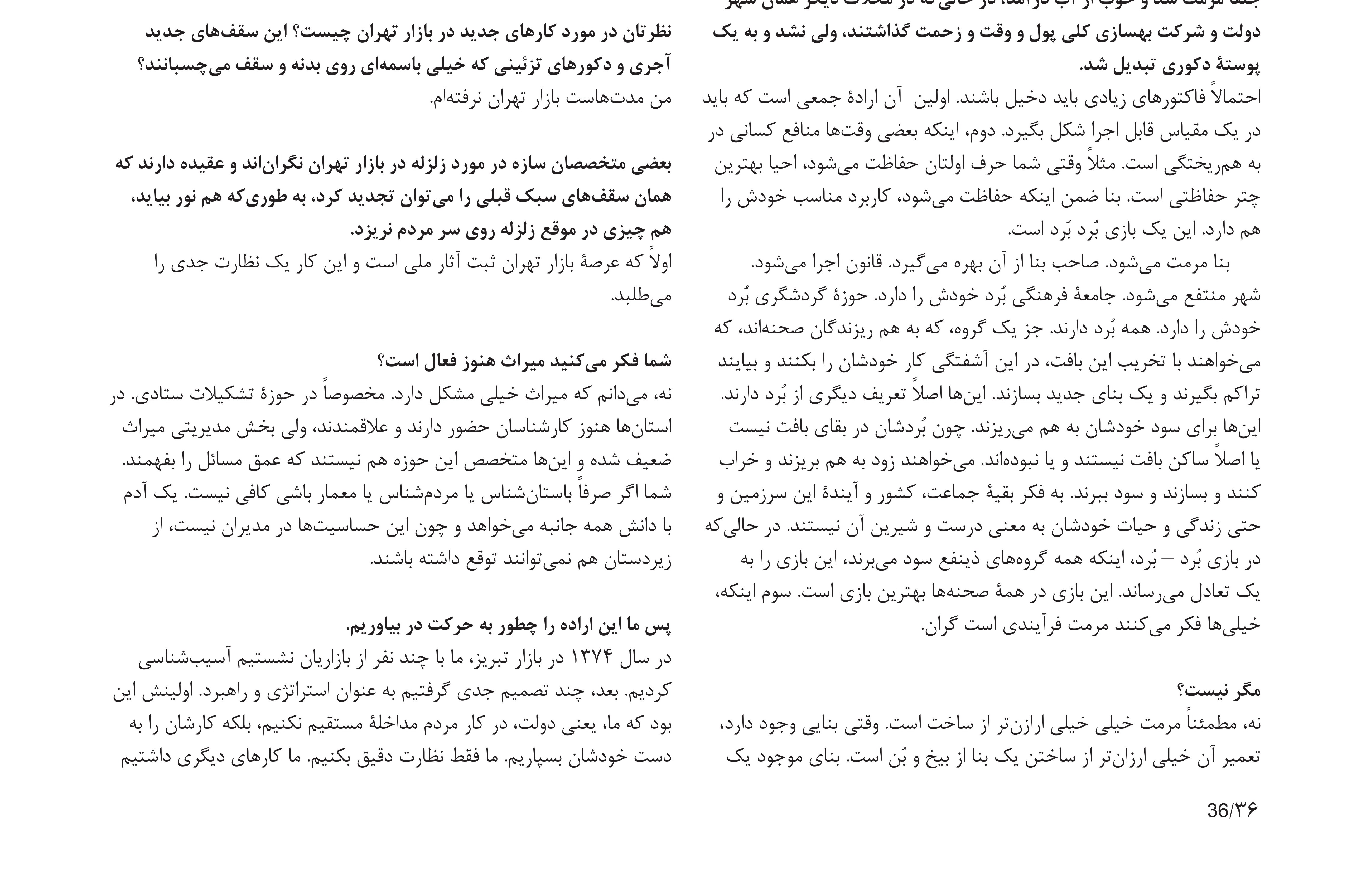
Interview with Akbar Taghizadeh-Asl
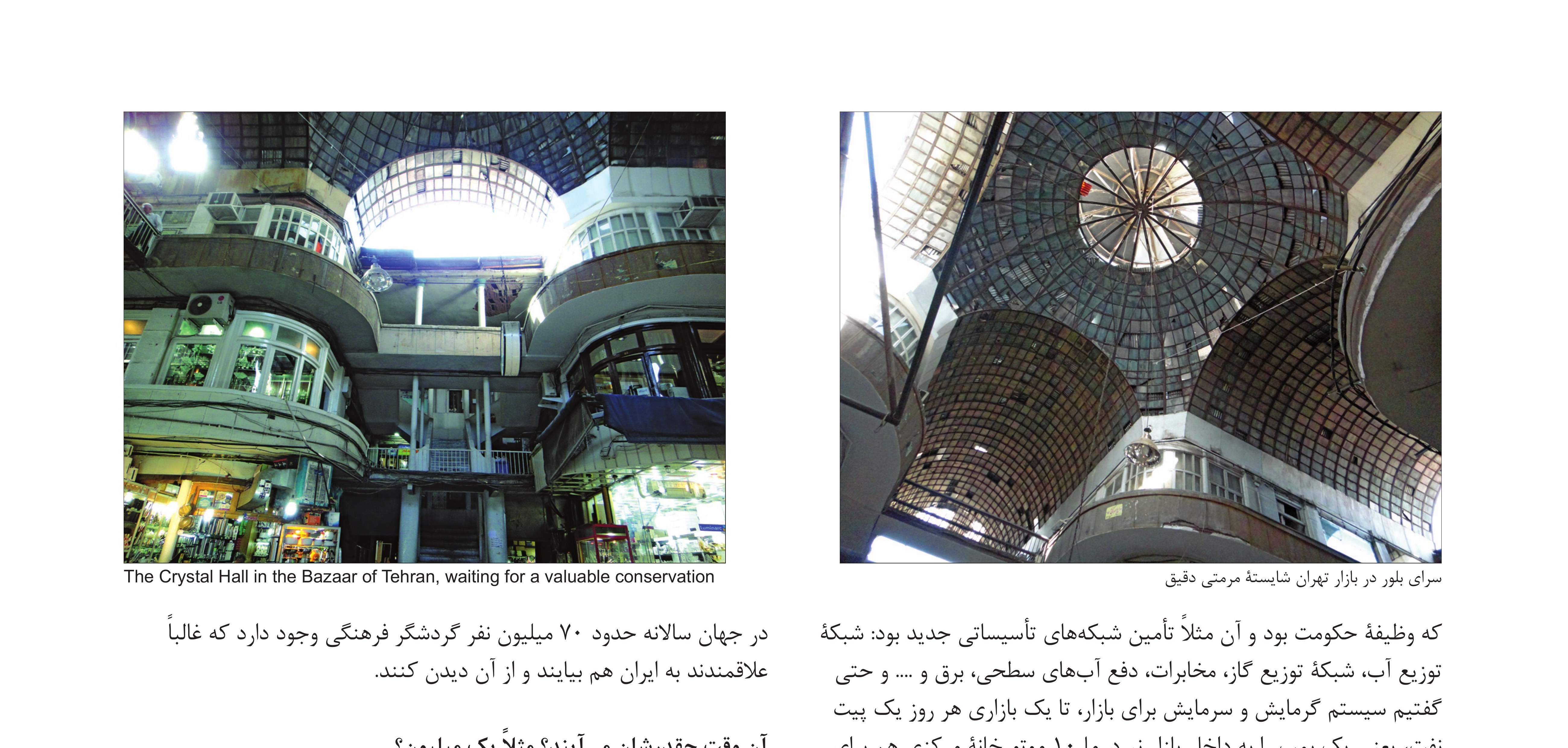
Ar. Akbar Taghizadeh is the most important personage in our Heritage scene, because of all the projects he has realized. At the beginning of his career, he was the organizer and technical manager of the Regeneration Project of the Bazaar of Tabriz, that has probably the biggest renovated surface in the world. Not long after that he acted as the head of the Pardisan Project, that meant to conserve around 70 historical monuments for touristic purposes. In the interview with Memar, he talked to us about how we can conserve the values in Tehran by the regeneration of the historical city. He thinks that conservation in the old fabrics costs less than renovation, that is, the reconstruction of the buildings.
Of course, there are people who don’t know about this win-win game, and want to gain higher profits by ruining the game. They don’t respect the society, and don’t see how a whole city could benefit from a rehabilitation program in the old town. Another point is that the bazaaris do not have the right information. Projects are not facilitated and nobody is really aware of the fact that with regeneration, not only the prices rise, but also the security of the urban environment in general increases in the city center. And this means quality, identity, comfort, and beauty in the center of our cities.
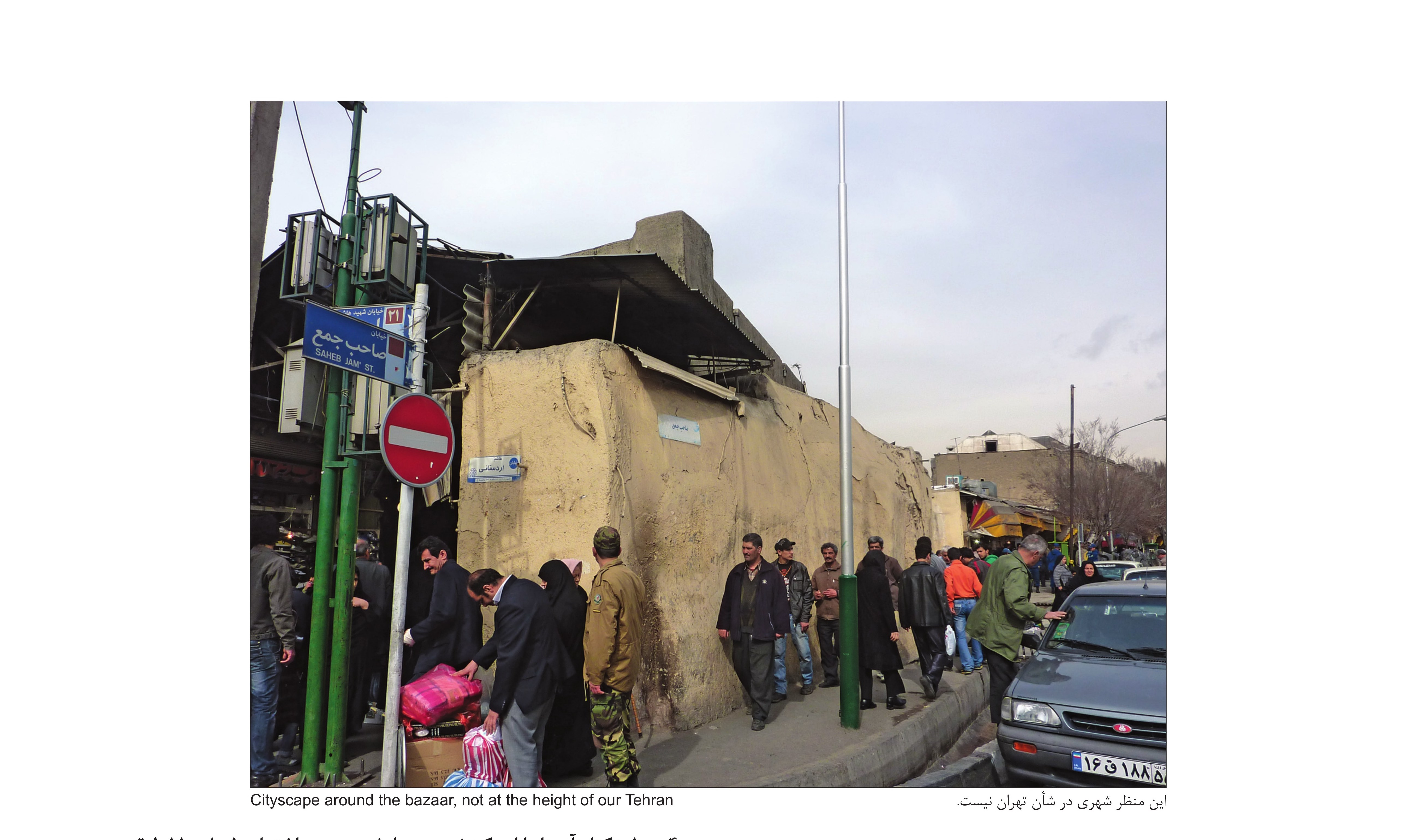
Unfortunately, according to Taghizadeh, the Heritage Organization has lost its power and importance, and the experts are scattered. There is no imposing will that could move the regeneration machine, he says. Nevertheless, Taghizadeh believes in Iran and its future. He, who is now collaborating with the restoration of the Masoudieh Palace in Tehran, believes that in the future, Tourism will bring life into all this. So many tourists will be willing to come to Iran, although the first step should be the internal tourism. He thinks that what the Justice Administration is doing to the heritage is a big harm — letting the private houses out from the Heritage List of conservation — and that only in future we will see people queuing to register their old houses like in Europe, where heritage means income and prestige.
Taghizadeh proposes that low-profit loans be given to the people who want to restore their old houses, and that they be exempted from taxes, etc. He is sure that with good management and design, innovation can take place in the core of the old city, to make it more historically attractive and modern at the same time.
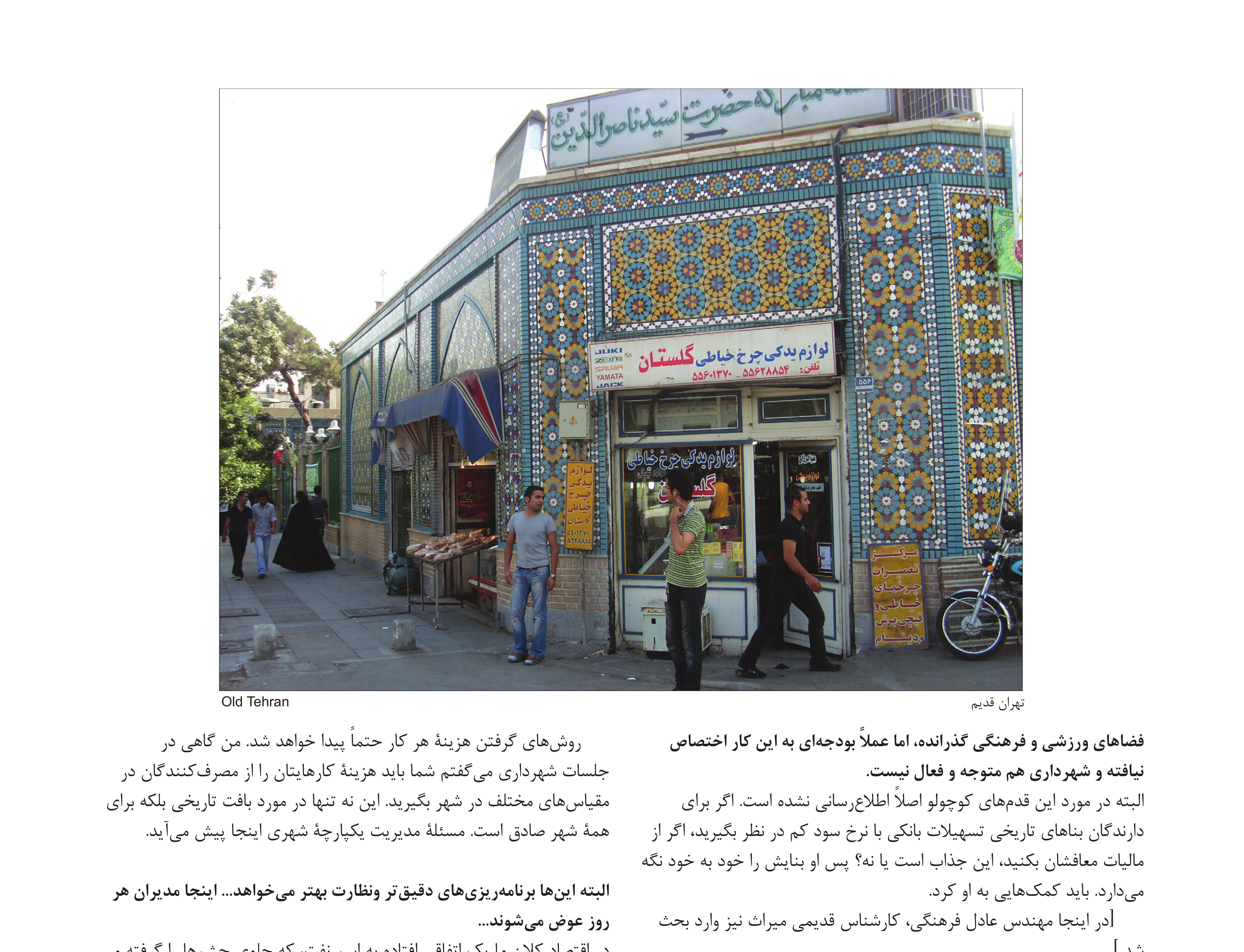
Interview with Mohammadreza Khoshfekri
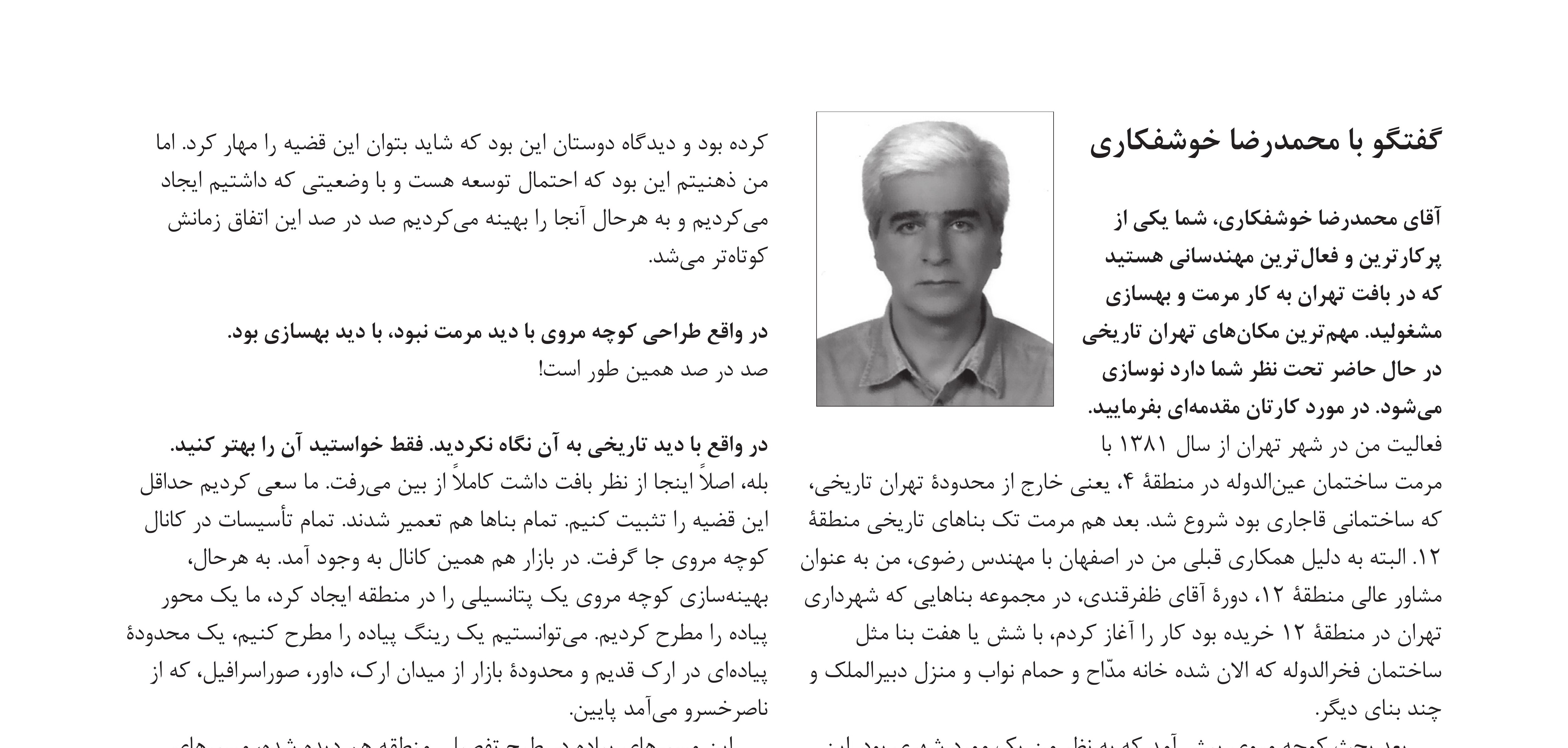
In the third interview, with Ar. Mohammadreza Khoshfekari, today’s practical and methodic problems of the interventions and projects in old Tehran are discussed. He who has worked as an expert for the Heritage Org. in the past, is now implementing his own projects for the most important public spaces around the Bazaar of Tehran, and in other areas, in historic houses. He came to Tehran less than 10 years ago, but having worked with some of the mayors in Isfahan in the past, soon became the counselor of Tehran municipality in the historical district of Tehran.
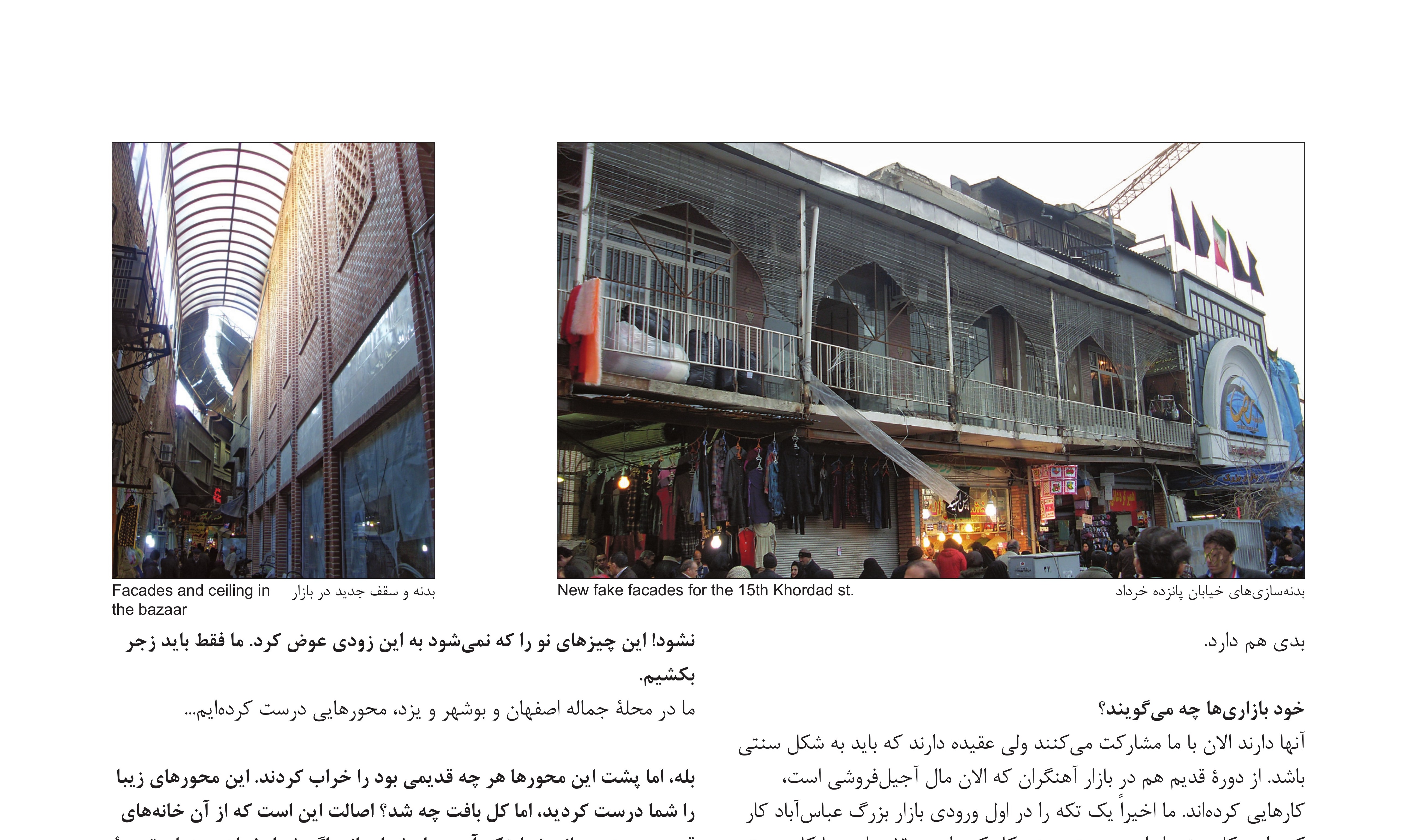
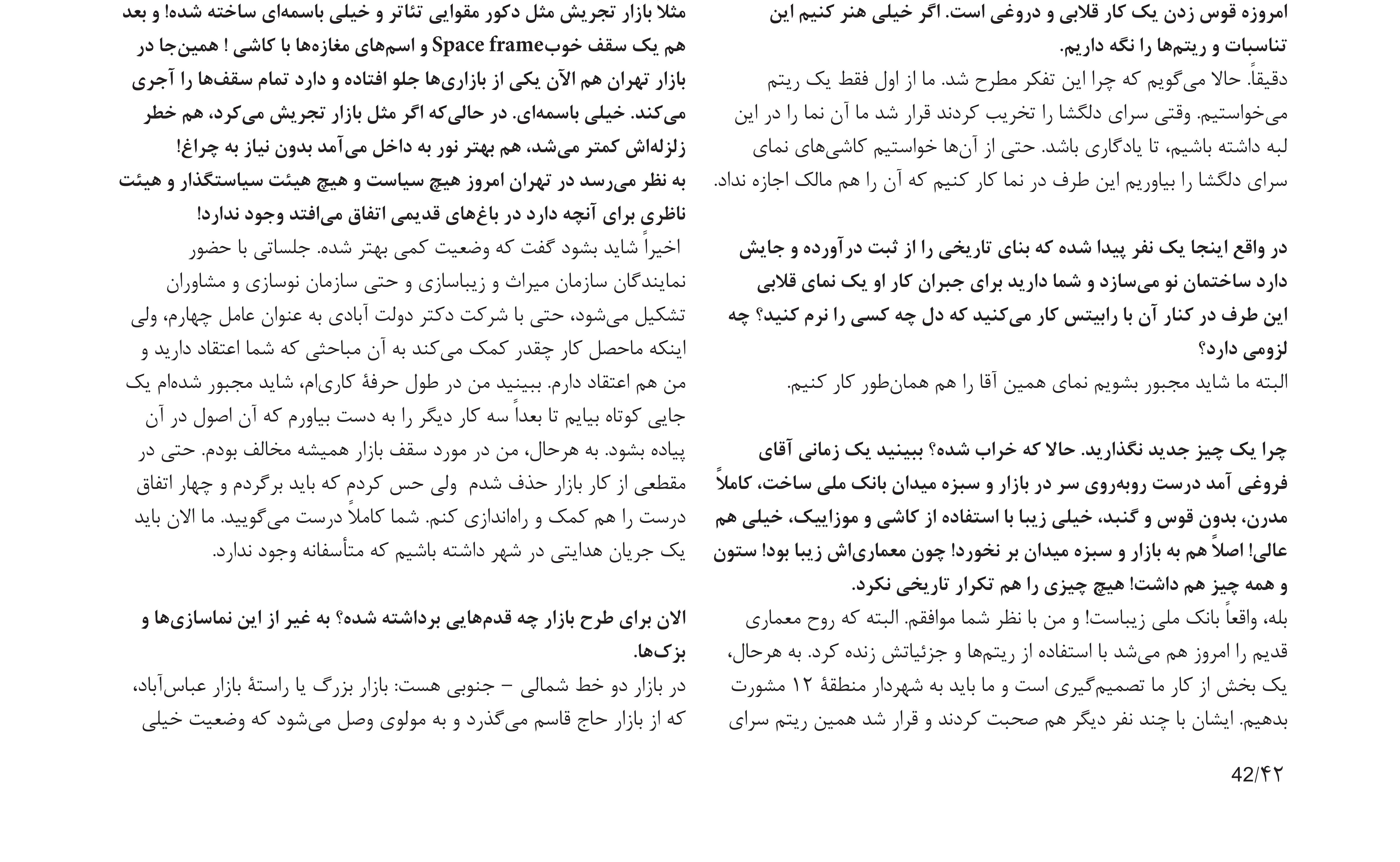
He participated in the Marvi Street Project, where a pedestrian near the Bazaar was renovated with porticos. “It did not have porticos before”, says Ar. Khoshfekari, “but we were guided by today’s tendencies and added porticos. We have to respond to what the market wants. It is at the moment not very easy to conserve in a proper way, but I hope to be able to do better jobs in future.”
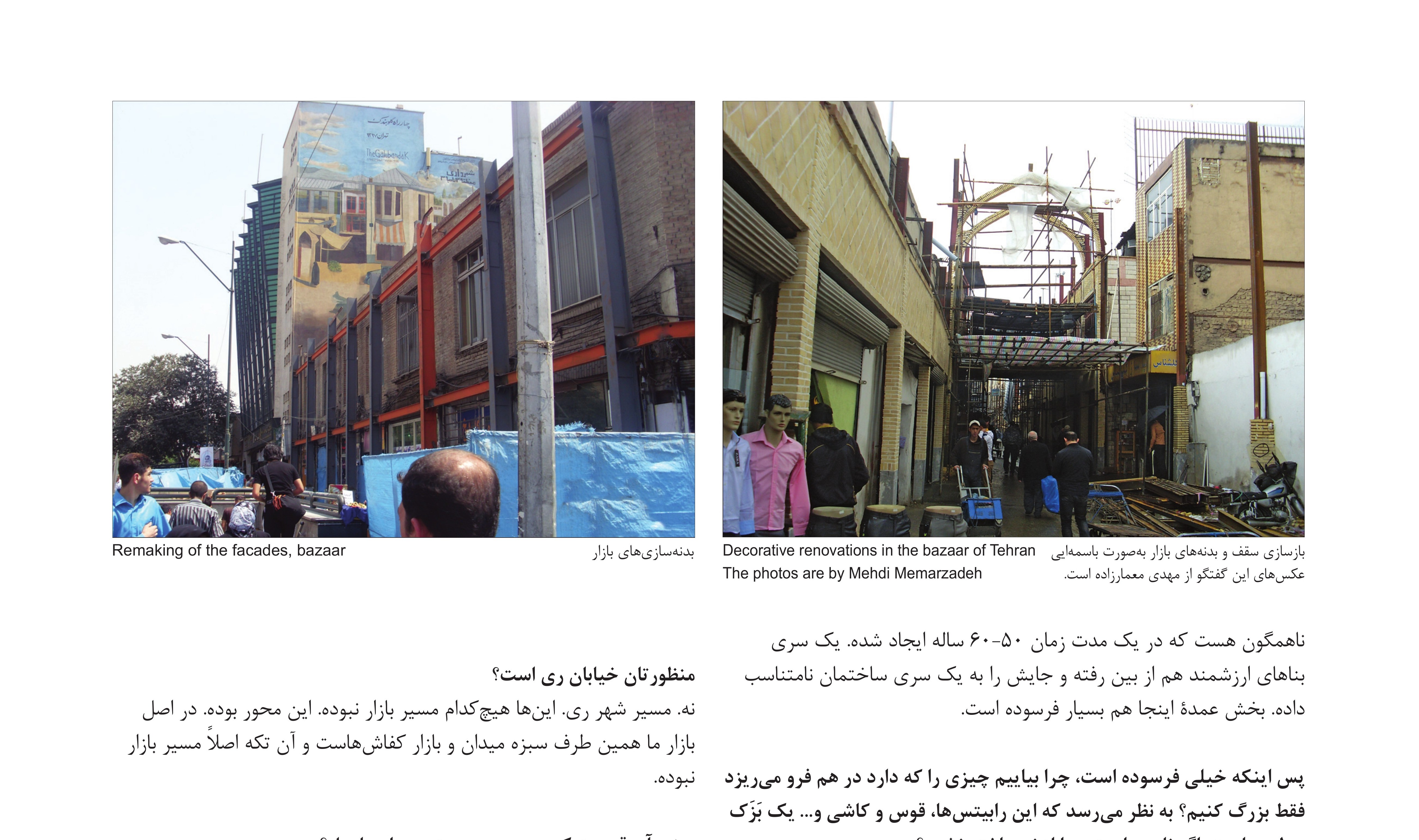
Although he has a vague idea of how historical surveys can help the practical work in historic areas, he prefers — or has no other choice than — to follow the present tendencies in the municipality of Tehran, who has the money and who doesn’t want, to everyone’s surprise, including Khoshfekari, to hire excellent architects to design for old Tehran. These tendencies consist of decorating and embellishing the facades in a so-called Islamic manner, and a sort of traditionalization of the buildings, ignoring that Tehran and its Bazaar have had in the past authentic and precious modern and Art Deco buildings that can be conserved today in the exact way they are. Mr Khoshfekari agrees with all this, but has to follow the instructions of the municipality as a temporary solution.