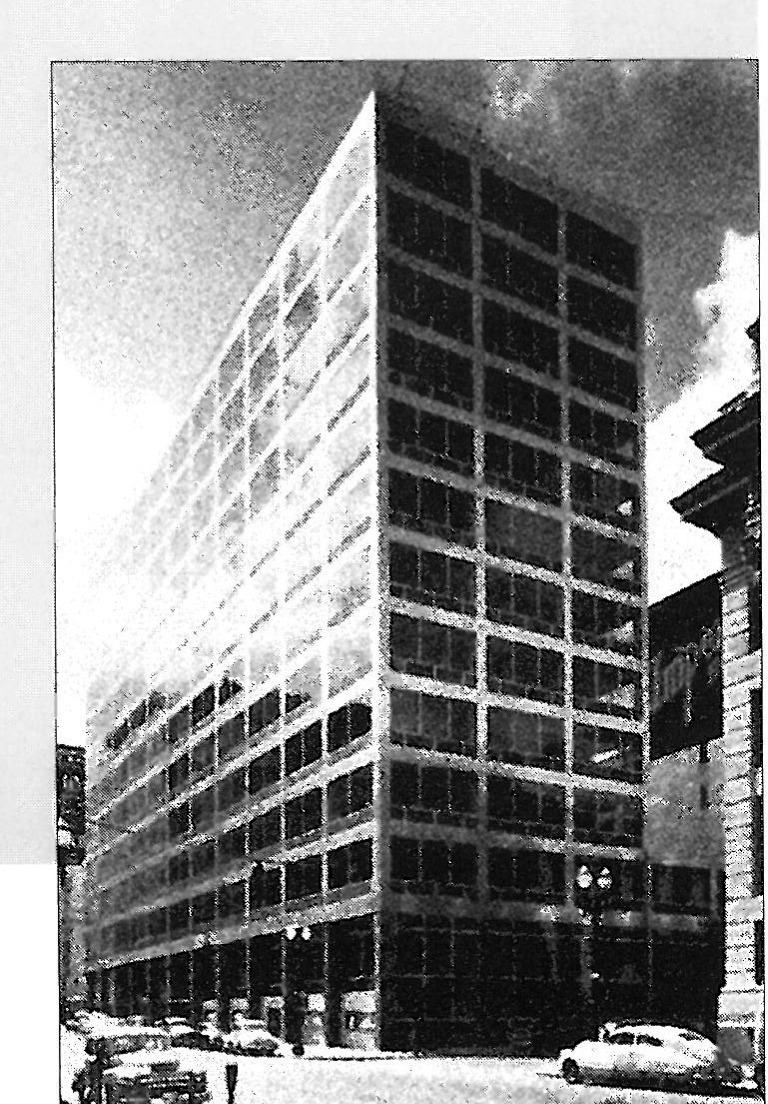
Colin Rowe's account of early twentieth-century modern architecture's voyage across the Atlantic startled a whole generation of would-be avant-garde enthusiasts. In his introduction to Five Architects (1972), Rowe described how form and ideology were separated on the passage from Europe to America: ideology stayed behind in Europe, or sank somewhere in the cold Atlantic deep, while form made it to American shores to become the preferred style of corporate America. This same architecture — the "International Style" — was then repackaged as the "real modern" and sold back to the rest of the world, Europe included; and it was this same architecture that inspired a generation of progressive architects and critics to re-unite form and ideology and return political credibility to modern architecture.
Rowe's view also fits the way "theory" came ashore in America in the 1970s. Theory, like modern architecture, made the crossing to America to take up a shallower and less durable presence than the original. It entered American academic culture through comparative-literature departments, in the form of collected philosophical essays mostly in French, German and Italian; and everyone immediately took it up as the prevailing mode of critical analysis. Theory could be tucked under the arm and carried off anywhere; it could be applied to any field of study — film, literature, anthropology, art history, even architecture — and, because translated into American English, it was freed from national identity or professional attachment. It had German prefaces and French-style obscurity; most importantly, to become a master of it one (apparently) needed no years of study, no political allegiance, no great learning. Theory was a weapon in the hands of the post-1968 generation, tired of the ethical rules and stagnation of their elders. Theory rapidly took the place of philosophy. But, as Mark Wigley has famously and repeatedly said, it arrived late in architecture; and when it did, theory and the formalist modern architecture Rowe had described were, of necessity, reintroduced to one another.
The Brief Reunion of Word and Form
With Rowe's account in hand, we can see more clearly the ambition of contemporary avant-gardes to re-entrust architecture with a social mission — uniting word and form again and doing so with a thoroughly modern formal vocabulary. Nowhere is this more apparent than in the journals of the 1980s and 1990s such as Assemblage and ANY. The combination of theory with experimental form, in these journals and their kindred conferences and publications, was an attempt to produce a kind of critical, militant, progressive, left-leaning architecture. The use of theory to vouch for the avant-garde began in earnest with Oppositions (Peter Eisenman's journal of the Institute for Architecture and Urban Studies, 1973-1984) and was continued by its successors, ANY and Assemblage, and by other journals. Perhaps the last attempt to marry form and ideology was Architectural Design, issue 3, titled "Folding in Architecture." Edited by Eisenman's one-time protégé Greg Lynn as guest editor, this number used Gilles Deleuze's essay "The Fold: Leibniz and the Baroque" as the pretext for launching a form-driven fold style that enjoyed a short but intense vogue.
But by the mid-to-late 1990s the avant-garde's enthusiasm for uniting form and ideology cooled off: form gradually melted into fields and vast data files, and ideology deflated, turning into "branding" for identity and "lifestyle" topics. As popular science, the new computer-animation software, and branding became the more decisive topics of architecture, the theory-based "critical" stance quietly withdrew its hand from the small of the avant-garde's back. Ben van Berkel and Caroline Bos announced the situation in their network-architecture handbook, aptly titled MOVE (1999): architects, they said, will soon be the designers of the future of fashion; and, they added, architects must align themselves with management consultants, engineers, marketing specialists and other "invisible forces."
It seemed that the truth of this interpretation would finally put a period to theory. The little of theory that remains still clings on against the commercial reality driven forward by the forces of globalisation. Theory — its back bent under the weight of its historical attachment to philosophy — lacked the agility and quickness needed to face the opacity of e-commerce and open networked systems. In the end, theory and the avant-garde architecture it supported have proved their inadequacy in the face of contemporary transformations, and we now stand at the close of that experimental historical period which Rowe's plain account had shadowed.
Another Story Begins
Another story has now begun, one that has less to do with ideology and form than with the emergence of the global dot-com phenomenon, the new economy and management culture. These have replaced the distinction between the avant-garde and the current of resistance. What has emerged in place of that distinction are two poles — one entrepreneurial and one corporate — both of which admit that they are commercial projects competing in the global market.
The rise of the new economy in America has fixed attention on a new generation of entrepreneurial managers, whose photographs and profiles fill the pages of lifestyle magazines like Fast Company, Red Herring and Business 2.0. Elsewhere, in Britain and continental Europe, attention is fixed on a new generation of management consultants working in think-tanks such as Demos in London or the Advanced Management Program in Stockholm. These two generations have made themselves visible in the fast-paced world of consulting services in global business; but in the world of advanced design, architecture and urbanism — and especially in the schools — they are emerging in far greater numbers. Two of the most aggressive examples are the AA's Design Research Laboratory and the new Metropolitan Research and Design program. Both recommend that architecture should no longer stand apart from the supposedly paltry world of business and management thought, but should turn itself, in an aggressive spirit, into a research-based enterprise. This clear-eyed assessment has become the primary drive of a generation of architects and urbanists who now continuously tailor their design strategies — "softening" and flexing them as required — to compete in the ever-changing global market.
One of the boldest responses to this challenge has been given by Alejandro Zaera-Polo, head of Foreign Office Architects, based in London. In one of his recent essays, Zaera-Polo drew up a list of contemporary design practices that were based more on the market model than on the bureaucratic model. Zaera-Polo wants to build, from the whole set of practices, a kind of map that young offices can use to invent the flexible practices they need to respond better to the reality of the globalised new market. What he calls a "mapping device" is a means of moving work forward; the aim of "the map," he says, is not to arrive at something cold and lifeless but, on the contrary, to arrive at something useful. As Zaera-Polo puts it, we no longer live in the simple world that Le Corbusier or Mies ruled over; we live in a world itself made of worlds, in each of which a particular set of preconceptions about truth prevails.
But when we say practices, what do we mean? They are the techniques, the relationships and the invisible value-generating factors that ultimately distinguish one firm from another. Practices give rise to schemes and buildings; rather than forcing us to prepare a scheme to the client's directive, they allow us — by a "tact" born of those practices — to take control of the conditions under which the scheme and the building are produced. At the same time we can research new opportunities to be exploited. In other words, practices lead to a higher order of creativity, because they replace problem-solving with opportunity-seizing and risk-taking. Practices are therefore more flexible than any style or identity; they can be bent to changing circumstances without commitment to the absolute or regional formalist branding.
A specific form of this entrepreneurial-managerial approach can be seen in the emerging world of "rapid prototyping." Here the search for "new" patterns to solve particular problems gives way to the search for patterns that focus on linking the groups who work together. As Michael Schrage of MIT has clarified, the most creative practices today use rapid prototypes not to reach a particular scheme faster but to start designing. I think this is why offices like Greg Lynn FORM in Los Angeles use design animations, MVRDV in the Netherlands uses "datascapes," and Crimson and MAX keep raising the philosophy of the use of scenarios in urbanism. "Soft" or flexible, networked and knowledge-based — the three traits Kevin Kelly, the sage of business science, uses to define the importance of the emerging new economy — must be at the centre of attention.
The managerial arrangement just described has dealt a great blow to theory. Yet it should not be dismissed simply as another passing wave. It may be some time before we arrive at a theoretical understanding of it. We need to reconsider once again the link between thinking and working in architecture — the central theme of Gilles Deleuze, perhaps the last great figure of "theory." Deleuze wished to free our attention from a thinking that had pinned us to the rope of fundamental truths and to bind it to a thinking that impels us to action. But Deleuze remained too much a philosopher to admit the theory's helplessness compared with the mental agility of the business consultants he castigated in the preface he co-wrote with Félix Guattari to What is Philosophy? (1991 in French; 1994 in English).
After the End of Theory
Just as theory stood against philosophy's stagnation and moral principles, today managerial thinking stands against theory and its historical attachment to philosophy and its utopian morsels. Deleuze's longing to develop a practical way of thinking endowed with the freedom and speed required to act in the world — despite the utmost efforts of his American supporters and translators of his "French theory," and despite his own prejudices against managerial thought — will never come to fruition; only entrepreneurs of thought and managers of change, facing the merciless competition of a world unleashed by the forces of globalisation, will come to grasp the necessity of that freedom-of-movement which was so important to Deleuze — and indeed to every theorist. An important effort must, after the end of theory, ANY, Assemblage and the rest, be made in the domain of architectural thinking. But if that effort is to arrive at true innovation, it must shake off the delusions of space, genius and the utopian search for the new.
Michael Speaks holds a doctorate in literature from Duke University, where he worked with Fredric Jameson at the Center for Critical Theory. He is director of the undergraduate program and of the new graduate Metropolitan Research and Design program at the Southern California Institute of Architecture in Los Angeles.



