After several years, I took a trip to America — only New York and Boston, with a great deal of nostalgia in my mind. By my good fortune, it was the most architectural summer New York had ever seen. All the great museums of the city were showing architecture: the Museum of Modern Art (MoMA) under the title "Mies in Berlin" was showing Mies van der Rohe's German work; the Whitney Museum, Mies's work in America; and the Guggenheim, Frank Gehry's. I begin my report with the Mies work, because the path he opened in Berlin ninety years ago has now reached its close — whereas Gehry's work is the beginning of a new era and carries a long argument ahead of it: the substance of American architecture right now is Gehry's work.
Mies in BerlinMoMA had put on show Mies's work in Germany, and the architecture students of the University of Pratt were bringing out his earliest buildings, models and drawings. On top of that, a computer firm had prepared a three-dimensional programme for each building that would take you on a walk inside it — from Mies's very first project, the Riehl House of 1907 (when he was only twenty-one), through the Barcelona Pavilion for the international exhibition of 1929, and on to the rest of his work up to 1938, when at fifty-two he emigrated to America.
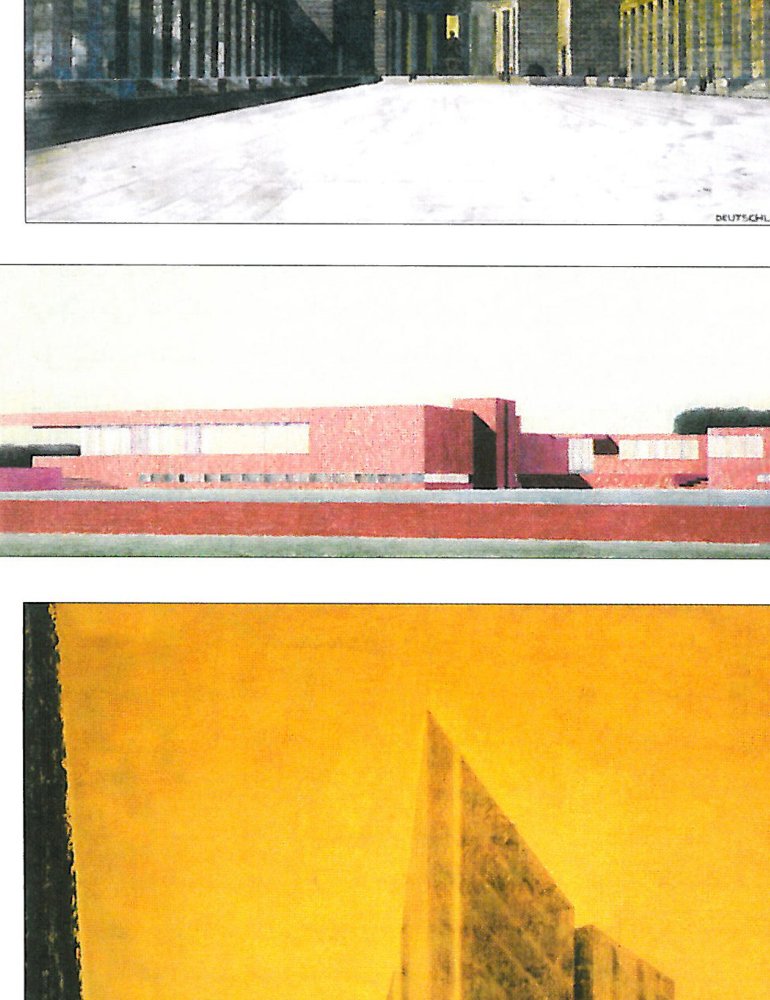
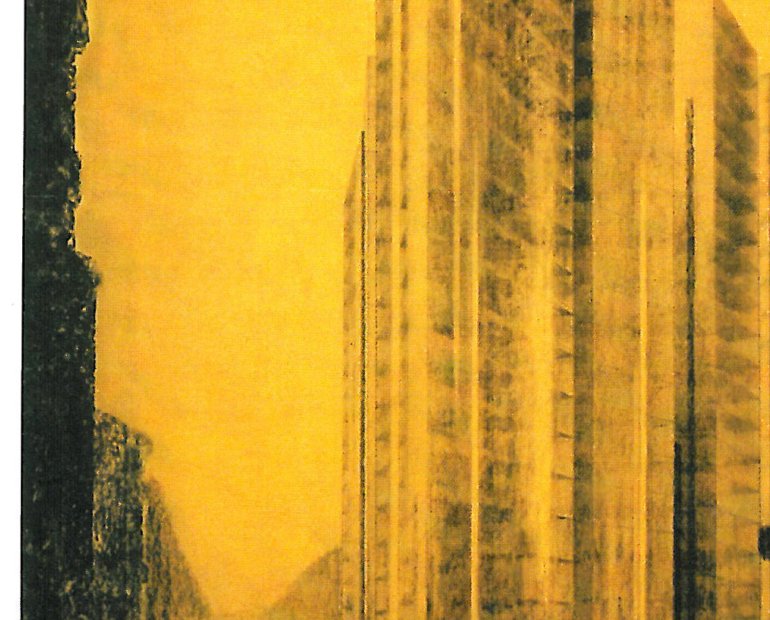
The charm of the exhibition lay in how clearly it showed that Mies's thinking had crystallised before he set foot in America — that the seeds of all his ideas had already been planted in those early projects. We must not forget that Mies never attended university; he was the son of a first-rate stonemason and learned architecture in the offices of Behrens and Berlage. Apart from a few early projects whose plans are classical and in Schinkel's manner — such as the Bismarck Monument (Fig. 1) — the rest of his work is genuinely modern and shows that from the very beginning he was freeing the architectural plan from the constraints of the wall and the façade from the classical devices of façade-making. I greatly enjoyed the elevations of a country-house project that he had painted himself in several colour variations — pink (Fig. 2) and green — and could picture young Mies in Berlin, painting these large elevation boards in gouache day and night, or drawing a perspective of a crystal-tower project (Fig. 3). He was the first to make visible the structure of a building — rather than concealing it, as was then the custom — his essential stance, and he founded the tradition of structural honesty. American technology gave him the means to put all his ideas into practice.
The Whitney exhibition above all expresses Mies's use of that technology. For the first time I understood that in his glass-and-steel towers he employed many applied steel columns on the façades — only to create geometric order, and ultimately only for beauty. We were told ad nauseam in architecture school that Mies meant structural honesty: everything showing, everything strictly what structure required... this too is one of the lies they teach us. And yet the elegance and the precision of Mies's detailing is genuinely beautiful — perhaps inherited from his father — and it is this detailing, in the end, that sets Mies's glass boxes apart from the boxes of the European and Asian also-rans of his generation who copied from him.
Mies's minimalism — which produced the slogan "Less is More" — is still fashionable in some of today's arts (in cinema, say, or in interior decoration). But American architecture has said goodbye to it. Venturi answered Mies years ago: "Less is a bore." The Guggenheim show of Frank Gehry's work was the witness to that: MoMA was fairly busy, the Whitney not especially crowded — but the Guggenheim was packed.
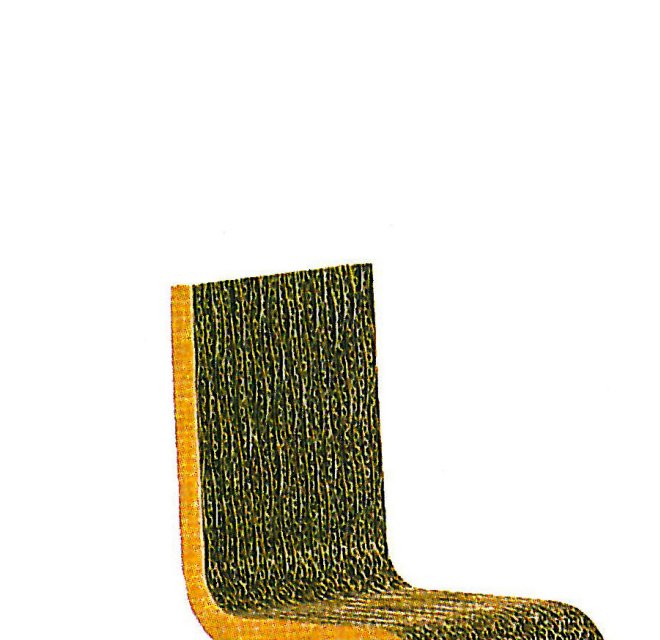
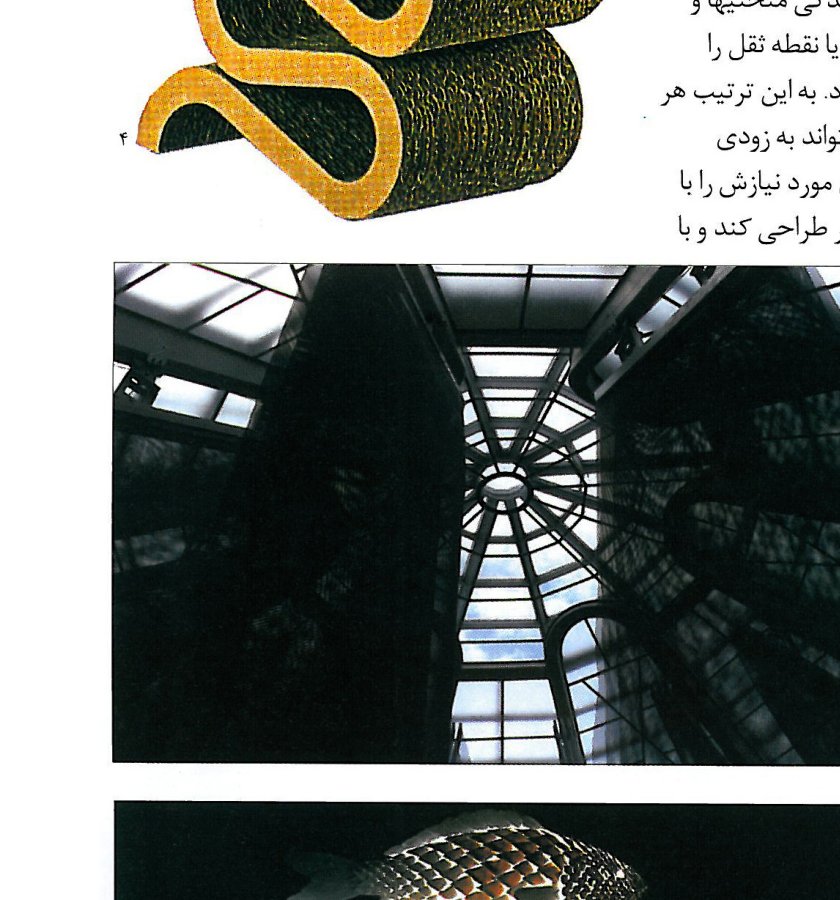
Gehry at the GuggenheimThe Guggenheim has given the whole three months of summer over to Frank Gehry. In the museum's central atrium, curved metal armours of different profiles hung from the ceiling (Fig. 4) — a symbolic image of what Gehry wants to do to space. The show starts at the bottom of the ramp with his earliest works and, at the top of the ramp, arrives at his most recent: the new Guggenheim Museum project in New York, soon to be built at the southern tip of Manhattan, and not unlike the Bilbao museum in form. In the galleries along the way you see Gehry's lamps — all in fish or snake shapes (Fig. 5) — and his chairs and sofas, most of them made of cardboard (Fig. 6). Truth be told, those sofas are not really made for sitting.
The higher up the ramp one goes, the more complicated Gehry's work becomes. This spiralling progress is thoroughly in keeping with the nature of his work and, almost effortlessly, clarifies his method.
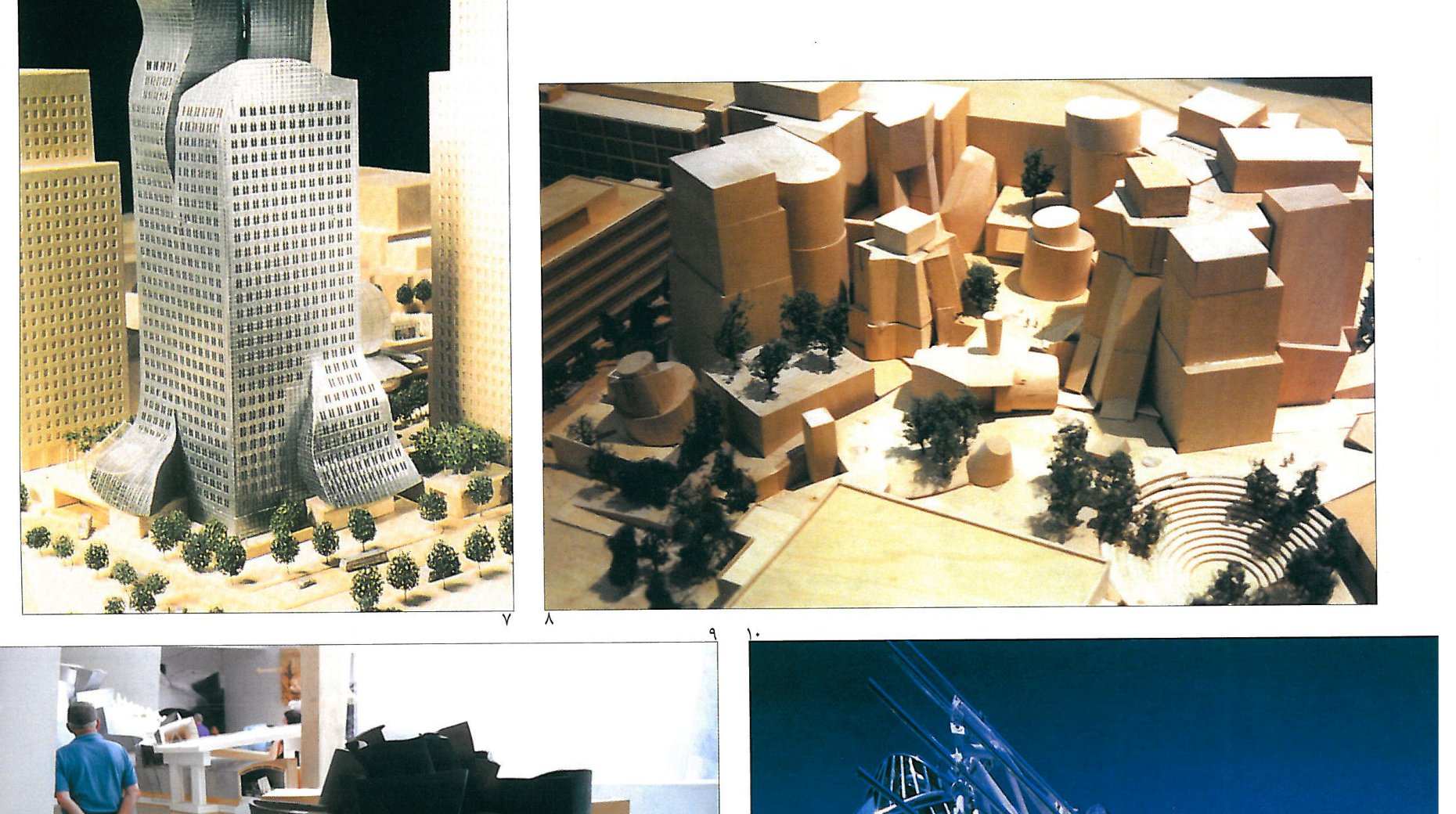
Though Gehry himself has said "I am not a deconstructivist, I hate having my work packaged in a category," one has no choice but to use the word deconstructivist in describing his work. Deconstruction in Gehry's work has three distinct stages: (1) the early California houses are mildly deconstructivist; (2) projects and buildings in the act of "melting, collapsing and crumbling," as though after an earthquake; (3) in the last stage we meet outright chaotic buildings (Fig. 8).
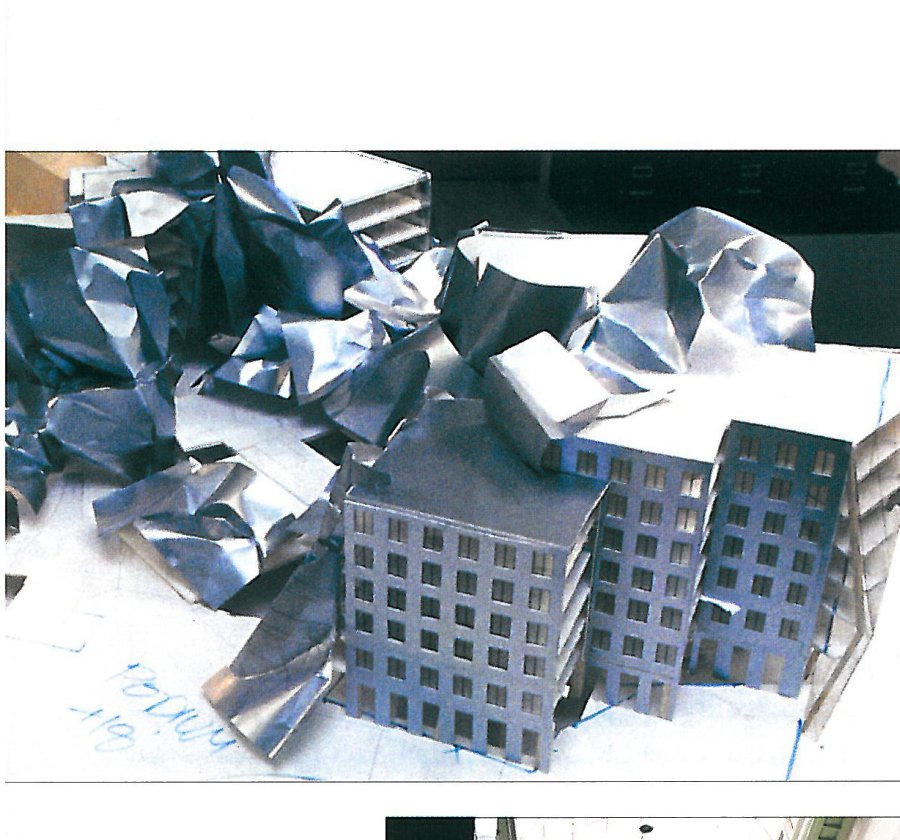
Then we reach the current phase of his work, in which chaos has produced a new organic order, only one degree away from disarray. Gehry has arrived at the organic spaces of his new work through model-making and the play of wooden and cardboard volumes, and has called in the computer to draw them and make them buildable (this method differs completely from Eisenman's, who designs his spaces through computer programmes). Gehry's new projects all use the order of petals: they have a centre of gravity, and everything spreads out into space from there — or, better to say, explodes out from there.
The Bilbao Museum comes with a thousand sheets of executive drawings, set out beside its model. Gehry's collaborators, with the help of computer programmes from aircraft manufacturing, were able to make the project buildable. Leafing through the drawings I asked myself whether this building could be copied and repeated. Yes, easily — it would be enough to load Gehry's office programmes onto one's personal computer and change the measurements or the centre of gravity. In this way, soon, any individual can design the spaces they need by computer and commission any engineering firm they like to build them using the same programme. No doubt this may lead to an explosion of shallow, shallow-rooted organic spaces — this time under the pretext that "it is designed in Gehry's manner!" — just as Venturi's post-modernism ended up producing in America a false mass-produced replica.
New York's many neighbourhoods each have their own air. A few years back I had read how many of its old buildings — and new ones — were going up, vertical, one after another. What I hadn't seen before was how the shrinking of buildings against their owners shapes the city in another way: in this city, whose language of art opens onto the Hudson, eyes keep wandering and wandering until several new buildings establish a fresh breathing-space.
The aesthetic sense of the New Yorker has also spread itself through New York, because the city has no need to look for an identity. Size, and money, and distinction are not something that need to be announced — they appear on their own. At the point of being discovered, they move about widely and continuously, and it is through that movement that other cities of the world are influenced. Oscar Wilde's principle — "nothing should be smaller than a big dream" — takes on its full scale here.



