Why Does Architecture No Longer Build Civilization?
Everywhere in the world, architecture has lost the civilizing role and stature it once possessed. The dominion of mercantile ethics — which has managed to harness new technologies in its service and, by sanctifying them, silence every humanistic voice of criticism — has substituted the growth of national income (climbing the ladder of inequality) and the spectacle of a consumption race for civilization itself. The essence of civilization, which from the smallest and simplest tools to the most expansive and complex physical structures, and from the most primitive societies to the most advanced, has fulfilled a central socio-physical role, is "building" — whose highest realization has been achieved in the profession of architecture-urbanism. The leadership of this socio-physical civilizing mission has always been shared by rulers and architects: rulers who regarded the execution of this mission as their duty, and architects who undertook its design at the commission and patronage of rulers. Perhaps the last example of this shared leadership between ruler and architect was the grand projects of Mitterrand's presidency in France, from 1981 to 1995. Mitterrand's goal was the construction of modern monuments befitting France's artistic, political, and economic role in the final two decades of the twentieth century — projects for which 15.7 billion francs were spent so that the city of Paris might acquire a new socio-spatial identity, while also serving as an emblem of the Socialist Party's commitment to the elevation of architecture. Projects whose ambitious scope invited comparison with the undertakings of Louis XIV's era: eight magnificent buildings — the Louvre Pyramid, the Musee d'Orsay, Parc de la Villette, the Arab World Institute, the Opera Bastille, the Grande Arche de la Defense, the Ministry of Finance building, and the Bibliotheque Nationale de France — which over the final two decades of the twentieth century transformed the skyline of Paris. Although the Orsay, la Defense, the Arab World Institute, and la Villette had been initiated during Giscard d'Estaing's presidency, they are attributed to Mitterrand due to the fundamental transformation they underwent during his tenure. In those same final two decades of the twentieth century, the leadership of Thatcher in England and Reagan in America set a different model before the architecture and urbanism of the world, as a result of which commerce, rather than culture, became architecture's patron. What prompted me to write this introduction was my chance encounter with a speech by Richard Farson addressed to the American Institute of Architects (AIA), published in the first quarter of 2011 in arcCA, the journal of the California chapter of the AIA, under the title "Can Architects Save Our Democracy?" It is available on the arccadigest.org website, and it struck me that in these days of disarray in the profession of architecture-urbanism, its study might benefit the readers of Memar magazine.
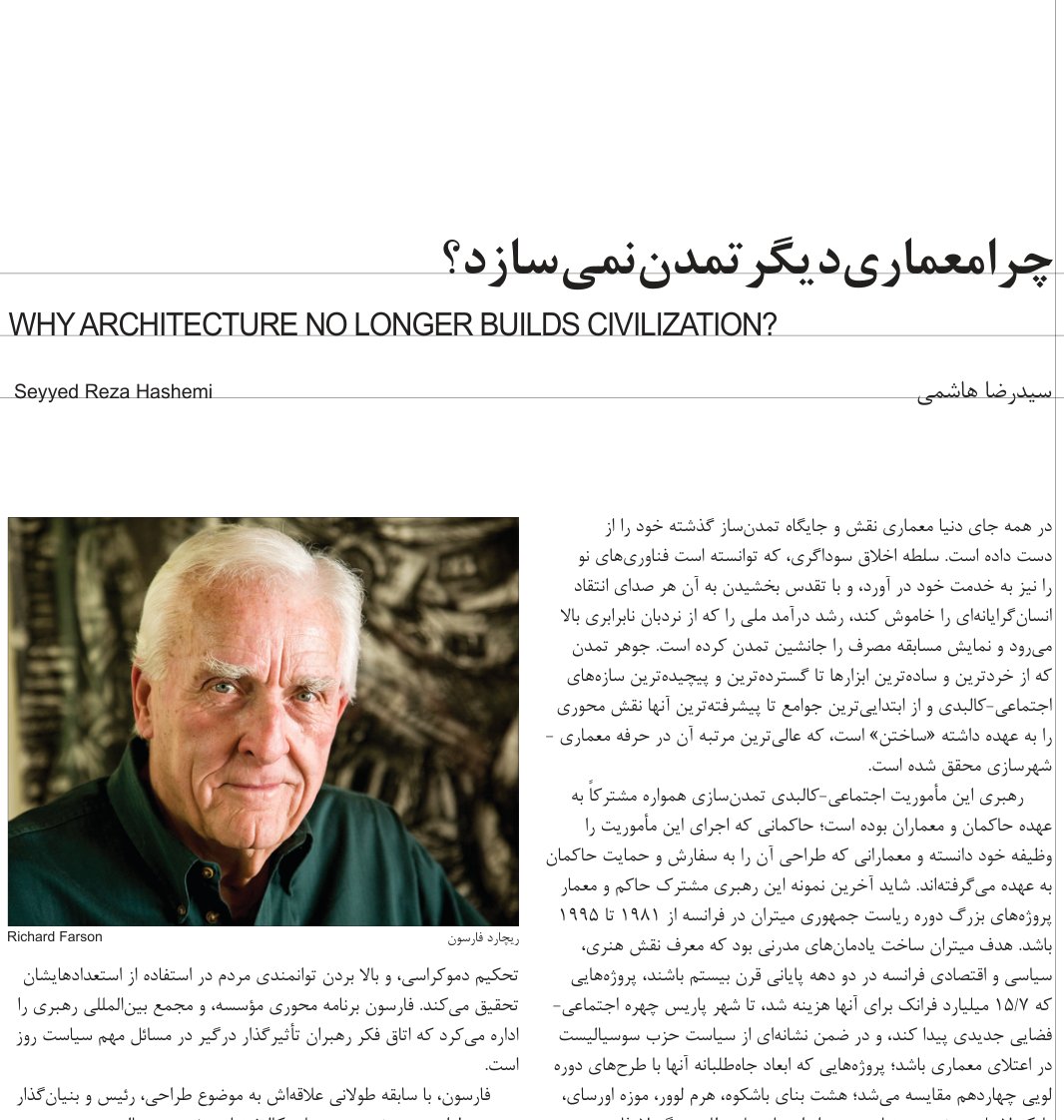
Richard Farson (1926–2017), an American psychologist, author, and educator, was the president and CEO of the Western Behavioral Sciences Institute, which he co-founded with a physician named Paul Lloyd and a social psychologist named Wyman Crow in 1958. The nonprofit Western Behavioral Sciences Institute conducts research on ways to enhance human relations,
strengthen democracy, and elevate people's capacity to make use of their talents. Farson directed the Institute's core program and the International Leadership Forum, a think tank of influential leaders engaged in important issues of current policy. Farson, with his longstanding interest in design, was the president and founder of the design school at the California Institute of the Arts, a thirty-year member of the board of the Aspen International Design Conference, and for seven of those years its chairman. He was also a board member of the AIA and a senior fellow of the Design Futures Council. The Design Futures Council is an interdisciplinary network of design, product, and construction leaders that explores trends, challenges, and global opportunities for advancing innovation and shaping the future of industry and the environment. Its members include architecture and design firms, building product manufacturers, service providers, and forward-thinking AEC companies of various sizes that have a serious interest in the future of their work. Farson's reference in his speech to the leadership role architects once played, and to the fact that two American presidents — George Washington and Thomas Jefferson — were architects, tempted me to gather further information on this subject. On the architizer.com website, there is an article titled "The Presidents Who Designed Today's America." Reading this piece along with images of these presidents' architectural works, after studying Richard Farson's speech, affirms the expectations that Farson has of architects.
Can Architects Save Our Democracy?
In films and stories, the character of architects is portrayed as doing what they do exceptionally well. They are creative, attractive, strong, thoughtful, responsible, even heroic in spirit... and successful both in leadership and in popularity. In the old days, when the field of practice was essentially reserved for men, it was said: "Architects turn women's heads." Now that women architects have entered the arena, their own image is likewise depicted as highly attractive, confident, self-reliant, innovative, successful, and popular. The reason is this: architects possess something mysterious, rooted in their magnificent history — a history in the course of which they have created some of the greatest moments of authority, stewardship, mystery, excitement, spirituality, purity, and beauty. Perhaps the reason is also the indescribable feeling that architects are members of the most powerful profession in the world. You probably do not believe this. Most architects will laugh at these words and dismiss them outright. And therein lies the very secret — believing something about someone who himself is certain it is untrue. Nevertheless, regarding architecture, it is true. Architects are the most powerful people. Even if they themselves do not know it — a power that is growing exponentially. Architects are creators of form, and form creates situation, and situation determines behavior, and situation, in the opinion of all behavioral scientists, is the most powerful determinant of behavior — more powerful than personality, history, character, habits, and even more powerful than heredity. Architects create beauty, human experiences, relationships, and communities — and these are what shape our lives as they are. Architects are doing these things even when they are not themselves aware of it. And that is the reason so many dreadful designs exist. Architecture is undergoing a transformation that will vastly increase its power. As the AIA has articulated its goals for the future of architecture, it will "change the role of architects in the world," "put architecture in the service of solving the pressing problems confronting society," "grapple with the most urgent issues of our time," "and place itself in the service of all people." I honor this goal and accept that what they describe is happening, and if our democratic society is to survive, it is inevitable. If the AIA does not lose sight of this goal, it fully deserves to become a force for transforming everything. But for the AIA to serve this mission to its fullest, what changes must be made in policies and practices? First, it must examine its own performance to determine which current practices facilitate achieving those goals and which do not. During
the dearest and most enjoyable days when I served as the general manager (a non-architect) of the AIA [California chapter] board of directors, I became aware of a number of programs and policies that, in my view, were obstacles to reaching these goals. I will not describe them here. But if one of the board's committees undertakes a thorough analysis of its own condition, it will identify those obstacles. Identifying them — when we know they were supposed to elevate the standing and power of architects but instead not only fail to do so but actually diminish them — is not so difficult. Second, a distinction must be drawn between architecture as a business and architecture as a profession. They can coexist, but they are not the same. Business pursues the fulfillment of its own "wants"; a profession pursues the fulfillment of society's "needs." If architects wish to serve the larger interests of society, they must be able to bring their professional judgment to bear. They cannot join the ranks of merchants, think only of market interests, or become obedient to their clients' orders. The AIA can vigorously support this professional stance even when architects are thinking about their business. Lawyers, physicians, university professors, and accountants all think about their business, but from the position of professionals. In fact, their business requires a professional approach more than anything else. Third, the AIA must work to facilitate collaboration — not competition — among other design disciplines, and among social scientists, technologists, systems analysts, paraprofessionals, volunteers, and many others. To confront the great concerns of society, architects need every kind of help. There will never be enough architects to perform these momentous tasks. The Association should use its bargaining power not to block the issuance of licenses for interior designers or — when I first served on the Association's board — for the elimination of the estate tax (which one must ask: what effect could it have had on the advancement of architecture?) — but rather to marshal the diverse resources necessary for the renewed restoration of our society's social and physical infrastructure. Protectionism, which is unlikely ever to be the right approach, is at the very least not the right approach for architecture. Fourth, architects must return to the leadership role they once held. Achieving these great humanistic goals requires the capacity for influence at the highest levels, which should not be regarded as beyond reach. Architects are the very people who served on the highest councils of decision-making, founded the Commonwealth Club, fought against slavery, and advised presidents. Their professional choices should place them in those same positions of influence. That is where they belong — where, with collective wisdom, they define their shared vision. When the public good is the aim, architects can see horizons that others are unable to perceive.
Fifth, architects must continuously redefine the identity and duty of the architect. As they move from designing brick and mortar to designing social systems — designs that strengthen democracy, liberate the oppressed from oppression, and elevate the quality of life — they will realize that the time has passed when each person merely continued doing what they had been taught. Sixth, and perhaps the hardest to accept, is that they must devote more of their time — and perhaps most of it — to working in the public sector, in the redesign of the social and physical infrastructure of our society, none of which currently functions at an acceptable level. Most of them do not work at all, and some actually make things worse. Education, transportation, health, prisons, communities, and media are all on the verge of bankruptcy. In nearly every index measuring the adequacy of national conditions — where our country once stood at the top — we are rarely among the top ten and usually find ourselves at or near the bottom. We cannot acquiesce to this perpetual decline. This is the hard-nosed agenda of the AIA. For several decades, the Association has worked hard to steer its members toward service in the private sector, business, and the market — perhaps because that is where the money is. But first, if we do the math, the big money is the money spent on public services; second, expecting a mercantile approach to meet social objectives is an almost impossible expectation. The mercantile approach, as we have learned over the course of this past century, is incapable of prioritizing responsible behavior toward society. Those who pursue business must follow the market, and the market, as Princeton economist Charles Lindblom holds, is ruthless and heartless. Building enormous cube-shaped warehouses that destroy social bonds has no relation whatsoever to the work that only architects can do. Of course, another economist, Milton Friedman, who believes "the only social responsibility of any business is to generate profit," would agree with such an approach. It is true that keeping our economy strong by following the market is a vital responsibility, for democracy has never existed without a market system, but the path architects must travel to restore our infrastructure is not this one. These humanistic goals should not be viewed as charity. Other professions — education, health, and criminal justice, professions that we believe are essential to life — enjoy enormous government support. They receive hundreds of billions of dollars annually from taxpayers. Their planning is based on trillions of dollars. The future of architecture has the right, the ability, and the obligation to be the same. The AIA can facilitate achieving this. Spending on architecture, unlike spending on war, counts as investment. We get all of it back and more. The 700 billion dollars of current government spending on the "economic stimulus package" is primarily
for infrastructure reconstruction. Imagine what the architectural profession could accomplish if it had the vision, organization, and expertise ready to seize this opportunity. The future of our democracy, and indeed the future of our nation, is gravely threatened. Both our social infrastructure and our physical infrastructure must be completely redesigned. Yes, completely redesigned. Our future is in the hands of architects. Will they fulfill this duty? They should know that they still possess that secret weapon — that beautiful, reassuring grandeur.
Undulating brick walls, University of Virginia, by Thomas Jefferson



