



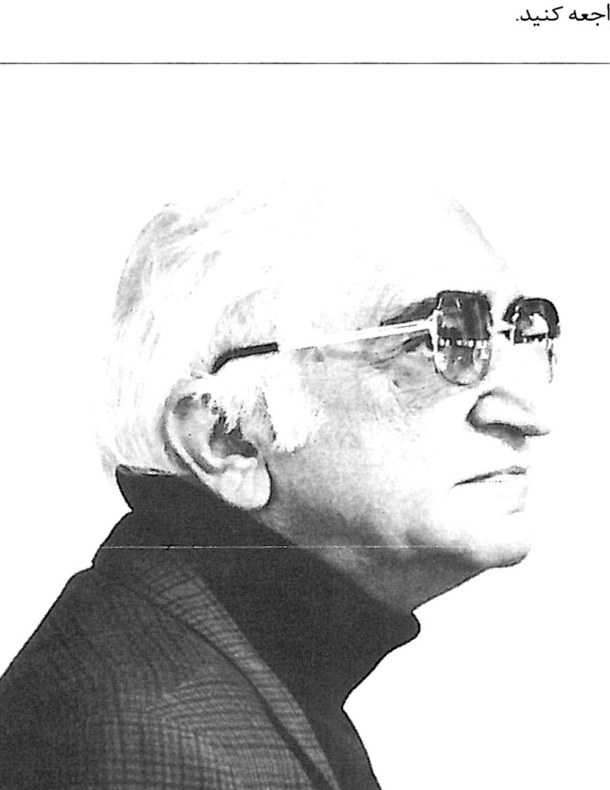
It was the second year of the school (1342 SH / 1963) when Mr Shariatzadeh, with a very brief and apparently slight diploma project — the design of a village — graduated with high distinction; and we, the students of the lower years, saw Shariatzadeh for the first time. He had long since finished his school projects and was no longer coming to the school. My fellow atelier-mates and I were proud that Shariatzadeh had been one of us.
In those years of age and student temper — and given the renown that the architecture course held in those days — every event was reflected with exaggeration and inflation. Yet, in the jury hall, we saw the teachers on the panel speaking with Shariatzadeh not as with a student, but as with an equal. The clamour is always around the talkers, the show-offs, the disputers, the parade-of-knowledge men. But Shariatzadeh, by displaying a manner and conduct contrary to all this — by speaking little, by claiming nothing, by not pressing his position, and on the whole by having no urge to take a particular stance — was the one who drew the respect of those present in the jury; a manner and conduct that stayed with him until the end of his life.
Shariatzadeh was an architect. His life was given to architecture, and his legacy is, more than anything else, his architecture. I have heard that, beyond his command of building, in fields outside architecture — in the other arts, in literature, in the social sciences — he was the master of wide and deep reading. But his relation with the world outside himself was architecture. Those who wish to study the special quality of Shariatzadeh's architecture must find it in this relation that he, as an architect, set up with the world outside himself.
The matter of Shariatzadeh's architecture cannot be settled by a simple naming, nor by placing it in some classification. When I say “Shariatzadeh's architecture,” I do not mean a leaning towards any such name. By Shariatzadeh's architecture I mean Shariatzadeh's gaze upon architecture, and the man to whom architecture belonged. At the same time, I do not wish to lessen the worth and standing of architectures that have taken on particular names and adjectives and have, by such means, set themselves apart. Anyone who has worked hard in the world of architecture, reached somewhere, and left a noteworthy work, deserves respect.
But, in any case, Shariatzadeh was not of that kind of architects who use their architecture to assert themselves — that is, to do work such that everyone may know his architecture by his name, and through it set out a notion and a face of himself. Of all the ways an architect proves himself, he held by belief and attachment to that one in which architecture is taken in by the society or the users of architecture. I avoid the term “popular architecture” or “architecture for the people,” for the word “people” carries a particular ideological weight. By people I mean — poor or rich, of whatever creed or persuasion — anyone who, in the end, needs air and light and sunshine and ease and quiet, and instinctively understands the gentleness of architecture. Architecture, of course, has higher spiritual subtleties for the elite as well. The cliff-edge of architecture is excess at this elite level.
It is not music, or any other kind of art, which directly and exclusively touches the imagination and the feeling. Perhaps an exceptional architecture under particular conditions may show such a property; but that is not the duty of architecture. Yet, since architecture is the most human, or among the most human, kinds of service that one human being — whom we name an artist or an engineer — performs for the rest of his fellow humans, the gentleness of this relation can always be felt in it. In which case, even thinking about the details of those conditions that bring ease and quiet, even gladness and pleasure, to the inhabitants and users of a building — and that particular form or mould which, in my view, God Himself has decreed for architecture so that it may bring within itself such conditions of ease, quiet, gladness and pleasure — provides the very ground for the gentleness and emotional reach of architecture.
Architecture is not pure art; nor is it the art of building in the abstract or the formal. It is the art of making a place for the human being. Shariatzadeh looked upon architecture in this way. The first thing he learned from the conditions of architecture's transformation in the new world — the answering of architecture to the new and specialised needs of urban societies on the way to industrialisation, and the use of scientific and industrial achievements in architecture, the work in a group, and Shariatzadeh's architecture — was that this was not a purely formal architecture without its real technical aspects. For this reason, to speak of Shariatzadeh's architecture, we must speak of the group architecture of which Shariatzadeh was a member, a group that cast the product of all its members' joint work into its final form. Shariatzadeh was an effective member of a consulting-engineers group that has been able to carry the past forward in a professional working organisation.
Shariatzadeh, by submerging himself in the professional work of architecture — submerging in the literal sense of the word, for he followed the work of architecture down to its smallest details and questions, and beyond attending to all the small functional considerations would dive into the depths of structural and services questions — imposed on himself a kind of seclusion, or, better said, an asceticism in the matter of attending teaching centres, circles and architecture media; on which account the radius of his professional vision did not shine on the students and the young architects.
The achievement of the late Shariatzadeh's architectural work, with his colleagues, over 34 years of professional practice — to which, in Shariatzadeh's own case, ten years of student work before that must be added — is very heavy; and I find it unlikely that any other architect or architecture office has left so many architectural works behind.*
We extend our condolences on the passing of this noble, free-spirited human being and great architect to his wife and children, to his old and new professional colleagues, and to the architectural community of the country.
* For a survey of the works of Shariatzadeh and his colleagues, see Memar 4.