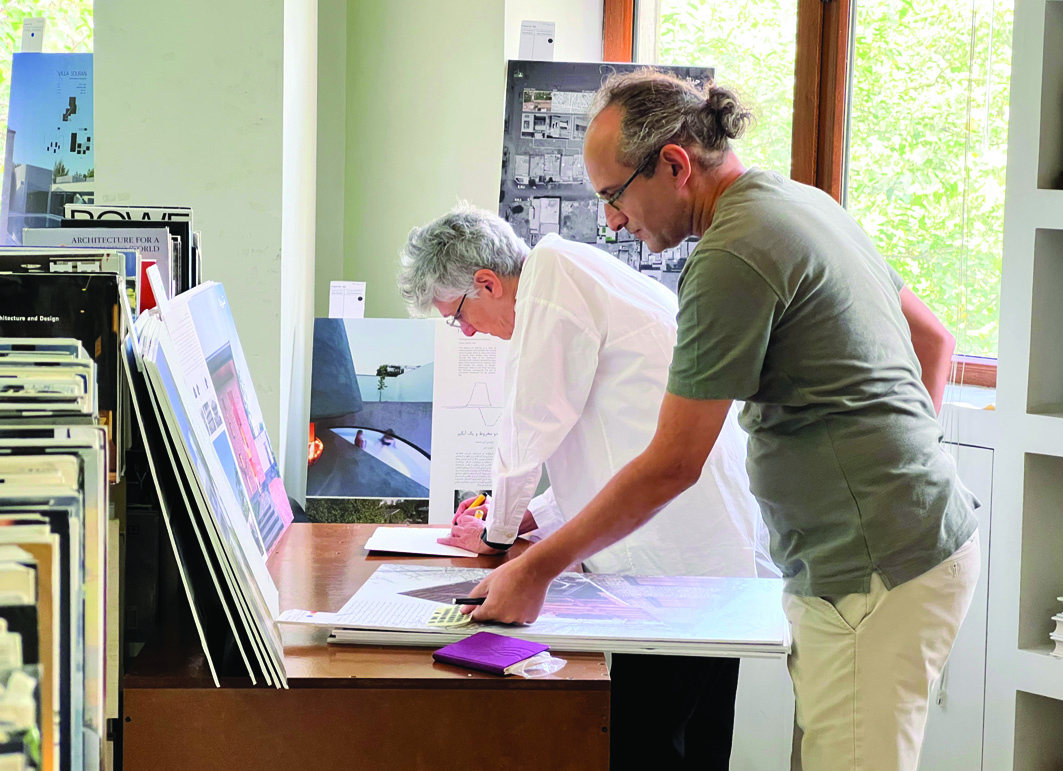
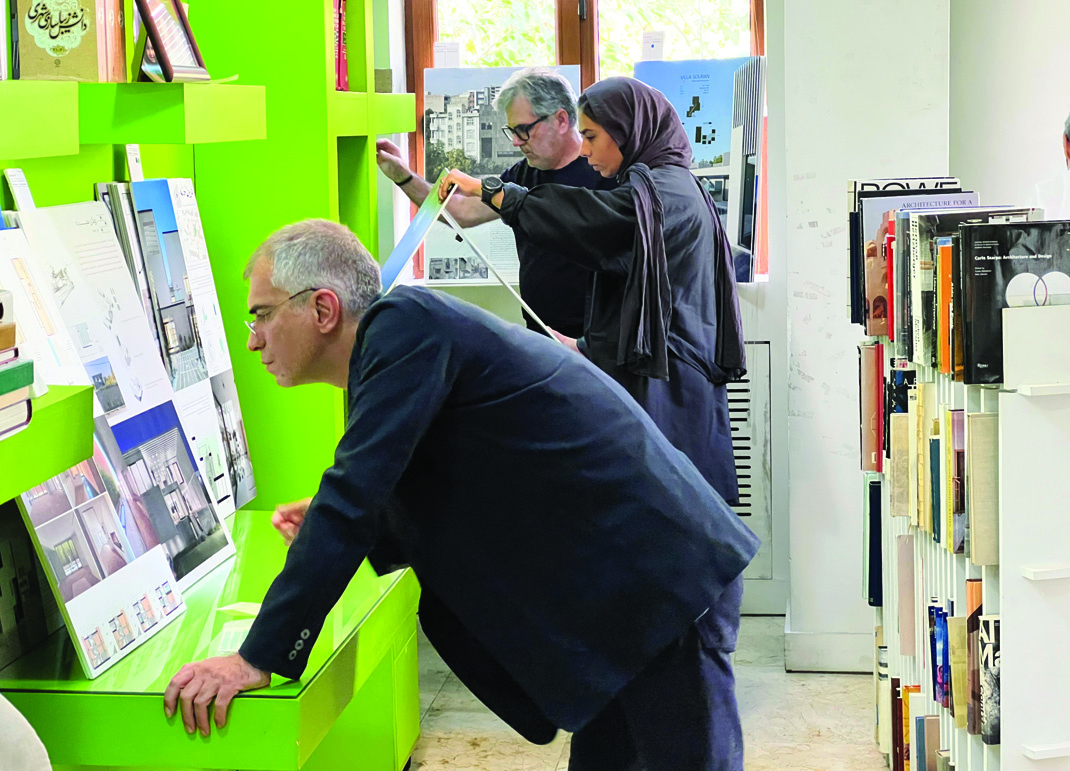
The 25th Memar Award competition, like previous editions, was conducted in two stages. In the first stage, held as an elimination round on the 3rd and 4th of Shahrivar, from among 239 projects that had submitted their documentation in four categories — Apartment Buildings, Individual Dwellings, Public Buildings, and Renovation — 46 projects advanced to the semifinal round.
The second stage of judging took place on the 5th and 6th of Mehr. In this stage, 31 projects reached the final round, from which 12 projects were selected as winners and one project was honoured with a special commendation.
239Submissions
46Semifinalists
31Finalists
12Winners
◆ ◆ ◆
Judging Process and Methodology
Projects are divided into four categories: Apartment Buildings, Individual Dwellings, Public Buildings, and Renovation. The following stages are followed for the projects in each category:
Stage 1 — Elimination: All projects within the same category are presented together for the jury’s review. After examination, projects that the jury members reject are set aside. Even if a single juror votes to keep a project, it will not be eliminated. Each juror has a sheet of colored stickers in their designated color; at this stage, each sticker represents a negative vote against a project. The remaining projects advance to the semifinal.
Stage 2 — Finalist Selection: From among the semifinal projects, each juror selects their preferred projects — without ranking — using their own sticker, which this time represents a positive vote. Projects that none of the jurors selected are eliminated. The selected projects become finalists.
Stage 3 — Ranking: Each juror independently selects their first, second, and third choices from among the finalists. 3 points are awarded to first place, 2 points to second place, and 1 point to third place. The sum of all jurors’ points determines the final rankings.
Stage 4 — Special Commendation: Jurors may designate certain finalists as worthy of special commendation. If the other jurors agree, this designation is confirmed.
◆ ◆ ◆
Jury Members
Ameneh Bakhtiar
Ehsan Hoseini
Afshin Farzin
Nasrin Seraji
Han Tumertekin (Turkey)
Tumertekin replaced Tao Zhu, whose visa could not be issued in time a few days before the judging began.
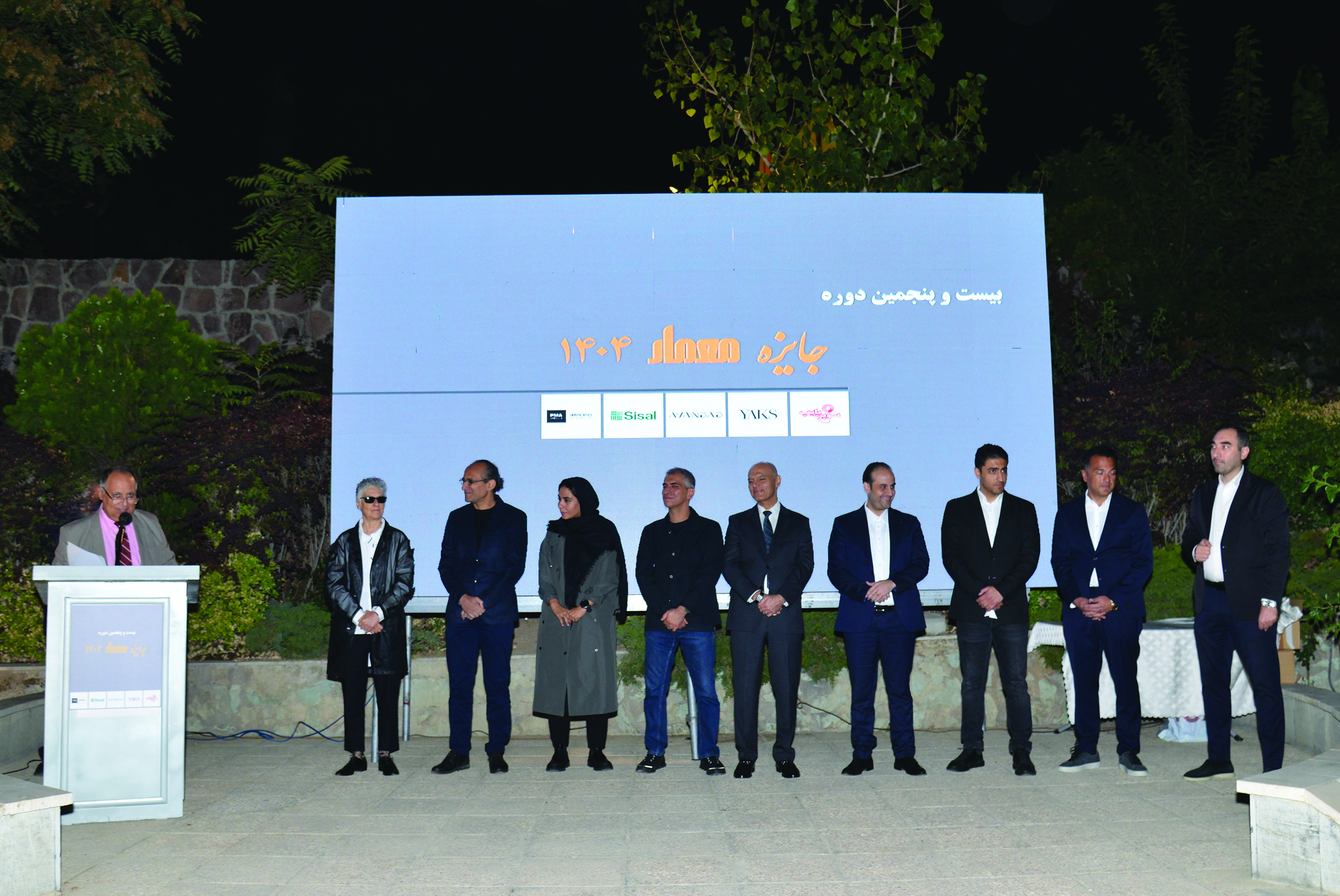
From right: Mohammad Attar (Yaks Co.), Navid Farhadian (Sisal), Sam Kashani (representative of Avandad Co.), Homam Ajodani (PMA IMPERIO), Mehrdad Yousefi (CEO Superpipe International Co.), Ehsan Hoseini, Ameneh Bakhtiar, Afshin Farzin, Nasrin Seraji
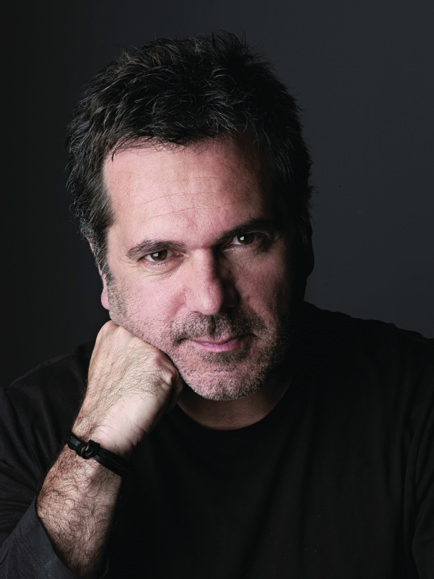
Han Tumertekin
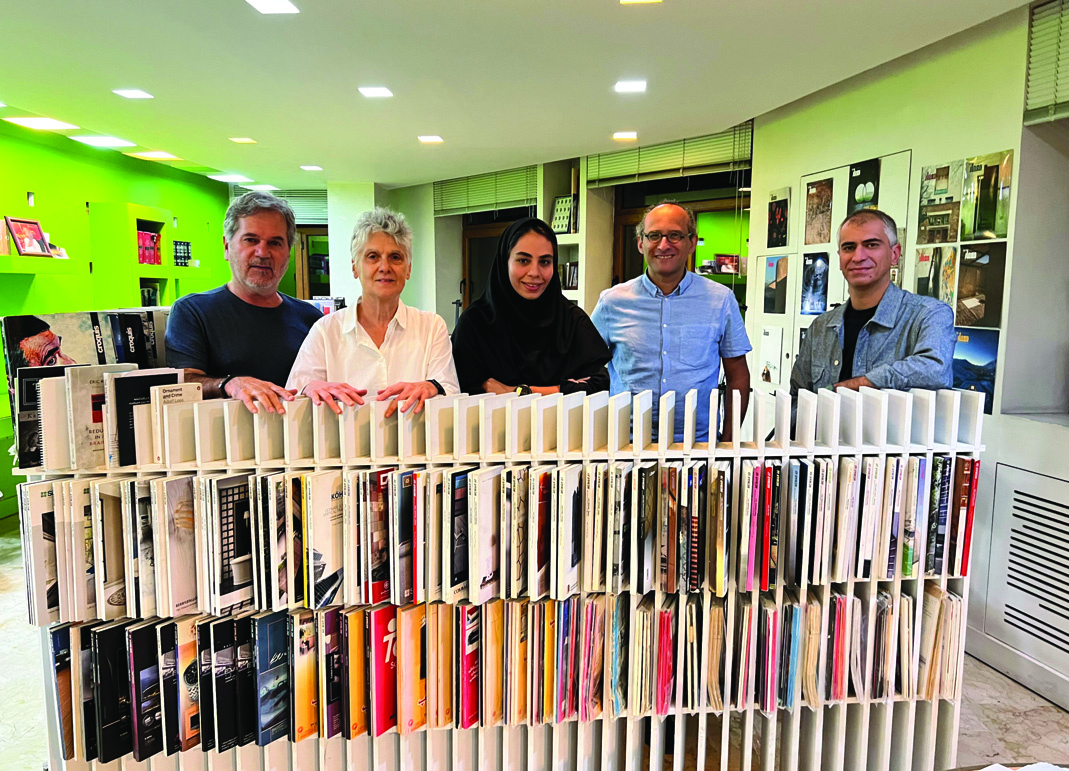
Han TumertekinJury deliberation session
A Turkish architect who, in addition to Istanbul, has maintained an office in Strasbourg since 2014. His projects have primarily been built in Turkey, though he has also worked in the Netherlands, Japan, England, France, China, Mongolia, and Kenya. A graduate of Istanbul Technical University in architecture, he has taught at several institutions since 1992, including Harvard University Graduate School of Design, the Federal Polytechnic School of Lausanne, and the Paris School of Architecture. Tumertekin is a founding member of the graduate architecture program at Istanbul Bilgi University. His works have been published in international architecture journals, and in 2006 Harvard University Press released a monograph of his work. His projects have won several architecture awards. In 2004, the Aga Khan Award for Architecture was given to his project, the B2 House; from 2004–2007 he served on the jury for that award. He was also a member of the Memar Award jury in 1394 (2015) and 1402 (2023). He is the first Turkish architect whose work was exhibited at the Venice Architecture Biennale in 2021.
1st — Voocho Cultural Complex, Gachsaran (15 points) — unanimous 2nd — Metro Station No. 1 Chaharbagh, Isfahan (10 points) — unanimous 3rd — Dar Divar, Isfahan (5 points) — unanimous
Honoured: Journey Cafe, Shiraz
This project is worthy of commendation for its conscious attention to the quality of urban space in a small-scale project, extending this perspective from the public realm to interior connecting spaces and activating the roof as an open urban courtyard. The result is the formation of a coherent whole that makes spatial and social continuity possible from sidewalk to rooftop.
◆ ◆ ◆
Jury Deliberation — Individual Dwellings
Ham Sang House, Dolatabad, Isfahan — Golchin Studio, Navid Golchin
Ameneh Bakhtiar:
The project is very simple and introverted. One of its positive aspects is that it communicates very well with the surrounding fabric. It doesn’t try to say anything extra, yet the spaces it has created — like the semi-open spaces, the connecting axis, the bridges and interior spaces — are very functional and apt. Both in terms of execution and spatial creation, it is very clean. The spaces are not mono-functional; in the interior perspectives I feel that the spatial variety it has created gives it the potential to respond to different needs and activities.
Afshin Farzin:
Beyond all these points, I think the designer has managed to bring purity to the facade. Considering the technological elements like the window frames and setting them back in a second layer, a kind of timelessness has been given to the project that brings it much more calm. In its urban fabric, it sits very unassumingly and peacefully, yet it stands apart from everything else and somehow shows its own character.
Ehsan Hoseini:
With sixty percent of the land occupied on the north side, effectively forty percent can never play the role of a courtyard. A small space has been allocated for the car. The rest is essentially the entrance to the house, and they have managed to bring a branch of this courtyard inside — very successfully. The photos also show the quality of the work: they’ve created a very private open space while entry also occurs through it.
Han Tumertekin:
This is a very good example of what I was saying about “being overly distinctive.” And we see that the space or setting of the project is not so attractive that one would want to live there or establish a relationship with it. So they’ve created a completely introverted life around a courtyard. Their ability to create beautiful forms and volumes is something I admire — very simple, just volumes and an ordinary central courtyard.
Nasrin Seraji:
This is the difficulty of the house. As a piece of architecture in its own setting, it works perfectly well. The only point I want to bring into the discussion is my slight hesitation — not about this project specifically, but about the reality that it seems we no longer invent anything. Have we accepted that everything has already been invented? So what we’re doing now is just reacting? Or are we truly creating new ways of living? The only place where the architects have freed themselves and allowed creativity to emerge is in the staircases and bridges. In a way, they’re designed in a peculiar manner… If the bridges and stairs were also made of brick, a different conversation about “invention in architecture” would have emerged.
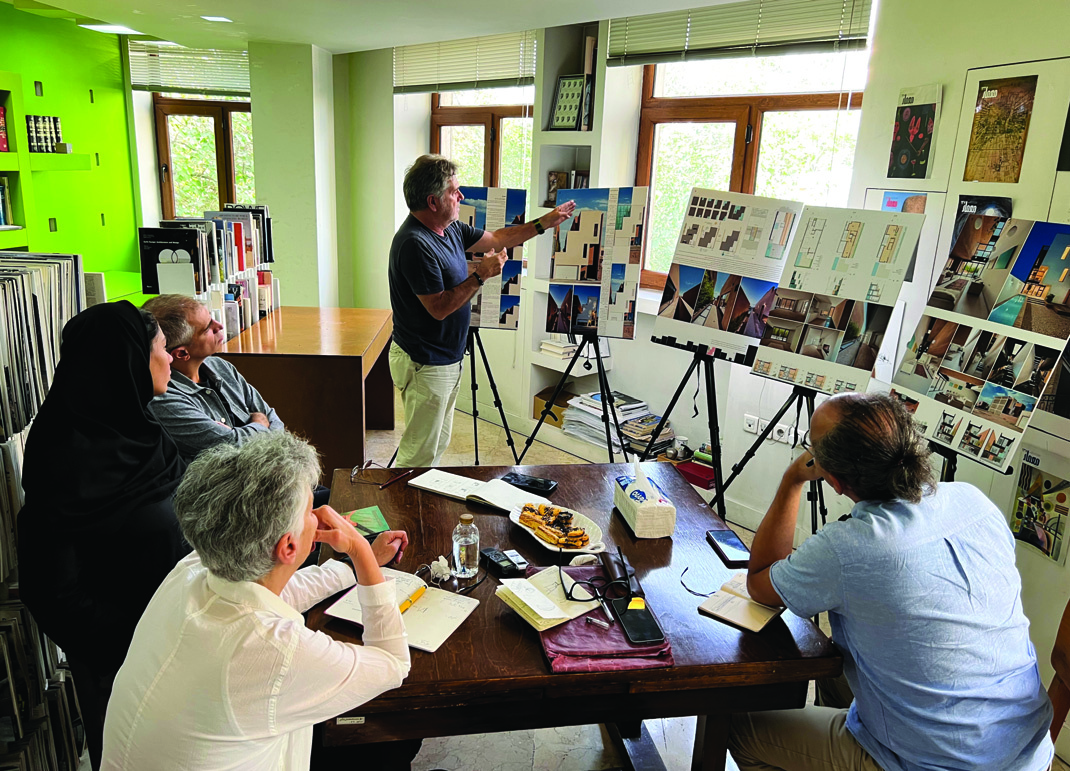
Jury members reviewing project submissions
Patti Project, Someh Sara — Agar Design Atelier in collaboration with May Dan Office, Amirali Alaei, Ali Chaichian, Meysam Soltani
Han Tumertekin:
Once again I admire this simplicity, those very limited but effective touches that create an entirely fresh way of living and sensing life. The concrete structure existed beforehand — look at how they’ve dealt with it. They haven’t made major interventions, just a series of “touches.” With a sloped roof and a few small additions, they’ve created an entirely new world. Perhaps it’s an exaggeration to say a new world, but simple elements, ordinary materials, and simultaneously a very intelligent composition. Their work is excellent.
Afshin Farzin:
The points Han made are entirely correct in my view. The key to this project is how it deals with everyday materials that villagers in rural areas use extensively, usually out of necessity. A designer can give it a poetics and elegance such that while it remains the same ordinary material, it creates a suitable space. The way the roof sits on this structure is very noteworthy — the roof maintains itself as a pure element while making even the concrete structure beneath it still legible. This transparency gives the project a very interesting lightness.
Nasrin Seraji:
A question remains — the subject of “reference” in architecture. We keep encountering projects that look very closely at others’ works. This project, contrary to what I said earlier, seems to have “stolen” many existing ideas. The previous project “borrowed” more, but this one has truly “stolen” — certainly first from Glenn Murcutt, and from Lacaton and Vassal, though executed differently. It stole from Murcutt, but not as well. The idea is interesting but hasn’t truly integrated those concepts into the design. If we say it borrowed from or stole from Zumthor or whatever we call it — the things the other project didn’t understand, this one also didn’t understand. The issue goes back to the first discussion: how do they work with architectural references? If our architects today want to work only with form and such things, it means they’ve understood nothing from either Zumthor or Murcutt.
Nim Rokh, Kerman — Gera Architecture Studio, Hossein Namazi
Ehsan Hoseini:
This project is my favorite. It’s an attempt in projects of this scale and in narrow, low-rise infill that forms the city’s body. They used the term “sky-eating” but in reality gave more sky to the city than consumed it. Through this exercise, they’ve managed to establish this north-south connection both at eye level on the ground and in the sky, defining a kind of narrow linear courtyard.
Nasrin Seraji:
I completely disagree with you. This is a “doll house.” Its architecture, from one perspective, is also quite beautiful… But here is where I completely disagree. Our disagreement is conceptual and intellectual, not personal — and I hope our friendship won’t be harmed by this debate. I think architecture is no longer that “object” that performs all this formal gymnastics… For what purpose? To achieve what? I’m very interested in the idea you three proposed — what appears to be one of the principles: “the right to sky.” The right to sky for whom?
Ehsan Hoseini:
The project is one of those that, in the history of contemporary architecture anywhere, could be the starting point of something.
Nasrin Seraji:
I hope you’re right. I think this is the end of an era, and that itself is a good discussion.
Jury members examining project submissions
◆ ◆ ◆
Jury Deliberation — Renovation
Minu-An, Tehran
Han Tumertekin:
The simplicity, those very limited but effective touches create an entirely fresh sense of living. The concrete structure existed before — look at how they dealt with it, they haven’t made major interventions.
Khwan-Khaneh, Khansar
Nasrin Seraji:
The interesting thing is that the design has eliminated corridors. The only paths of access are the staircases themselves, vertical or horizontal, but there are no corridors. The communal spaces are the connection points, and the rest of the spaces are private. This idea of eliminating “service spaces” and turning all spaces into ones that simultaneously serve and are used has created a hierarchy-free structure — and that is what makes it attractive to me.
Zest Cafe, Shahsavar — Vahid Joudi Architecture Studio, Vahid Joudi
Nasrin Seraji:
Han, you were the only one who didn’t vote. As an architect, why didn’t you vote?
Han Tumertekin:
To create a visual impact, part of the building had been painted blue. I wasn’t sure about the scaffolding elements — they seemed like part of the structure but weren’t as simple as I expected. Too many elements were used to create the new space, and that was my main reason for not voting.
Journey Cafe, Shiraz — HONOURED
Special Commendation
This project is commended for its conscious attention to the quality of urban space in a small-scale project, and for extending this perspective from the public realm to interior connecting spaces, all the way to activating the roof as an open urban courtyard. The result is the formation of a coherent whole that makes spatial and social continuity possible from sidewalk to rooftop.
Nasrin Seraji:
The more important point in this project is the transformation of an ordinary house into a social space — a place where people can come, children can play, without needing to go to the street. The project is about the concept of “shared space” and “publicness within the urban fabric,” not just about form or tectonics. In terms of spatial programming, this was the most intelligent design we saw — expanding the concept of a cafe into a place for study, rest, children’s play, and social interaction. Instead of a house, it creates a “shared urban space.”
◆ ◆ ◆
Jury Deliberation — Public Buildings
Voocho Cultural Complex, Gachsaran
Han Tumertekin:
I found it very challenging that within such a large volume, something of such delicacy and sculptural precision was designed, while simultaneously creating a pleasant collection of spaces — not only in terms of form and flexibility, but also in terms of spatial quality, the composition of spaces, the staircases, and the fact that within the daily life of the factory, such a functional and beautiful element exists that all employees pass by every day.
Nasrin Seraji:
I voted for this project, not because I think it’s a particularly significant work in terms of meaning or architecture, but because there’s an aspect that’s interesting and relates to a discussion we’ve been having in architecture for a long time: the wall, the thickness of the wall. How we deal with the wall. How can we turn the wall into something more than a boundary or separator? In this project, the architects have given the wall a function — something like a vitrine that prevents the wall, which is inherently a heavy element, from becoming heavier, while having space within itself. This idea of spatializing the dividing element is what interests me about the project.
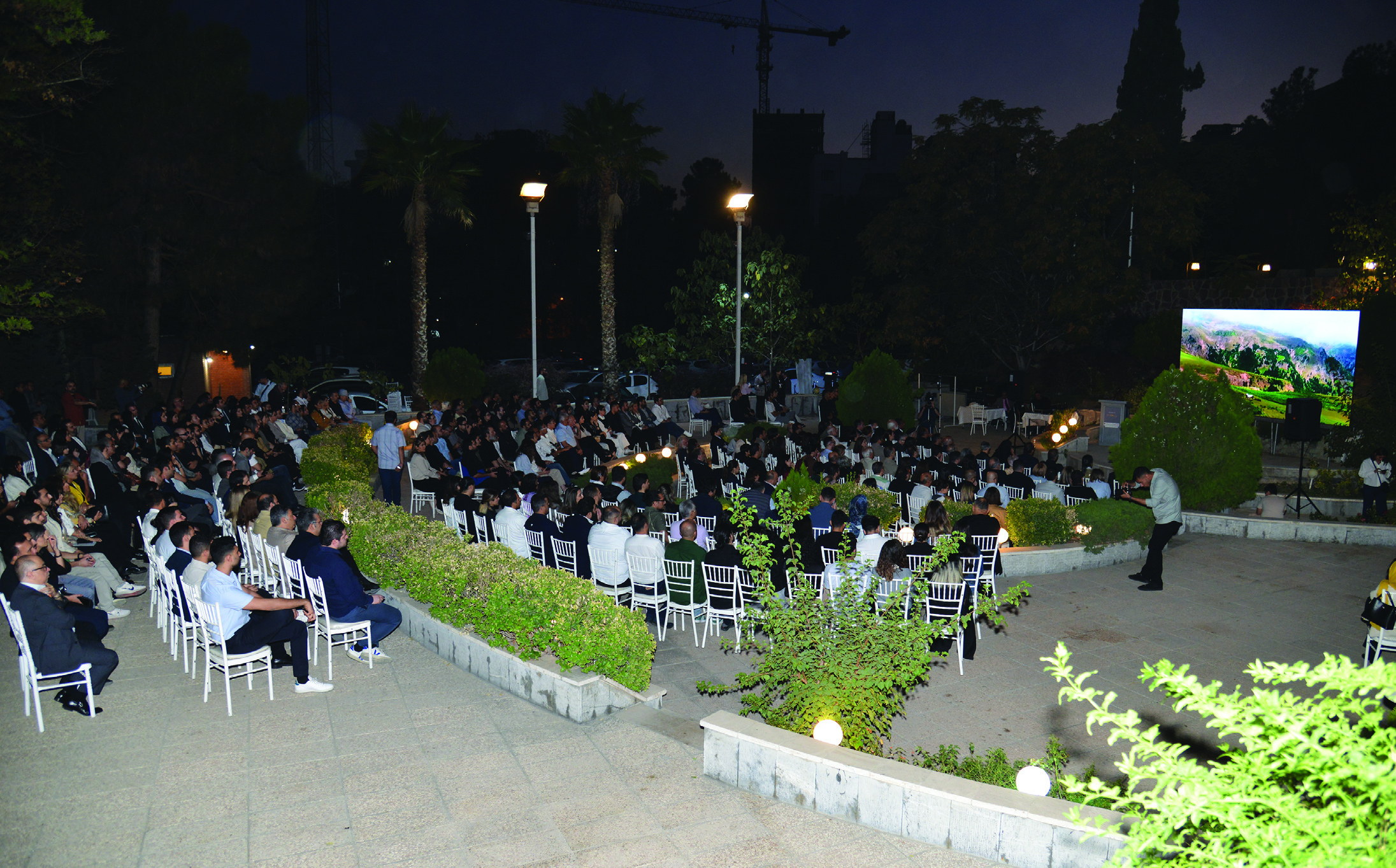
25th Memar Award ceremony — audience in the outdoor amphitheatre
Metro Station No. 1 Chaharbagh, Isfahan
Ehsan Hoseini:
Several points I mentioned before. First, apart from a section the municipality built as the facade of Chaharbagh, this is the only building constructed on the main section of Chaharbagh-e Abbasi — there’s also a TOD [Transit-Oriented Development]. The metro entrance and these facilities are being developed. Another important point is that the structure of this building was pre-existing. They essentially decided to bring the void to the Chaharbagh front and create a kind of condensed concept of a small Chehel Sotoun, with a portico or entrance iwan. I think this was a good decision.
Han Tumertekin:
I imagine the program relates to an industrial building or some kind of factory. As far as I understood, the aim was to create a product showroom and several ancillary spaces. I found it very interesting that in such a large volume, something of such delicacy and sculptural precision was designed.
Nasrin Seraji:
I voted for this project because of an aspect related to a discussion in architecture for a long time: the wall, the thickness of the wall. The architects have considered a function for the wall — something like a vitrine — which prevents the wall from becoming heavier while containing space within itself. This idea of spatializing the dividing element is the interesting part of the project for me. Though in corner details it’s a bit rough, and in material terms I’m not fully convinced, the idea of thickening the wall as space, which we see less often in today’s architecture, felt fresh to me.