


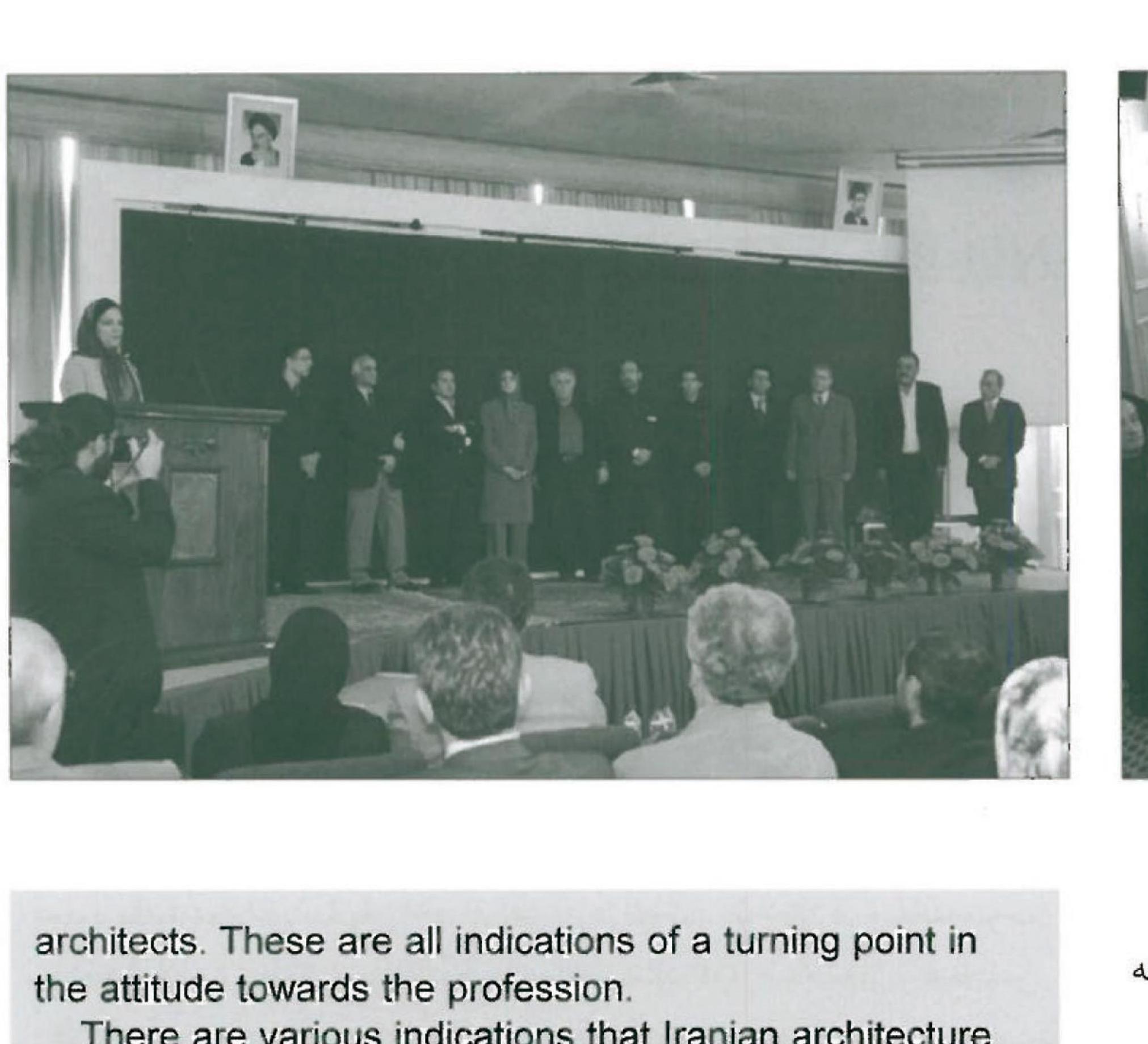
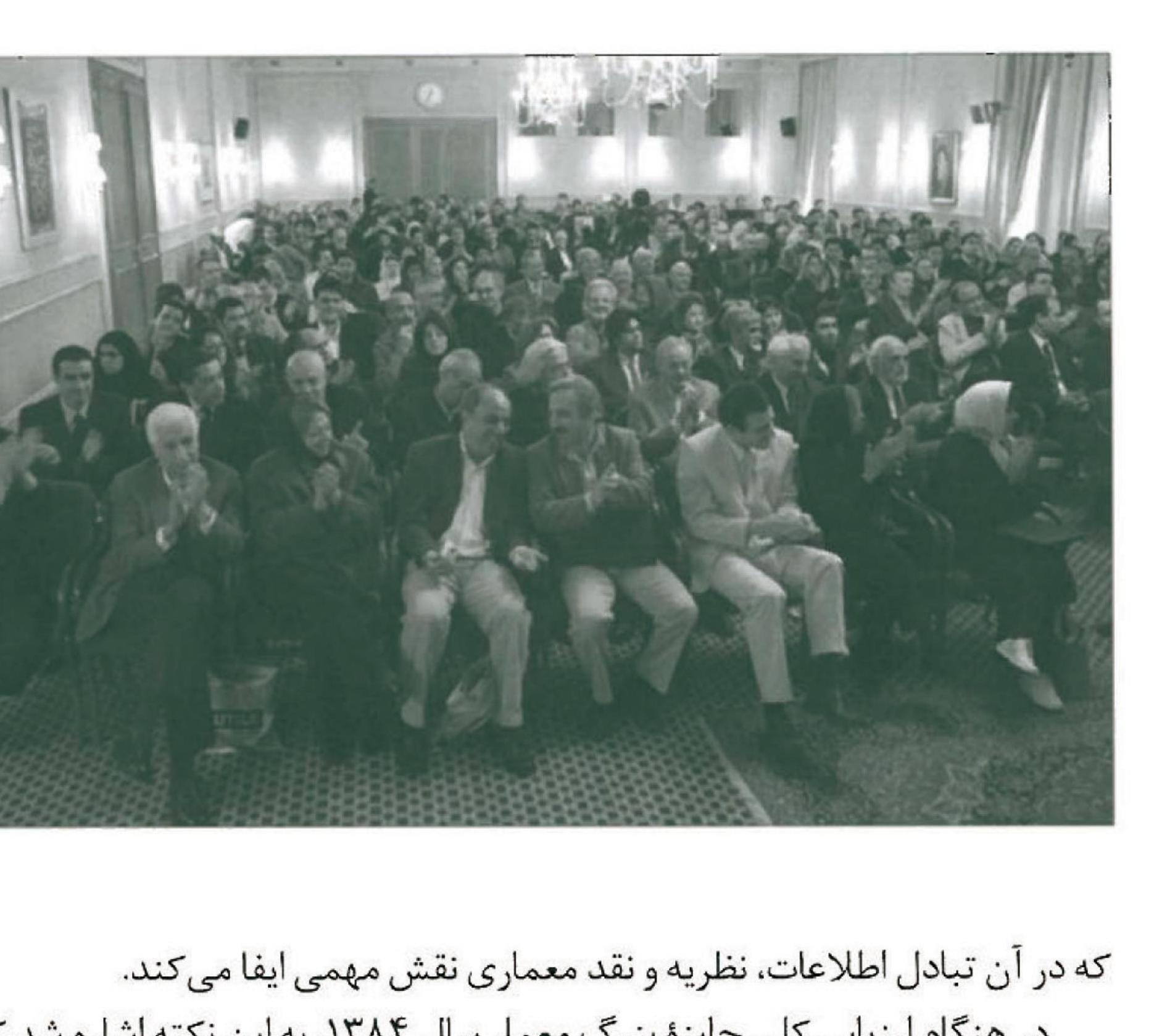
As in previous years, the Grand Me'mar Awards have provided an opportunity for summing up and reflecting on the architectural events of recent years. The participation of designers in the competition, and the attention paid by specialists in the relevant fields, by contractors and those involved in construction, as well as by keen observers, showed that the Me'mar Award has become an event that many people look forward to each year. The same attention is evident in the country's architectural journals, seminars and other exhibitions.
The growing number of domestic journals goes hand in hand with a relative decline in attention to foreign books and journals, which until a few years ago had monopolised the market. Specialists in this field now look at foreign developments with a deeper gaze and also pay attention to the developments of contemporary Iranian architecture. In other words, the improvement of the architectural market and the growth of architecture's cultural tools have led architects to attend, more than in the past, to the tangible and concrete issues of the country.
Above all, it must be acknowledged that the works entered in the Me'mar Award — and of course the works outside the competition that have been published over the past two years through the many architectural journals — together show a considerable qualitative improvement compared with the past. In the judging process of the recent Award, eliminating works to arrive at a limited number of selected schemes was difficult. This qualitative improvement in production is not confined to architecture, and the same qualitative growth can be felt in many fields. The increase in welfare, owing to higher oil prices, has moved society from a state of attending to primary needs towards attending to non-material needs and even, in some cases, to aspirations. Society has, to some extent, begun to look with greater care at the question of the quality of products — including architecture and its role in improving the economy and the standard of living. Nowadays the architect is gradually taking a place alongside the established figures of the physician, the tradesman, the clerk and the farmer. Even in television and cinema films, characters of architects have appeared. Readers of architectural journals sometimes go beyond the circle of architects, and a number of people who have no professional connection with architecture take, out of curiosity or personal interest, to reading articles and examining architectural works.
It seems that, little by little, people are learning that an architect does not merely remove certain technical and administrative obstacles and does not simply hand a beautiful facade over to the client, but can produce added value — part of which appears in the very nature of the work and part of which is transformed, along a cultural path, into social prestige, playing a role in advancing the general discussions of architecture. In other words, it seems that society is now moving towards establishing the role of the architect as an author. One further sign of the increasing importance of the architect in society is the diversification of the projects commissioned to architects. Among the works entered in this round of the Grand Me'mar Award were technical and service spaces, a factory warehouse, a school and a mosque — the kind of projects that in the past were rarely entrusted to author-architects. All of this shows that architecture stands at a cultural turning point, in which the exchange of information, theory and architectural criticism plays an important role.
During the overall evaluation of the Grand Me'mar Award of 1384 (2005), it was noted that a new architectural trend seems to be forming, one that differs from the architectural fashions of past years — a tendency that, alongside its considerable and growing diversity, refers, in terms of typology and style, to specific and meaningful factors in design, which are pointed out in this article. At the same time, the composition of the works selected by the jury — who for the most part were unaware of the particulars and the names of the competitors, or of their age and social standing — reflects a reality we have raised many times over the past ten years or so, through articles and discussions: namely that the emergence from the crisis of architecture, which had for years frozen the country's architecture, is being achieved by a young, innovative generation who a decade ago were still university students. Perhaps it is now necessary for state and public institutions to pay some attention to this generation, who are the country's real assets and who still have long years ahead of them to gain experience, to progress and to produce.
A New Trend — Independence
One of the merits of the new trend is its relative independence and its distance from imposed debates that had, for a long time, influenced professional and academic discussion. Until the mid-1370s (SH), superficial prejudices — and perhaps also anxiety about the absence of an art expressive of the spirit of the Revolution — had led some university instructors and state officials, under the banner of reviving a lost identity, to press designers and students to introduce, in a summarised and imitative manner, the appearances of Iran's Islamic historical architecture into their works. Although experience showed that the stronger works, architecturally, were those in which the presence of identity elements was more diluted, the abrupt abandonment of the cultural-historical debates concerning Iranian architecture — which occurred in the following decade — did not, in the end, benefit contemporary Iranian architecture either.
In reaction to traditionalism, the young generation of architects and a number of architects of earlier generations who sought change turned, as a reference, to the most extreme tendencies — those always presented through specialised foreign journals as the real embodiments of a new, post-modern era (there is no doubt as to the fashion-following and mannerism latent in most of these works). In this way, for a long time, most students and a number of professional designers, in the opportunities they found away from the regressive reality of the market and the academic environment, engaged in stylistic experiments concerning the abstract architectures of the 1980s and 1990s, whose most important theme was the use of non-Euclidean geometries in architecture, in forms consonant with the arts of graphics, sculpture and painting.
But now it seems that, with the passing of that period, leading architects have inclined towards a tendency that is independent and grounded in the objective conditions of society, giving way, on two sides, to a logical inference from contemporary architecture and from the practice of design in Iran.
The Idea
If, until a few years ago, the concern of many architects — consciously or unconsciously — was to find a style suitable for presenting a society in transition and, once again, open towards global developments, at present designers seek to establish the legitimacy of their works through offering original and pure ideas for the small problems that they encounter daily in their professional practice. Most of the projects entered in the competition put forward distinct ideas, and these ideas were tied to the givens of the projects. There was no longer much sign of the borrowed geometric diagrams rooted in the experiments of Peter Eisenman, Greg Lynn and their like, which had once been in vogue.
Designers have come to realise that in architecture too, just as in other disciplines and fields, what matters more than taste is the level at which problems are engaged and the manner of looking at them. It is for this very reason that the good works of the last few years of Iranian architecture have drawn close to a level presentable on a global scale. It seems they have found a logical solution to the dualism of being local or global: the level of professional work and the manner of engaging problems on a global scale, and design principles based on data and knowledge adapted from local, objective conditions.
In fact, the stylistic and formalist efforts — accompanied by special effects and grounded in quasi-intellectual foundations — have given way to a more or less independent tendency that draws on historical sources (the contemporary and pre-contemporary history of architecture) as befits the occasion, in relation to the design idea. On the whole, designers have shown that they have relatively good control over the design process and, instead of leaping from one branch to another, are able to develop distinct, worked-out ideas and to remain faithful to them down to the smallest details. Even where a foreign reference is to be used in design, it is done with greater maturity than in the past, and the designer strives to digest and absorb the borrowed ideas. The expansion of relations between Iran and advanced countries, the growth of tourism abroad, along with the spread of the internet and other international media, have also given our architects a more precise acquaintance with today's works of the world. Apparently, the presence of major figures of world architecture and criticism — such as Isozaki, Maki, Botta, Jencks, Jodidio and Sottsass — has not been without effect either.
Attention to the Objective Conditions of the Project
This matter has several dimensions, in all of which a considerable advance can be seen:
- Attention to the typology and appropriate character of the various educational, administrative, industrial, religious and other spaces;
- Attention to the physical programme and the objectives of the project;
- Use of the site's particular features to generate the project's principal ideas;
- An effort to establish a relationship with the urban fabric or the surrounding natural environment, and attention to prominent landmarks and existing visual references effective in the design;
- Attention to climatic conditions and ambient light;
- An effort to establish a kind of relationship with the architectural past — which was seen especially in the restoration and rehabilitation works entered in the Award.
Technology and Materials
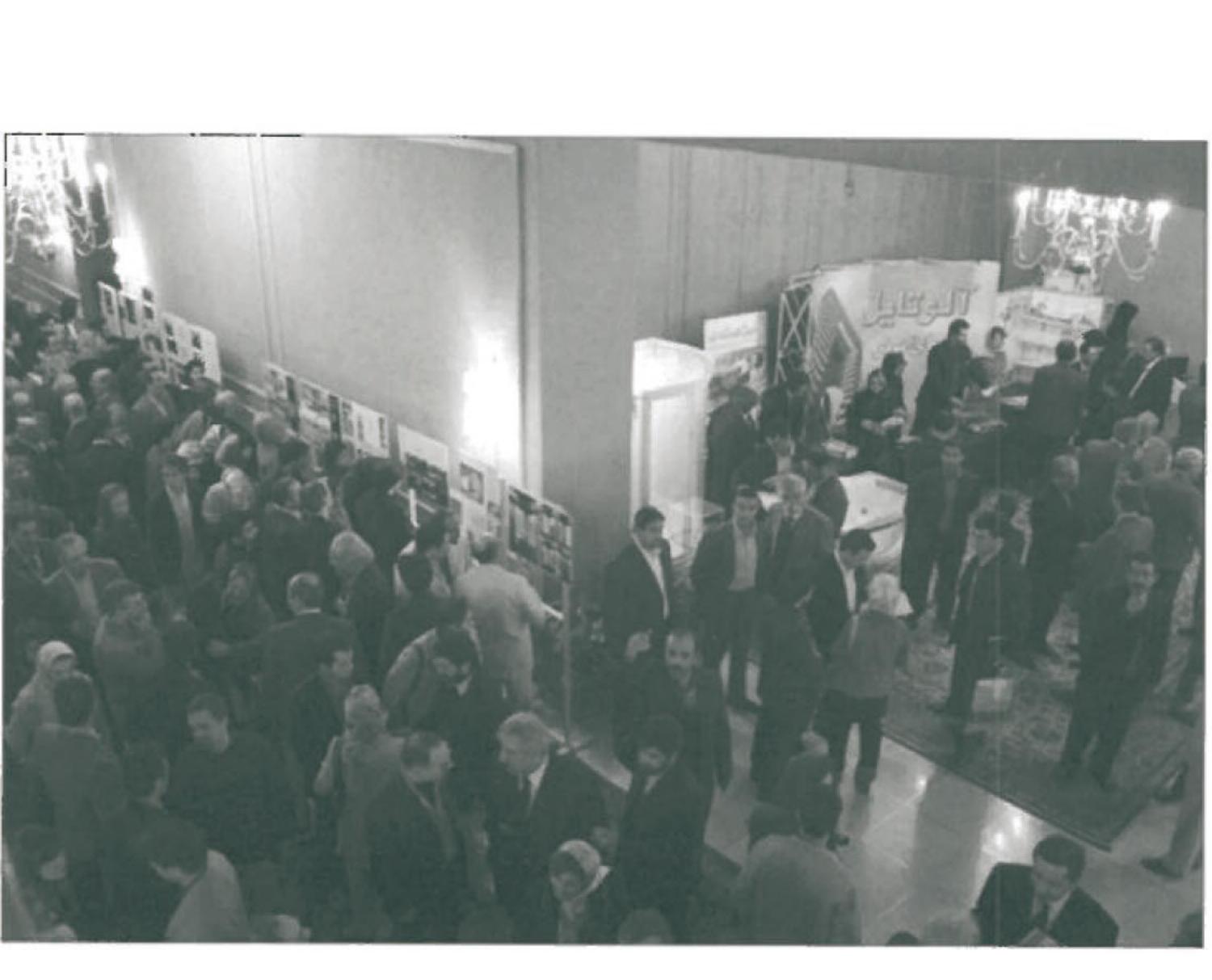
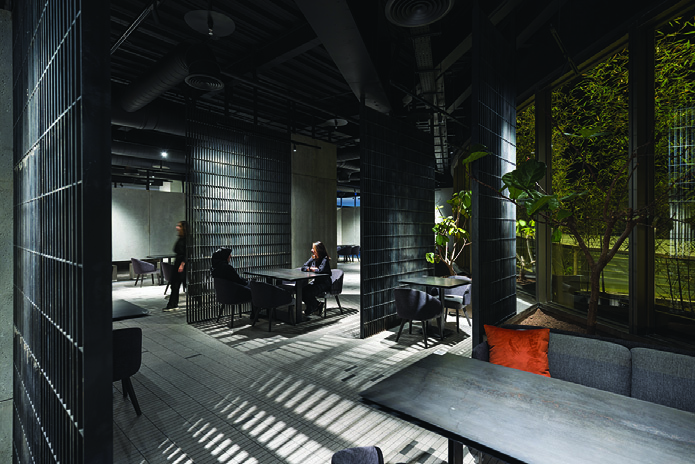
The buildings executed in recent years are, at the same time, indicative of a considerable advance in technology as well. Structures are designed and executed with greater care and, compared with the past, have a more coherent relationship with the architectural design. The variety of materials used in buildings has increased and their quality has also improved. Execution details are designed and carried out with greater precision and are in accord with the overall form of the building.
On the whole, one may say that the relationship of whole and part has advanced considerably. Many designers — and, for example, the first-prize scheme — have sought to give value, through a particular design, to low-cost materials such as corrugated metal sheet, stone and cheap brick, sandwich panels and simple facade rendering. This progress of architecture in the above respects is also owed, in part, to the increase in the production and import of building materials in recent years, in terms of quality, variety and quantity. New companies which, alongside supplying new building materials, place the relevant technical knowledge at designers' disposal, have played an important role.
Conclusion
All of the above events show that architecture is on a good path and, provided it is not affected by inhibiting upstream factors — such as negative economic fluctuations — it has a bright future ahead. Architectural work and debate have become, compared with the past, more complex, more real and more professional, and we have drawn close to good global standards. Of course, the country's architecture is not yet in a position to advance a new and fundamental proposition — in terms of design principles — that would also have global value and, at the same time, move the general history of world architecture forward. Yet it must be pointed out that a number of young Iranian architects have, in recent years, been able to win first places in international competitions with their new ideas. Some of these schemes — such as the two winners of the first and second prizes in the competition for the idea of 'A House for Children, Plants and Domestic Animals in Korea', by two young Iranians — are, in terms of their idea, entirely novel and outstanding.
At any rate, it seems that society is gradually coming to understand the role of architecture in improving the quality of life through principled design, and that designers, too, are acquiring the readiness to respond to the material and spiritual needs of society. The role of the author-architect and the qualities of original, artistically valuable work are also, little by little, being raised among architects and the public. In this, architectural criticism and the specialised journals, which have grown considerably in the last decade, play an important role. It is necessary that those responsible in state and public institutions also attend to this sensitive and important moment in the history of contemporary Iranian architecture, and that, by providing the ground for good talents to emerge, they assist the overall elevation of the level of architecture and the realisation of outstanding artistic works. Progress in architecture — as in other scientific and research fields — requires the acceptance of risk, experiment, endeavour and even error; and outstanding work is never achieved effortlessly by way of ready-made, pre-written prescriptions.