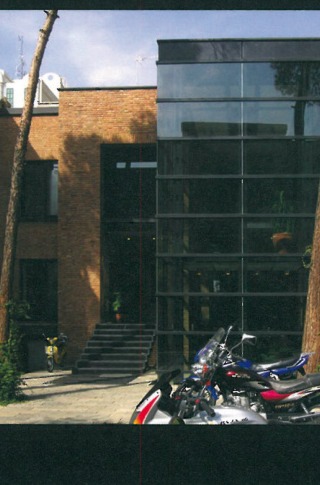
The commission to design and execute the adaptive reuse of a building dating back to the 1940s, situated within one of the original affluent neighborhoods of old Tehran (Villa Street), into the main office of a motorcycle factory, presented an opportunity to engage with the compelling challenge that invites a great number of architects in this land: connecting with the present without discarding everything old that carries part of our identity. The old building, though inspired by the modernist tendencies of the era known as the Vartan period, strikes one at first glance with its age and authenticity, nudging our severely depleted historical memory and transporting us to the atmosphere of Tehran's graceful years of transformation. Thus, we immediately found this concern: that after the completion of the work, others would continue to have this feeling, and through contemporary activity in an old building, see and feel today's life through the lens of yesterday.
On the other hand, the industrial identity of the building's new function also needed to manifest somehow — perhaps symbolically and indirectly — within it. Beyond all this, fitting diverse new functions into existing spaces, installing heating and cooling systems, water supply, electricity and lighting, computer networks and audio-visual systems with minimal spatial alterations — owing to the load-bearing nature of most walls and the necessity of addressing restoration damages such as moisture and termites, along with the need to structurally reinforce the building and prepare it to accommodate a population many times larger than its previous residents — these were the project's specific constraints. It is worth noting that the support and trust of an enlightened client greatly facilitated overcoming all these challenges.
The Glass Staircase
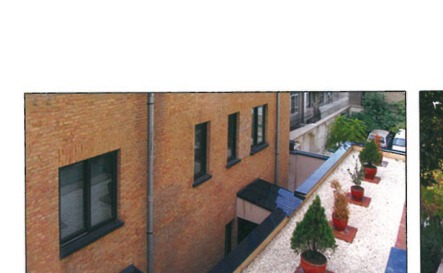
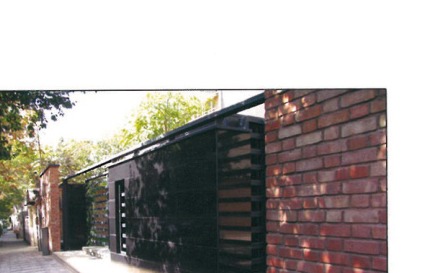
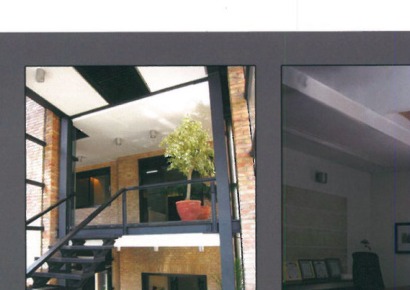
After removing the interior staircases due to spatial changes, the most significant design challenge was constructing a new staircase outside the building and connecting it to the structure. After designing multiple options for how to attach the glass stair box to the old building, the chosen solution was to create an intermediary element — a brick shell made from old bricks salvaged from the demolished building — and pass the stair box through it, with a tall portal on the axis of the courtyard entrance.
Project Details
Project: Pajang Khodro Main Office (Adaptive Reuse)
Location: Villa Street, Tehran, Iran
Architect: Zand Harirchi / Harirchi & Associates Architects
Client: Mahdi Hajimiri
Design Team: Ataollah Nik Kholgh, Nasim Khojaste Nikou, Ali Haeri
Architectural Details: Parviz Ghasemi
Structure: Majid Naghipour
Construction Manager: Ataollah Nik Kholgh
Construction Associates: Mahmoud Mohammadi, Saeed Armaghan
Mechanical Installation: Amin Esfandzad, Reza Mirzaei
Photography: Ataollah Omidvar, Zand Harirchi
Area: 878.35 m²
Design & Construction: July 2003 – September 2004
Award: 5th Place (Joint), 5th Grand Memar Award, 2005



