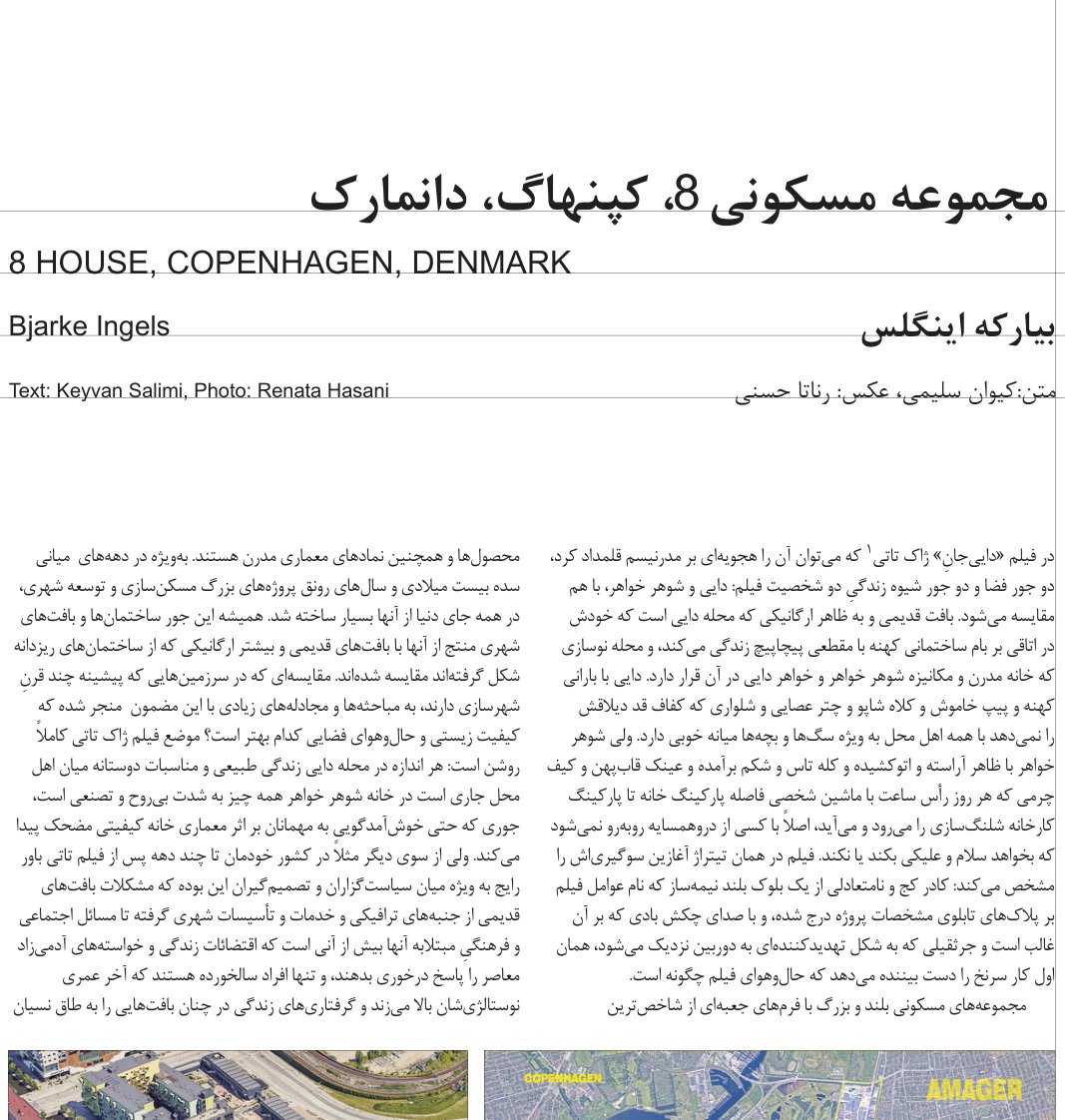
In the southern reaches of Copenhagen, in the newly built district of Ørestad, stands a residential complex that poses a fundamental question: can a single building of enormous scale generate the spontaneous, layered vitality of an old urban neighborhood? The 8 House, completed in 2010 by Bjarke Ingels Group, is an attempt — ambitious, provocative, and largely successful — to answer that question affirmatively.
Ørestad is a peculiar place. Developed on former agricultural land along a new metro line, it has filled rapidly with large, isolated buildings set in open green space, each designed with architectural ambition but collectively producing an environment of remarkable bleakness. The streets are wide and empty. The ground floors are blank. The sense of neighborhood that animates Copenhagen's older districts — the corner café, the cycle-repair shop, the tobacconist, the intimate scale of facades that change every few meters — is entirely absent.
The 8 House sets out to manufacture, within a single structure of 61,000 square meters, exactly the urban complexity that Ørestad lacks. Its name derives from its figure-eight plan: two rectangular loops interlock to create a form that, seen from above, traces the numeral eight. Within this diagram, the building accommodates approximately 476 apartments of varying types — penthouses, townhouses, and standard flats — along with offices, retail spaces, restaurants, a gymnasium, and a daycare center.
The organizing innovation is vertical rather than horizontal. Instead of stacking all residential uses above a commercial podium in the conventional manner, the architects distribute different programs at different levels and connect them by a continuous diagonal promenade — a sloped walkway that winds from street level to the rooftop garden, seven stories above. Along this path, residents and visitors pass through changing gradients of light and air, encounter their neighbors at unexpected moments, and experience the building as a compressed urban landscape rather than a stack of identical floors.
The diagonal path is the building's most discussed feature, and also its most analyzed. At its lower levels it is genuinely street-like: wide enough for cyclists, lined with café tables and plantings, changing direction enough to create a sense of discovery. As it rises, it narrows and becomes more intimate — a private lane between the townhouse terraces, where potted plants and bicycle wheels and children's shoes appear in front of doors. At the summit, the path opens onto a shared roof terrace with views across the flat Danish landscape to the Øresund and, on clear days, to Sweden.
Each townhouse has its own private garden terrace, which faces south to capture maximum sunlight and opens onto the diagonal promenade. This arrangement produces something rare in apartment buildings: a genuine threshold between private life and the quasi-public space of the path. Residents open their doors and step not into a corridor but into something resembling a quiet alley.
The building's two loops create a central courtyard at ground level — a shared outdoor space protected from the wind that sweeps across the flat Ørestad plain. This inner space is planted and animated by the activities of the daycare center and the comings and goings of residents. It is the building's closest approximation to a village square.
The 8 House has attracted considerable critical attention and numerous awards, and it deserves both. It is a serious and intelligent attempt to resolve one of the central dilemmas of contemporary housing: how to achieve the density necessary for sustainable urban living without sacrificing the intimacy and variety that make urban life desirable. It does not solve this dilemma entirely — no building of its scale can fully replicate the organic accumulation of an old neighborhood — but it creates conditions in which something like neighborhood life can take root. That is no small achievement.



