(2) A Journey to Transoxiana: Bukhara — BUKHARA
The historic city of Bukhara, once called the Dome of Islam of the East, became renowned as Bukhara-yi Sharif during the reign of Amir Haydar, ruler of Bukhara in the thirteenth century AH. It is the fifth largest city in Uzbekistan. The city lies on a plain along the lower course of the Zeravshan River and alongside the Shahrud Canal (City River). Ya'qubi counted Bukhara among the cities of Iran. Before the Muslim conquest of Bukhara, the oasis was under the control of Nizak Tarkhan. Ferdowsi recorded his name as Bizhan Tarkhan. He turned against Yazdegerd III and dispatched an army from Bukhara to Merv, which ultimately led to Yazdegerd's assassination. In most written sources, Bukhara has been considered part of the land of Sogdia (Encyclopaedia of the Great Islamic World, 11/431). Yaqut mentioned the existence of two Sogdias: Sogdia of Samarkand and Sogdia of Bukhara. The city of Bukhara has a population of approximately 300,000, and its people speak the Tajik dialect of Persian. The ancient city of Bukhara is one of the oldest cities of Transoxiana (Mawara'un-Nahr), with a history stretching back more than two thousand five hundred years. It stood on the Silk Road and served as the capital during the Samanid dynasty. "In the fourth century, the city of Bukhara had a wall whose sides each measured one farsakh in length. The Sogd River flowed south of the city. Vast plains surrounded it, filled with gardens, settlements, and numerous buildings, all enclosed by a wall twelve farsakhs long with a circumference exceeding one mile. The Sogd River and its branches irrigated the lands within the wall. Outside the city wall of Bukhara, to the northwest, stood a citadel connected to the city that was considered a small town in its own right — the seat of the governor, the prison, and the treasury. The major suburbs of Bukhara were mostly to the west, comprising Darb-i Nawbahar, Darb-i Samarkand, Darb-i Ramithna, and several other gates. The wall of Bukhara had seven iron gates: the Castle Gate, the Mihr Gate, the Bani Asad Gate — the exact locations of the gates are not precisely known, but two gates of the Ark were called the Registan Gate (Bab al-Ashal) and the Mosque Gate. From the Mosque Gate one proceeded to the Jami Mosque, which stood in the Registan before the citadel gate. Ten main roads passed through these suburbs, each leading to its own gate." (Encyclopedia of World Cities, p. 72). The Samanid Mausoleum, known as the Tomb of Amir Ismail Samanid, stands in the midst of a large garden — a unique brick structure dating to the fourth century AH. The building features brick ornamentation both inside and out, much of it rendered in a woven brick pattern. At its four corners stand four round decorative brick columns, and a brick dome without a drum rises above it, with four small minarets or cupolas positioned at the four corners of the structure, roughly above the decorative columns and adjacent to the main dome. Beneath the dome and on the building's facade, a row of circular carved bricks (doughnut-shaped) can be seen, and below them a row of ten small decorative arch niches on each side of the building.
These arch niches rest upon two spiral-shaped decorative columns of carved brick. This rectangular cube-shaped structure has door-windows on three sides and a door on the fourth, accessed by five steps. The lintel of all four doors and windows features brick ornamentation, with two squares on either side of the arch and a triangle motif at its axis. The arches above the doors and windows rest on four decorative columns both inside and outside (two exterior and two interior). The transition from square to circle for constructing the dome in each wall face has been completely concealed. The building sits upon a pedestal nearly one meter in height. "Fourth-century Transoxiana witnessed the construction of a complete series of square-domed mausoleums, mostly with elaborate articulated brick decoration (the Samanid tomb in Bukhara, the Tomb of Arab-Ata in Tim, mausoleums known as Chahar-Juy, Imam Baba, Qaz
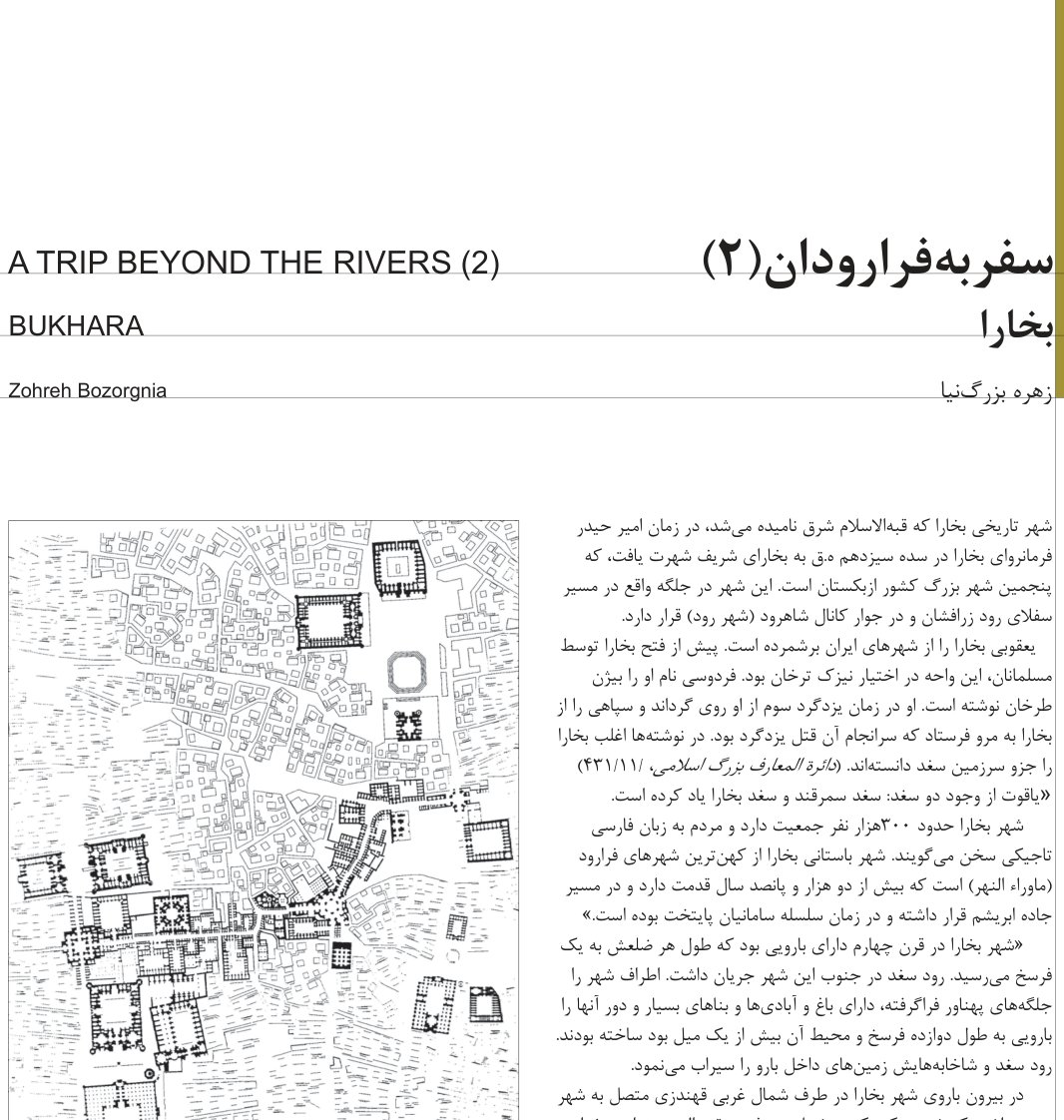
Plan of the historic urban fabric of Bukhara, from the book The Structure of Form in Iranian and Turkestan Islamic Architecture
From Cultural Iran — From Cultural Iran
Bibi, Shir Kabir, and finally the mausoleum known as Ahmad — the masterpiece of this school is without doubt the Samanid Mausoleum, which dates to before 331 AH and is arguably the most epoch-making building in the Islamic architecture of Iran. Nevertheless, this structure looks both to the past and to the future. Its square-domed form, the arched entrance on each side, the lack of emphasis on directionality, and the presence of an upper gallery with squinch domes are all characteristics that belong to the Sasanian historical tradition. In short, this mausoleum is essentially a fire temple in Islamic guise." (Islamic Architecture, p. 349). "This shrine is a domed cube, each side measuring 10 meters. The building is constructed of brick, covered by a large central dome, and four small domes are visible at the four corners. Among the interior's notable features is the zone of transition from square to dome, composed of a sixteen-sided section resting upon an octagonal base. The squinch foundations are built from two parallel arches resting on a perpendicular half-arch, which approaches the spiral gallery that encircles the upper portion of the building." (The Samanids: An Era of Islamic-Iranian Cultural Flourishing, p. 63). "This building, constructed by order of Nasr II (301–331 AH / 914–943 CE), measures 80.70 x 10.10 meters, with four openings, and draws its style and manner from pre-Islamic Iranian architecture. This perforated brick structure adorned with motifs of the sun, moon, and stars is a rare and outstanding work of art." (Encyclopaedia of the Great Islamic World, 11/451).
"The burial customs of the Sunni community were very simple and took root rapidly in Central Asia after the arrival of Islam, merging with pre-existing traditions. This grand mausoleum of the first local Muslim dynasty is one of the oldest monuments of Islamic architecture (one tombstone belongs to al-Sa'id Nasr II, 914–43). Here, the use of fired brick for walls and the great dome was also employed for decoration instead of stucco — itself an innovation. The corner columns add to the solidity of the upper cube. Inside, the transition from the square to the dome, with a diameter exceeding 7 meters, is accomplished through an angled arch — a novel solution. The presence of an interior gallery running around the drum of the dome has expressed the exterior elevation plan through a series of arcade rows, resulting in the undulating and basket-weave brick patterning of the walls that covers the lower portion of the dome. The entrances on all four sides are bordered by brickwork, and the spandrels are filled with quatrefoil motifs formed by brick ends." (Architecture of the Islamic World, pp. 259–260).
The Lab-i Hauz Complex — This complex consists of a pool surrounded by several ancient trees, with three buildings — the Nadir Divan-Begi Madrasa, the Nadir Divan-Begi Khanaqah, and the Kukaldash Madrasa — situated on three sides of the adjacent courtyard. The complex was built around 1620 CE by order of Nadir Divan-Begi.
Tomb of Amir Ismail Samanid, brick ornamentation detail of a corner of the facade
Tomb of Amir Ismail Samanid, details of three squinches beneath the dome — Lab-i Hauz Complex
Tomb of Amir Ismail Samanid, interior brick ornamentation — Tomb of Amir Ismail Samanid, entrance and corner of the building
The pool measures 36 by 42 meters with a depth of 5 meters.
The Kukaldash Madrasa — Built in 1568–1569 CE, the Kukaldash Madrasa is a two-story, two-iwan structure with a tall portal and a facade of simple brick ornamentation with modest tilework. At its two corners stand two half-round brick towers equal in height to the building itself. Although this structure has a rectangular courtyard with chamfered corners — following the central courtyard model — it is an extroverted building whose chambers open toward both the neighboring Lab-i Hauz complex and the interior courtyard. "Among the historic buildings and architectural monuments of Bukhara, one may mention the Kukaltash Madrasa, the largest madrasa in Central Asia, measuring 80 x 60 meters, built in the second half of the 10th/16th century." (Encyclopaedia of the Great Islamic World). Four square garden beds in the courtyard are level with it and were probably constructed during major restorations of the building. The construction date is contemporary with the Safavid dynasty in Iran.
After major restorations, they were added to the building. The date of construction coincides with the Safavid era in Iran.
The Nadir Divan-Begi Madrasa — Built in 1620 CE, approximately 50 years after the construction of the Kukaldash Madrasa. It is a two-story structure whose facade facing the pool is covered in tilework. This building shares the characteristics of the Kukaldash Madrasa, with two half-towers at its corners decorated with tiles. The chambers face the pool. The image of two simurghs adorns the lintel of the entrance portal and is repeated in some sections. The Nadir Divan-Begi Khanaqah — The Nadir Divan-Begi Khanaqah stands opposite his madrasa, beside the pool. This beautiful two-story structure, which bears a resemblance to the Haruniyya of Tus, has a facade
Facade perpendicular to the pool, Nadir Divan-Begi Khanaqah — Rear facade of the Khanaqah, plain and unadorned — Facade overlooking the pool, Nadir Divan-Begi Khanaqah
Entrance portal of Nadir Divan-Begi Madrasa and the motif of simurgh and sun
adorned with brick ornamentation, and only the facade facing the pool features tilework decoration. Two half-towers flank the entrance, and a dome without a drum or guluwi — roughly similar to the dome of the Samanid Mausoleum — crowns the roof. This building was constructed in 1620 CE, two years before the Nadir Divan-Begi Madrasa. The two facades perpendicular to the pool are symmetrical.
The Ark of Bukhara — In the past, the Ark of Bukhara served for a time as the governmental center of the city, housing the ruling palace, the mosque, and the city prison. Its original entrance was in Registan Square. Before its current entrance stands a water pool, and the Lab-i Hauz Mosque is situated on the opposite side. The Ark has a brick wall along which towers of roughly truncated half-conical shape can be seen. To enter the Ark, one must ascend a sloped ramp to reach the gate. Two relatively thick brick minarets stand on either side of the entrance gate.
After passing through a sloped corridor with a wooden ceiling, one enters the Ark's compound. A mosque with a wooden ceiling, columns, and wooden ornamentation stands opposite the entrance. After passing through an arch and climbing several steps, one reaches the governmental center. As in other historic buildings of the city, the primary materials are brick, plaster, and wood. Archaeologists have estimated the date of the Ark's fortress construction to approximately the 3rd century BCE (Mankovskaya). Over many centuries, the Ark was destroyed, and a mound 18 meters high formed in its place, upon which the amirs of Bukhara later erected buildings on the upper layer (ibid., 57). Opposite the Ark, the ancient historical monument of the Registan gateway has been placed (Pugachenkova, ibid., 36; also cf. Narshakhi) (Encyclopaedia of the Great Islamic World, 11/451). The fortress, known as the Kuhandiz (Quhandiz), is an indicator of Bukhara's social and economic conditions in the pre-Islamic era. Beside the fortress lies the Shahristan (inner city) and its walls, which initially had four gates, later increased to seven. This area was the bazaar and
Entrance corridor of the Ark of Bukhara — Entrance gate of the Ark of Bukhara
Wall and towers of the Ark of Bukhara — Behind the gate of the Ark of Bukhara
the center of artisans and merchants, though it later shifted to the Rabad (outer quarter) (Pugachenkova, ibid.) (Encyclopaedia of the Great Islamic World, 11/451). The Kalan Minaret Complex — The Kalan Minaret is the symbol of the city of Bukhara: "One of the architectural monuments of Bukhara is the Kalan Minaret, whose construction date has been recorded as 521 AH / 1127 CE. The diameter of this brick structure at its base is 9 meters, extending to a depth of 10 meters underground. Its height from ground level is 46 meters, and the diameter of its upper section is 6 meters. At the top of the minaret, a small chamber for the muezzin was intended. The minaret stood firm for 800 years without needing restoration" (ibid., 168; Pugachenkova, 61; Pribykova, under Bukhara). Beneath the minaret lies a complex called Pai Kalan, whose various buildings date from the 6th–10th/12th–16th centuries. The minaret, located in the city center, was built by order of Arslan Khan of the Qarakhanid dynasty. The Pai Kalan complex, besides the minaret, includes the Kalan Mosque, the Mir Ibrahim Madrasa, the Taq-i Zargaran, the Ulugh Beg Madrasa, the Abd al-Aziz Khan Madrasa, the Tim of Abdullah Khan, and the library (Hashemi, ibid.; Pugachenkova, 67–69; Mankovskaya, 61–62) (Encyclopaedia of the Great Islamic World, 11/451).
The Ulugh Beg Madrasa — "The Ulugh Beg Madrasa is an outstanding architectural monument of the 9th/15th century, built in 820 AH / 1417 CE by order of Ulugh Beg and restored in 994 AH / 1586 CE during the reign of Abdullah Khan II. This madrasa, situated opposite the Abdullah Khan [Abd al-Aziz Khan] Madrasa, exemplifies the advancement of architectural art
in Bukhara. According to an existing inscription, the Ulugh Beg Madrasa was built by one Ismail son of Tahir, grandson of Muhammad the Architect of Isfahan (Pugachenkova, 77)." (Encyclopaedia of the Great Islamic World, 11/452).
The Abd al-Aziz Khan Madrasa — "Built 235 years after the Ulugh Beg Madrasa, the Abd al-Aziz Khan Madrasa is one of the architectural masterpieces of its era. The ornate interior of the dome, the stuccowork and carvings are truly wondrous (ibid., 78; Hashemi, 194)." (Encyclopaedia of the Great Islamic World, 11/452). "This madrasa, considered among the last madrasas of Bukhara — which had once again become the capital — stands opposite the Ulugh Beg Madrasa and is notable for its vast area, elongated portal, and delicate ornamentation. On either side of the entrance, two halls, a summer mosque, and a reception room recall the arrangement of the Ulugh Beg Madrasa, and its two upper galleries with surrounding chambers are similarly composed. The four-iwan plan and the diagonal connection at the courtyard corners ensure spatial equilibrium. Various techniques were employed in its decoration: tile mosaic using abundant yellow colors covers the portal and upper gallery of the front facade. The walls and masterful vaulting of the summer mosque and assembly room, drawing on fifteenth-century carved lattice screens, are filled with wall paintings depicting red, white, and blue roses, with emphasis on fan-shaped and star-shaped forms as well as muqarnas decoration with gold highlights. In some of the panels, images of European-style kiosks and garden pavilions appear. The relief stuccowork inside the entrance portal also demonstrates a high level of mastery and craftsmanship." (Architecture of the Islamic World, p. 260).
Ulugh Beg Madrasa — Abd al-Aziz Khan Madrasa
The Kalan Mosque — "The Kalan Mosque, the congregational mosque of Bukhara, rivals in size the Bibi-Khanym Mosque in Samarkand (Mankovskaya, 62). Built in the 10th/16th century at the foot of the Kalan Minaret, it was also known as the Friday Mosque, measuring 127 x 78 meters and ranking among the largest mosques in Central Asia (Pugachenkova, 80)." (Encyclopaedia of the Great Islamic World, 11/452). "The Shaybanid Uzbeks, after defeating the last Timurid ruler, set about lending grandeur to their rule and accordingly erected a number of religious monuments and public bazaars. The Kalan Friday Mosque received its definitive form under Abdullah I (1512–39). Its magnificent brick minaret, 46 meters tall and dated 1127, survives from an early twelfth-century mosque. Its plan follows the traditional four-iwan format with a fronting portal, and the portal reinforces the qibla wall and the tall dome of the mihrab hall. Another smaller portal cupola stands at the entrance. Stone bases and some 288
arcades in the remainder of the building form the courtyard rows. This mosque was so large that it was said to hold 120,000 people. Its gilded tilework decoration is not particularly striking. A group of public buildings was attached to the mosque, and the Mir-i Arab Madrasa, also with a four-iwan plan and approximately one hundred chambers, was built opposite it in the 1530s." (Architecture of the Islamic World, p. 260).
The Mir-i Arab Madrasa — "Another of Bukhara's historic buildings is the Mir-i Arab Madrasa, situated opposite the Kalan Mosque beside the square. This large madrasa, with more than 100 chambers, was built by Sheikh Abdullah Yamani, known as Mir-i Arab. It is said that the cost of building this madrasa was covered by the revenue from selling 3,000 Shiite Iranian captives, under Abdullah Shaybanid, the then ruler of Bukhara. In the northern section of the madrasa lie the tombs of Ubaydullah Khan Shaybanid and Sheikh Abdullah Yamani, the madrasa's founder (Ashurov,
50; Hashemi, 184)." (Encyclopaedia of the Great Islamic World, 11/452–453).
The Naqshband Khanaqah and Mausoleum Complex — "Among the historic monuments of the 10th/16th century is the Khanaqah and Mausoleum complex of Sheikh Baha al-Din Naqshband (d. 791 AH / 1389 CE), built in 951 AH / 1544 CE by order of Abd al-Aziz Khan II, around which a marble wall was erected, transforming it into a pilgrimage site (Hashemi, ibid.)." (Encyclopaedia of the Great Islamic World, 11/453). The Naqshband complex comprises several old and new buildings, with the khanaqah bearing a resemblance to the Nadir Divan-Begi Khanaqah. Its primary material is brick, and it is covered by a large dome without a drum. The other buildings of the complex feature wooden structural frameworks and ornamentation with beautiful and highly varied ceiling paintings. A relatively short minaret stands in its grounds, similar in form and scale to the short minaret opposite the Lab-i Hauz Mosque. The Magok Mosque — "Another monument is the Magok-i Attari (Perfumers') Mosque. During Shishkin's excavations, at a depth of 12 meters, pottery was discovered likely dating to the earliest years of the medieval period. It is thought that Magok-i Attari may be the same medieval mosque of Makh (Mah) mentioned by Islamic authors. On this site, one of the
former fire temples was located (Modarres Razavi, 274–275; Ashurov, 40–41; Pugachenkova, 71–72). This mosque, whose original structure dates to the 5th/11th century, was repeatedly ravaged by fire and destruction. The current building, surviving from 953–954 AH / 1546–1547 CE, was built in a pit 6 meters deep, for which reason it is called Magok (meaning 'sunken') (Hashemi, 169)."
Cheshmeh Ayyub — "The Cheshmeh Ayyub (Spring of Job) mausoleum is another architectural monument of the 8th/14th century. Built in 782 AH / 1380 CE, it was repaired and expanded several times during the 10th–13th/16th–19th centuries. This mausoleum, with two conical domes and multiple rooms for resting, receiving visitors, sleeping quarters for pilgrims, and a hall dedicated to worship, has in effect become a khanaqah (ibid., 75–76; Ashurov, 39–40; Hashemi, ibid.). It is said that Ayyub (Job) went there and offered prayers for Bukhara. This prayer was the reason Bukhara could boast of its superiority over other cities." The Char Minar Madrasa — One of Bukhara's historic buildings is the Char Minar Madrasa, dating to the 13th/19th century. The year of construction is 1806–1807 CE. The courtyard and
Paintings and wooden ornamentation of the Khanaqah complex — Khanaqah complex
Paintings and wooden ornamentation of the Naqshband complex courtyard — Pool of the Naqshband complex
Brick ornamentation of Magok Mosque — Portal of Magok Mosque — Magok Mosque
chambers of the madrasa have been lost, and only a small structure remains, at whose four corners stand four stout minarets with a dome serving as the roof. The tops of these minarets are covered in monochrome blue tiles, while the lower sections feature a combination of tile and brick ornamentation. This building too is situated beside a water pool.
The Bala Hauz Mosque — Opposite the entrance gate of the Ark and facing a large pool stands the beautiful Bala Hauz Mosque. This is an entirely Uzbek mosque, its architecture quite foreign to Iranian traditions. The structural framework combines brick and wood, with a large iwan supported by wooden columns forming the mosque's facade. The entrance to the prayer hall is on the axis of this iwan. The building resembles the Chehel Sotoun Palace in Isfahan. The roof is flat. The column capitals are decorated, and the wooden ceiling is covered with diverse and beautiful geometric paintings, bordered by Persian calligraphic ornamentation. The bases of the wooden columns are also decorated.
References: Seville, Ahmad Pakatchi, first edition, Tehran; Encyclopaedia of the Great Islamic World, vol. 8, Uzbekistan–Ashbilia, 1377 SH, published by the Center for the Great Islamic Encyclopaedia; Timurid Architecture in Iran and Turan, Dr. Lisa Golombek and Dr. Donald Wilber, translated by Keramatollah Afsar and Mohammad Yusuf Kiani, Cultural Heritage Organization, 1374; Islamic Architecture: Form, Function and Meaning, Prof. Robert Hillenbrand, translated by Dr. Iraj Etesam, Urban Processing and Planning Company, Deputy of Urbanism and Architecture, 1377; Islamic Art, Prof. Ernst Kuhnel, translated by Eng. Houshang Taheri, Mash'al-e Azadi Press, Khordad 1347; The Structure of Form in Iranian and Turkestan Islamic Architecture, Klaus Herdeg, Research and Translation Unit of Consulting Engineers, Boom Publications, first edition, 1376; Encyclopaedia of the Great Islamic World, vol. 11, Baba Faraj Tabrizi–Banyan Barmavi, ed. Kazem Mousavi Bojnourdi, Center for the Great Islamic Encyclopaedia, first edition, 1381, Tehran; Islamic Architecture and Ornamentation, Derek Hill / Oleg Grabar, translated by Mehrdad Vahdati Daneshmand, Scientific and Cultural Publishing, first edition, 1375; Encyclopedia of World Cities, translated and compiled by Abdolhossein Saidian, Elm va Zendegi Publications, first edition, 1362; cisroad.com/countries/Uzbekistan/Samarkand/lang/Fa.
Minaret beside the Bala Hauz Mosque — Wooden ornamentation of the iwan columns of the Bala Hauz Mosque — Wooden decoration and paintings on the ceiling
Cheshmeh Ayyub Mausoleum — Char Minar Madrasa
Bala Hauz Mosque — Ceiling of the prayer hall of the Bala Hauz Mosque — Entrance facade of Cheshmeh Ayyub