



Source: domus 846, March 2002: 44-61.
Project: the New Library of Alexandria
- Competition design phase, 1989: Architects — Craig Dykers, Per Morton Josephson, Christoph Kapeller, Eivind Maus Kittel-Tordl Thorsen. Photography: Yorn Sand. Consultants and assistants: Adrina Bayli, Ihab El-Habak, Cordula Maur. Artwork: Yorn Sand.
- Initial design revision, 1989-90: Architects — Craig Dykers, Per Morton Josephson, Christoph Kapeller, Eivind Maus Kittel-Tordl Thorsen. Landscape: Snøhetta. Structural engineers: VS3 — Kari Stensrud, Johan Stengen. Artwork: Yorn Sand.
- Design phase, 1994: Architect — Mohamed Sharkas. Architects and engineers: Snøhetta–Hamza consortium. Structural & geotechnical engineering: Hamza Associates / Mamdouh Hamza. Structural engineers: Ahmed Rashid, Mashour Ghoneim. Mechanical: Hamza Associates / Naser Fawzi, Mohsen Abdo. Electrical: Hamza Associates / Ibrahim Helal.
- Construction phase, 1996: Architects — Greenwood, Ola Gustavsson, Tarald Lundewall, Kittel Trondal Thorsen. Architectural assistant: Yorn Sand. Photography: Gerald Zugmann.
- Cost: US $223,000,000.
Even before the terrorist operations of September 11, an impartial judgment of the cultural events of "the Arab world" was difficult. Western observers in this regard struggle with various unwritten political legacies, must overcome their own religious unfamiliarity, and must defeat their misreading of colonialism. On this basis there is a good chance that the opening of the new Alexandria Library — among the most distinguished buildings of the new millennium — should not, simply because it sits in Egypt, find the recognition it deserves. It may be too optimistic to claim that with cultural acts of this kind one can change the international mind; but one cannot deny that the establishment of this institution will be one of the most outstanding humanist efforts in the Middle East — an effort that goes beyond the considerations of religion, ideology and ethnicity. Beyond the architectural value worth its attention, the new Library of Alexandria can also be regarded as a herald of peace. For Egypt is still the cultural heart of the Arabic-speaking countries, and the great majority of Arabic books are still printed there.
Yet can a fine building, a structure with a powerful symbolic and lasting form, determine the fate of a city? The Frank Gehry Guggenheim in Bilbao certainly puts forward a convincing example. The earlier sea-tower of Alexandria — the Pharos — testifies to that earlier moment when a monumental form expressed the multiple identities of this particular city. The new library, set like a glowing disc in the dense built fabric of the corniche, signals not just the city's appetite for cultural transformation but the region's. The scheme is fresh both in form and in structure, and is well suited to its urban site. It has been executed flawlessly with high-grade materials and excellent details. The first serious discussion of reviving the most renowned of all the libraries of antiquity was raised, it is said, by a minor political figure in 1974: Richard Nixon, after the Camp David accords, paid a visit to Egypt and expressed his desire to visit "the Library of Alexandria". In a competition organised in 1989 by the International Union of Architects (UIA) together with the local management committee, the United Nations and UNESCO, more than 500 entries were received. The jury included Fumihiko Maki of Japan and Charles Correa of India. Although the results of the competition were widely publicised, no one believed such an ambitious project would actually be executed. Snøhetta's team won: a consortium based in Oslo of Norwegian, American and Austrian partners, most of whom were under thirty at the time. After seven years of preparing the budget and dealing with the early bureaucratic battles — pursued by Suzanne Mubarak, the wife of Egypt's then-president — the project was finally executed over the past four years in collaboration with Mamdouh Hamza, an architect from Cairo. In 2001, in order to safeguard the institution's independence from various bureaucracies, a law was passed that gave full legal authority to Ismail Serageldin, the new head of the library, and to the board of directors he chose; an authority answerable to no one but the President himself. The library — by virtue of its strange shape (a truncated cylinder cut by an inclined plane at an angle of 16 degrees) — appears as a great translucent disc rising from the ground at the very edge of the corniche.
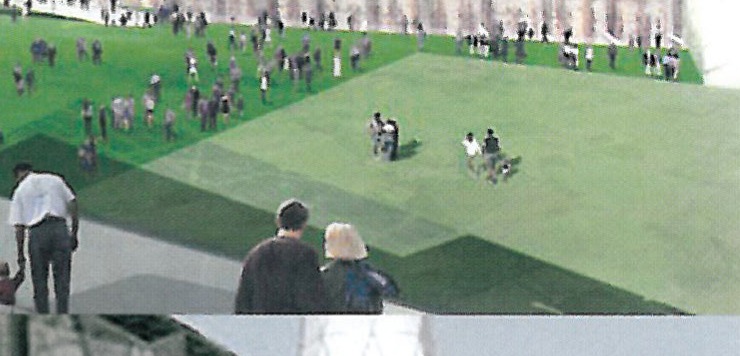
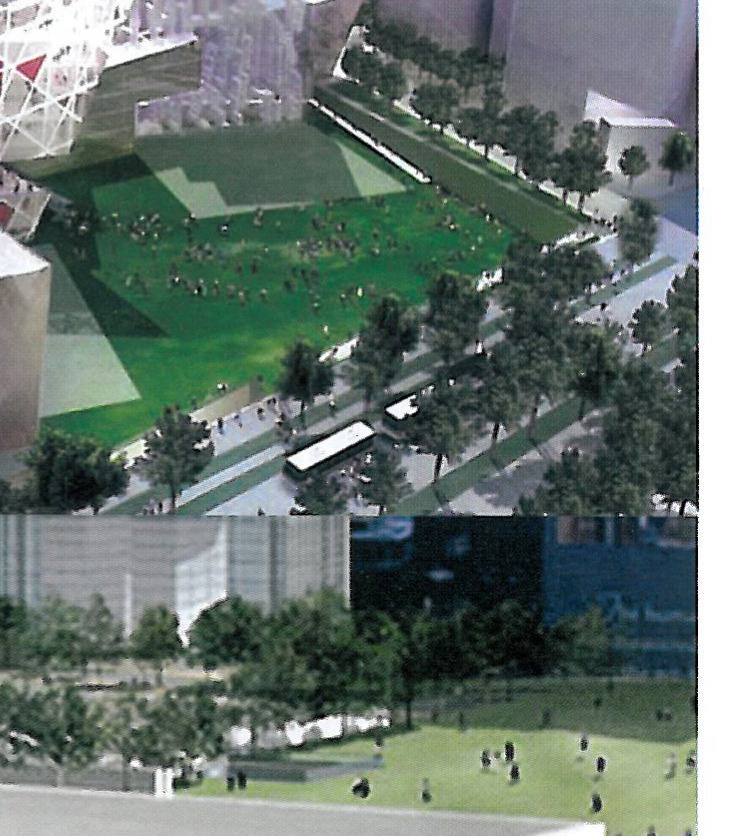
The whole library complex sits over a site of about 85,000 sq m, with a built area on the order of 60,000 sq m, and accommodates the library proper, a school of information science, museums of antiquities and manuscripts, the planetarium, conference rooms, exhibition galleries, restoration laboratories, the library administration and the parking. The library is conceived as a single great vessel — a tilted cylinder, half-buried in the ground, with the disc of its roof emerging at the corniche and the lower part disappearing into the city. The roof is a vast aluminium-and-glass surface that filters the strong sun of Alexandria into the great reading hall below. The plaza in front of the entrance, framed by a calligraphic stone wall, is approached at an angle: visitors first encounter the wall — inscribed with the world's writing systems — and only then enter the reading hall, descending into a tiered space that follows the gradient of the roof.

The reading hall is the heart of the project. Daylight enters from above through the lattice of the roof — the structural geometry transforms the strong Egyptian sun into a soft, shifting illumination. The slim concrete columns, with their tree-like spreading capitals, are spaced on a thirteen-metre grid; the cascading floors of reading desks step down from the high side of the disc to its low side, bringing readers ever closer to the books and to the great wall of stacks at the centre of the volume. The reading desks are clad in light wood and the floors are wooden too, lending warmth to a space that would otherwise feel too austere.
The library is a multi-purpose institution: the city sees in it not only a library but a centre of public life. The vast reading hall, the planetarium, the exhibition galleries and the conference centre invite all kinds of visitors and readers. The library has 8,000,000 volumes capacity, with a present collection of 200,000 books. The school of information science offers training in conservation, archival studies, and library administration. The library also acts as a node in a network of institutions across the eastern Mediterranean.
Above all, the new library can be read as a quiet monument to a culture that, after centuries of discontinuity, has returned to its old confidence. The legendary Library of Alexandria — destroyed by fire (the date and circumstances of which are disputed) — has been recalled, by the new building, to the cultural memory of the city. In conceiving the calligraphic wall, Snøhetta's team made a small decision of great significance: the wall does not say "Welcome", does not commemorate any particular person; it simply gathers, in stone, the writing systems by which humanity has remembered itself. From this small gesture the whole project draws a quiet authority.
1 Bibliotheca Alexandrina.
2 Egypt is still considered the cultural centre of the Arabic-speaking world, where most Arabic books are printed.
3 The Pharos of Alexandria.
4 Charles Correa.
5 Mamdouh Hamza.
6 International Union of Architects, IUA.
7 Vittorio Emanuele di Savoia.
8 Suzanne Mubarak.
9 Ismail Serageldin.
10 Snøhetta.